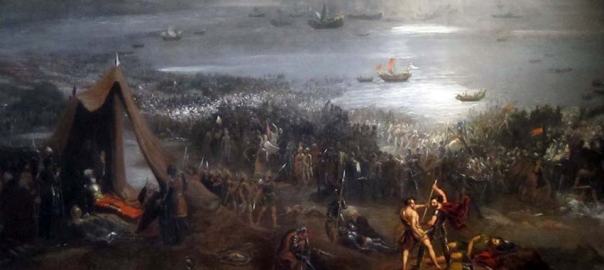
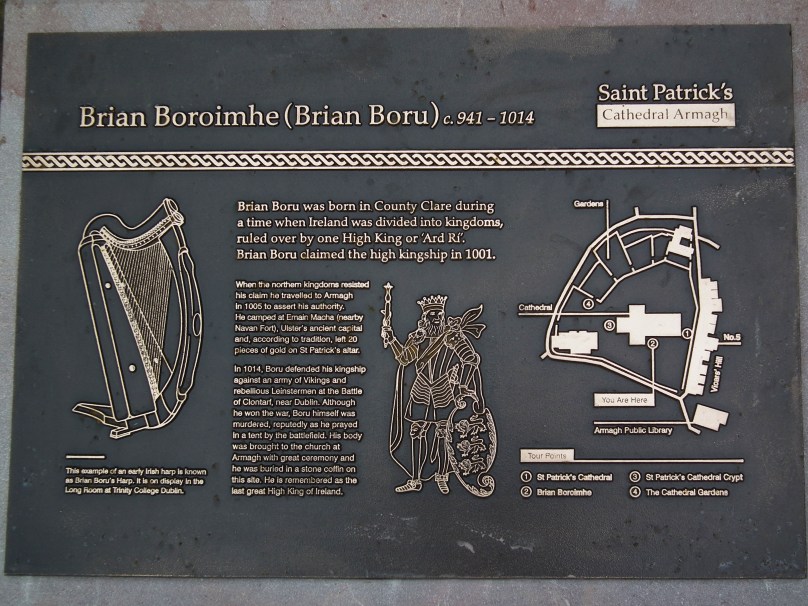
The Battle of Clontarf (Irish: Cath Chluain Tarbh) was a battle that took place on 23 April 1014 at Clontarf, near Dublin, on the east coast of Ireland. It pitted the forces of Brian Boru, high king of Ireland, against a Norse–Irish alliance comprising the forces of Sigtrygg Silkbeard, king of Dublin, Máel Mórda mac Murchada, king of Leinster, and a Viking contingent led by Sigurdof Orkney and Brodir of Mann. It lasted from sunrise to sunset, and ended in a rout of the Viking and Leinster forces. It is estimated that between 7,000 and 10,000 men were killed. Although Brian’s forces were victorious, Brian himself was killed, as were his son Murchad and his grandson Toirdelbach. Leinster king Máel Mórda and Viking leaders Sigurd and Brodir…
We are a Protestant fraternity with members throughout the world. Autonomous Grand Lodges are found in Scotland, England, the United States of America, West Africa, Canada, Australia and New Zealand.
Our name comes from William III, Prince of Orange, and is kept because his victory over despotic power laid the foundation for the evolution of Constitutional Democracy in the British Isles.
Support for William of Orange in the British Isles led to the formation of Orange Societies to commemorate his victory at the Battle of the Boyne in July 1690, but the largest and longest lasting groups were the Boyne Societies in Ireland.
In 1795, following the culmination of attacks on Protestants in County Armagh at the Battle of the Diamond , in which Protestants routed those who had attacked them and attempted to burn properties, it was decided to form an organisation which…
Steve Marriott Stephen Peter “Steve” Marriott (30 January 1947 – 20 April 1991) was an English musician, songwriter and frontman of two notable rock and roll bands, spanning over two d…
Below is a comprehensive list of 60 films about the “Troubles” and Republican/Loyalist paramilitaries . The list includes background information on the movies and where possible I have incl…
Forkhill or Forkill (from Irish: Foirceal) is a small village and civil parish in south County Armagh, Northern Ireland, in the ancient barony of Upper Orior. It is within the Ring o…
Below is a Tweet from Jeremy Corbyn – 25/09/2015 Jeremy Corbyn MP @jeremycorbyn 52m52 minutes ago 1yr anniversary of disappearance of 43 Mexican students. I’ve written to the Ambassad…
Omagh Bombing – The IRA’s Deadliest Massacre of Civilians See real IRA page See 29 people Slaughtered by the Real IRA The Omagh bombing was a deliberate massacre of civilians carried ou…
Key Events & Deaths on this day in Northern Ireland Troubles
Friday 15 August 1969 Six People Killed
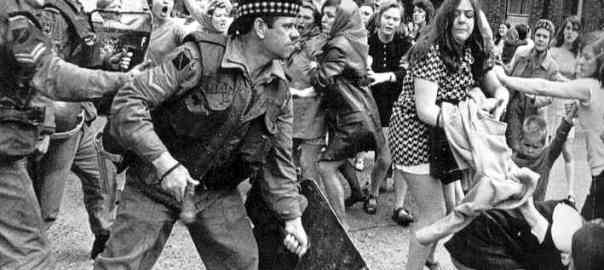
Six people were killed and many more injured during sectarian riots in Belfast. Many families were also forced to move from their homes. British troops took up duties on the streets of west Belfast.
Political Developments; Law Order; Deployment of British Troops ] [ August 1969; United Nations; USA
Sunday 15 August 1971Campaign of Civil Disobedience
The Social Democratic and Labour Party (SDLP) announced that it was starting a campaign of civil disobedience in response to the introduction of Internment. The SDLP also withdrew their representatives from a number of public bodies.
Friday 15 August 1980
An elderly Protestant man and his daughter were found dead at their home in Belfast; they had been beaten, stabbed and shot.
Sunday 15 August 1982
During a visit to the United States of America (USA) Martin Smyth, then Ulster Unionist Party (UUP) Member of Parliament (MP), alleged that the Central Intelligence Agency (CIA) was involved in Northern Ireland.
Wednesday 15 August 1984
There were serious riots in Protestant areas of Belfast following protests against a ‘surpergrass’ trial involving William ‘Budgie’ Allen.
[The riots continue for three nights.]
Friday 15 August 1986
Peter Robinson, then deputy leader of the Democratic Unionist Party (DUP), was remanded to Ballybay, Republic of Ireland, following a hearing in Dundalk, County Louth, because of a demonstration he led on 7 August 1986. A number of Robinson’s supporters were attacked in Dundalk with stones and petrol-bombs.
Monday 15 August 1994
John Bruton, then leader of Fine Gael (FG), said that Sinn Féin (SF) could not be involved in political talks until the Irish Republican Army (IRA) had called a total cessation of violence
Thursday 15 August 1996
The Police Authority of Northern Ireland estimated a cost of £10 million for police overtime during and after the Drumcree standoff.
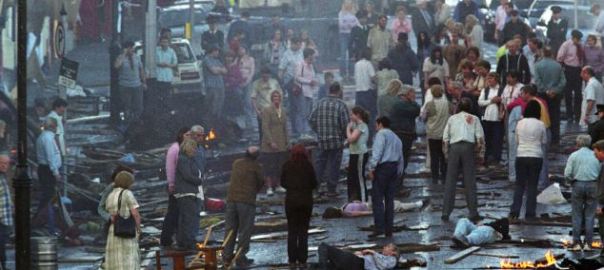
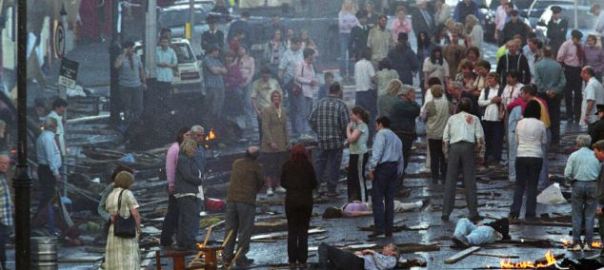
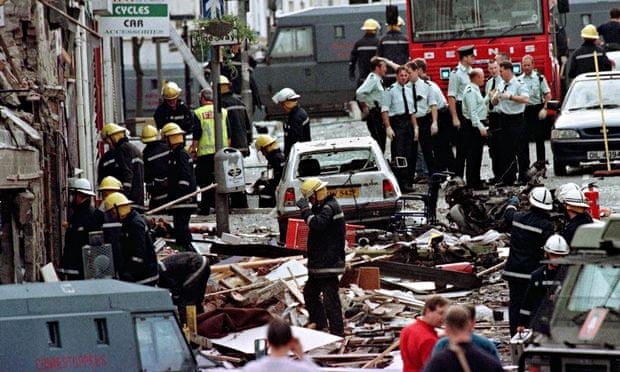
Twenty-nine people died as a result of an explosion at 3.10 pm in Omagh, County Tyrone. The bomb had been planted by the “real” Irish Republican Army (rIRA).
The death toll represented the single worst incident within Northern Ireland since the beginning of the conflict.
33 people were killed in bombs in Dublin and Monaghan on 17 May 1974.
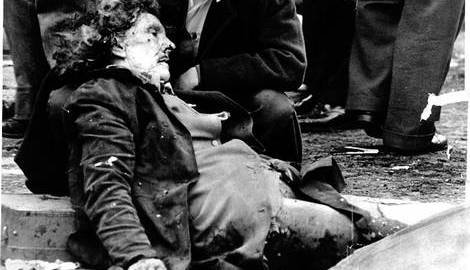
Among the dead were family members, one family lost members from three generations, and close friends, and a number of tourists from the Republic of Ireland and Spain. One woman who died was pregnant with twins. There were hundreds of people injured some of whom lost limbs or their sight.
28 people died on the day and an injured man died three weeks later. Another man was killed when the car he was driving was involved in a collision with an ambulance that was transporting injured people to a hospital in Belfast.
It was later learnt that there had been a misleading phone warning and the Royal Ulster Constabulary (RUC) directed people towards the bomb rather than away from it.
The code word used was that of the rIRA, a breakaway group of dissident members from the Provisional IRA who disagreed with the political direction being taken by the Sinn Féin leadership. There was outrage and shock across the whole population of Northern Ireland. Many people expressed the hope that this incident would mark a turning point in the conflict.
Thousands gathered in Omagh and Buncrana to mark the first anniversary of the Omagh bombing. Silent vigils were kept at 3.10pm throughout the country to commemorate the 29 people killed and 300 injured in the attack which caused the biggest loss of life of any incident in the North.
Tuesday 15 August 2000
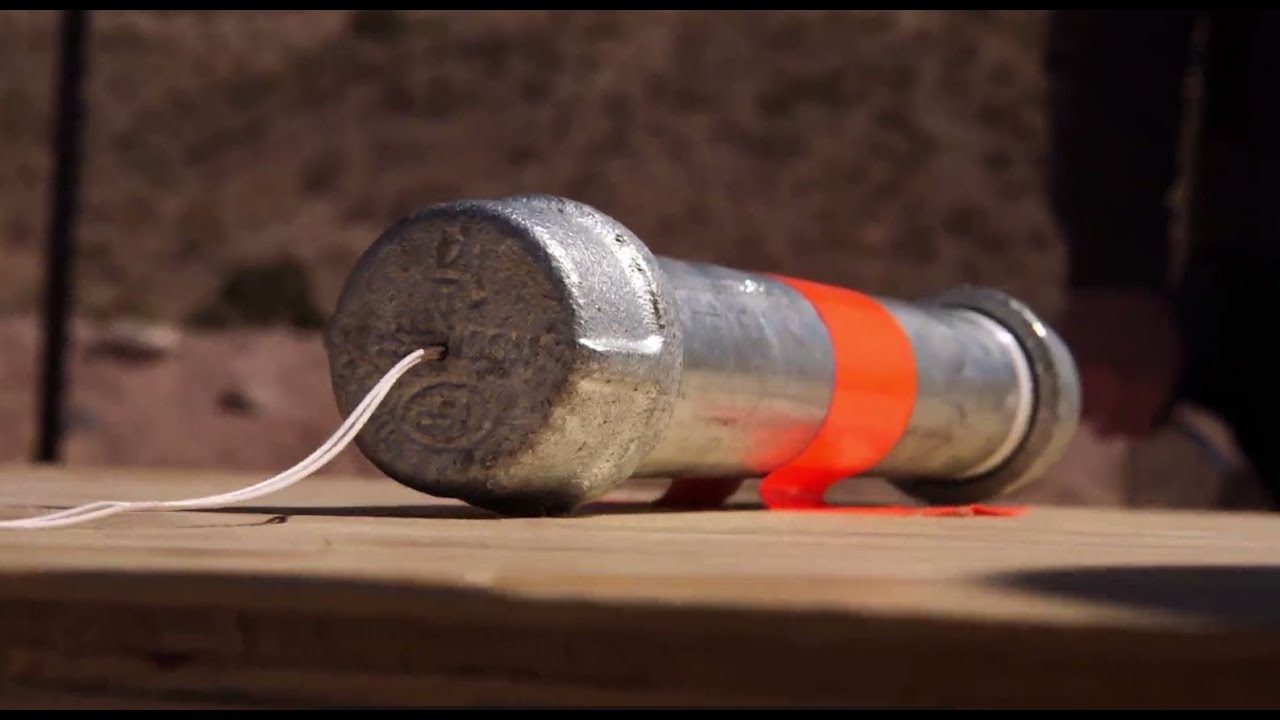
Johnny Adair, then a leader of the Ulster Freedom Fighters (UFF), a cover name (pseudonym) used by the Ulster Defence Association (UDA), claimed that Republicans were responsible for the pipe-bomb explosion that injured his hand.
The incident happened on Beechpark Street in the Protestant part of the Oldpark district.
The claim was dismissed by security force personnel who said the pipe-bomb fragments recovered were from a type of device frequently used by Loyalists. It was further alleged that Adair and some men with him were carrying the device in the car in which they were travelling when it exploded prematurely.
Wednesday 15 August 2001
A remembrance service was held in Omagh, County Tyrone, to mark the third anniversary of the “real” Irish Republican Army (rIRA) bomb attack on the town that left 29 people, and two unborn children, dead (15 August 1998).
The service took place at the Garden of Remembrance near the site of the bombing. The Royal Ulster Constabulary (RUC) and the Garda Síochána (the Irish police) held a joint press conference to appeal to members of the public for more information on the bombing. A relative of one of those killed interrupted the conference to criticise both the RUC and the Garda for their lack of progress in the investigation of the bombing.
Two men were treated in hospital after being shot and wounded in separate paramilitary ‘punishment’ attacks in west Belfast.
The first shooting happened at about 8.30pm at Lower Glen Parade, when the man was shot in both ankles. The other man was shot in one ankle at Vere Foster Walk at about 10.40pm. There was rioting in the Duncairn Gardens area of north Belfast.
Nationalist residents claimed that the RUC had to interven to rescue two young girls who had been surrounded by a Loyalist mob.
There was a series of bomb hoaxes in four towns in County Derry. British Army personnel dealt with suspect devices that were found in Desertmartin, Moneymore, Maghera, and Magherafelt.
The hoaxes caused widespread disruption. Sinn Féin released a report containing details of what the party claimed was more that 180 sectarian attacks carried out this year (to date) by the Ulster Defence Association (UDA) a Loyalist paramilitary group.
—————————————-
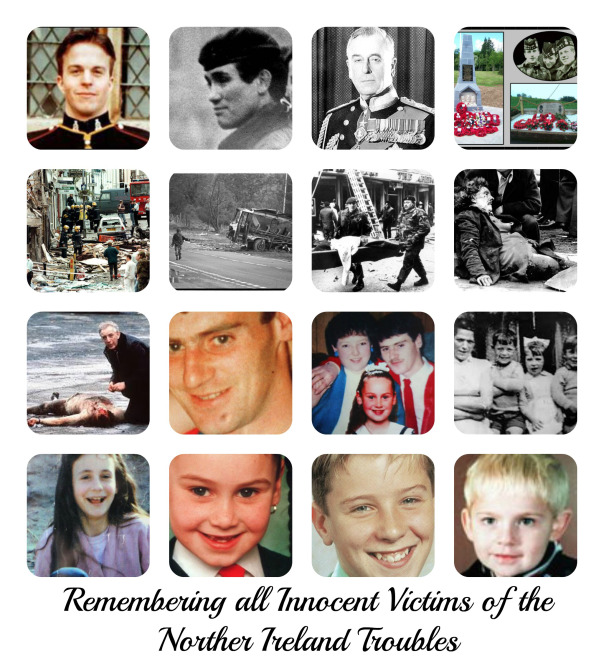
Remembering all innocent victims of the Troubles
Today is the anniversary of the follow people killed as a results of the conflict in Northern Ireland
“To live in hearts we leave behind is not to die
– Thomas Campbell
To the innocent on the list – Your memory will live forever
– To the Paramilitaries –
“There are many things worth living for, a few things worth dying for, but nothing worth killing for.
44people lost their lives on the 15th August between 1969 – 1998
Including 29 in Omagh Bombing
————————————————————–
15 August 1969
Herbert Roy, (26)
Protestant Status: Civilian (Civ),
Killed by: non-specific Republican group (REP)
Shot while part of Loyalist crowd, during street disturbances, corner of Divis Street and Dover Street, Lower Falls, Belfast.
————————————————————–
15 August 1969
Huge McCabe,
(20)Catholic Status: British Army (BA),
Killed by: Royal Ulster Constabulary (RUC)
On leave. Shot during street disturbances while on the roof of Whitehall Block, Divis Flats, Belfast.
————————————————————–
15 August 1969
McLarnon, Samuel (27)
Catholic Status: Civilian (Civ),
Killed by: Royal Ulster Constabulary (RUC)
Shot at his home during nearby street disturbances, Herbert Street, Ardoyne, Belfast
————————————————————–
15 August 1969
Michael Lynch, (28)
Catholic Status: Civilian (Civ),
Killed by: Royal Ulster Constabulary (RUC)
Shot during street disturbances, Butler Street, Ardoyne, Belfast.
————————————————————–
15 August 1969
Gerard McAuley, (15)
Catholic Status: Irish Republican Army Youth Section (IRAF),
Killed by: non-specific Loyalist group (LOY)
Shot during street disturbances, Bombay Street, Falls, Belfast.
————————————————————–
15 August 1969 David Linton, (48)
Protestant Status: Civilian (Civ),
Killed by: non-specific Republican group (REP)
Shot during street disturbances at the junction of Palmer Street and Crumlin Road, Belfast.
————————————————————–
15 August 1973 Edward Drummond, (50)
Catholic Status: Civilian (Civ),
Killed by: Ulster Volunteer Force (UVF)
Killed in car bomb attack, outside Sportsman’s Inn, Little Patrick Street, Belfast.
————————————————————–
15 August 1975
Norman Kerr, (28)
Protestant Status: Civilian (Civ),
Killed by: Irish Republican Army (IRA)
Disc Jockey. Shot while packing up his equipment, Camrick Bar, Market Street, Armagh.
————————————————————–
15 August 1975
Samuel Llewellyn, (29)
Protestant Status: Civilian (Civ), Killed by: Irish Republican Army (IRA)
Shot while driving van, shortly after delivering hardboard to premises damaged in bomb explosion, Osmond Street, Lower Falls, Belfast.
————————————————————–
15 August 1975 Cecil Anderson, (51)
Protestant Status: Civilian (Civ),
Killed by: non-specific Republican group (REP)
Killed in bomb attack on Travellers Rest Inn, Derriaghy, near Belfast.
————————————————————–
15 August 1980
William Younger, (87)
Protestant Status: Civilian (Civ),
Killed by: not known (nk)
Found shot and stabbed at his home, Wolfhill Avenue South, Ligoniel, Belfast
————————————————————–
15 August 1980
Letitia Younger, (57)
Protestant Status: Civilian (Civ),
Killed by: not known (nk)
Found shot and stabbed at her home, Wolfhill Avenue South, Ligoniel, Belfast.
————————————————————–
15 August 1986 Patrick Murray, (30)
Catholic Status: Irish Republican Army (IRA),
Killed by: Irish Republican Army (IRA)
Found shot in entry off Clonard Street, Lower Falls, Belfast. Alleged informer.
Killed by: Irish Republican Army (IRA)
Shot at his workplace, farm, Brocklass Road, Sion Mills, County Tyrone.
————————————————————–
15 August 1991 James Woods, (23) Catholic Status: Civilian (Civ),
Killed by: Irish Republican Army (IRA)
Killed in grenade attack on British Army (BA) foot patrol, waste ground, off Gortfin Street, Falls, Belfast.
————————————————————–
Oamgh Bomb Victims
Omagh Victims
Never Forgotten
————————————————————————
15 August 1998
James Barker, (12) nfNI Status: Civilian (Civ),
Killed by: real Irish Republican Army (rIRA)
From County Donegal. Killed in car bomb explosion, Market Street, Omagh, County Tyrone. Inadequate warning given.
————————————————————————
15 August 1998
Fernando Blasco Bacelga, (12) nfNI Status: Civilian (Civ),
Killed by: real Irish Republican Army (rIRA)
Spanish visitor. Killed in car bomb explosion, Market Street, Omagh, County Tyrone. Inadequate warning given.
————————————————————————
15 August 1998
Geraldine Breslin, (43)
Catholic Status: Civilian (Civ),
Killed by: real Irish Republican Army (rIRA)
Killed in car bomb explosion, Market Street, Omagh, County Tyrone. Inadequate warning given.
————————————————————————
15 August 1998
Debra Ann Cartwright, (20)
Protestant Status: Civilian (Civ),
Killed by: real Irish Republican Army (rIRA)
Killed in car bomb explosion, Market Street, Omagh, County Tyrone. Inadequate warning given.
————————————————————————
15 August 1998
Gareth Conway, (18)
Catholic Status: Civilian (Civ),
Killed by: real Irish Republican Army (rIRA)
Killed in car bomb explosion, Market Street, Omagh, County Tyrone. Inadequate warning given.
————————————————————————
15 August 1998
Breda Devine, (1)
Catholic Status: Civilian (Civ),
Killed by: real Irish Republican Army (rIRA)
Killed in car bomb explosion, Market Street, Omagh, County Tyrone. Inadequate warning given.
————————————————————————
15 August 1998
Oran Doherty, (8) nfNI Status: Civilian (Civ),
Killed by: real Irish Republican Army (rIRA)
From County Donegal. Killed in car bomb explosion, Market Street, Omagh, County Tyrone. Inadequate warning given.
————————————————————————
15 August 1998
Adrian Gallagher, (21)
Catholic Status: Civilian (Civ),
Killed by: real Irish Republican Army (rIRA)
Killed in car bomb explosion, Market Street, Omagh, County Tyrone. Inadequate warning given.
————————————————————————
15 August 1998
Esther Gibson, (36)
Protestant Status: Civilian (Civ),
Killed by: real Irish Republican Army (rIRA)
Killed in car bomb explosion, Market Street, Omagh, County Tyrone. Inadequate warning given
————————————————————————
15 August 1998
Mary Grimes, (65)
Catholic Status: Civilian (Civ),
Killed by: real Irish Republican Army (rIRA)
Killed in car bomb explosion, Market Street, Omagh, County Tyrone. Inadequate warning given.
————————————————————————
15 August 1998
Olive Hawkes, (60)
Protestant Status: Civilian (Civ),
Killed by: real Irish Republican Army (rIRA)
Killed in car bomb explosion, Market Street, Omagh, County Tyrone. Inadequate warning given.
————————————————————————
15 August 1998
Julia Hughes, (21)
Protestant Status: Civilian (Civ),
Killed by: real Irish Republican Army (rIRA)
Killed in car bomb explosion, Market Street, Omagh, County Tyrone. Inadequate warning given
————————————————————————
15 August 1998
Brenda Logue, (17)
Catholic Status: Civilian (Civ),
Killed by: real Irish Republican Army (rIRA)
Killed in car bomb explosion, Market Street, Omagh, County Tyrone. Inadequate warning given.
————————————————————————
15 August 1998
Anne McCombe, (48)
Protestant Status: Civilian (Civ),
Killed by: real Irish Republican Army (rIRA)
Killed in car bomb explosion, Market Street, Omagh, County Tyrone. Inadequate warning given.
————————————————————————
15 August 1998
Brian McCrory, (54)
Catholic Status: Civilian (Civ),
Killed by: real Irish Republican Army (rIRA)
Killed in car bomb explosion, Market Street, Omagh, County Tyrone. Inadequate warning given.
————————————————————————
15 August 1998
Samantha McFarland, (17)
Protestant Status: Civilian (Civ),
Killed by: real Irish Republican Army (rIRA)
Killed in car bomb explosion, Market Street, Omagh, County Tyrone. Inadequate warning given.
————————————————————————
15 August 1998
Sean McGrath, (61)
Catholic Status: Civilian (Civ),
Killed by: real Irish Republican Army (rIRA)
Injured in car bomb explosion, Market Street, Omagh, County Tyrone. Inadequate warning given. He died 5 September 1998.
————————————————————————
15 August 1998
Sean McLaughlin, (12) nfNI Status: Civilian (Civ),
Killed by: real Irish Republican Army (rIRA)
From County Donegal. Killed in car bomb explosion, Market Street, Omagh, County Tyrone. Inadequate warning given.
————————————————————————
15 August 1998
Jolene Marlow, (17)
Catholic Status: Civilian (Civ),
Killed by: real Irish Republican Army (rIRA)
Killed in car bomb explosion, Market Street, Omagh, County Tyrone. Inadequate warning given.
————————————————————————
15 August 1998
Avril Monaghan, (30)
Catholic Status: Civilian (Civ),
Killed by: real Irish Republican Army (rIRA)
Killed in car bomb explosion, Market Street, Omagh, County Tyrone. Inadequate warning given.
————————————————————————
15 August 1998
Maura Monaghan, (1)
Catholic Status: Civilian (Civ),
Killed by: real Irish Republican Army (rIRA)
Killed in car bomb explosion, Market Street, Omagh, County Tyrone. Inadequate warning given.
————————————————————————
15 August 1998
Alan Radford, (16)
Protestant Status: Civilian (Civ),
Killed by: real Irish Republican Army (rIRA)
Killed in car bomb explosion, Market Street, Omagh, County Tyrone. Inadequate warning given
————————————————————————
15 August 1998
Rocia Abad Ramos, (23) nfNI Status: Civilian (Civ),
Killed by: real Irish Republican Army (rIRA)
Spanish visitor. Killed in car bomb explosion, Market Street, Omagh, County Tyrone. Inadequate warning given.
————————————————————————
15 August 1998
Elizabeth Rush, (57)
Catholic Status: Civilian (Civ),
Killed by: real Irish Republican Army (rIRA)
Killed in car bomb explosion, Market Street, Omagh, County Tyrone. Inadequate warning given.
————————————————————————
15 August 1998
Veda Short, (56)
Protestant Status: Civilian (Civ),
Killed by: real Irish Republican Army (rIRA)
Killed in car bomb explosion, Market Street, Omagh, County Tyrone. Inadequate warning given.
————————————————————————
15 August 1998
Philomena Skelton, (39)
Catholic Status: Civilian (Civ),
Killed by: real Irish Republican Army (rIRA)
Killed in car bomb explosion, Market Street, Omagh, County Tyrone. Inadequate warning given.
————————————————————————
15 August 1998
Fred White, (60)
Protestant Status: Civilian (Civ),
Killed by: real Irish Republican Army (rIRA)
Killed in car bomb explosion, Market Street, Omagh, County Tyrone. Inadequate warning given.
————————————————————————
15 August 1998
Bryan White, (26)
Protestant Status: Civilian (Civ),
Killed by: real Irish Republican Army (rIRA)
Killed in car bomb explosion, Market Street, Omagh, County Tyrone. Inadequate warning given.
————————————————————————
15 August 1998
Lorraine Wilson , (15)
Protestant Status: Civilian (Civ),
Killed by: real Irish Republican Army (rIRA)
Killed in car bomb explosion, Market Street, Omagh, County Tyrone. Inadequate warning given
————————————————————————
—————————————————————————————————————————–
This is simply the story of a boy trying to grow up, survive, thrive, have fun & discover himself against a backdrop of events that might best be described as ‘explosive’, captivating & shocking the world for thirty long years.
Key Events & Deaths on this day in Northern Ireland Troubles
Thursday 14 August 1969
British Army Troops Deployed
After two days of continuous battle, and with the Royal Ulster Constabulary (RUC) exhausted, the Stormont government asked the British government for permission to allow British troops to be deployed on the streets of Northern Ireland.
Late in the afternoon troops entered the centre of Derry. John Gallagher, a Catholic civilian, was shot dead by the Ulster Special Constabulary (‘B-Specials’) during street disturbances on the Cathedral Road in Armagh.
John Gallagher was recorded, by the Royal Ulster Constabulary (RUC), as the first ‘official’ victim of ‘the Troubles’.
In Belfast vicious sectarian riots erupted and continued the following day. In Divis Street the RUC fired a number of shots, from a heavy Browning machine-gun mounted on an armoured car, into the Divis Flats and Towers.
Patrick Rooney
One of the shots killed a young Catholic boy while he lay in bed.
Saturday 14 August 1971
A British soldier was killed by the Official Irish Republican Army (OIRA) in Belfast.
Monday 14 August 1972
Two British soldiers were killed by an IRA booby trap bomb in Belfast. A Catholic civilian was shot dead during an IRA attack on a British Army patrol in Belfast.
Saturday 14 August 1976
Majella O’Hare
Majella O’Hare (12), a young Catholic girl, was shot dead by British soldiers while she was walking near her home in Ballymoyer, Whitecross, County Armagh.
A rally in Andersontown to call for peace attracted a crowd of approximately 10,000 people. This rally was organised by the Women’s Peace Movement (later Peace People).
Monday 14 August 1978
The Daily Mirror, a British national newspaper, announced its support for a British withdrawal from Northern Ireland.
Sunday 14 August 1983
Security forces in France uncovered a haul of weapons believed to be on route to the Irish Republican Army (IRA) on a ferry from Le Harve to Rosslare in the Republic of Ireland.
Tuesday 14 August 1984
James Prior, then Secretary of State for Northern Ireland, said that the decision to ban Martin Galvin, then leader of NORAID (Irish Northern Aid Committee), from the UK had been “a bad mistake”.
[The decision and subsequent police action had led to the death of Sean Downes on 12 August 1984.]
Monday 14 August 1989
Twentieth anniversary of the deployment of the British Army on the streets of Northern Ireland. Peter Brook, then Secretary of State for Northern Ireland, had talks with James Molyneaux, then leader of the Ulster Unionist Party (UUP), and Ian Paisley, then leader of the Democratic Unionist Party (DUP).
Wednesday 14 August 1991
Loyalist paramilitaries attacked a bus near Markethill, County Armagh, that was carrying families of Republicans prisoners. Two women were injured in the attack.
Saturday 14 August 1993
A group of supporters of ETA from the Basque country paid a visit to Belfast and expressed support for Sinn Féin (SF) and the Irish Republican Army (IRA).
Sunday 14 August 1994
Sean Monaghan
Sean Monaghan (20), a Catholic civilian, was abducted and killed by the Ulster Freedom Fighters (UFF), a cover name (pseudonym) used by the Ulster Defence Association (UDA). He was found shot dead, on waste ground, off Ottawa Street, Woodvale, Belfast.
Gerry Adams, then President of Sinn Féin (SF), said that he had confidence that the peace process could move towards a negotiated political settlement.
Thursday 14 August 1997
A man was killed by masked men who entered his flat on the Newtownards Road, Belfast. Four serving and former members of the prison service who lived in the mid-Ulster area had their homes attacked.
[The attacks were believed to have been carried out by the Loyalist Volunteer Force (LVF).]
Gerry Adams, then President of Sinn Féin (SF), Martin McGuinness, then Vice-President of Sinn Féin (SF), and a SF Teachta Dála (TD; member of Irish Parliament) were granted visas to visit the United States of America (USA) and to raise funds for SF.
Saturday 14 August 1999
There was violence in Derry and Belfast following Apprentice Boys parades through the Bogside and lower Ormeau Road. Several Nationalists engaged in a protest were injured as Royal Ulster Constabulary (RUC) officers cleared the lower Ormeau Road to allow the Loyal Order parade to pass.
The Northern Ireland politician, trade unionist and author, Paddy Devlin, died in Belfast. Devlin had been a founding member of the Social Democratic and Labour Party (SDLP). He had been awarded an MBE in 1998.
Tuesday 14 August 2001IRA Withdraws Decommissioning Proposals
The Irish Republican Army (IRA) announced in a statement that it had withdrawn its plan on how to put its weapons beyond use. The Independent International Commission on Decommissioning (IICD) had announced on 6 August 2001 that the IRA had agreed a plan on how it was going to decommission its weapons.
This IRA move had been rejected by David Trimble, then leader of the Ulster Unionist Party (UUP), who said that the UUP wanted to see decommissioning actually begin (7 August 2001).
The UUP rejection, together with the British government’s decision to suspend the Assembly and the institutions, were the reasons given by the IRA for the decision to withdraw the plan.
The IRA statement concluded that: “Conditions therefore do not exist for progressing our proposition. We are withdrawing our proposal. The IRA leadership will continue to monitor developments. Peacekeeping is a collective effort”.
John Reid, then Secretary of State for Northern Ireland, said the move would “play into the hands of those sceptics who have always doubted their intention”. Brian Cowen, then Irish Minister for Foreign Affairs, said the decision was “very disappointing”.
All shades of Unionist opinion reacted with scorn to the news on decommissioning and also to the arrests of three suspected IRA members in Colombia (13 August 2001).
A 12 year-old Catholic boy was beaten in what police described as a sectarian attack in south Belfast. In north Belfast the British Army carried out a controlled explosion on a lorry, one of two vehicles that had been hi-jacked by Loyalists.
There was a pipe-bomb attack on a Catholic family in north Belfast at 11.15pm (2315BST). Two men were seen running away from the area after the attack.
Graham Shillington (90), a former Chief Constable of the Royal Ulster Constabulary (RUC), died in a nursing home in County Armagh. Shillington had been Chief Constable from 1970 to 1973.
The Irish Times (a Republic of Ireland newspaper) reported on the results of a survey into the level of knowledge that people in the two parts of Ireland had about the other.
The survey found that, of those questioned, residents in the Republic had
“considerable ignorance”
about the Northern Irish Protestant tradition, although 48 per cent said they would like to learn more.
Only 19 per cent of Northern Protestants felt they had a good or excellent understanding of the traditions and culture of the Republic. The survey had been carried out on behalf of Co-operation Ireland.
———————————–
Remembering all innocent victims of the Troubles
Today is the anniversary of the follow people killed as a results of the conflict in Northern Ireland
“To live in hearts we leave behind is not to die
– Thomas Campbell
To the innocent on the list – Your memory will live forever
– To the Paramilitaries –
“There are many things worth living for, a few things worth dying for, but nothing worth killing for.
12 people lost their lives on the 14Th August between 1969 – 1994
————————————————————–
14 August 1969
John Gallagher, (30)
Catholic Status: Civilian (Civ),
Killed by: Ulster Special Constabulary (USC) Shot during street disturbances, Cathedral Road, Armagh.
————————————————————–
14 August 1969
Patrick Rooney, (9)
Catholic Status: Civilian (Civ),
Killed by: Royal Ulster Constabulary (RUC) Shot at his home, during nearby street disturbances, St Brendan’s Path, Divis Flats, Belfast.
————————————————————–
14 August 1971
John Robinson (21) nfNI Status: British Army (BA),
Killed by: Official Irish Republican Army (OIRA) Shot by sniper while on British Army (BA) mobile patrol, Butler Street, Ardoyne, Belfast.
————————————————————–
14 August 1972
David Storey,
(36) nfNI Status: British Army (BA),
Killed by: Irish Republican Army (IRA) Killed by booby trap bomb left outside Casement Park British Army (BA) base, Andersonstown, Belfast.
————————————————————–
14 August 1972 Brian Hope, (20) nfNI Status: British Army (BA),
Killed by: Irish Republican Army (IRA) Killed by booby trap bomb left outside Casement Park British Army (BA) base, Andersonstown, Belfast.
————————————————————–
14 August 1972 Charles McNeill, (70)
Catholic Status: Civilian (Civ),
Killed by: Irish Republican Army (IRA) Shot during sniper attack on British Army (BA) foot patrol, Brompton Park, Ardoyne, Belfast.
————————————————————–
14 August 1974 Joseph McGuinness (13)
Catholic Status: Civilian (Civ),
Killed by: Ulster Defence Association (UDA) Shot while walking along North Queen Street, New Lodge, Belfast.
————————————————————–
14 August 1974
Paul Magorrian, (21)
Catholic Status: Irish Republican Army (IRA),
Killed by: British Army (BA) Shot while walking through St Malachy’s estate, Castlewellan, County Down
Killed by: Irish Republican Army (IRA) Abducted while driving his delivery van, Mullaghduff, near Cullyhanna, County Armagh. Found shot, near Newtownhamilton, County Armagh, on 15 August 1975.
————————————————————–
14 August 1976
Majella O’Hare, (12)
Catholic Status: Civilian (Civ),
Killed by: British Army (BA) Shot while walking near to her home, Ballymoyer, near Whitecross, County Armagh.
————————————————————–
14 August 1980 James Bell, (24)
Catholic Status: Civilian (Civ),
Killed by: British Army (BA) Shot during attempted burglary of Greenvale Restaurant, Cookstown, County Tyrone
————————————————————–
14 August 1994
Sean Monaghan, (20)
Catholic Status: Civilian (Civ),
Killed by: Ulster Freedom Fighters (UFF) Found shot, on waste ground, off Ottawa Street, Woodvale, Belfast
————————————————————–
This is simply the story of a boy trying to grow up, survive, thrive, have fun & discover himself against a backdrop of events that might best be described as ‘explosive’, captivating & shocking the world for thirty long years.

















 belfastchildis.com