Tag Archives: Kim Jong-nam#

VX Nerve Agent – What’s it all about?

VX Nerve Agent

 The incredible state sanctioned (unconfirmed but highly likely) execution of Kim Jong-nam has all the ingredients of a 1970’s John le Carré spy novel and the plot seems to thicken by the day as more and more details become available and the world is watching with bated breath to see where the story takes us next.


Related image

Kim Jong-nam

Composite photo of Doan Thi Huong and Siti Aisyah

According to reports today 28th Feb 2017 – the two women implicated in the killing of the estranged brother of North Korea’s leader will be charged with murder shortly, Malaysia’s prosecutor has says.

Attorney General Mohamed Apandi Ali said the women – from Indonesia and Vietnam – would be formally charged and could face death if convicted.

The women allegedly smeared a deadly chemical over Kim Jong-nam’s face at a Malaysia airport earlier this month.

They have said they thought they were taking part in a TV prank.

“They will be charged in court under Section 302 of the penal code,” the attorney general said, which is a murder charge with a mandatory death sentence if found guilty.

He said no decision had yet been taken on whether to charge a North Korean man, Ri Jong Chol, who is also being held over the killing.

That “depends on the outcome of the police investigation, which is still ongoing”, Mr Apandi was quoted as saying by AFP news agency.

See BBC News for full story

——————–

Image result for nerve agent vx

What is VX?


VX is a lethal nerve agent and one of the deadliest chemicals ever created by man. It is classified as a weapon on mass destruction by the UN and can come in liquid, gas or cream form. A victim can be subjected to as little as 10mg and be dead within 15 minutes.

How does it work?


The chemical attacks the body’s nervous system and shuts it down, causing death. Victims may initially feel giddy or nauseous but soon their bodies begin to convulse and they can no longer breathe.

See Georgi Markov – The Umbrella Assassin

umbra-collage

See Alexander Litvinenko Polonium Execution
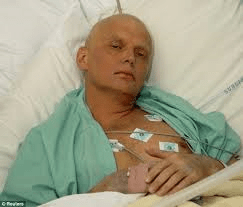
Alexander Litvinenko

History & Background

VX (nerve agent)

From Wikipedia, the free encyclopedia
VX
Stereo structural formula VX ((S)-phosphinate)
Ball and stick model of VX ((R)-phosphinate)
VX-S-enantiomer-3D-vdW.png
Names
IUPAC name

Ethyl ({2-[bis(propan-2-yl)amino]ethyl}sulfanyl)(methyl)phosphinate
Systematic IUPAC name

Ethyl ({2-[bis(propan-2-yl)amino]ethyl}sulfanyl)(methyl)phosphinate
Other names

[2-(Diisopropylamino)ethyl]-O-ethyl methylphosphonothioate
Ethyl {[2-(diisopropylamino)ethyl]sulfanyl}(methyl)phosphinate
Ethyl N-2-diisopropylaminoethyl methylphosphonothiolate
Identifiers
50782-69-9 YesY[1]
51848-47-6 YesY[1]
53800-40-1 YesY[1]
65143-05-7 N[1]
3D model (Jmol) Interactive image
Interactive image
ChEBI CHEBI:609247 N
ChEMBL ChEMBL483105 YesY
ChemSpider 36386 YesY
MeSH VX
PubChem 39793
Properties
C11H26NO2PS
Molar mass 267.37 g·mol−1
Density 1.0083 g cm−3
Melting point −3.90 °C (24.98 °F; 269.25 K)
Boiling point 300 °C (572 °F; 573 K)
log P 2.047
Vapor pressure 0.09 Pa
Hazards
NFPA 704
Flammability code 1: Must be pre-heated before ignition can occur. Flash point over 93 °C (200 °F). E.g., canola oil Health code 4: Very short exposure could cause death or major residual injury. E.g., VX gas Reactivity code 1: Normally stable, but can become unstable at elevated temperatures and pressures. E.g., calcium Special hazards (white): no code

NFPA 704 four-colored diamond

Flash point 159 °C (318 °F; 432 K)
Lethal dose or concentration (LD, LC):
7 µg/kg (intravenous, rat)
Except where otherwise noted, data are given for materials in their standard state (at 25 °C [77 °F], 100 kPa).
verify (what is YesYN ?)
Infobox references

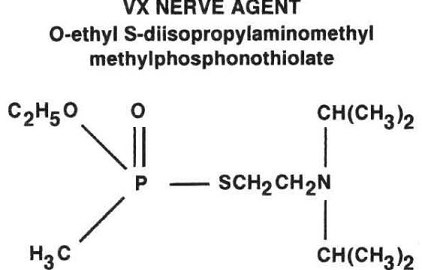
VX (IUPAC name: O-ethyl S-[2-(diisopropylamino)ethyl] methylphosphonothioate) is an extremely toxic organophosphate. A tasteless and odorless liquid with an amber-like color, it severely disrupts the body’s nervous system and is used as a nerve agent in chemical warfare. Ten milligrams (0.00035 oz) is sufficient for it to be fatal through skin contact, and the median lethal dose for inhalation is estimated to be 30–50 mg·min/m3. As a chemical weapon, it is classified as a weapon of mass destruction (WMD) by the United Nations Resolution 687.

The production and stockpiling of VX exceeding 100 grams (3.53 oz) per year was outlawed by the Chemical Weapons Convention of 1993. The only exception is for “research, medical or pharmaceutical purposes outside a single small-scale facility in aggregate quantities not exceeding 10 kg [22 lb] per year per facility”.

The VX nerve agent is the best-known of the V-series of nerve agents and is considered an area denial weapon due to its physical properties. It is far more potent than sarin, another well-known nerve agent toxin, but works in a similar way.

Chemical characteristics

With its high viscosity and low volatility, VX has the texture and feel of motor oil. This makes it especially dangerous, as it has a high persistence in the environment. It is odorless and tasteless, and can be distributed as a liquid, either pure or as a mixture with a clay or talc in the form of thickened agent, or as an aerosol.

VX is an acetylcholinesterase inhibitor, i.e., it works by blocking the function of the enzyme acetylcholinesterase. Normally, when a motor neuron is stimulated, it releases the neurotransmitter acetylcholine into the space between the neuron and an adjacent muscle cell. When this acetylcholine is taken up by the muscle cell, it stimulates muscle contraction. To avoid a state of constant muscle contraction, the acetylcholine is then broken down to non-reactive substances (acetic acid and choline) by the enzyme acetylcholinesterase. VX blocks the action of acetylcholinesterase, resulting in an accumulation of acetylcholine in the space between the neuron and muscle cell, leading to uncontrolled muscle contraction.

This results in initial violent contractions, followed by sustained supercontraction restricted to the subjunctional endplate sarcoplasm and prolonged depolarizing neuromuscular blockade, the latter resulting in flaccid paralysis of all the muscles in the body. Sustained paralysis of the diaphragm muscle causes death by asphyxiation.

Synthesis

VX is produced via the transester process. This entails a series of steps whereby phosphorus trichloride is methylated to produce methyl phosphonous dichloride. The resulting material is reacted with ethanol to form a diester. This is then transesterified with N,N-diisopropylaminoethanol to produce the mixed phosphonite. Finally, this immediate precursor is reacted with sulfur to form VX.


VX TransesterProcess.png

VX can also be delivered in binary chemical weapons which mix in-flight to form the agent prior to release. Binary VX is referred to as VX2,[6] and is created by mixing O-(2-diisopropylaminoethyl) O′-ethyl methylphosphonite (Agent QL) with elemental sulfur (Agent NE) as is done in the Bigeye aerial chemical bomb. It may also be produced by mixing with sulfur compounds, as with the liquid dimethyl polysulfide mixture (Agent NM) in the canceled XM736 8-inch projectile program.

Solvolysis

Like other organophosphorus nerve agents, VX may be destroyed by reaction with strong nucleophiles. The reaction of VX with concentrated aqueous sodium hydroxide results in competing cleavage of the P-O and P-S esters, with P-S cleavage dominating. This is problematic, however, as the product of P-O bond cleavage (named EA 2192) remains toxic. In contrast, reaction with the hydroperoxide anion (hydroperoxidolysis) leads to exclusive cleavage of the P-S bond.

VX-solvolysis-P-S-2D-skeletal.png P-S cleavage
NaOH(aq) reacts with VX in two ways. It can cleave VX’s P-S bond, yielding two relatively nontoxic products…
VX-solvolysis-P-O-2D-skeletal.png P-O cleavage
…or it can cleave VX’s P-O bond, forming ethanol and EA 2192 (shown in red), which has similar toxicity to VX itself

Biological effects

VX is the most toxic nerve agent ever synthesized for which activity has been independently confirmed. The median lethal dose (LD50) for humans is estimated to be about 10 mg (0.00035 oz) through skin contact and the LCt50 for inhalation is estimated to be 30–50 mg·min/m3.

Nerve agents act by inhibiting the hydrolysis of acetylcholine (ACh) by acetylcholinesterase (AChE). Nerve agents bind to the active site of AChE, rendering it incapable of deactivating ACh. Any ACh that is not hydrolyzed (deactivated) still can interact with the receptor, resulting in persistent and uncontrolled stimulation of that receptor. Thus, the clinical effects of nerve agent poisoning are the result of this persistent stimulation and subsequent fatigue at the muscarinic and nicotinic ACh receptors.

Early symptoms of percutaneous exposure (skin contact) may be local muscular twitching or sweating at the area of exposure followed by nausea or vomiting. Some of the early symptoms of a VX vapor exposure to nerve agent may be rhinorrhea (runny nose) and/or tightness in the chest with shortness of breath (bronchial constriction). Miosis (pinpointing of the pupils) may be an early sign of agent exposure but is not usually used as the only indicator of exposure.

Treatment

When treating VX exposure, primary consideration should be given to removal of the liquid agent from the skin, before removal of the individual to an uncontaminated area or atmosphere. After removal from the area, the casualty (the victim) should be decontaminated by washing the contaminated areas with household bleach and flushing with clean water. After decontamination, clothing should be removed and skin contamination washed away. If possible, decontamination should be completed before the casualty is taken for further medical treatment.

An individual who has received a known nerve-agent exposure, or who exhibits definite signs or symptoms of nerve-agent exposure should immediately be given the antidotes atropine and pralidoxime (2-PAM), as well an injected sedative/antiepileptic such as diazepam. In several nations the nerve agent antidotes are issued for military personnel in the form of an autoinjector such as the United States military Mark I NAAK.

Atropine blocks a subset of acetylcholine receptors known as muscarinic acetylcholine receptors (mAchRs), so that the buildup of acetylcholine produced by loss of the acetylcholinesterase function has a reduced effect on their target receptor. Pralidoxime (2-PAM) reactivates the acetylcholinesterase enzyme (AChE), thus reversing the effects of VX. VX and other organophosphates block AChE activity by binding to the active site of the enzyme. The phosphate group on VX is transferred from VX to AChE, which inactivates the enzyme and produces an inactive metabolite of VX. Pralidoxime removes this phosphate group.

However, if pralidoxime is not given soon enough, the inactivated enzyme will “age”, resulting in a much stronger AChE-phosphate binding, that pralidoxime cannot reverse.

Diagnostic tests

Controlled studies in humans have shown that minimally toxic doses cause 70–75% depression of erythrocyte cholinesterase within several hours of exposure. The serum level of ethyl methylphosphonic acid (EMPA), a VX hydrolysis product, was measured to confirm exposure in one poisoning victim.

History

Discovery

The chemists Ranajit Ghosh La-a and J.F. Newman discovered the V-series nerve agents at the British firm ICI in 1952, patenting diethyl S-2-diethylaminoethyl phosphono- thioate (agent VG) in November 1952. Further commercial research on similar compounds ceased in 1955 when its lethality to humans was discovered. The U.S. went into production of large amounts of VX in 1961 at Newport Chemical Depot.

The discovery occurred when the chemists were investigating a class of organophosphate compounds (organophosphate esters of substituted aminoethanethiols).[16] Like Gerhard Schrader, an earlier investigator of organophosphates, Ghosh found that they were quite effective pesticides. In 1954, ICI put one of them on the market under the trade name Amiton. It was subsequently withdrawn, as it was too toxic for safe use. The toxicity did not go unnoticed, and samples of it had been sent to the British Armed Forces research facility at Porton Down for evaluation.

After the evaluation was complete, several members of this class of compounds became a new group of nerve agents, the V agents. The best-known of these is probably VX, assigned the UK Rainbow Code Purple Possum, with the Russian V-Agent coming a close second (Amiton is largely forgotten as VG). This class of compounds is also sometimes known as Tammelin’s esters, after Lars-Erik Tammelin of the Swedish National Defence Research Institute. Tammelin was also conducting research on this class of compounds in 1952, but did not widely publicize his work. The name is a contraction of the words “venomous agent X”.

Instances of VX use

There was evidence of a combination of chemical agents having been used by Iraq against the Kurds at Halabja in 1988 under Saddam Hussein. Hussein later testified to UNSCOM that Iraq had researched VX, but had failed to weaponize the agent due to production failure. After U.S. and allied forces had invaded Iraq, no VX agent or production facilities were found. However, UNSCOM laboratories detected traces of VX on warhead remnants.

In December 1994 and January 1995, Masami Tsuchiya of Aum Shinrikyo synthesized 100 to 200 grams (3.5 to 7.1 oz) of VX which was used to attack three people. Two people were injured and one 28-year-old man died, who was the first victim of VX ever documented in the world at that time. The VX victim, whom Shoko Asahara had suspected as a spy, was attacked at 7:00 am on December 12, 1994 on the street in Osaka by Tomomitsu Niimi and another AUM member, who sprinkled the nerve agent on his neck.

He chased them for about 100 yards (90 metres) before collapsing, dying 10 days later without ever coming out of a deep coma. Doctors in the hospital suspected at the time he had been poisoned with an organophosphate pesticide, but the cause of death was pinned down only after cult members arrested for the subway attack confessed to the killing. Metabolites of VX such as ethyl methylphosphonate, methylphosphonic acid and diisopropyl-2-(methylthio)ethylamine were later found in samples of the victim’s blood seven months after his murder.

Unlike the cases for sarin gas (the Matsumoto incident and the attack on the Tokyo subway), VX was not used for mass murder.

On February 13, 2017, Kim Jong-nam, half-brother of North Korean leader Kim Jong-un, died after an assault in Kuala Lumpur International Airport in Malaysia. According to the authorities he was murdered by poisoning with VX which was found on his face.

The authorities further reported that one of the women suspected of applying the nerve agent experienced some physical symptoms of VX-poisoning. The director of a non-proliferation research program of the Middlebury Institute of International Studies at Monterey stated that VX fumes would have killed the suspected attackers even if they had been wearing gloves, suggesting that the VX was applied as two non-fatal components that would mix to form VX only on the victim’s face.

Worldwide stockpiles

Some countries known to possess VX are the United States, Russia,  and Syria.

A Sudanese pharmaceutical facility, the Al-Shifa pharmaceutical factory, was bombed by the U.S. in 1998 acting on information that it produced VX and that the origin of the agent was associated with both Iraq and Al Qaeda. The U.S. had obtained soil samples identified as containing O-ethyl hydrogen methylphosphonothioate (EMPTA), a chemical used in the production of VX which may also have commercial applications. Chemical weapons experts later suggested that the widely used Fonophos organophosphate insecticide could have been mistaken for EMPTA.

In 1969, the U.S. government canceled its chemical weapons programs, banned the production of VX in the United States, and began the destruction of its stockpiles of agents by a variety of methods. Early disposal included the U.S. Army’s CHASE (Cut Holes And Sink ‘Em) program, in which old ships were filled with chemical weapons stockpiles and then scuttled. CHASE 8 was conducted on June 15, 1967, in which the steamship Cpl. Eric G. Gibson was filled with 7,380 VX rockets and scuttled in 2,200 m (7,200 ft) of water off the coast of Atlantic City, New Jersey. Incineration was used for VX stockpile destruction starting in 1990 with Johnston Atoll Chemical Agent Disposal System in the North Pacific with other incineration plants following at Deseret Chemical Depot, Pine Bluff Arsenal, Umatilla Chemical Depot and Anniston Army Depot with the last of the VX inventory destroyed on December 24, 2008.

Stockpile elimination under the Chemical Weapons Convention

Worldwide, VX disposal has continued since 1997 under the mandate of the Chemical Weapons Convention. In fiscal year 2008, the U.S. Department of Defense released a study finding that the United States had dumped at least 112 tonnes (124 short tons) of VX into the Atlantic Ocean off the coasts of New York/New Jersey and Florida between 1969 and 1970. This material consisted of nearly 22,000 M55 rockets, 19 bulk containers holding 640 kg (1,400 lb) each, and one M23 chemical landmine.

The Newport Chemical Depot began VX stockpile elimination using chemical neutralization in 2005. VX was hydrolyzed to much less toxic byproducts by using concentrated caustic solution, and the resulting waste was then shipped off-site for further processing. Technical and political issues regarding this secondary byproduct resulted in delays, but the depot completed their VX stockpile destruction in August 2008.

The remaining VX stockpile in the U.S. will be treated by the Blue Grass Chemical Agent-Destruction Pilot Plant, part of the Program Executive Office, Assembled Chemical Weapons Alternatives program. The program was established as an alternative to the incineration process successfully used by the Army Chemical Materials Agency, which completed its stockpile destruction activities in March 2012. The Blue Grass Pilot Plant has been plagued by repeated cost over-runs and schedule slippages since its inception.

In Russia, the U.S. is providing support for these destruction activities with the Nunn-Lugar Global Cooperation Initiative. The Initiative has been able to convert a former chemical weapons depot at Shchuchye, Kurgan Oblast, into a facility to destroy those chemical weapons. The new facility, which opened in May 2009, has been working on eliminating the nearly 5,400 tonnes (5,950 short tons) of nerve agents held at the former storage complex. However, this facility only holds about 14% of Russian chemical weapons, which are stored at seven sites.

In popular culture

One of the best-known references to VX in popular culture is its use in the 1996 film The Rock,  which centers on a threatened VX attack on San Francisco from the island of Alcatraz. The film uses artistic license, notably with VX being ascribed corrosive powers it does not possess, permitting an early scene in which a VX victim is shown with his face melting, rather than dying through asphyxiation. It also shows the hero applying an intracardiac injection of atropine as a defense against VX contamination, rather than the more usual intramuscular injection (e.g. into the thigh) of a combination of atropine and pralidoxime.

In the BBC One spy drama Spooks, an episode named “I Spy Apocalypse” (Series 2, Episode 5) features an EERE (Extreme Emergency Response Exercise) turned real life emergency. A dirty bomb was reported to have exploded in Parliament Square and later the Morningside area of Edinburgh. The bomb was confirmed to have dispersed VX in quantities that exceeded the lethal dose across much of the southeast of England. It is later found that the emergency is a well constructed and believable exercise designed to test the MI5 officers to their limits.

In the CBS American science-based drama television series Eleventh Hour, an episode named Subway (Episode 16); Dr Hood, a science advisor to the FBI is called in to determine the cause of a poison cluster, which is killing people in Philadelphia.

VX agent was featured on the History Channel’s television series Modern Marvels in the episode Deadliest Weapons (Season 11, Episode 10).

Another reference to VX is found in the 2012 art-house dark comedy film It’s a Disaster. The film centers around four couples who gather for a regular couples brunch and later learn about a multi-city VX attack on the United States that may threaten their lives

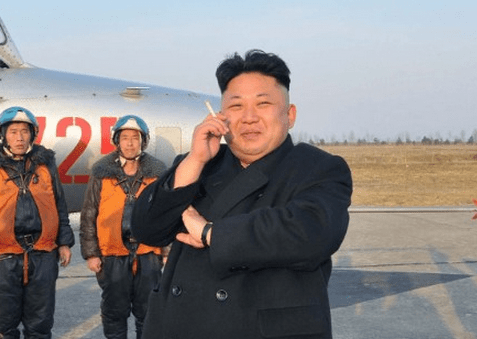
Kim Jong-un Supreme Leader of The Democratic People’s Republic of Korea.

Kim Jong-un  Supreme Leader

of

The Democratic People’s Republic of Korea.

——————————————————————————

BBC Documentary North Korea and Kim Jong In

——————————————————————————

Kim Jong-un[4] (Korean pronunciation: [ɡ̊imd͜zɔŋɯn]; born 8 January 1983;[2] also romanized as Kim Jong-eun, Kim Jong Un or Kim Jung-eun)[5] is the supreme leader of the Democratic People’s Republic of Korea (North Korea). He is the son of Kim Jong-il (1941–2011) and the grandson of Kim Il-sung (1912–1994). He has held the titles of the First Secretary of the Workers’ Party of Korea, the Chairman of the Central Military Commission, Chairman of the National Defence Commission, the Supreme Commander of the Korean People’s Army, and presidium member of the Politburo of the Workers’ Party of Korea. He was officially declared the supreme leader following the state funeral of his father on 28 December 2011.[6] He is the third and youngest son of Kim Jong-il and his consort Ko Yong-hui.[7]

——————————————————————————

Inside North Korea

——————————————————————————

From late 2010, Kim Jong-un was viewed as heir apparent to the leadership of the nation, and following his father’s death, he was announced as the “Great Successor” by North Korean state television.[8] At Kim Jong-il’s memorial service, North Korean Chairman of the Supreme People’s Assembly Kim Yong-nam declared that “Respected Comrade Kim Jong-un is our party, military and country’s supreme leader who inherits great comrade Kim Jong-il’s ideology, leadership, character, virtues, grit and courage”.[9] On 30 December 2011, the Politburo of the Workers’ Party of Korea formally appointed Kim as the Supreme Commander of the Korean People’s Army.[1] In April 2012, the 4th Party Conference elected him to the newly created post of First Secretary of the Workers’ Party of Korea.

He was promoted to the rank of marshal of the DPRK in the Korean People’s Army on 18 July 2012, consolidating his position as the supreme commander of the armed forces[10] and is often referred to as Marshal Kim Jong-un or “the Marshal” by state media.[11][12] He obtained two degrees, one in physics at Kim Il-sung University and another as an Army officer at the Kim Il-sung Military University.[13][14] On 9 March 2014 Kim Jong-un was elected unopposed to the Supreme People’s Assembly. At 32 years of age, he is the first North Korean leader born after the country’s founding and the world’s youngest head of state.

Kim was named the world’s 46th most powerful person by the Forbes list of The World’s Most Powerful People in 2013, the third highest among Koreans after Ban Ki-moon and Lee Kun-hee.[15]

Name

Kim was formerly known as Kim Jong-woon or Kim Jung-woon.[16] His name was first reported as 김정운 (Hanja: ; lit. righteous cloud), possibly as a result of an error in transliteration; the Japanese language does not distinguish between 운 (/un/) and 은 (/ɯn/).[citation needed] The initial source of his name was Kim Jong-il’s former personal chef, known by the pen name Kenji Fujimoto, who was among the few who had access to information about Kim’s household from inside the government. Chinese media had named him as 김정은 (Hanja: ; lit. righteous grace).[3]

In December 2014, South Korea’s KBS TV revealed that they had obtained an official “administrative order” originally circulated by Kim Jong-il in January 2011 mandating that anyone sharing Kim Jong-un’s name needed to formally change their name. Similar edicts were issued regarding the names of the regime’s previous leaders when they were coming to power. The 2011 document states, “All party organs and public security authorities should make a list of residents named Kim Jong-un … and train them to voluntarily change their names.”[17]

Early life and education

The Liebefeld-Steinhölzli public school in Köniz, Switzerland, which Kim Jong-un is reported to have attended.

No official comprehensive biography on Kim Jong-un has yet been released. Therefore, the only known information on his early life comes from defectors and people who have claimed to witness him abroad, such as during his school attendance in Switzerland. Some of the information has been conflicting and contradictory, perhaps conflating him with his brother Kim Jong-chul, who was also attending school in Switzerland around the same period. Nevertheless, there has been some consensus on information about his early life. North Korean authorities have stated that his birthdate is 8 January 1982, but South Korean intelligence officials believe the actual date is a year later. Dennis Rodman said that the birthdate is 8 January 1983 after meeting Kim in September 2013.[2] Kim Jong-Un was the second of three children Ko Yong-hui bore to Kim Jong-il; his elder brother Kim Jong-chul was born in 1981, while his younger sister, Kim Yo-jong, is believed to have been born in 1987.[18][19]

According to reports first published in Japanese newspapers, he went to school in Switzerland near Bern. First reports claimed he attended the private English-language International School in Gümligen near Bern under the name “Chol-pak” or “Pak-chol” from 1993 until 1998.[20][21][22] He was described as shy, a good student who got along well with his classmates and was a basketball fan.[23] He was chaperoned by an older student, who was thought to be his bodyguard.[24]

Later, it was reported that Kim Jong-un attended the Liebefeld Steinhölzli school in Köniz near Bern under the name “Pak-un” or “Un-pak” from 1998 until 2000 as the son of an employee of the Embassy of North Korea. Authorities of Köniz confirmed that a student from North Korea, registered as the son of a member of the Embassy, attended the school from August 1998 until the autumn of 2000, but were unable to give details about his identity. Pak-un first attended a special class for foreign-language children and later attended the regular classes of the 6th, 7th, 8th, and part of the final 9th year, leaving the school abruptly in the autumn of 2000. He was described as a well-integrated and ambitious student who liked to play basketball.[25] However, his grades and attendance rating are reported to have been poor.[26][27] The ambassador of North Korea in Switzerland, Ri Tcheul, had a close relationship with him and acted as a mentor.[28] One of Pak-un’s classmates told reporters that he had told him that he was the son of the leader of North Korea.[29][30] According to some reports, Jong-un was described by classmates as a shy child who was awkward with girls and indifferent to political issues but who distinguished himself in sports, and had a fascination with the American National Basketball Association and Michael Jordan. One friend claimed that he had been shown pictures of Pak-un with Kobe Bryant and Toni Kukoč.[31]

In April 2012, new documents came to light indicating that Kim Jong-un had lived in Switzerland since 1991 or 1992, earlier than previously thought.[32]

The Laboratory of Anatomic Anthropology at the University of Lyon, France, after comparing the picture of the boy Pak-un taken at the Liebefeld Steinhölzli school in 1999 with a picture of Kim Jong-un from 2012 came to the conclusion that the two faces show a conformity of 95%. The head of the institute, Raoul Perrot, a forensic anthropologist, considers it most likely that the two pictures show the same person.[33][34]

It is believed that the student at the Gümligen International School was not Kim Jong-un but his elder brother Kim Jong-chol. It is not known whether the student known as Pak-un in Liebefeld Steinhölzli lived in Switzerland prior to 1998.[35] All the children of Kim Jong-il are said to have lived in Switzerland, as well as the mother of the two youngest sons, who lived in Geneva for some time. The Kim clan is also said to organize family meetings in Switzerland at Lake Geneva and Interlaken.[28]

Most analysts agree that Kim Jong-un attended Kim Il-sung University, a leading officer-training school in Pyongyang, from 2002 to 2007.[36]

For many years, only one confirmed photograph of him was known outside North Korea, apparently taken in the mid-1990s, when he was eleven.[37] Occasional other supposed images of him surfaced but were often disputed.[38][39][40] It was only in June 2010, shortly before he was given official posts and publicly introduced to the North Korean people, that more pictures were released of Kim, taken when he was attending school in Switzerland.[41][42] The first official image of him as an adult was a group photograph released on 30 September 2010, at the end of the party conference that effectively anointed him, in which he is seated in the front row, two places from his father. This was followed by newsreel footage of him attending the conference.[43]

In 2013, Kim Jong-un was awarded an honorary doctorate in Economics by HELP University, a private Malaysian university.[44]

Succession

Pre-2010 Party Conference speculation

His eldest half-brother, Kim Jong-nam, had been the favorite to succeed, but reportedly fell out of favor after 2001, when he was caught attempting to enter Japan on a fake passport to visit Tokyo Disneyland.[45]

Kim Jong-il’s former personal chef, Kenji Fujimoto, revealed details regarding Kim Jong-un, with whom he had a good relationship,[46] stating that he was favored to be his father’s successor. Fujimoto also claimed that Jong-un was favored by his father over his elder brother, Kim Jong-chul, reasoning that Jong-chul is too feminine in character, while Jong-un is “exactly like his father”.[47] Furthermore, Fujimoto stated that “If power is to be handed over then Jong-un is the best for it. He has superb physical gifts, is a big drinker and never admits defeat.” Also, according to Fujimoto, Jong-un smokes Yves Saint Laurent cigarettes, loves Johnnie Walker whisky and has a Mercedes-Benz 600 Sedan.[48] When Jong-un was 18, Fujimoto described an episode where Jong-un once questioned his lavish lifestyle and asked, “We are here, playing basketball, riding horses, riding Jet Skis, having fun together. But what of the lives of the average people?”[47] On 15 January 2009 the South Korean news agency Yonhap reported that Kim Jong-il had appointed Kim Jong-un to be his successor.[45][49]

On 8 March 2009, the BBC reported rumors that Kim Jong-un was on the ballot for elections to the Supreme People’s Assembly, the rubber stamp parliament of North Korea.[50] Subsequent reports indicate that his name did not appear on the list of lawmakers,[51] but he was later elevated to a mid-level position in the National Defense Commission, which is a branch of the North Korean military.[52] Reports have also suggested that he is a diabetic and suffers from hypertension.[16][53]

North Koreans bowing to the statues of Kim Il-sung and Kim Jong-il

From 2009, it was understood by foreign diplomatic services that Kim was to succeed his father Kim Jong-il as the head of the Korean Workers’ Party and de facto leader of North Korea.[54] He has been named “Yŏngmyŏng-han Tongji” (영명한 동지), which loosely translates to “Brilliant Comrade”.[55] His father had also asked embassy staff abroad to pledge loyalty to his son.[53] There have also been reports that citizens in North Korea were encouraged to sing a newly composed “song of praise” to Kim Jong-un, in a similar fashion to that of praise songs relating to Kim Jong-il and Kim Il-sung.[56] Later, in June, Kim was reported to have visited China secretly to “present himself” to the Chinese leadership, who later warned against North Korea conducting another nuclear test.[57] The Chinese Foreign Ministry has strongly denied that this visit occurred.[58][59]

North Korea was later reported to have backed the succession plan, after Kim Jong-il suspended a propaganda campaign to promote his youngest son.[60] His birthday has since become a national holiday, celebrated on 8 January, according to a report by a South Korean website.[61] He was expected to be named on 28 September 2010 as successor to his father as leader of North Korea.[62][63][64]

Former U.S. president Jimmy Carter visited China in early September 2010, and discussed the issue of the North Korean leadership succession with Chinese Premier Wen Jiabao. According to Carter, Kim Jong-il had said to Wen that Kim Jong-un’s prospective promotion to paramount leader of North Korea was “a false rumor from the West”.[65]

Vice Chairman of the Central Military Commission

Kim Jong-un was made a daejang, the equivalent of general in the United States,[66] on 27 September 2010, a day ahead of a rare Workers’ Party of Korea conference in Pyongyang, the first time North Korean media had mentioned him by name and despite his having no previous military experience.[67][68][69] Despite the promotion, no further details, including verifiable portraits of Kim, were released.[70] On 28 September 2010, he was named vice chairman of the Central Military Commission and appointed to the Central Committee of the Workers’ Party, in an apparent nod to become the successor to Kim Jong-il.[71]

On 10 October 2010, alongside his father, Kim Jong-un attended the ruling Workers’ Party’s 65th anniversary celebration. This was seen as fully confirming his position as the next leader of the Workers’ Party. Unprecedented international press access was granted to the event, further indicating the importance of Kim Jong-un’s presence.[72] In January 2011, the regime began purging around 200 protégés of both Jong-un’s uncle-in-law Jang Sung-taek and O Kuk-ryol, the vice chairman of the National Defence Commission of North Korea, by either detention or execution to further prevent either man from rivaling Jong-un.[73] In the following months, Kim Jong-un was given more and more prominence as he accompanied Kim Jong-il during several “guidance tours” and received gifts from foreign delegations and personages, an honor traditionally awarded only to the living supreme leader.

Ruler of North Korea

On 17 December 2011, Kim Jong-il died. Despite the elder Kim’s plans, it was not immediately clear after his death whether Jong-un would in fact take full power, and what his exact role in a new government would be.[74] Some analysts had predicted that when Kim Jong-il died, Jang Sung-taek would act as regent, as Jong-un was too inexperienced to immediately lead the country.[75] On 25 December 2011, North Korean television showed Jang Sung-taek in the uniform of a general in a sign of his growing sway after the death of Kim Jong-il. A Seoul official familiar with North Korea affairs said it was the first time Jang has been shown on state television in a military uniform. His appearance suggested that Jang had secured a key role in the North’s powerful military, which pledged its allegiance to Kim Jong-un.[76]

North Korea’s cult of personality around Kim Jong-un was stepped up following his father’s death. He was hailed as the “great successor to the revolutionary cause of Juche“, “outstanding leader of the party, army and people”[77] and “respected comrade who is identical to Supreme Commander Kim Jong-il”,[78] and was made chairman of the Kim Jong-il funeral committee. The Korean Central News Agency described Kim Jong-un as “a great person born of heaven”, a propaganda term only his father and grandfather had enjoyed,[79] while the ruling Workers’ Party said in an editorial: “We vow with bleeding tears to call Kim Jong-un our supreme commander, our leader.”[80]

He was publicly declared Supreme Commander of the Korean People’s Army on 24 December 2011[81] and formally appointed to the position on 30 December when the Political Bureau of the Central Committee of the Workers’ Party “courteously proclaimed that the dear respected Kim Jong Un, vice-chairman of the Central Military Commission of the WPK, assumed the supreme commandership of the Korean People’s Army”.[1]

On 26 December 2011, the leading North Korean newspaper Rodong Sinmun announced that Kim Jong-un had been acting as chairman of the Central Military Commission,[82] and supreme leader of the country, following his father’s demise.[83]

On 9 January 2012, a large rally was held by armed forces in front of Kumsusan Memorial Palace to honor Kim Jong-un and demonstrate loyalty.[84]

Assuming official titles

On 27 March 2012, Kim was elected to the Fourth Conference of the Workers’ Party of Korea, that elected him first secretary, a newly made position, on 11 April. This position replaced the post of general secretary, which was awarded “eternally” to Kim Jong-il. At the conference, Kim Jong-un also took his father’s seats as Politburo Presidium member and Chairman of the Central Military Commission.[85] In a speech made prior to the Conference, Kim Jong-un declared that “Imbuing the whole society with Kimilsungism-Kimjongilism is the highest programme of our Party”. On 13 April 2012, the 5th Session of the 12th Supreme People’s Assembly appointed Kim Jong-un Chairman of the National Defence Commission.

On 15 April 2012, during a military parade to commemorate Kim Il-sung’s centenary, Kim Jong-un made his first public speech.[86] That speech became the basis of “Onwards Toward the Final Victory“, a repeatedly aired propaganda hymn dedicated to him.[87]

In July 2012, Kim Jong-un was promoted to wonsu, the highest active rank in the military. The decision was jointly issued on by the Central Committee and the Central Military Commission of the Workers’ Party of Korea, the National Defence Commission, and the Presidium of the Supreme People’s Assembly, the Korean Central News Agency subsequently announced. By this promotion, he is one of only two wonsu holders now alive in North Korea. The other is Lee Ul-sol, who received the rank in 1995. The only higher rank is Dae Wonsu (roughly translated as Grand Marshal or Generalissimo) which was held by Kim’s grandfather, Kim Il-sung, and which was awarded posthumously to his father, Kim Jong-il, in February 2012.[10][88] The promotion confirmed Kim’s role as top leader of the North Korean military and came days after the replacement of Chief of General Staff Ri Yong-ho by Hyon Yong-chol.

During a 26 July 2012 performance marking the 59th anniversary of the armistice of the Korean War, security around Kim reportedly increased dramatically because Kim “is extremely nervous about the possibility of an emergency developing inside North Korea” caused by “mounting opposition to his efforts to rein in the military”.[89]

In November 2012, satellite photos revealed a half-kilometer-long propaganda message carved into a hillside in Ryanggang Province, reading, “Long Live General Kim Jong-un, the Shining Sun!”. The message, located next to an artificial lake built in 2007 to serve a hydroelectric station, is made of Korean syllable blocks measuring 15 by 20 meters, and is located approximately 9 kilometers south of Hyesan near the border with China.[90]

Kim Jong-il’s personal chef Kenji Fujimoto stated, “Stores in Pyongyang were brimming with products and people in the streets looked cheerful. North Korea has changed a lot since Kim Jong-un assumed power. All of this is because of leader Kim Jong-un.”[91]

Model of a Unha-9 rocket on display at a floral exhibition in Pyongyang, 30 August 2013

Officially, Kim Jong-un is part of a triumvirate heading the executive branch of the North Korean government along with Premier Pak Pong-ju and parliament chairman Kim Yong-nam (no relation). Each nominally holds powers equivalent to a third of a president’s powers in most other presidential systems. Kim Jong-un commands the armed forces, Pak Pong-ju heads the government, and Kim Yong-nam handles foreign relations. Nevertheless, it is generally understood that Kim Jong-un, like his father and grandfather before him, exercises absolute control over the government and the country.

On 30 November 2012, Kim met with Li Jianguo, who “briefed Kim on the 18th National Congress of the Communist Party of China“, according to the KCNA news agency.[92] A letter from Xi Jinping was hand-delivered during the discussion.[92]

In 2013, Kim re-established his grandfather’s style when he made his first New Year’s address, a break from the approach of his father. Kim Jong-il never made televised addresses during his 17 years in power.[93] In lieu of delivering a speech, Kim Jong-il contributed to and approved a New Year’s Day editorial, jointly published by Rodong Sinmun (the daily newspaper of the Korean Workers’ Party), Joson Inmingun (the newspaper of the Korean People’s Army), and Chongnyon Jonwi (the newspaper of the Kim Il-sung Socialist Youth League).[94] At the extraordinary meeting with his top defense and security officials on 26 January 2013, Kim issued orders on preparations for a new nuclear test and introduced martial law in North Korea effective from 29 January.[95][96]

In May 2014, following the collapse of an apartment building in Pyongyang, Kim Jong-un was said to be very upset at the loss of life that resulted. A statement issued by the country’s official news agency the Korean Central News Agency used the rare expression “profound consolation and apology”. An unnamed government official was quoted by the BBC as saying Kim Jong-un had “sat up all night, feeling painful”.[97] While the height of the building and the number of casualties was not released, media reports described it is a 23-story building and indicated hundreds of people may have died in the collapse.

On 9 March 2014, Kim Jong-un was elected to the Supreme People’s Assembly. He was unopposed, but voters had the choice of voting yes or no. There was a record turnout of voters, and according to government officials, all voted yes. The Supreme People’s Assembly subsequently elected him chairman of the National Defense Commission.

Economic policies

In August 2012, Kim Jong-un announced economics reforms similar to China.[98] Kim began to be mentioned by the North Korean state media as “supreme leader” (chego ryongdoja) at this time.

A set of comprehensive economic measures, the “Socialist Corporate Responsible Management System”, were introduced in 2013.[99] The measures increase the autonomy of enterprises by granting them “certain rights to engage in business activities autonomously and elevate the will to labor through appropriately implementing the socialist distribution system”. Another priority of economic policies that year was agriculture, where the pojon (vegetable garden) responsibility system was implemented. The system reportedly achieved a major increase in output in some collective farms.[99]

North Korean media were describing the economy as a “flexible collectivist system” where enterprises were applying “active and evolutionary actions” to achieve economic development.[100] These reports reflect Kim’s general economic policy of reforming management, increasing the autonomy and incentives for economic actors. This set of reforms known as the “May 30th measures” reaffirms both socialist ownership and “objective economic laws in guidance and management” to improve living standards. Other objectives of the measures are to increase the availability of domestically manufactured goods on markets, introduction of defence innovations into the civilian sector and boost international trade.[100]

Nuclear threats

On 7 March 2013, North Korea threatened the United States with a “pre-emptive nuclear attack”,[101] and Kim Jong-un issued a detailed threat to “wipe out” Baengnyeong Island, the scene of previous naval clashes.[102] North Korea has revealed its plans for conducting nuclear strikes on U.S. cities, including Los Angeles, and Washington, D.C.[103]

At a plenary meeting of the WPK Central Committee held on 31 March 2013 in the wake of war threats with South Korea, Kim Jong-un announced that North Korea will adopt “a new strategic line on carrying out economic construction and building nuclear armed forces simultaneously”.[104]

Purges

Ri Yong-ho, Kim Yong-chun, U Tong-chuk and Kim Jong-gak were handpicked to groom the young leader and were close confidants of Kim Jong-il. They have either been demoted or disappeared. One South Korean government official said Kim Jong-un is trying to “erase all traces of his father’s rule” eleven months after stepping into power and “replacing top brass with officers who are loyal to him alone”.[105] By the end of 2013, three defense ministers and four chiefs of the army’s general staff had been replaced and five of the seven men who had escorted his father’s hearse two years earlier had been purged,[106] with his uncle Jang Sung-taek one of the most prominent.[107] Jang Sung-taek is believed to have been executed by machine gun.

Jang Sung-taek

———————————–

Kim Jong Uns Uncle Jang Song Thaek gets publicly arrested

———————————–

———————————–

Execution scene of Jang Sung-taek, North Korea

———————————–

Hyon Yong-Chol

——————————————————

North Korea Defence Chief Hyon Yong-chol ‘executed’

——————————————————

It has been claimed that Kim Jong-un has also put to death members of Jang’s family. According to multiple sources, Kim is attempting to completely destroy all traces of Jang’s existence through “extensive executions” of his family, including the children and grandchildren of all close relatives. Those reportedly killed in Kim’s purge include Jang’s sister Jang Kye-sun, her husband and ambassador to Cuba, Jon Yong-jin, and Jang’s nephew and ambassador to Malaysia, Jang Yong-chol. The nephew’s two sons were also said to have been killed.[108] At the time of Jang’s removal, it was announced that “the discovery and purge of the Jang group… made our party and revolutionary ranks purer…”[109] and after his execution on 12 December 2013 state media warned that the army “will never pardon all those who disobey the order of the Supreme Commander.”[110]

Personality

Kenji Fujimoto, a Japanese chef who used to work as Kim Jong-il’s personal cook, described Kim Jong-un as “a chip off the old block, a spitting image of his father in terms of face, body shape, and personality”.[111]

The Washington Post reported in 2009 that Kim Jong-un’s school friends recalled he “spent hours doing meticulous pencil drawings of Chicago Bulls superstar Michael Jordan.”[112] He was obsessed with basketball and computer games.[113][114] On 26 February 2013, Kim Jong-un met ex-NBA star Dennis Rodman,[115] leading many reporters to speculate that Rodman was the first American that Kim had met.[116] Rodman described his trip to Kim Jong-un’s private island, “It’s like Hawaii or Ibiza, but he’s the only one that lives there.”[117] Kim Jong-un is reportedly a fan of Eric Clapton.[118]

In July 2012, Kim Jong-un showed a change in cultural policy from his father by attending a Moranbong concert. The concert contained several elements of pop culture from the West, particularly the United States. Kim used this event to debut his wife to the public, an unprecedented move in North Korea.[119]

In a 2012 news story, Business Insider reported, “Signs of a rise in luxury goods have been creeping out of North Korea since Kim Jong-un took over as last year. Just recently, Kim’s wife Ri Sol-ju was photographed holding what appeared to be an expensive Dior handbag, worth almost $1,594 — an average year’s salary in North Korea.”[120] According to diplomatic sources, “Kim Jong-un likes to drink and party all night like his father and ordered the [imported sauna] equipment to help him beat hangovers and fatigue.”[121]

During Dennis Rodman’s 26 February 2013 trip to North Korea, Vice Media correspondent Ryan Duffy observed that “the leader was ‘socially awkward’ and didn’t make eye contact when shaking hands”.[122]

According to Cheong Seong-chang of Sejong Institute, Kim Jong-un has greater visible interest in the welfare of his people and engages in greater interaction with them than his father did.[123]

Health

Kim Jong-un did not appear in public for six weeks in September and October 2014. State media reported that he was suffering from an “uncomfortable physical condition”. Previously he had been seen limping.[124][125][126][127][128][129] When he reappeared he was using a walking stick.[130][131]

Human rights violations

——————————————————

The N. Korean TV Star Standing Up To Kim Jong-Un

——————————————————

Human rights violations under the leadership of Kim Jong-il were condemned by the UN General Assembly.[132] Press reports indicate that they are continuing under Kim Jong-un.[133][134][135][136] It is believed by some that Kim Jong-un was involved in the Cheonan sinking[137] and the bombardment of Yeonpyeong[138] to strengthen his military credentials and facilitate a successful transition of power from his father.[139]

The 2013 report on the situation of human rights in North Korea[140] by United Nations Special Rapporteur Marzuki Darusman proposed a United Nations commission of inquiry[141] to document the accountability of Kim Jong-un and other individuals in the North Korean government for alleged crimes against humanity.[142] The report of the commission of inquiry[143] was published in February 2014 and recommends to make him accountable for crimes against humanity at the International Criminal Court.[144]

One report by the Japanese Asia Press agency in January 2013 claimed that in North and South Hwanghae provinces more than 10,000 people had died of famine. Other international news agencies have begun circulating stories of cannibalism. One informant, based in South Hwanghae, said: “In my village in May, a man who killed his own two children and tried to eat them was executed by a firing squad.”[145]

Family

Portraits of Kim Jong-un’s father and grandfather (Arirang Festival mass games in Pyongyang)

On 25 July 2012 North Korean state media reported for the first time that Kim Jong-un is married to Ri Sol-ju (리설주).[146][147] Ri, who appears to be in her early 20s, had been accompanying Kim Jong-un to public appearances for several weeks prior to the announcement.[147] The BBC, quoting an analyst who spoke to The Korea Times of South Korea, reported that Kim Jong-il had hastily arranged his son’s marriage after suffering a stroke in 2008. According to some sources, the two married in 2009 and Ri gave birth to a daughter in 2010.[148][149]

Kim Jong-un has one half-brother, one half-sister and an older full-brother (see below). He also has a younger full-sister, Kim Yo-jong, who was believed to be about 23 in 2012. She sometimes accompanies him.[19][150]

Fatherhood

In March 2013, former NBA basketball player Dennis Rodman visited Kim Jong-un in North Korea and on his return reported that Ri had given birth to a daughter named Ju-ae in 2012.[151][151][152][153][154]