Disclaimer – The views and opinions expressed in these documentary are soley intended to educate and provide background information to those interested in the Troubles of Northern Ireland. They in no way reflect my own opinions and I take no responsibility for any inaccuracies or factual errors
The Dail Eireann is declared illegal and the new IRA fights a guerrilla war around Dublin and in the Irish Countryside in an effort to make Ireland ungovernable for the British
Anglo Irish War 3 Short films about the early years of the Troubles
Disclaimer – The views and opinions expressed in these documentary are soley intended to educate and provide background information to those interested in the Troubles of Northern Ireland. They in no way reflect my own opinions and I take no responsibility for any inaccuracies or factual errors
————————————————————————————————————————————-
Ross Kemp Extreme World travels to Northern Ireland to look at the state of play fifteen years after the Good Friday agreement visiting communities meeting with the people who live in them and speaking with both Loyalists, Republicans and the police as he explores the issues in one of Northern Ireland’s most divided societies.
Disclaimer – The views and opinions expressed in these documentary are soley intended to educate and provide background information to those interested in the Troubles of Northern Ireland. They in no way reflect my own opinions and I take no responsibility for any inaccuracies or factual errors .
Disclaimer – The views and opinions expressed in these documentary are soley intended to educate and provide background information to those interested in the Troubles of Northern Ireland. They in no way reflect my own opinions and I take no responsibility for any inaccuracies or factual errors .
Belfast: Us and Them (2009) – Kilometres of graffiti-daubed concrete walls snake through Belfast. They divide Catholic neighbourhoods from Protestant. But do these Peace Walls keep the hatred and suspicion locked outside or inside?
The consensus among the locals is clear if the walls came down there would be a return to intractable sectarian violence. If you pull that wall down therell be murder, mayhem, therell be blood spilt, says a loyalist resident. The recent killings of two soldiers, a policeman and a Catholic community worker, indicate that trouble is still very close to the surface. Theres walls of prejudice; walls that were built here 300 years ago and they’re still here in legislation, in prejudice and bigotry’, tells Republican Sean McVeigh. ‘So those are the walls that are going to have to come down first. Are the Peace Walls monuments to the past or vital and necessary peacekeepers in the present?
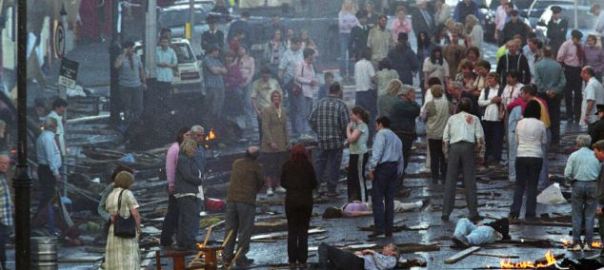
The Omagh bombing was a deliberate massacre of civilians carried out by the Irish Republican Army on Saturday 15 August 1998, in Omagh, County Tyrone, Northern Ireland. Twenty-nine people were murdered in the attack and approximately 220 people were injured. The attack was described by the BBC as “Northern Ireland’s worst single terrorist atrocity” and by the British Prime Minister, Tony Blair, as an “appalling act of savagery and evil”.
The victims included people from many different backgrounds: Protestants, Catholics, a Mormon teenager, five other teenagers, six children, a woman pregnant with twins, two Spanish tourists, and other tourists on a day trip from the Republic of Ireland. The nature of the bombing created a strong international and local outcry against the IRA, and spurred on the Northern Ireland peace process.
Builder and publican Colm Murphy was tried, convicted, and then released after it was revealed that the Gardaí forged interview notes used in the case. Murphy’s nephew Sean Hoey was also tried and found not guilty. Police Service of Northern Ireland Chief Constable Sir Hugh Orde said that he expects no further prosecutions. In June 2009, the families of all the killed victims won a £1.6 million civil action against four defendants..
The Omagh bombing is only one in a long list of savage massacres of civilians in Northern Ireland by catholic fundamentalists from the IRA. Others include the La Mon napalm bombing where elderly pensioners were burnt alive while eating in a hotel restaurant, the Kingsmill massacre which involved the cold-blooded murder of a bus full of protestant factory workers, the Enniskillen bombing which involved a bomb planted at a war memorial on Remembrance Sunday and the Darkley church shooting in which a small, rural protestant church was attacked with automatic rifles during a Sunday church service.
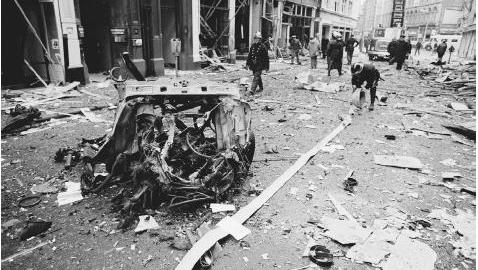
.Bloody Friday is the name given to the bombings by the Provisional Irish Republican Army (IRA) in Belfast on 21 July 1972. Twenty-six bombs exploded in the space of eighty minutes, killing nine people (including two British soldiers) and injuring 130. The majority of these were car bombs, driven to their detonation sites that same day.
Bloody Friday is the name given to the bombings by the Provisional Irish Republican Army (IRA) in Belfast on 21 July 1972. Twenty-six bombs exploded in the space of eighty minutes, killing nine people (including two British soldiers) and injuring 130. The majority of these were car bombs, driven to their detonation sites that same day.
The bombings were partly a response to the breakdown of talks between the IRA and the British government. Since the beginning of its campaign in 1969, the IRA had carried out a concerted bombing campaign against economic, military and political targets in Northern Ireland.
It carried out a total of 1,300 bombings in 1972. Bloody Friday was the spur for Operation Motorman, launched by the British Army ten days later.
– Disclaimer –
The views and opinions expressed
in this documentary/ies /post/s are soley intended to educate and provide background information to those interested in the Troubles of Northern Ireland. They in no way reflect my own opinions and I take no responsibility for an inaccuracies or factual errors .
Overview
In late June and early July 1972, a British government delegation led by William Whitelaw held secret talks with the Provisional IRA leadership. As part of the talks, the IRA agreed to a temporary ceasefire beginning on 26 June. The IRA leaders sought a peace settlement that included a British withdrawal from Northern Ireland by 1975 and the release of republican prisoners. However, the British refused and the talks broke down.
The ceasefire came to an end on 9 July. It is also speculated the the bombings were in response to the shooting deaths of innocent Catholic Civil rights marchers on 30 January 1972 known as Bloody Sunday.
“Bloody Friday” was the IRA’s response to the breakdown of the talks. According to the IRA’s Chief of Staff, Seán Mac Stíofáin, the main goal of the bombing operation was to wreak financial harm. It was a
“message to the British government that the IRA could and would make a commercial desert of the city unless its demands were met”.
Some also saw it as a reprisal for Bloody Sunday in Derry six months earlier. The attack was carried out by the IRA’s Belfast Brigade and the main organiser was Brendan Hughes, the brigade’s Officer Commanding. A total of 26 bombs were planted and, in the resulting explosions, eleven people were killed and a further 130 civilians injured, many horrifically mutilated.
At the height of the bombing, the middle of Belfast
“resembled a city under artillery fire; clouds of suffocating smoke enveloped buildings as one explosion followed another, almost drowning out the hysterical screams of panicked shoppers”.
Of those injured, 77 were women and children.
The Belfast Brigade claimed responsibility for the bombings and said that it had given warnings to the security forces (through the local media) before the bombs exploded. It said that the press, the Samaritans and the Public Protection Agency “were informed of bomb positions at least 30 minutes to one hour before each explosion”.
Mac Stíofáin said that
“It required only one man with a loud hailer to clear each target area in no time” and alleged that the warnings for the two bombs that claimed lives were deliberately ignored by the British for “strategic policy reasons”.
The security forces also received hoax warnings, which “added to the chaos in the streets”. The Royal Ulster Constabulary (RUC) and British Army only effectively cleared a small number of areas before the bombs went off. Furthermore, because of the large number of bombs in the confined area of Belfast city centre, people evacuated from the site of one bomb were mistakenly moved into the vicinity of other bombs.
Thirty years after the attack the IRA formally apologised for harming civilians.
—————————————————————————————
Bloody Friday Documentary
This excellent production from BBC NI was shown to commemorate the 40th Anniversary of Bloody Friday. Bloody Friday is the name given to the bombings by the Provisional Irish Republican Army (IRA) in Belfast on 21 July 1972. Twenty-two bombs exploded in the space of eighty minutes, killing nine people (including two British soldiers) and injuring 130.
—————————————————————————————
Timeline
The accounts of the events that appeared in the first editions of local and national newspapers were, naturally enough, somewhat confused about the details of the events of the day. The timetable below is approximate and given in BST (GMT+1). The details are based on a number of accounts.
~2:10 pm (Smithfield Bus Station)
A car bomb exploded in an enclosed yard at Smithfield Bus Station, causing extensive damage to the surrounding area.
~2:16 pm (Brookvale Hotel)
A bomb (estimated at 50 pounds (23 kg) of explosive) exploded at the Brookvale Hotel on Brookvale Avenue. The bomb was left in a suitcase by three men armed with sub-machine guns. The area had been cleared and there were no injuries.
Some sources give the time of this bombing as 2:36 pm.
A suitcase bomb (estimated at 30 pounds (14 kg) of explosive) exploded on the platform, wrecking the inside of the station and blowing the roof off. Some sources give the time of this bombing as 3:03 pm.
A car bomb exploded at the Star Taxis depot on Crumlin Road. Nearby were the houses of the Crumlin Road Prison warders and the prison itself.
Some sources say that there were two bombs and that they exploded at 3:25 pm.
Aftermath of the Oxford Street bomb showing the body of one of the victims being shovelled into a bag
~2:48 pm (Bus depot, Oxford Street)
A carbomb exploded outside the Ulsterbus depot on Oxford Street, the busiest bus station in Northern Ireland. An Austin 1100 saloon car loaded with explosives had been driven to the rear of the depot. The blast resulted in the greatest loss of life and the greatest number of casualties. Some of the victims’ bodies were torn to pieces by the blast, which led authorities to give an initial estimate of 11 deaths.
The area was being cleared but was still crowded when the bomb exploded. Two British Army soldiers, Stephen Cooper (19) and Philip Price (27), were near the bomb when it detonated and were killed outright. Three Protestant civilians who worked for Ulsterbus were killed: William Crothers (15), Thomas Killops (39) and Jackie Gibson (45). One other Protestant Ulsterbus employee, who was a member of the Ulster Defence Association, was also killed in the blast: William Irvine (18).
Crothers, Killops and Irvine had been in the vicinity of the car bomb helping to search for the device at the moment it exploded, killing the three men instantly. Bus driver Jackie Gibson was killed after having completed his bus route just minutes before the blast. Almost 40 people suffered injuries. Some sources give the time of this bombing as 3:10 pm.
A van bomb exploded in the station’s bus yard. Four buses were wrecked and 44 others damaged. The nearby Murray’s Tobacco Factory in Sandy Row was also damaged.
~2:50 pm (Ulster Bank, Limestone Road)
A car bomb (estimated at 50 pounds (23 kg) of explosive) exploded outside the Ulster Bank on Limestone Road. The area had not been cleared and there were several injuries.[1] Some sources give the time of this bombing as 2:40 pm.
A car bomb (estimated at 160 pounds (73 kg) of explosive)[13] exploded on the Queen Elizabeth Bridge. There was some damage to the structure of the bridge.[1]
A car bomb (estimated at 50 pounds (23 kg) of explosive) exploded at the Belfast–Liverpool ferry terminus at Donegall Quay. The nearby Liverpool Bar was badly damaged.
~2:57 pm (Gas Department offices, Ormeau Avenue)
A car bomb (estimated at 50 pounds (23 kg) of explosive) exploded outside the offices of the Gas Department, causing extensive damage.
~2:59 pm (Garmoyle Street)
A parcel bomb, which had been planted by armed men, exploded at the premises of John Irwin seed merchants. The building was wrecked.
~3:02 pm (Agnes Street)
A car bomb (estimated at 30 pounds (14 kg) of explosive) exploded outside a group of houses on Agnes Street, a loyalist area off the Shankill Road. Those in the area did not receive a warning but there were no serious injuries.
~3:04 pm (M2 motorway bridge, Bellevue)
A car bomb (estimated at 30 pounds (14 kg) of explosive) partially exploded on the bridge over the M2 motorway at Bellevue in north Belfast. As the bomb only partially detonated, nearby buildings were not damaged.
~3:05 pm (Filling station, Upper Lisburn Road)
A car bomb exploded at Creighton’s filling station, setting the petrol pumps ablaze.
A car bomb exploded at an electrical substation at the junction of Salisbury Avenue and Hughenden Avenue. The substation and surrounding houses were badly damaged.
~3:05 pm (Railway bridge, Finaghy Road North)
A lorry bomb exploded on a railway bridge at Finaghy Road North.
A bomb (estimated at 30 pounds (14 kg) of explosive) exploded on a footbridge over the railway at Windsor Park football grounds. Concrete sleepers were blown on to the line, blocking it.[1] Some sources give the time of this bombing as 2:09 pm.
~3:12 pm (Eastwood’s Garage, Donegall Street)
A car bomb (estimated at 150 pounds (68 kg) of explosive) destroyed Eastwood’s Garage on Donegall Street.[17] There were several injuries.
~3:15 pm (Stewartstown Road)
A bomb, thought to have been abandoned on the Stewartstown Road, exploded but caused no serious injuries.
~3:15 pm (Cavehill Road)
A car bomb (estimated at 50 pounds (23 kg) of explosive) exploded outside a row of single storey shops near the top of Cavehill Road, north Belfast. The shops were in a religiously-mixed residential area. Those in the area had not received the bomb warning. Two women and a man died in this blast. Margaret O’Hare (37), a Catholic mother of seven children, died in her car.
Her 11-year-old daughter was with her in her car and was badly injured. Catholic Brigid Murray (65) and Protestant teenager Stephen Parker (14) were also killed. Many others were seriously injured. Stephen Parker’s father, the Rev. Joseph Parker, was only able to identify his son’s body at the mortuary by the box of trick matches in his pocket, and the shirt and scout belt he had been wearing. Some sources give the time of this bombing as 3:20 pm.
~3:25 pm (Railway line near Lisburn Road)
A bomb exploded on the railway line near the Lisburn Road.
~3:30 pm (Grosvenor Road)
A bomb (estimated at 50 pounds (23 kg) of explosive) exploded at the Northern Ireland Carriers depot on Grosvenor Road. There were no serious injuries.
Reactions and consequences
According to former RUC officer Jack Dale a large group of people in the republican Markets area had
“jeered and shouted and yelled” as if each explosion was “a good thing”.
He also drew attention to the Catholic victims, and mentioned the revulsion in the Republic of Ireland and elsewhere. Leader of the Opposition Harold Wilson described the events as “a shocking crime against an already innocent population”.
“The chief injury is not to the British Army, to the Establishment or to big business but to the plain people of Belfast and Ireland. Anyone who supports violence from any side after yesterday’s events is sick with the same affliction as those who did the deed.”
Television images of fire-fighters shovelling body parts into plastic bags at the Oxford Street bus station were the most shocking of the day.
Twenty-five years later, a police officer who had been at Oxford Street bus station described to journalist Peter Taylor the scene he came upon in the wake of the bombing:
“The first thing that caught my eye was a torso of a human being lying in the middle of the street. It was recognisable as a torso because the clothes had been blown off and you could actually see parts of the human anatomy. One of the victims was a soldier I knew personally.
He’d had his arms and legs blown off and some of his body had been blown through the railings. One of the most horrendous memories for me was seeing a head stuck to the wall. A couple of days later, we found vertebrae and a rib cage on the roof of a nearby building. The reason we found it was because the seagulls were diving onto it. I’ve tried to put it at the back of my mind for twenty-five years.”
In 1972, 479 people died in the Troubles, more than in any other year of the conflict. Ten days after the bombings the British Army launched Operation Motorman, to retake IRA-controlled areas in Belfast and Derry. There were also several revenge attacks by loyalists.
The City of Belfast Youth Orchestra set up a Stephen Parker Memorial Trust in memory of teenager Stephen Parker, who had been a music student and played the French Horn in the orchestra at the time he was killed. Stephen had also been posthumously awarded the Queen’s Commendation for bravery as he had died while trying to warn others about the car bomb left outside the row of shops on Cavehill Road.
Irish republican reaction
For the IRA, and the Belfast Brigade in particular, it was “an operation gone awry”. Brendan Hughes, Officer Commanding of the IRA’s Belfast Brigade, viewed the attack as a disaster. He described his reaction in an interview organised by Boston College:
“I was the operational commander of the ‘Bloody Friday’ operation. I remember when the bombs started to go off, I was in Leeson Street, and I thought, ‘There’s too much here’. I sort of knew that there were going to be casualties, either [because] the Brits could not handle so many bombs or they would allow some to go off because it suited them to have casualties. I feel a bit guilty about it because, as I say, there was no intention to kill anyone that day. I have a fair deal of regret that ‘Bloody Friday’ took place … a great deal of regret … If I could do it over again I wouldn’t do it.”
On 16 July 2002, the Provisional IRA issued a statement of apology to An Phoblacht, which read:
Sunday 21 July marks the 30th anniversary of an IRA operation in Belfast in 1972 which resulted in nine people being killed and many more injured.
While it was not our intention to injure or kill non-combatants, the reality is that on this and on a number of other occasions, that was the consequence of our actions.
It is therefore appropriate on the anniversary of this tragic event, that we address all of the deaths and injuries of non-combatants caused by us.
We offer our sincere apologies and condolences to their families.
Please visit the autobiography section of this blog if you would like to read extracts from my forthcoming book – Belfast Child.
Go on- Surprise me !
As I child I learned the stories & legends of the Battle of Boyne & Siege of Derry at my grandfather’s & father’s knees, becoming immersed in the Loyalist culture that would shape & dominate my whole existence.
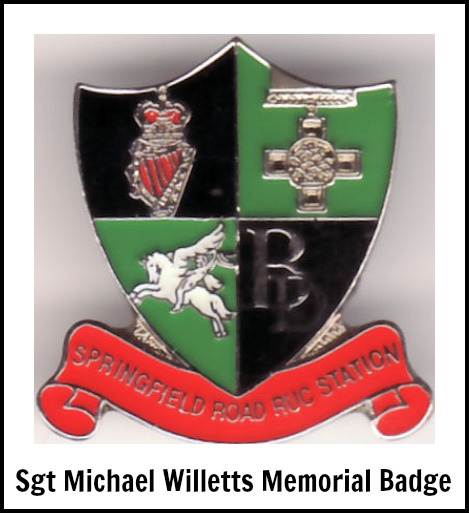
In memory of Sergeant Michael Willetts , GC & all other members of HM Armed Forces murdered by Irish Terrorists.
See below for the full story of this brave Hero’s death
————————————–
A short video, set to music, in memory Sergeant Michael G. Willets and all those members of HM Armed Forces murdered by Irish Terrorists.
A True British hero
We salute you all – Your memory will live on forever!
My son loves this song ( he’s 9 ) and it always brings a lump to my throat when I hear it and I feel myself welling up. Its a funny thing being a patriot sometimes , it can fill me with pride and love for my country and culture and other times melancholy flows through my being when I listen too and remember the sacrifice our glorious troops have paid to ensure our freedom and liberty.
Born in 1943 in the Nottinghamshire town of Sutton-in-Ashfield, Michael Willetts entered a local colliery after leaving school but found that he did not suit the job and soon afterwards joined the British Army, serving in the 3rd Battalion of the Parachute Regiment. He married his wife, Sandra and had two children, Dean and Trudy during his time in the army.
After several tours abroad and a promotion to sergeant, Willetts was dispatched with the rest of his regiment to Northern Ireland at the outbreak of violence there between Irish nationalists and the unionistRoyal Ulster Constabulary in 1971. Placed with his squad at Springfield Road police station in Belfast, Willetts engaged in local operations until 25 May 1971, when he was killed in a Provisional IRA bomb attack on the barracks.
Willetts was killed in Springfield Road RUC station by the Provisional IRA. A man in his mid-twenties emerged from a car and threw a suitcase containing a blast bomb into the lobby of the station. Willetts thrust two children and two adults into a corner and stood above them as the 30 lbs of explosives detonated, seriously injuring him.
Seven RUC officers, two British soldiers and eighteen civilians were injured in the attack. Willetts was fatally injured by a chunk of metal from a locker which had struck him in the back of the head. As he was being removed by ambulance, he and the injured officers were jeered by local youths who screamed obscenities at them. Willetts died after two hours on the operating table at Royal Victoria Hospital.
The sacrifice of Sergeant Michael G. Willets, 27, 3 Para.
Some just stared in hatred, and others turned in pain
And the lonely British soldier wished he was back home again
Come join the British Army! Said the posters in his town
See the world and have your fun come serve before the Crown
The jobs were hard to come by and he could not face the dole
So he took his country’s shilling and enlisted on the roll
For there was no fear of fighting, the Empire long was lost
Just ten years in the army getting paid for being bossed
Then leave a man experienced a man who’s made the grade
A medal and a pension some mem’ries and a trade
Then came the call to Ireland as the call had come before
Another bloody chapter in an endless civil war
The priests they stood on both sides the priests they stood behind
Another fight in Jesus name the blind against the blind
The soldier stood between them between the whistling stones
And then the broken bottles that led to broken bones
The petrol bombs that burnt his hands the nails that pierced his skin
And wished that he had stayed at home surrounded by his kin
The station filled with people the soldier soon was bored
But better in the station than where the people warred
The room filled up with mothers with daughters and with sons
Who stared with itchy fingers at the soldier and his gun
A yell of fear a screech of brakes the shattering of glass
The window of the station broke to let the package pass
A scream came from the mothers as they ran towards the door
Dragging children crying from the bomb upon the floor
The soldier stood and could not move his gun he could not use
He knew the bomb had seconds and not minutes on the fuse
He could not run to pick it up and throw it in the street
There were far too many people there too many running feet
Take cover! Yelled the soldier, Take cover for your lives
And the Irishmen threw down their young and stood before their wives
They turned towards the soldier their eyes alive with fear
For God’s sake save our children or they’ll end their short lives here
The soldier moved towards the bomb his stomach like a stone
Why was this his battle God why was he alone
He lay down on the package and he murmured one farewell
To those at home in England to those he loved so well
He saw the sights of summer felt the wind upon his brow
The young girls in the city parks how precious were they now
The soaring of the swallow the beauty of the swan
The music of the turning world so soon would it be gone
A muffled soft explosion and the room began to quake
The soldier blown across the floor his blood a crimson lake
They never heard him cry or shout they never heard him moan
And they turned their children’s faces from the blood and from the bones
The crowd outside soon gathered and the ambulances came
To carry off the body of a pawn lost in the game
And the crowd they clapped and cheered and they sang their rebel songs
One soldier less to interfere where he did not belong
But will the children growing up learn at their mothers’ knees
The story of the soldier who bought their liberty
Who used his youthful body as a means towards an end
Who gave his life to those who called him murderer not friend
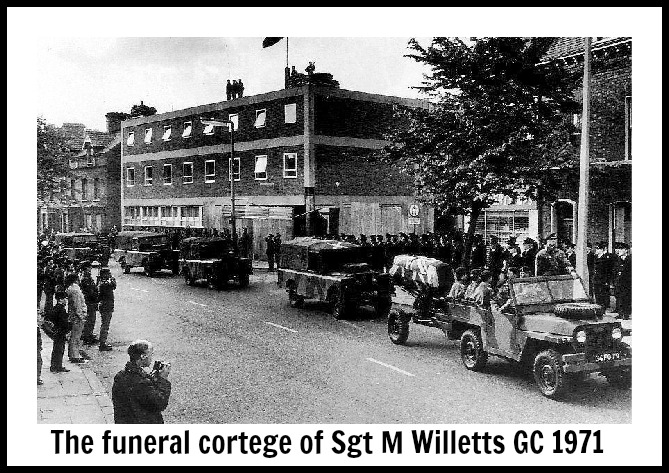
Sergeant Michael Willetts, GC– 25 May 1971
At 8.24 pm on the evening of 25 May 1971 a terrorist entered the Springfield Road Police Station in Belfast. He carried a suitcase from which a smoking fuse protruded, dumped it quickly on the floor and fled outside. Inside the room were two adults, two children and several police officers.
The police officers raised the alarm and began to organize the evacuation of the hall past the reception desk, through the reception office and out of the door into the rear passage.
Sergeant Michael Willetts, 3rd Battalion The Parachute Regiment, was on duty in the inner hall. Hearing the alarm, he sent an NCO up to the first floor to warn those above and hastened to the door towards which a police officer was thrusting those in the reception hall and office. He held the door open while all passed safely through and then stood in the doorway, shielding those taking cover.
In the next moment, the bomb exploded with terrible force. Sergeant Willets was mortally wounded.
His duty did not require him to enter the threatened area, his post was elsewhere. He knew well, after four month’s service in Belfast, the peril of going towards a terrorist bomb but he did not hesitate to do so. All those approaching the door from the far side agreed that if they had had to check to open the door they would have perished. Even when those in the room had reached the rear passage, Sergeant Willets waited, placing his body as a screen to shelter them.
By this considered act of bravery, he risked and lost his life for those of the adults and children. His selflessness and courage are beyond praise.
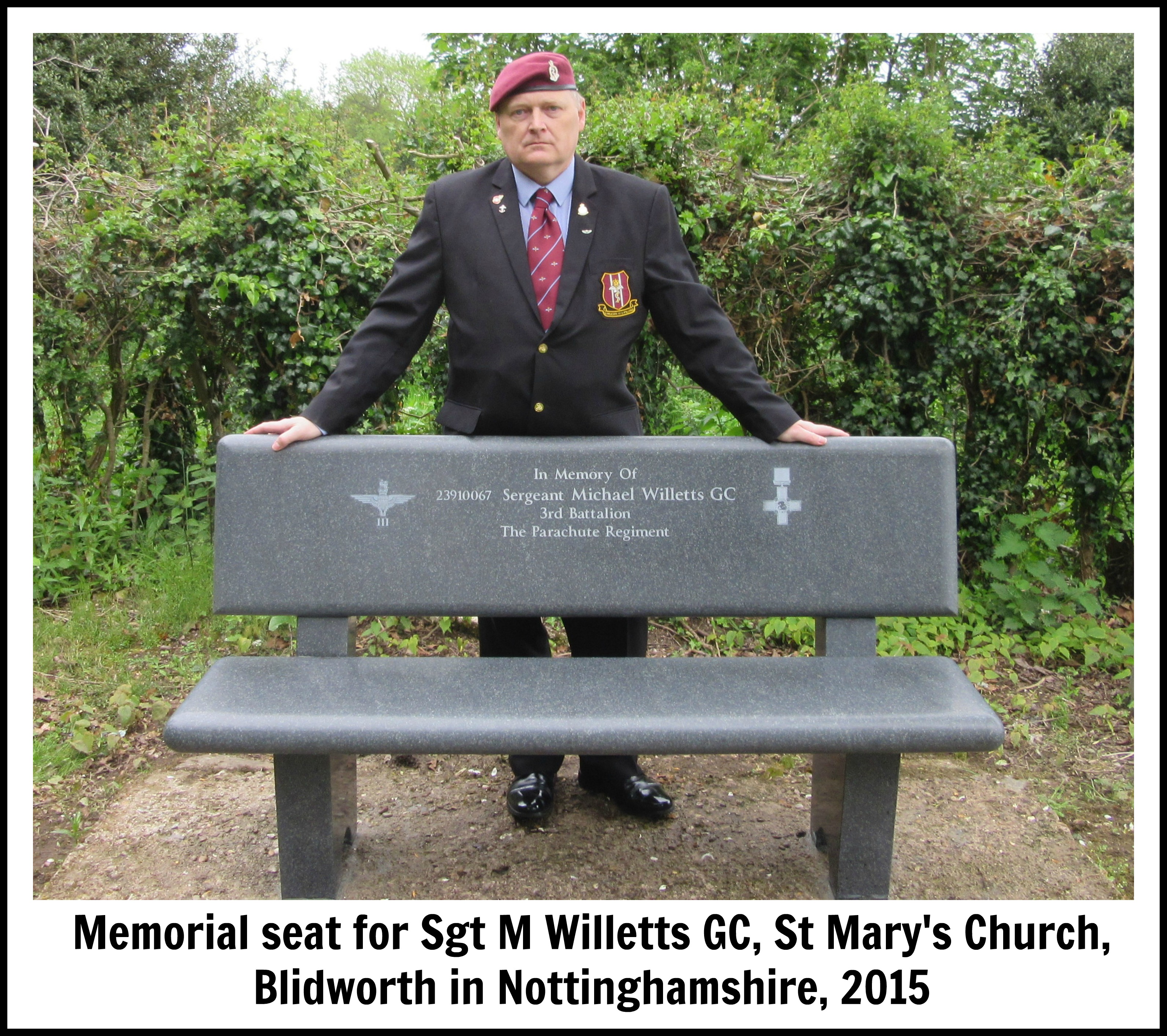
Sergeant Willetts is now buried at St Mary’s Church, Blidworth in Nottinghamshire.
by Paradata Editor
Medal citation
The George Cross was awarded to Sergeant Willett’s widow in June and the citation appeared in the London Gazette at the same time.
The Queen has been graciously pleased to approve the posthumous award of the George Cross to:
2391067 Sergeant Michael WILLETTS, The Parachute Regiment.
At 8.24 p.m. on the evening of 25th May 1971, a terrorist entered the reception hall of the Springfield Road Police Station in Belfast. He carried a suitcase from which a smoking fuse protruded, dumped it quickly on the floor and fled outside. Inside the room were a man and a woman, two children and several police officers. One of the latter saw at once the smoking case and raised the alarm. The Police Officers began to organise the evacuation of the hall past the reception desk, through the reception office and out by a door into the rear passage.
Sergeant Michael Willetts was on duty in the inner hall. Hearing the alarm, he sent an N.C.O. up to the first floor to warn those above and hastened himself to the door towards which a Police Officer was thrusting those in the reception hall and office. He held the door open while all passed safely through and then stood in the doorway, shielding those taking cover. In the next moment, the bomb exploded with terrible force.
Sergeant Willetts was mortally wounded. His duty did not require him to enter the threatened area, his post was elsewhere. He knew well, after 4 months service in Belfast, the peril of going towards a terrorist bomb but he did not hesitate to do so. All those approaching the door from the far side agree that if they had had to check to open the door they would have perished. Even when they had reached the rear passage, Sergeant Willetts waited, placing his body as a screen to shelter them. By this considered act of bravery, he risked – and lost – his life for those of the adults and children. His selflessness, his courage are beyond praise. 22nd June 1971
London Gazette, 21 June 1971
If you would like to read extracts from my autobiography please follow link above.
On the evening of the 25th May 1971 an IRA terrorist entered the reception hall of Springfield Road Police station in Belfast. He carried a suitcase from which a smoking fuse protruded, dumping the case on the floor he fled out-side, inside the room were a man a woman and two children and several police officers. One of the police officers raised the alarm then began organising an evacuation of the hall through the reception office.
Sgt Willetts was on duty in the inner hall, on hearing the alarm he sent an NCO to the first floor to warn those above and hastened himself to the door towards which the police officer was thrusting those in the reception hall and office.
He held the door open while all passed safely through and then stood in the doorway shielding those taking cover.
In the next moment the bomb exploded with terrible force. Sgt Willetts was mortally wounded. His duty did not require him to enter the threatened area. All those people who were approaching the door from the far side agreed that if they had had to check to open the door, They would have perished.
Sgt Willetts waited, placing his body as a screen to shelter them.
By this act of bravery, he risked and lost his life for those of the adults and children.
Sgt Michael Willetts was awarded the George Cross (Posthumous).
Republicans jeered when the ambulance arrived, but Willets had saved Catholic civilians and children. The IRA had no such respect for life.
Don’t forget to read extracts from my Autobiography Belfast Child , which tells the amazing story of my life growing up on the Loyalist Shankill Road and my secret 25 year search for my ” Dead” catholic mother.
Disclaimer – The views and opinions expressed in these documentary are soley intended to educate and provide background information to those interested in the Troubles of Northern Ireland. They in no way reflect my own opinions and I take no responsibility for any inaccuracies or factual errors.
Hunting the IRA
This 1992 documentary focuses on the escalating number of anti-IRA, counter-terrorist operations being carried out by the Loyalist paramilitary group UDA (Ulster Defence Association).
For over twenty years the catholic fundamentalist terrorist gang (the Irish Republican Army) had been murdering protestant civilians in Northern Ireland on a daily basis. The British government had refused to crack down on this far-right extremist group, so protestants took it upon themselves to form vigilante groups to try to halt the IRA religious murders.
The three main protestant counter-terrorist groups were the Ulster Defence Association (who also used the name ‘Ulster Freedom Fighters’ on occasion), the Ulster Volunteer Force and a smaller, more elite group called the Red Hand Commando.
Originally these groups were formed to stop IRA drive-by shootings in protestant areas but, as the IRA attacks became more deadly and targeted against civilians, these groups armed themselves and began hunting down and executing IRA terrorists in their own homes. By 1992, the Loyalist groups had the IRA on the run with a UDA group based in the Shankill Road are of west Belfast being particularly successful. This group contained Loyalists such as Stevie ‘Top Gun’ McKeag, Johnny ‘Mad Dog’ Adair, Sam ‘Skelly’ McCrory and Gary ‘Smickers’ Smyth.
By 1994 the IRA had surrendered and within a few years had given over all of their illegal arms to be destroyed by the British government.
The Loyalists’ counter-terrorism campaign had been successful.











 belfastchildis.com