Key Events & Deaths on this day in Northern Ireland Troubles
19th May
Sunday 19 May 1974
Day 5 of the UWC strike
Merlyn Rees, then Secretary of Sate for Northern Ireland, announced a State of Emergency (Section 40, Northern Ireland Constitution Act 1973).
Rees flew to Chequers, the country home of the Prime Minister, for talks.
The United Ulster Unionist Council (UUUC) met and agreed to support the Ulster Workers’ Council (UWC). The UWC withdrew its call for a total stoppage as of midnight. Some shops reported panic buying. A memorandum was submitted by the Northern Ireland Labour Party (NILP) to the Northern Ireland Office (NIO
Tuesday 19 May 1981
Five British soldiers were killed in an Irish Republican Army (IRA) landmine attack near Bessbrook, County Armagh. The soldiers had been travelling in an armoured vehicle when the bomb exploded.
The Ulster Unionist Party (UUP) expelled Robert McCartney because of his criticism of UUP leaders and also for his involvement in the Campaign for Equal Citizenship.
Wednesday 19 May 1993
Local Government Elections
There were district council elections to choose 582 councillors for the 26 District Councils in Northern Ireland.
[When the results were declared they showed an increase in the percentage share of the vote for the Social Democratic and Labour Party (SDLP), Sinn Féin (SF), and the Alliance Party of Northern Ireland (APNI).]
Three former detectives in the British police who had been involved in the investigations that led to the convictions of the Guildford Four were cleared of conspiring to pervert the course of justice. The men were accused of having manufactured the interview notes of one of the Guildford Four.
The Northern Ireland Office (NIO) published a 21 page British government response to Sinn Féin (SF) questions that arose from the Downing Street Declaration (DSD). SF had submitted a series of 20 questions via the Irish government. Albert Reynolds, then Taoiseach (Irish Prime Minister), described the clarification as “comprehensive and positive”.
Friday 19 May 1995
At the Forum for Peace and Reconciliation in Dublin, Seamus Mallon, then deputy leader of the Social Democratic and Labour Party (SDLP), criticised the support by Sinn Féin (SF) for imposed all-Ireland institutions without a democratic assembly in Northern Ireland. Mallon argued in favour of the model in the Framework Documents (published on 22 February 1995).
Sunday 19 May 1996
Geoffrey Anderson, then a Royal Irish Regiment soldier, killed two people and injured a third before committing suicide.
There was a confrontation between the Royal Ulster Const abulary (RUC) and nationalists in the village of Dunloy, County Antrim, during an Apprentice Boys of Derry march
Monday 19 May 1997
Gerry Adams, then President of Sinn Féin (SF), and Martin McGuinness, then Vice-President of Sinn Féin (SF), travelled to Westminster to press their case for facilities within the House of Commons.
The two SF Members of Parliament (MPs) were denied access to the House when they refused to take their seats which would have involved taking an oath of allegiance to the Queen.
Tuesday 19 May 1998
John Hume, then leader of the Social Democratic and Labour Party (SDLP), and David Trimble, then leader of the Ulster Unionist Party (UUP), met on the stage at a U2 concert at Belfast’s Waterfront Hall.
The concert had been arranged to support the ‘Yes’ campaign.
[Bono, then lead singer with the group U2, joined the two party leaders on stage and held their arms aloft. This event was thought to have given the ‘Yes’ campaign a much needed boost. Until then the two party leaders had not campaigned together.]
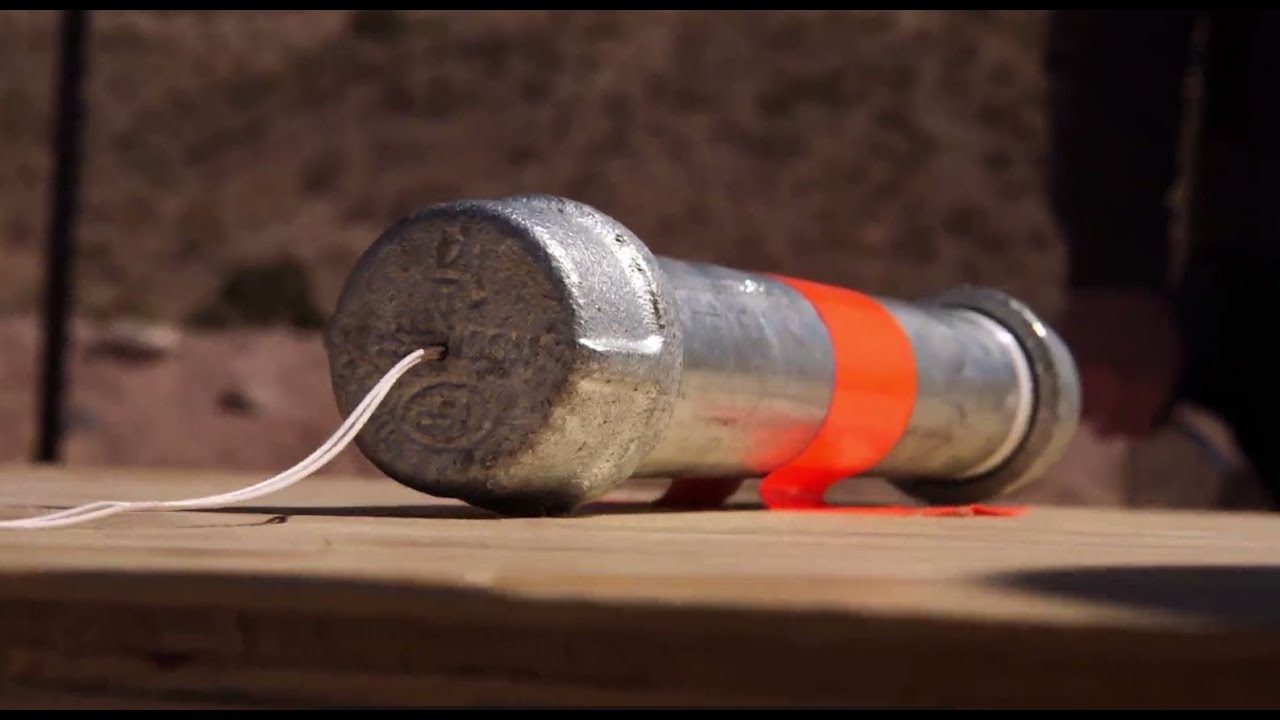
A ‘pipe-bomb’ contained in a parcel was delivered to the Dublin Tourist offices in St Andrew’s Street, Dublin, Republic of Ireland. The device was spotted and defused.
[An unknown Loyalist paramilitary group was thought to be responsible for the attack. Pipe-bombs were widely used by Loyalist paramilitaries over the coming years particularly in attacks on the homes of Catholic families in Northern Ireland.]
Wednesday 19 May 1999
John Pickering (Rev), then rector of Drumcree, together with his vestry, decided to defy the General Synod’s vote on 18 May 1999 and announced that they would go ahead with the service for the Orange Order at Drumcree on 4 July 1999.
Talks were held in Downing Street involving the Ulster Unionist Party (UUP), the Social Democratic and Labour Party (SDLP), and Sinn Féin (SF).
However the parties failed to reach agreement on outstanding issues.
Loyalists clashed with Royal Ulster Constabulary (RUC) officers in Portadown, County Armagh.
Eddie Copeland was awarded £27,500 by Belfast High Court in compensation for injuries received when he was shot by a British Army soldier on 26 October 1993. The case was taken against the Ministry of Defence. Copeland had been attending the funeral of Thomas Begley who was killed planting a bomb on the Shankill Road on 23 October 1993.
Garda Síochána (the Irish police) opened an inquiry into the killing of Seamus Ludlow on 2 May 1976 who was found shot in laneway near to his home, Thistlecross, near Dundalk, County Louth. Gardaí initially blamed the Irish Republican Army (IRA) for the killing.
[However later it was claimed that Ludlow had been killed by the Red Hand Commando (RHC) / Ulster Volunteer Force (UVF). There was also speculation of involvement by the Special Air Service (SAS) and also by the Ulster Defence Regiment (UDR).]
——————————————
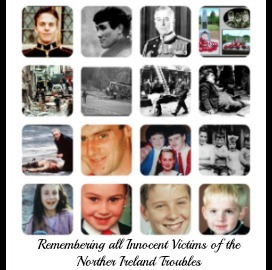
Remembering all innocent victims of the Troubles
Today is the anniversary of the death of the following people killed as a results of the conflict in Northern Ireland
“To live in hearts we leave behind is not to die
– Thomas Campbell
To the innocent on the list – Your memory will live forever
– To the Paramilitaries –
There are many things worth living for, a few things worth dying for, but nothing worth killing for.
10 People lost their lives on the 19th May between 1972 – 1981
——————————————
19 May 1972 Harold Morris (15)
Protestant Status: Civilian (Civ),
Killed by: Irish Republican Army (IRA)
Shot by sniper while walking along Boundary Street, Shankill, Belfast.
——————————————
19 May 1972
Manus Deery (15)
Catholic Status: Civilian (Civ),
Killed by: British Army (BA)
Shot by sniper from British Army (BA) observation post on city walls, while in entry off Westland Street, Derry.
——————————————
19 May 1973 Robert McIntyre (24)
Protestant Status: Ulster Volunteer Force (UVF),
Killed by: Ulster Defence Regiment (UDR)
Died two days after being shot by off duty Ulster Defence Regiment (UDR) member while attempting to hijack a car, Shankill Road, Belfast.
——————————————
19 May 1973 Edward Coogan (39)
Catholic Status: Civilian (Civ),
Killed by: non-specific Loyalist group (LOY)
Shot from passing car while walking along Adela Street, off Antrim Road, Belfast.
Killed by: Irish Republican Army (IRA)
Shot while delivering bread, Garrison, County Fermanagh.
——————————————
19 May 1981
Andrew Gavin (19)
nfNI Status: British Army (BA),
Killed by: Irish Republican Army (IRA)
Killed in land mine attack on British Army (BA) Armoured Personnel Carrier, Chancellor’s Road, Altnaveigh, near Bessbrook, County Armagh.
——————————————
19 May 1981
Paul Bulman (19)
nfNI Status: British Army (BA),
Killed by: Irish Republican Army (IRA)
Killed in land mine attack on British Army (BA) Armoured Personnel Carrier, Chancellor’s Road, Altnaveigh, near Bessbrook, County Armagh.
——————————————
19 May 1981
Michael Bagshaw (25)
nfNI Status: British Army (BA),
Killed by: Irish Republican Army (IRA)
Killed in land mine attack on British Army (BA) Armoured Personnel Carrier, Chancellor’s Road, Altnaveigh, near Bessbrook, County Armagh.
——————————————
19 May 1981 John King (20)
nfNI Status: British Army (BA),
Killed by: Irish Republican Army (IRA)
Killed in land mine attack on British Army (BA) Armoured Personnel Carrier, Chancellor’s Road, Altnaveigh, near Bessbrook, County Armagh.
——————————————
19 May 1981
Grenville Winstone (27)
nfNI Status: British Army (BA),
Killed by: Irish Republican Army (IRA)
Killed in land mine attack on British Army (BA) Armoured Personnel Carrier, Chancellor’s Road, Altnaveigh, near Bessbrook, County Armagh.
A number of claims have been made about both Nairac’s involvement in the killing of an IRA member and his collusion with loyalist paramilitaries, although he was never charged.
Whilst several men have been imprisoned for his death, the whereabouts of his body remains unknown.
– Disclaimer –
The views and opinions expressed in these blog post/documentary are solely intended to educate and provide background information to those interested in the Troubles of Northern Ireland. They in no way reflect my own opinions and I take no responsibility for any inaccuracies or factual errors
Background
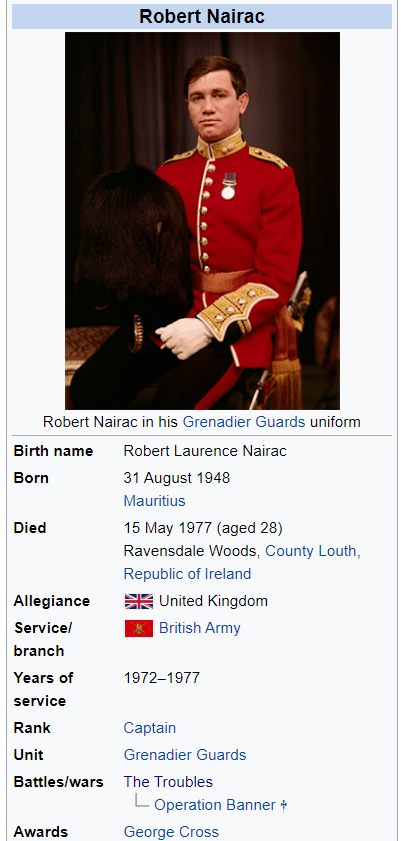
Nairac was born in Mauritius to English parents. His family – long settled in Gloucestershire – had ancestors from the south of Ireland. His family name originates from the Gironde area of France. His father was an eye surgeon who worked first in the north of England and then in Gloucester. He was the youngest of four children, with two sisters and a brother.
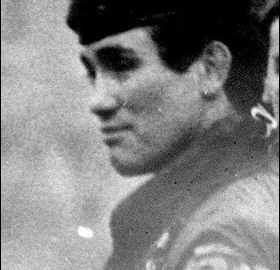
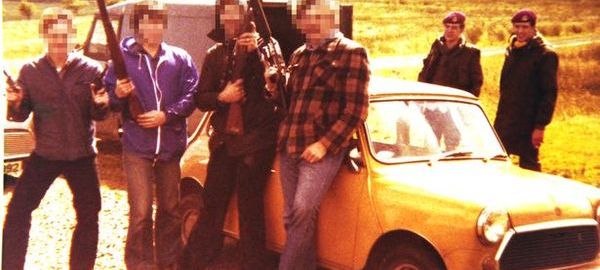
This iconic picture of Robert was published in Republican News & was used widely by the IRA in press reports of his “execution” . It was taken by a fellow soldier and was not intended for general release. How the IRA got a hold of a copy is still a mystery.
The guy with the long hair is John Todd , who went on to join and serve time as an IRA terrorist
He read medieval and military history at Lincoln College, Oxford, and excelled in sport; he played for the Oxford rugby 2nd XV and revived the Oxford boxing club where he won four blues in bouts with Cambridge. He was also a falconer, keeping a bird in his room which was used in the film Kes.
In fact he did not attend University of Dublin according to Author Alistair Kerr
Nairac has been described by former army colleagues as “a committed Roman Catholic” and as having “a strong Catholic belief”.
Military career in Northern Ireland
Nairac’s first tour of duty in Northern Ireland was with No.1 Company, the Second Battalion of the Grenadier Guards. The Battalion was stationed in Belfast from 5 July 1973 to 31 October 1973. The Grenadiers were given responsibility first for the ProtestantShankill Road area and then the predominantly Catholic Ardoyne area. This was a time of high tension and regular contacts with paramilitaries. Ostensibly, the battalion’s two main objectives were to search for weapons and to find paramilitaries.
Nairac was frequently involved in such activity on the streets of Belfast. He was also a volunteer in community relations activities in the Ardoyne sports club. The battalion’s tour was adjudged a success with 58 weapons, 9,000 rounds of ammunition and 693 lbs of explosive taken and 104 men jailed.
The battalion took no casualties and had no occasion to shoot anyone. After his tour had ended he stayed on as liaison officer for the replacement battalion, the 1st Battalion of the Argyll and Sutherland Highlanders. The new battalion suffered a baptism of fire with Nairac narrowly avoiding death on their first patrol when a car bomb exploded on the Crumlin Road.
Rather than returning to his battalion, which was due for rotation to Hong Kong, Nairac volunteered for military intelligence duties in Northern Ireland. Following completion of several training courses, he returned to Northern Ireland in 1974 attached to 4 Field Survey Troop, Royal Engineers, one of the three sub-units of a Special Duties unit known as 14 Intelligence Company (14 Int).
Posted to South County Armagh, 4 Field Survey Troop was given the task of performing surveillance duties. Nairac was the liaison officer among the unit, the local British Army brigade, and the Royal Ulster Constabulary.
He also took on duties which were outside his official jurisdiction as a liaison officer – working undercover, for example. He apparently claimed to have visited pubs in republican strongholds and sung Irish rebel songs and acquired the nickname “Danny Boy”. He was often driven to pubs by former Conservative MP Patrick Mercer, who was then an Army officer. Former SAS Warrant Officer Ken Connor, who was involved in the creation of 14 Int, wrote of him in his book, Ghost Force, p. 263:
“
Had he been an SAS member, he would not have been allowed to operate in the way he did. Before his death we had been very concerned at the lack of checks on his activities. No one seemed to know who his boss was, and he appeared to have been allowed to get out of control, deciding himself what tasks he would do.
”
Nairac finished his tour with 14th Int in mid-1975 and returned to his regiment in London. Nairac was promoted to captain on 4 September 1975. Following a rise in violence culminating in the Kingsmill massacre, British Army troop levels were increased and Nairac accepted a post again as a liaison officer back in Northern Ireland.
Nairac on his fourth tour was a liaison officer to the units based at Bessbrook Mill. It was during this time that he was abducted and killed.
BBC Panorama – Bandit Country, South Armagh
Shot by the Provisional IRA
On the evening of 14 May 1977, Nairac arrived at The Three Steps pub in Dromintee, South Armagh, by car, alone. He is said to have told regulars of the pub that his name was Danny McErlaine, a motor mechanic and member of the Official IRA from the republican Ardoyne area in north Belfast. The real McErlaine, on the run since 1974, was killed by the Provisional IRA in June 1978 after stealing arms from the organisation.
Witnesses say that Nairac got up and sang a republican folk song “The Broad Black Brimmer” with the band who were playing that night. At around 11.45 p.m., he was abducted following a struggle in the pub’s car park and taken across the border into the Republic of Ireland to a field in the Ravensdale Woods in County Louth. Following a violent interrogation during which Nairac was allegedly punched, kicked, pistol-whipped and hit with a wooden post, he was shot dead.
He did not admit to his true identity. Terry McCormick, one of Nairac’s abductors, posed as a priest in order to try to elicit information by way of Nairac’s confession. Nairac’s last words according to McCormick were: ‘Bless me Father, for I have sinned’
His disappearance sparked a huge search effort throughout Ireland. The hunt in Northern Ireland was led by Major H. Jones, who as a colonel in the Parachute Regiment was to be awarded a posthumous Victoria Cross in the Falklands War. Jones was Brigade Major at HQ 3rd Infantry Brigade. Nairac and Jones had become friends and would sometimes go to the Jones household for supper. After a four-day search, the Garda Síochána confirmed to the Royal Ulster Constabulary that they had reliable evidence of Nairac’s killing.
An edition of Spotlight broadcast on 19 June 2007, claimed that his body was not destroyed in a meat grinder, as alleged by an unnamed IRA source. McCormick, who has been on the run in the United States for thirty years because of his involvement in the killing (including being the first to attack Nairac in the car park), was told by a senior IRA commander that it was buried on farmland, unearthed by animals, and reburied elsewhere. The location of the body’s resting place remains a mystery.
In May 2000 allegations were made claiming that Nairac had married, and fathered a child with a woman named Nel Lister, also known as Oonagh Flynn or Oonagh Lister. In 2001, her son sought DNA testing himself and revealed the allegations to be a hoax.
Criminal prosecutions
In November 1977, Liam Townson, a 24-year-old IRA member from the village of Meigh outside Newry, was convicted of Nairac’s murder. Townson was the son of an Englishman who had married a County Meath woman. He confessed to killing Nairac and implicated other members of the unit involved. Townson made two admissible confessions to Garda officers. The first was made around the time of his arrest, it started with
“I shot the British captain. He never told us anything. He was a great soldier.”
The second statement was made at Dundalk police station after Townson had consulted a solicitor. He had become hysterical and distressed and screamed a confession to the officer in charge of the investigation.
Townson was convicted in Dublin’s Special Criminal Court of Nairac’s murder and sentenced to life imprisonment. He served 13 years in prison and was released in 1990. He was part of Conor Murphy‘s 1998 election campaign team and as of 2000 he was living in St. Moninna Park, in Meigh.
In 1978, the RUC arrested five men from the South Armagh area. Three of them – Gerard Fearon, 21, Thomas Morgan, 18, and Daniel O’Rourke, 33 -were charged with Nairac’s murder. Michael McCoy, 20, was charged with kidnapping, and Owen Rocks, 22, was accused of withholding information. Fearon and Morgan were convicted of Nairac’s murder. O’Rourke was acquitted but found guilty of manslaughter and jailed for ten years. McCoy was jailed for five years and Rocks for two. Morgan died in a road accident in 1987, a year after his release. O’Rourke became a prominent Sinn Féin member in Drumintee.
Two other men, Terry McCormick and Pat Maguire, wanted in connection with this incident remain on the run. Maguire has been reported as living in New Jersey in the US.
————————
Man charged with murder of undercover British Army officer in 1977
A man has been charged with the murder of Robert Nairac, an undercover British Army officer, in Northern Ireland more than 30 years ago
Crilly was interviewed by detectives in the weeks after the incident but left for the United States before officers could arrest him on suspicion of murderPhoto: PA
5:01PM GMT 11 Nov 2009
Kevin Crilly, 59, from Lower Foughill Road, Jonesborough, Co Armagh, is already facing charges of kidnapping and falsely imprisoning the 29-year-old Grenadier Guardsman near the Irish border in 1977.
The captain, originally from Gloucestershire, was interrogated, tortured and then shot dead by the IRA after being snatched from a pub car park near Jonesborough and driven to a field at Ravensdale, Co Louth. His body has never been found.
Prosecutors laid the murder charge before Crilly as he appeared at Newry Magistrates’ Court for a routine bail hearing on the two lesser counts, with which he was charged last year.
District Judge Austin Kennedy granted Crilly bail; however, he ordered him to remain in custody after Crown lawyers indicated that they may seek to appeal against the decision in the High Court in Belfast.
In the years after Capt Nairac’s disappearance, three men were convicted of his murder, but police have always said they were looking for more suspects.
Crilly was interviewed by detectives in the weeks after the incident but left for the United States before officers could arrest him on suspicion of murder.
Judge Kennedy was told today that the suspect had remained in the US for almost 30 years.
Investigating officer Detective Sergeant Barry Graham said that, when he returned, he took another name, explaining that Crilly was adopted as a child and had assumed his birth name of Declan Parr.
“The only reason he returned to Northern Ireland was because he was in a long-term relationship in America and that relationship had broken down,” he said.
The officer told the judge that he could connect Crilly with the murder charge and the two other counts of kidnapping and false imprisonment.
Crilly, dressed in a black leather jacket, white check shirt and blue jeans, spoke only to acknowledge that he understood the charges that he was facing.
His defence team objected that the prosecution had given them no prior warning that the murder charge would be put to their client or that they would be objecting to his bail.
Noting that Crilly had complied with all bail requirements since his original arrest 18 months ago and pointing out that, at that point, the defendant was aware that the Public Prosecution Service was examining whether there were grounds for charging him with murder, Judge Kennedy rejected the prosecution objection to bail.
The magistrate said any appeal against his decision would have to be lodged within two hours. He ordered that Crilly was held in the cells until the PPS signalled its intentions.
————————
On 20 May 2008, 57-year-old IRA veteran Kevin Crilly of Jonesborough, County Armagh, was arrested at his home by officers of the Police Service of Northern Ireland (PSNI). He had been on the run in the United States but had returned to Northern Ireland under an alias after the 1998 Belfast Agreement. He was charged the following day with the kidnapping and false imprisonment of Nairac.
In November 2009, Crilly was also charged with the murder of Robert Nairac at Newry magistrates’ court during a bail hearing on the two counts on which he had been charged in 2008. Crilly was cleared on all counts in April 2011 as the Judge considered that the prosecution failed to prove intention or prior knowledge on the part of Crilly.
On 13 February 1979 Nairac was posthumously awarded the George Cross.
Captain Nairac’s posthumous George Cross citation reads, in part:
“
[…]On his fourth tour Captain Nairac was a Liaison Officer at Headquarters 3 Infantry Brigade. His task was connected with surveillance operations.
On the night of 14/15 May 1977 Captain Nairac was abducted from a village in South Armagh by at least seven men. Despite his fierce resistance he was overpowered and taken across the border into the nearby Republic of Ireland where he was subjected to a succession of exceptionally savage assaults in an attempt to extract information which would have put other lives and future operations at serious risk. These efforts to break Captain Nairac’s will failed entirely. Weakened as he was in strength – though not in spirit – by the brutality, he yet made repeated and spirited attempts to escape, but on each occasion was eventually overpowered by the weight of the numbers against him. After several hours in the hands of his captors Captain Nairac was callously murdered by a gunman of the Provisional Irish Republican Army who had been summoned to the scene. His assassin subsequently said ‘He never told us anything’.
Captain Nairac’s exceptional courage and acts of the greatest heroism in circumstances of extreme peril showed devotion to duty and personal courage second to none.
”
Collusion allegations
Claims have been made abouts Nairac’s involvement in the killing of an IRA member in the Republic of Ireland and his relationship with Ulster loyalist paramilitaries.
Hidden Hand documentary
Dublin Monaghan Bombings 1974 – First Tuesday -1993
Allegations were made concerning Nairac in a 1993 Yorkshire Television documentary about the Dublin and Monaghan Bombings of 1974 entitled Hidden Hand. The narrator of Hidden Hand states:
“
We have evidence from police, military and loyalist sources which confirms the links between Nairac and the Portadown loyalist paramilitaries. And also that in May 1974, he was meeting with these paramilitaries, supplying them with arms and helping them plan acts of terrorism against republican targets. In particular, the three prime Dublin suspects, Robert McConnell, Harris Boyle and the man called ‘The Jackal’ (Robin Jackson, Ulster Volunteer Force [UVF] member from Lurgan), were run before and after the Dublin bombings by Captain Nairac.
”
According to the documentary, support for this allegation was said to have come from various sources:
It was alleged by a former Secret Intelligence Service operative, Captain Fred Holroyd, that Nairac admitted involvement in the assassination of IRA member John Francis Green on 10 January 1975 to him. Holroyd claimed in a New Statesman article written by Duncan Campbell that Nairac had boasted about Green’s death and showed him a colour Polaroid photograph of Green’s corpse taken directly after his assassination.
The evidence before the Inquiry that the polaroid photograph allegedly taken by the killers after the murder was actually taken by a Garda officer on the following morning seriously undermines the evidence that Nairac himself had been involved in the shooting.
Holroyd’s evidence was also questioned by Barron in the following terms:
The picture derived from this is of a man increasingly frustrated with the failure of the British Authorities to take his claims seriously; who saw the threat to reveal a crossborder SAS assassination as perhaps his only remaining weapon in the fight to secure a proper review of his own case. His allegations concerning Nairac must be read with that in mind.[36]
Barron report
Nairac was mentioned in Justice Henry’ Barron’s inquiry into the Dublin and Monaghan bombings when it examined the claims made by the Hidden Hand documentary, Holroyd and Colin Wallace
Former RUC Special Patrol Group member John Weir, who was also a UVF member, claimed he had received information from an informant that Nairac was involved in the killing of Green:
“
The men who did that shooting were Robert McConnell, Robin Jackson and I would be almost certain, Harris Boyle who was killed in the Miami attack. What I am absolutely certain of is that Robert McConnell, Robert McConnell knew that area really, really well. Robin Jackson was with him. I was later told that Nairac was with them. I was told by… a UVF man, he was very close to Jackson and operated with him. Jackson told [him] that Nairac was with them.
”
In addition, “Surviving Miami Showband members Steve Travers and Des McAlee testified in court that an Army officer with a crisp English accent oversaw the Miami attack” (see Miami Showband killings), the implication being that this was Nairac.[38] Fred Holroyd and John Weir also linked Nairac to the Green and Miami Showband killings. Martin Dillon, however, in his book The Dirty War maintained that Nairac was not involved in either attack.
Colin Wallace, in describing Nairac as a Military Intelligence Liaison Officer (MILO) said “his duties did not involve agent handling”. Nevertheless, Nairac “seems to have had close links with the Mid-Ulster UVF, including Robin Jackson and Harris Boyle”. According to Wallace, “he could not have carried out this open association without official approval, because otherwise he would have been transferred immediately from Northern Ireland”
Wallace wrote in 1975; Nairac was on his fourth tour of duty in 1977.
Robin Jackson was implicated in the Dublin and Monaghan bombings of May 1974, and Harris Boyle was blown up by his own bomb during the Miami Showband massacre.
The Barron Inquiry found a chain of ballistic history linking weapons and killings under the control of a group of UVF and security force members, including RUC Special Patrol Group members John Weir and Billy McCaughey, that is connected to those alleged to have carried out the bombings. This group was known as the “Glenanne gang“. Incidents they were responsible for “included, in 1975, three murders at Donnelly’s bar in Silverbridge, the murders of two men at a fake Ulster Defence Regiment checkpoint, the murder of IRA man John Francis Green in the Republic, the murders of members of the Miami showband and the murder of Dorothy Trainor in Portadown in 1976, they included the murders of three members of the Reavey family, and the attack on the Rock Bar in Tassagh.”
According to Weir, members of the gang began to suspect that Nairac was playing republican and loyalist paramilitaries off against each other, by feeding them information about murders carried out by the “other side” with the intention of “provoking revenge attacks”.
The Pat Finucane Centre stated when investigating allegations of collusion between the security forces and loyalist paramilitaries, that although Nairac has been linked to many attacks, “caution has to be taken when dealing with Nairac as attacks are sometimes attributed to him purely because of his reputation”.
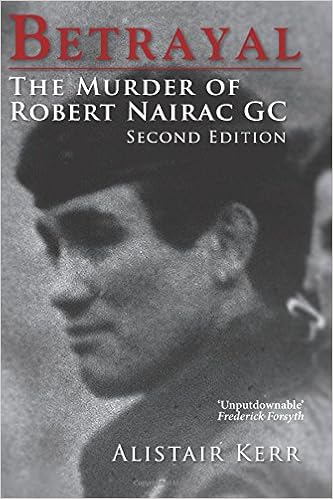
Im reading a great book about Robert Nairac at the moment . I’ll do a review when I’ve completed it. See below:
This is simply the story of a boy trying to grow up, survive, thrive, have fun & discover himself against a backdrop of events that might best be described as ‘explosive’, captivating & shocking the world for thirty long years.

















 belfastchildis.com