Source: Birmingham Pub Bombings – 21 November, 1974
Category Archives: Major events in The Troubles


The London Docklands bombing – 9 February 1996
Docklands bombing
1996
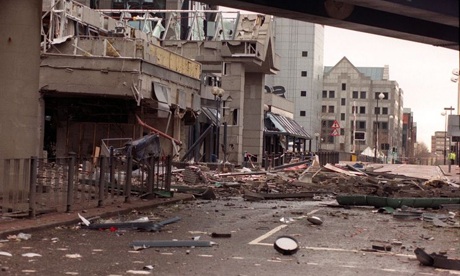
The London Docklands bombing (also known as the Canary Wharf bombing or South Quay bombing) occurred on 9 February 1996, when the Provisional Irish Republican Army (IRA) detonated a powerful truck bomb in Canary Wharf, one of the two financial districts of London. The blast devastated a wide area and caused an estimated £100 million worth of damage. Although the IRA had sent warnings 90 minutes beforehand, the area was not fully evacuated; two people were killed and 39 were injured.
———————————————-
IRA bombs Canary Wharf, London
———————————————-
It marked an end to the IRA’s seventeen-month ceasefire. The IRA had agreed to a ceasefire in August 1994, on the understanding that Sinn Féin would be allowed to take part in peace negotiations. However, when the British government then demanded the IRA must fully disarm before any negotiations, the IRA resumed its campaign. After the bombing, the British government dropped its demand for the IRA to disarm before any negotiations
Background and planning
Since the beginning of its campaign in the early 1970s, the IRA had carried out many bomb attacks in England. As well as attacking military and political targets, it also bombed infrastructure and commercial targets. The goal was to damage the economy and cause disruption, which would put pressure on the British government to negotiate a withdrawal from Northern Ireland.[1] In the early 1990s, the IRA began another major bombing campaign in England. In February 1991 it launched a mortar attack on 10 Downing Street, headquarters of the British government, while Prime Minister John Major was holding a meeting. The mortars narrowly missed the building and there were no casualties. In April 1992, the IRA detonated a powerful truck bomb at the Baltic Exchange in the City of London, its main financial district. The blast killed three people and caused £800 million worth of damage; more than the total damage caused by all IRA bombings before it.[2] In November 1992, the IRA planted a large van bomb at Canary Wharf, London’s second financial district. However, security guards immediately alerted the police and the bomb was defused.[3] In April 1993 the IRA detonated another powerful truck bomb in the City of London. It killed one person and caused £500 million worth of damage.
In December 1993 the British and Irish governments issued the Downing Street Declaration. It allowed Sinn Féin, the political party associated with the IRA, to participate in all-party peace negotiations on condition that the IRA called a ceasefire. The IRA called a ceasefire on 31 August 1994. Over the next seventeen months there were a number of meetings between representatives of the British government and Sinn Féin. There were also talks—among the British and Irish governments and the Northern Ireland parties—about how all-party peace negotiations could take place.
By 1996, John Major’s government had lost its majority in the British parliament and was depending on Ulster unionist votes to stay in power. It was accused of pro-unionist bias as a result. The British government began insisting that the IRA must fully disarm before Sinn Féin would be allowed to take part in full-fledged peace talks. The IRA rejected this, seeing it as a demand for total surrender.[4] Sinn Féin said that the IRA would not disarm before talks, but that it would discuss disarmament as part of an overall solution. On 23 January 1996, the international commission for disarmament in Northern Ireland recommended that Britain drop its demand, suggesting that disarmament begin during talks rather than before.[5] The British government refused to drop its demand.
The bombing

At about 19:01 on 9 February, the IRA detonated a large bomb containing 500 kg of ammonium nitrate fertilizer and sugar,[4][6] in a small lorry about 80 yards (70 m) from South Quay Station on the Docklands Light Railway (in the Canary Wharf area of London), directly under the point where the tracks cross Marsh Wall.[7] The detonating cord was made of semtex, PETN and RDX high explosives.[4] The IRA had sent telephoned warnings 90 minutes beforehand, and the area was evacuated. However, two men working in the newsagents shop directly opposite the explosion, Inam Bashir (29) and John Jeffries (31), had not been evacuated in time and were killed in the explosion. 39 people required hospital treatment due to blast injuries and falling glass. Part of the South Quay Plaza was destroyed.[7] The explosion left a crater ten metres wide and three metres deep.[4] The shockwave from the blast caused windows as far east as Barking, approximately five miles away, to rattle.
————
Victims
————
—————————————
09 February 1996

Inan Ul-Haq Bashir, (29)
nfNIB
Status: Civilian (Civ),
Killed by: Irish Republican Army (IRA)
Killed in lorry bomb explosion, left in car park, South Quay railway station, Isle of Dogs, London. Inadequate warning given.
—————————————
09 February 1996

John Jefferies, (31)
nfNIB
Status: Civilian (Civ),
Killed by: Irish Republican Army (IRA)
Killed in lorry bomb explosion, left in car park, South Quay railway station, Isle of Dogs, London. Inadequate warning given.
—————————————
Approximately £100 million worth of damage was done by the blast.[4] Three nearby buildings (the Midland Bank building, South Quay Plaza I and II) were severely damaged (the latter two requiring complete rebuilding whilst the former was beyond economic repair and was demolished). The station itself was extensively damaged, but both it and the bridge under which the bomb was exploded were reopened within weeks (on 22 April), the latter requiring only cosmetic repairs despite its proximity to the blast.
This bomb represented the end to the IRA ceasefire during the Northern Ireland peace process at the time. James McArdle was convicted of conspiracy to cause explosions, and sentenced to 25 years in prison, but murder charges were dropped.[citation needed] McArdle was released under the terms of the Good Friday Agreement in June 2000 with a royal prerogative of mercy from Queen Elizabeth II.[8]

The IRA described the deaths and injuries as a result of the bomb as “regrettable”, but said that they could have been avoided if police had responded promptly to “clear and specific warnings”. Commissioner of the Metropolitan Police Sir Paul Condon said: “It would be unfair to describe this as a failure of security. It was a failure of humanity.”[9]
On 28 February, John Major, the Prime Minister of the United Kingdom, and John Bruton, the Taoiseach of the Republic of Ireland, announced that all-party talks would be resumed in June. Major’s decision to drop the demand for IRA decommissioning of weapons before Sinn Fein would be allowed into talks led to criticism from the press, which accused him of being “bombed to the table”.[10]
My blog and Twitter account are dedicated to remembering all innocent victims of the Northern Ireland Troubles and all those killed by terrorists across the globe. Have a little look around , you might find something of interest.
Please take the time to follow me on Twitter @bfchild66 and sign up for my blog by clicking the follow button at the bottom of this page , or any page for that matter.
Take Care and be safe!
Share this:

IRA Mortar Attack on Downing Street
Downing Street mortar attack
7th February 1991
—————————-
IRA mortar 10 Downing Street
—————————-
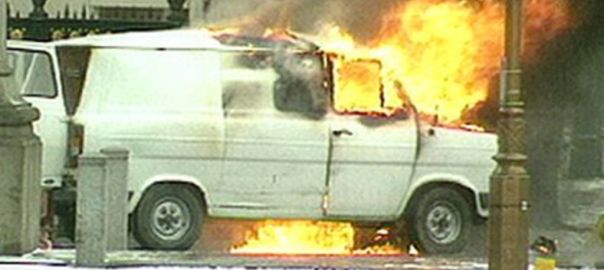
The Downing Street mortar attack was carried out by the Provisional Irish Republican Army (IRA) on 10 Downing Street, London, the official residence of the Prime Minister of the United Kingdom. The 7 February 1991 attack, an assassination attempt on John Major and his War Cabinet who were meeting to discuss the Gulf War, was originally planned to target Major’s predecessor Margaret Thatcher. Two shells overshot Downing Street and failed to explode, and one shell exploded in the rear garden of number 10. No members of the cabinet were injured, though four other people received minor injuries, including two police officers.
Background

The security gates installed in 1989 as a result of the IRA’s bombing campaign in England
During the Troubles, as part of its armed campaign against British rule in Northern Ireland, the Provisional IRA had repeatedly used homemade mortars against targets in Northern Ireland.[1][2] The most notable attack was the 1985 Newry mortar attack which killed nine members of the Royal Ulster Constabulary.[1][2] The IRA had not previously used mortars in England, but in December 1988 items used in their construction and technical details regarding the weapon’s trajectory were found during a raid in Battersea, South London conducted by members of the Metropolitan Police Anti-Terrorist Branch.[3][4] In the late 1980s British Prime Minister Margaret Thatcher was top of the IRA’s list for assassination, following the failed attempt on her life in the Brighton hotel bombing.[3] Security around Downing Street had been increased at a cost of £800,000 following increased IRA activity in England in 1988, including the addition of a police guard post and security gates at the end of the street.[5][6] Plans to leave a car bomb on a street near Downing Street and detonate it by remote control as Thatcher’s official car was driving by had been ruled out by the IRA’s Army Council owing to the likelihood of civilian casualties, which some Army Council members argued would have been politically counter-productive.[3]
Preparation
The Army Council instead sanctioned a mortar attack on Downing Street, and in mid-1990 two IRA members travelled to London to plan the attack.[3] One of the IRA members was knowledgeable about the trajectory of mortars and the other, from the IRA’s Belfast Brigade, was familiar with their manufacture.[3] An active service unit purchased a Ford Transit van and rented a garage, and an IRA co-ordinator procured the explosives and materials needed to manufacture the mortars.[3] The IRA unit began constructing the mortars and cutting a hole in the roof of the van for the mortars to be fired through, and reconnoitred locations in Whitehall to find a suitable place from which the mortars could be fired at the rear of 10 Downing Street, the Prime Minister’s official residence and office.[3][5] Once preparations were complete the two IRA members returned to Ireland, as the IRA leadership considered them to be valuable personnel and did not wish to risk them being arrested in any follow-up operation by the security services.[3] In November 1990 Margaret Thatcher unexpectedly resigned from office, but the Army Council decided the planned attack should still go ahead, targeting her successor John Major.[5] The IRA planned to attack when Major and his ministers were likely to be meeting at Downing Street, and waited until the date of a planned cabinet meeting was publicly known.[7]
The attack
———————-
IRA Mortar Attack on 10 Downing Street
———————-
On the morning of 7 February 1991, the War Cabinet and senior government and military officials were meeting at Downing Street to discuss the ongoing Gulf War. As well as the Prime Minister, John Major, those present at the meeting included politicians Douglas Hurd, Tom King, Norman Lamont, Peter Lilley, Patrick Mayhew, David Mellor and John Wakeham, civil servants Robin Butler, Percy Cradock, Gus O’Donnell and Charles Powell, and Chief of the Defence Staff David Craig.[5][8] As the meeting began an IRA member was driving the transit van to the launch site, at the junction of Horse Guards Avenue and Whitehall close to the headquarters of the Ministry of Defence, approximately 200 yards (200 m) from Downing Street,[2][7] amid a heavy snowfall.[9]
On arrival, the driver parked the van and left the scene on a waiting motorcycle.[7] Several minutes later at 10:08 am, as a policeman was walking towards the van to investigate it, three mortar shells were launched, followed by the explosion of a pre-set incendiary device. This device was designed to destroy any forensic evidence and set the van on fire.[7] Each shell was four and a half feet long, weighed 140 pounds (60 kg), and carried a 40 pounds (20 kg) payload of the plastic explosive Semtex.[10] The type of device used by the attackers was a Mark 10 homemade mortar, according to the British designation.[11] Two shells landed on a grassed area near the Foreign and Commonwealth Office and failed to explode.[2][7] The third shell exploded in the rear garden of 10 Downing Street, 30 yards (30 m) from the office where the cabinet were meeting.[7][10] Had the shell struck 10 Downing Street itself, it is probable the entire cabinet would have been killed.[10][12] On hearing the explosion the cabinet ducked under the table for cover. Bomb-proof netting on the windows of the cabinet office muffled the force of the explosion, which also scorched the rear wall of the building and made a crater several feet deep in the garden.[13][2][3]
Once the sound of the explosion and aftershock had died down, John Major said, “I think we had better start again, somewhere else.”[14] The room was evacuated and the meeting reconvened less than ten minutes later in the Cobra Room.[13][2] No members of the cabinet were injured, but four people received minor injuries, including two police officers injured by flying debris.[3][9]
Reaction
The IRA claimed responsibility for the attack with a statement issued in Dublin, saying “Let the British government understand that, while nationalist people in the six counties [Northern Ireland] are forced to live under British rule, then the British Cabinet will be forced to meet in bunkers”.[13] John Major told the House of Commons that “Our determination to beat terrorism cannot be beaten by terrorism. The IRA’s record is one of failure in every respect, and that failure was demonstrated yet again today. It’s about time they learned that democracies cannot be intimidated by terrorism, and we treat them with contempt”.[13] Leader of the Opposition Neil Kinnock also condemned the attack, stating “The attack in Whitehall today was both vicious and futile”.[9] The head of the Metropolitan Police Anti-Terrorist Branch, Commander George Churchill-Coleman, described the attack as “daring, well planned, but badly executed”.[13] Peter Gurney, the head of the Explosives Section of the Anti-Terrorist Branch who defused one of the unexploded shells, gave his reaction to the attack:[10]
It was a remarkably good aim if you consider that the bomb was fired 250 yards [across Whitehall] with no direct line of sight. Technically, it was quite brilliant and I’m sure that many army crews, if given a similar task, would be very pleased to drop a bomb that close. You’ve got to park the launch vehicle in an area which is guarded by armed men and you’ve got less than a minute to do it. I was very, very surprised at how good it was. If the angle of fire had been moved about five or ten degrees, then those bombs would actually have impacted on Number Ten.[10]
A further statement from the IRA appeared in An Phoblacht, with a spokesperson stating “Like any colonialists, the members of the British establishment do not want the result of their occupation landing at their front or back doorstep … Are the members of the British cabinet prepared to give their lives to hold on to a colony? They should understand the cost will be great while Britain remains in Ireland.”[15] The attack was celebrated in Irish rebel popular culture when The Irish Brigade released a song titled “Downing Street”, to the tune of “On the Street Where You Live“, which included the lyrics “while you hold Ireland, it’s not safe down the street where you live
……………………………………………………………………
Share this:

Sean Graham bookmakers’ shooting
Sean Graham bookmakers’ shooting
5 February 1992

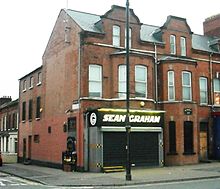
On 5 February 1992, a mass shooting took place at the Sean Graham bookmaker‘s shop on the Lower Ormeau Road in Belfast, Northern Ireland. Members of the Ulster Defence Association (UDA), a loyalist paramilitary group, opened fire on the customers, killing five civilians and wounding another nine. The shop was in an Irish nationalist area, and all of the victims were local Catholic civilians. The UDA claimed responsibility using the cover name “Ulster Freedom Fighters”, and said the shooting was retaliation for the Teebane bombing, which had been carried out by the Provisional IRA less than three weeks before
Background

Ulster Freedom Fighters insignia in the Annadale Flats area, January 2012
The start of 1992 had witnessed an intensification in the campaign of violence being carried out by the Ulster Defence Association (UDA) under their UFF covername. The group’s first killing that year was on 9 January when Catholic civilian Phillip Campbell was shot dead at his place of work near Moira by a Lisburn-based UDA unit.[1] The same group killed another Catholic civilian, Paul Moran, at the end of the month and a few days later taxi driver Paddy Clarke was killed at his north Belfast home by members of the UDA West Belfast Brigade.[2]
However, the Inner Council of the UDA, which contained the six brigadiers that controlled the organisation, felt that these one-off killings were not sending a strong enough message to republicans and so it sanctioned a higher-profile attack in which a number of people would be killed at once.[2] On this basis the go-ahead was given to attack Sean Graham bookmaker’s shop on the Irish nationalist Lower Ormeau Road. This was a major arterial route in the city and was near the UDA stronghold of Annadale Flats.[2] According to David Lister and Hugh Jordan, the bookmaker’s shop was chosen by West Belfast Brigadier and Inner Council member Johnny Adair because he had strong personal ties with the commanders of the Annadale UDA.[3] A 1993 report commissioned by RUC Special Branch also claimed that Adair was the driving force behind the attack.[3]
The shooting

Names of the dead commemorated on a plaque in Hatfield Street
The attack occurred at 2:20 in the afternoon.[4] A car parked on University Avenue facing the bookmakers and two men, wearing boiler suits and balaclavas, left the car and crossed the Ormeau Road to the shop.[5] One was armed with a VZ.58 Czechoslovak semi-automatic rifle and the other with a 9mm pistol. They entered the shop—in which there were 15 customers—and opened fire, unleashing a total of 44 shots on the assembled victims.[6]
Five Catholic men and boys were killed: Christy Doherty (52), Jack Duffin (66), James Kennedy (15), Peter Magee (18) and William McManus (54).[7] Nine others were wounded, one critically.[4] Four of them died at the scene although 15-year-old Kennedy survived until he reached the hospital, his final words being reported as “tell my mummy that I love her”.[8] Kennedy’s mother Kathleen died two years later after becoming a recluse. Her husband, James (Sr.), blamed his wife’s death on the shooting by claiming “the bullets that killed James didn’t just travel in distance, they travelled in time. Some of those bullets never stopped travelling”.[8]
One of the wounded described the shooting to British journalist Peter Taylor:
“There was a right crowd in [the betting shop] and I cracked a joke with a couple of them – they were like that, always laughing and carrying on. I had only been in for about twenty or twenty-five minutes when the shooting started – I was standing next to the door with a docket in my hand studying the form. At first I thought it was a hold-up but then the shooting started and somebody yelled, ‘Hit the deck’. I just lay there and prayed that the shooting would stop. It seemed to go on for a lifetime. There wasn’t a sound for a few seconds – everybody was so stunned, but then the screaming started. People were yelling out in agony. You could hardly see anything. The room was full of gun smoke and the smell would have choked you”.[9]
In a separate incident, a unit of the Ulster Volunteer Force (UVF) had travelled to the area at the time of the attack with the intention of killing a local Sinn Féin activist based on intelligence they had received that he returned home about that time every day. The attack was abandoned, however, when the car carrying the UVF members was passed by speeding Royal Ulster Constabulary (RUC) vehicles and ambulances. The UVF members, who had already retrieved their weapons for the attack, were said to be livid with the UDA for not co-ordinating with them beforehand and effectively spoiling their chance to kill a leading local republican.[10]
—————————————————————————
The Victims
—————————————————————————
05 February 1992

Peter Magee, (18)
Catholic
Status: Civilian (Civ),
Killed by: Ulster Freedom Fighters (UFF)
Shot during gun attack on Sean Graham’s Bookmaker’s shop, Ormeau Road, Belfast
—————————————————————————
05 February 1992

Jack Duffin, (66)
Catholic
Status: Civilian (Civ),
Killed by: Ulster Freedom Fighters (UFF)
Shot during gun attack on Sean Graham’s Bookmaker’s shop, Ormeau Road, Belfast
—————————————————————————
05 February 1992

James Kennedy, (15)
Catholic
Status: Civilian (Civ),
Killed by: Ulster Freedom Fighters (UFF)
Shot during gun attack on Sean Graham’s Bookmaker’s shop, Ormeau Road, Belfast
—————————————————————————
05 February 1992

William McManus, (54)
Catholic
Status: Civilian (Civ),
Killed by: Ulster Freedom Fighters (UFF)
Shot during gun attack on Sean Graham’s Bookmaker’s shop, Ormeau Road, Belfast
—————————————————————————
05 February 1992

Christy Doherty, (52)
Catholic
Status: Civilian (Civ),
Killed by: Ulster Freedom Fighters (UFF)
Shot during gun attack on Sean Graham’s Bookmaker’s shop, Ormeau Road, Belfast
—————————————————————————
Aftermath

Memorial stone laid in February 2012
A UDA statement in the aftermath of the attack claimed that the killings were justified as the Lower Ormeau was “one of the IRA‘s most active areas”.[8] The statement also included the phrase “remember Teebane”, suggesting that they intended the killings as retaliation for the Teebane bombing in County Tyrone less than three weeks earlier. In that attack, the IRA had killed eight Protestant men who were repairing a British Army base.[11] The same statement had also been yelled by the gunmen as they ran from the betting shop.[8] Alex Kerr, who was then UDA Brigadier for South Belfast, released a second statement about a month after the attack in which he sought to justify the killings. Kerr stated that “the IRA was extremely active in the lower Ormeau and the nationalist population there shielded them. They paid the price for Teebane”. He added that if there were any further bombings like that at Teebane then the UDA would retaliate in the same way as at Sean Graham’s.[12]
See Teebane Bus Bomb
The idea that the killings were justified because of Teebane was shunned by Rev. Ivor Smith, a Presbyterian minister who was based in the area and who worked with the families of the bomb victims. He said that the UDA claim was “like a knife through the heart. We were absolutely appalled at the thought that somebody would try to do something like that and justify it by bringing in Teebane. As far as the families were concerned, it was very definitely not ‘in my name'”.[11] A letter expressing deep sympathy from Betty Gilchrist, a Protestant whose husband had been killed at Teebane, was read out at the funeral of Jack Duffin.[12] Alasdair McDonnell, a general practitioner and Social Democratic and Labour Party councillor in the area, also suggested that the attack had been in response to Teebane. However, he was strongly rebuked by the Lower Ormeau Residents Action Group, a residents’ association with Sinn Féin links, for seemingly justifying the killings with this claim.[13]
When a July 1992 Orange Order march passed the scene of the shooting, Orangemen shouted pro-UDA slogans and held aloft five fingers as a taunt to residents over the five deaths.[4][14] The claim is corroborated by Henry McDonald and Jim Cusack. The images of Orangemen and loyalist flute band members holding up five fingers as they passed the shop were beamed around the world and was a public relations disaster for the Order.[15] Patrick Mayhew, then Secretary of State for Northern Ireland, said that the actions of the marchers “would have disgraced a tribe of cannibals”.[14] The incident led to a more concerted effort by Lower Ormeau residents to have the marches banned from the area, which later succeeded.[15]
No one was ever convicted for the killings although, locally, blame fell on Joe Bratty and his sidekick Raymond Elder, the two leading UDA figures in the Annadale Flats.[12] McDonald and Cusack suggest that, whilst Bratty had been the brains behind the attack, the gunmen he had used were actually from East Belfast and that a UDA member later convicted of supplying one of the guns had been at the shooting.[12] Lister and Jordan, however, claim that one of the gunmen was actually from west Belfast and was supplied to Bratty by Adair.[3] Bratty was charged with involvement in the attack although the charges were withdrawn.[16] Following his release from custody, Adair organised a lavish celebration party for Bratty in Scotland where he allegedly gave Bratty a gold ring inscribed with the initials UFF.[3]
The IRA did not immediately retaliate although in a statement they claimed to know the identity of the killers and claimed that they would “take them out when the time was right”.[17] When Bratty and Elder were shot dead by the IRA in July 1994, revellers in the Lower Ormeau hailed the attack as revenge for Sean Graham’s.[18]
On 5 February 2002 a plaque was erected on the side of the bookmaker’s shop in Hatfield Street carrying the names of the five victims and the Irish language inscription Go ndéana Dia trócaire ar a n-anamacha (“May God have mercy on their souls”). A small memorial garden was later added.[19] The unveiling ceremony, which took place on the tenth anniversary of the attack, was accompanied by a two-minute silence and was attended by relatives of the dead and survivors of the attack.[20] A new memorial stone was laid on 5 February 2012 to coincide with the publication of a booklet calling for justice for the killings.[21]
Historical Enquiries Team findings
The attack was one of a number to be investigated by the Historical Enquiries Team (HET) in 2010. It found that a Browning pistol used by the gunmen had been given to them by the police. UDA quartermaster and police agent William Stobie had handed the gun to police and the police had given it back to him. Police “may have thought they had tampered with it to prevent it from being used”. According to the HET report this operation “would have required both the authority of a senior police officer and a recovery plan, generally short-term and where possible supported by the security forces within a short period of time. Clearly in this case, there was a significant failure and the repercussions were tragic and devastating”. The gun was, the report continued, also used in other UDA killings.[22]
Alex Maskey, a Sinn Féin MLA for the area, commented that “the finding by the HET that the Browning pistol used by the UDA in this attack was handed back to them by the RUC will come as no surprise to the people of the Lower Ormeau area who have long known that a high degree of collusion took place in this attack”.[22]
Officers from the HET were told by police that the assault rifle used in the attack had been “disposed of”. However, it was later discovered on display in the Imperial War Museum.[23]
Jackie McDonald
.jpg/220px-Jackie_McDonald_2014_(cropped).jpg)
In February 2012 Jackie McDonald, the incumbent commander of the UDA South Belfast Brigade (the area in which the shop is located), admitted that the victims of the shooting had been innocent. However, McDonald said that he could not apologise for the attack, arguing that as he was imprisoned at the time he played no part in what had happened.[11] In an earlier interview with Peter Taylor, McDonald suggested that it was the rise in sectarian killings and attacks such as that at Sean Graham’s that “brought about the ceasefire at the end of the day”.[9]
Attack on James Murray’s bookmakers
On the afternoon of 14 November 1992, the UDA carried out another attack on a betting shop in Belfast. The target was James Murray’s betting shop on the Oldpark Road in the north of the city, which was used mostly by Catholics.[24] One gunman fired into the shop from the doorway with an automatic weapon, while another smashed the window and threw a grenade inside. As he did so, he shouted “Yous deserve it, yous Fenian bastards!”.[25] Two Catholic civilians were killed outright and another died in hospital shortly after;[25] all of them were elderly men.[26] Thirteen others were wounded, some seriously. Like the shooting at Sean Graham’s, the November attack had also been planned by Adair. It “was followed by a raucous celebration in a loyalist club in south Belfast with Adair occupying centre stage”.[25] According to McDonald and Cusack the attack on this shop, which also had a few Protestant patrons who were present during the shooting, was carried out by Stephen McKeag.[27]
Share this:

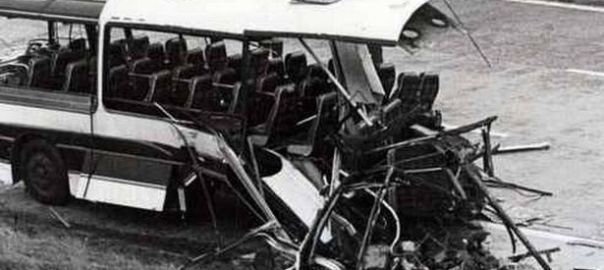
M62 Coach Bombing – 12 People including two children slaughtered by the IRA
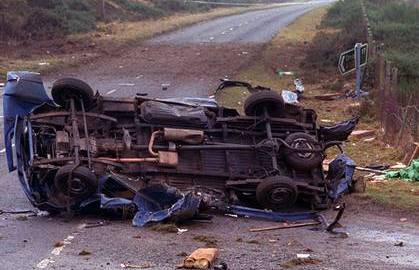
The M62 coach bombing happened on 4 February 1974 on the M62 motorway in northern England, when a Provisional Irish Republican Army (IRA) bomb exploded in a coach carrying off-duty British Armed Forces personnel and their family members.
Twelve people (nine soldiers, three civilians) were killed by the bomb, which consisted of 25 pounds (11 kg) of high explosive hidden in a luggage locker on the coach. Judith Ward was convicted of the crime later in 1974, but 18 years later the conviction was judged as wrongful and she was released from prison.
The Bombing
The coach had been specially commissioned to carry British Army and Royal Air Force personnel on leave with their families from and to the bases at Catterick and Darlington during a period of railway strike action. The vehicle had departed from Manchester and was making good progress along the motorway. Shortly after midnight, when the bus was between junction 26 and 27, near Oakwell Hall, there was a large explosion on board. Most of those aboard were sleeping at the time. The blast, which could be heard several miles away, reduced the coach to a “tangle of twisted metal” and threw body parts up to 250 yards (230 m).
The explosion killed eleven people outright and wounded over fifty others , one of whom died four days later. Amongst the dead were nine soldiers – two from the Royal Artillery, three from the Royal Corps of Signals and four from the 2nd battalion Royal Regiment of Fusiliers.

One of the latter was Corporal Clifford Haughton, whose entire family, consisting of his wife Linda and his sons Lee (5) and Robert (2), also died. Numerous others suffered severe injuries, including a six-year-old boy, who was badly burned.

The driver of the coach, Roland Handley, was injured by flying glass, but was hailed as a hero for bringing the coach safely to a halt. Handley died, aged 76, after a short illness, in January 2011.
Suspicions immediately fell upon the IRA, which was in the midst of an armed campaign in Britain involving numerous operations, later including the Guildford Pub Bomb and the Birmingham pub bombings.
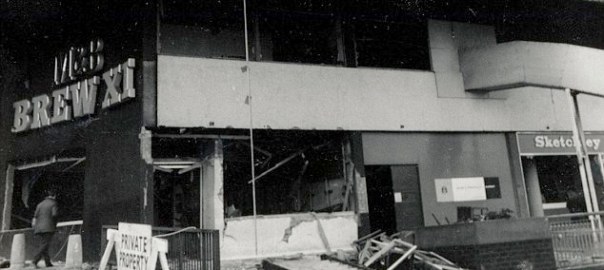
Reaction

Memorial plaque at Hartshead Moor services
Reactions in Britain were furious, with senior politicians from all parties calling for immediate action against the perpetrators and the IRA in general. The British media were equally condemnatory; according to The Guardian, it was:
“the worst IRA outrage on the British mainland” at that time, whilst the BBC has described it as “one of the IRA’s worst mainland terror attacks”.
The Irish Sunday Business Post later described it as the “worst” of the “awful atrocities perpetrated by the IRA” during this period.
IRA Army Council member Dáithí Ó Conaill was challenged over the bombing and the death of civilians during an interview, and replied that the coach was bombed because IRA intelligence indicated that it was carrying military personnel only.
The attack’s most lasting consequence was the adoption of much stricter ‘anti-terrorism‘ laws in Great Britain and Northern Ireland, allowing police to hold those ‘suspected of terrorism’ for up to seven days without charge, and to deport those ‘suspected of terrorism’ in Britain or the Republic of Ireland to Northern Ireland to face trial, where special courts judged with separate rules on ‘terrorism‘ suspects.
The entrance hall of the westbound section of the Hartshead Moor service area was used as a first aid station for those wounded in the blast. A memorial to those who were killed was later created there. following a campaign by relatives of the dead, a larger memorial was later erected, set some yards away from the entrance hall.
The site, situated behind four flag poles, includes an English oak tree, a memorial stone, a memorial plaque and a raised marble tablet inscribed with the names of those who died.
A memorial plaque engraved with the names of the casualties was also unveiled in Oldham in 2010.
M62 coach bombing
—————————————————————————
Victims
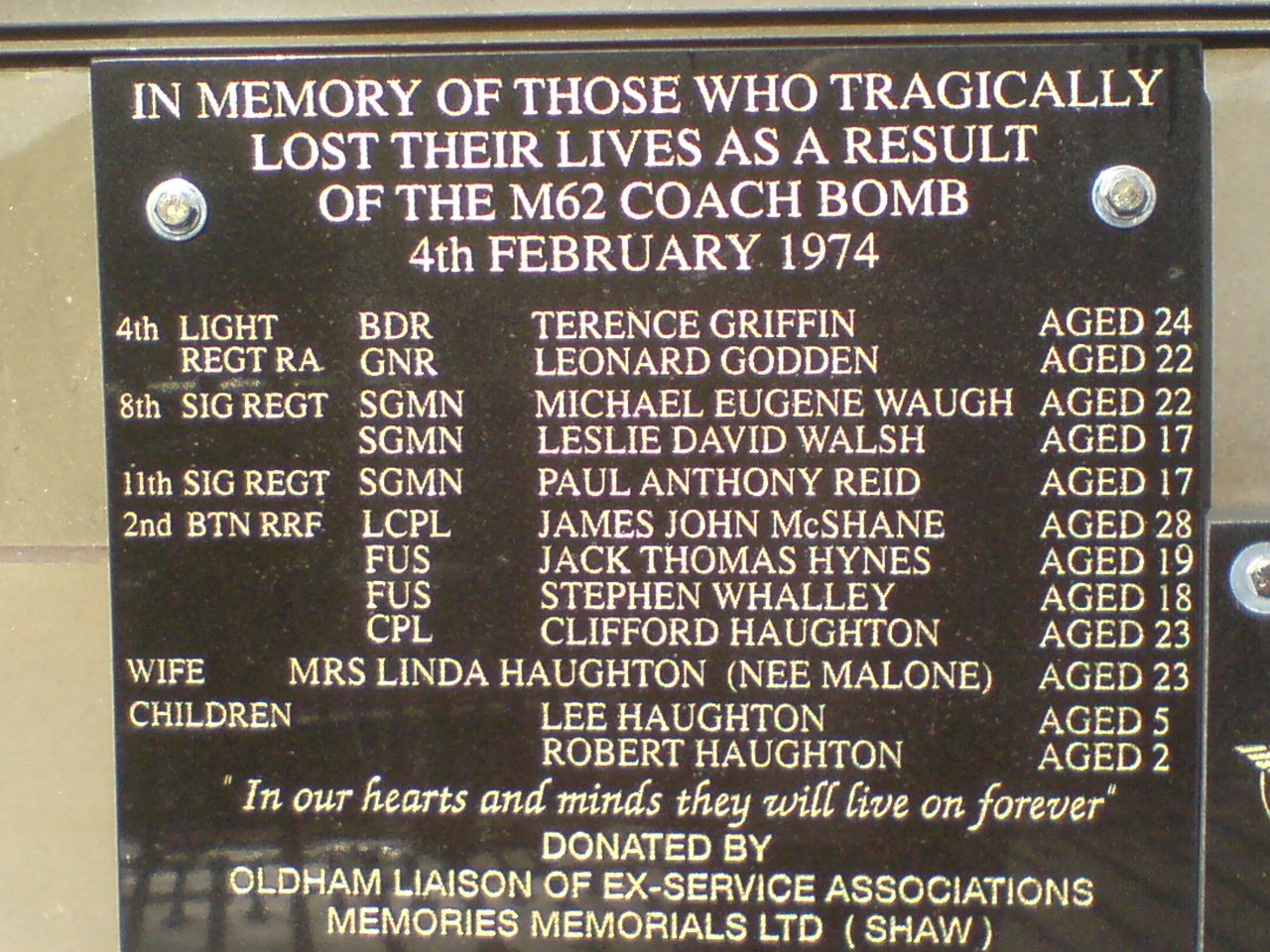
—————————————————————————
04 February 1974
Leonard Godden, (22)
nfNIB
Status: British Army (BA),
Killed by: Irish Republican Army (IRA)
Killed in time bomb attack on British Army (BA) coach travelling along M62 motorway, Yorkshire, England.
—————————————————————————
04 February 1974

Terence Griffin, (24)
nfNIB
Status: British Army (BA),
Killed by: Irish Republican Army (IRA)
Killed in time bomb attack on British Army (BA) coach travelling along M62 motorway, Yorkshire, England.
—————————————————————————
04 February 1974
Michael Waugh, (22)
nfNIB
Status: British Army (BA),
Killed by: Irish Republican Army (IRA)
Killed in time bomb attack on British Army (BA) coach travelling along M62 motorway, Yorkshire, England.
—————————————————————————
04 February 1974
Leslie Walsh, (19)
nfNI
Status: British Army (BA),
Killed by: Irish Republican Army (IRA)
Killed in time bomb attack on British Army (BA) coach travelling along M62 motorway, Yorkshire, England.
—————————————————————————
04 February 1974
Paul Reid, (17)
nfNIB
Status: British Army (BA),
Killed by: Irish Republican Army (IRA)
Killed in time bomb attack on British Army (BA) coach travelling along M62 motorway, Yorkshire, England
—————————————————————————
04 February 1974
Jack Hynes, (19)
nfNIB
Status: British Army (BA),
Killed by: Irish Republican Army (IRA)
Killed in time bomb attack on British Army (BA) coach travelling along M62 motorway, Yorkshire, England.
—————————————————————————
04 February 1974
James McShane, (28)
nfNIB
Status: British Army (BA),
Killed by: Irish Republican Army (IRA)
Killed in time bomb attack on British Army (BA) coach travelling along M62 motorway, Yorkshire, England.
—————————————————————————
04 February 1974

Clifford Houghton, (23)
nfNIB
Status: British Army (BA),
Killed by: Irish Republican Army (IRA)
Killed in time bomb attack on British Army (BA) coach travelling along M62 motorway, Yorkshire, England
—————————————————————————
04 February 1974

Linda Houghton, (23)
nfNIB
Status: Civilian (Civ),
Killed by: Irish Republican Army (IRA)
Killed in time bomb attack on British Army (BA) coach travelling along M62 motorway, Yorkshire, England
—————————————————————————
04 February 1974

Lee Houghton, (5)
nfNIB
Status: Civilian (Civ),
Killed by: Irish Republican Army (IRA)
Killed in time bomb attack on British Army (BA) coach travelling along M62 motorway, Yorkshire, England
—————————————————————————
04 February 1974

Robert Houghton, (2)
nfNIB
Status: Civilian (Civ),
Killed by: Irish Republican Army (IRA)
Killed in time bomb attack on British Army (BA) coach travelling along M62 motorway, Yorkshire, England.
—————————————————————————
04 February 1974

Stephen Whalley, (18)
nfNIB
Status: British Army (BA),
Killed by: Irish Republican Army (IRA)
Injured in time bomb attack on British Army (BA) coach travelling along M62 motorway, Yorkshire, England. He died 7 February 1974.
—————————————————————————

See: Palace Barracks Memorial Garden
04 February 1974
Prosecution

Second memorial at Hartshead Moor services
Following the explosion, the British public and politicians from all three major parties called for “swift justice”. The ensuing police investigation led by Detective Chief Superintendent George Oldfield was rushed, careless and ultimately forged, resulting in the arrest of the mentally ill Judith Ward who claimed to have conducted a string of bombings in Britain in 1973 and 1974 and to have married and had a baby with two separate IRA members. Despite her retraction of these claims, the lack of any corroborating evidence against her, and serious gaps in her testimony – which was frequently rambling, incoherent and “improbable” – she was wrongfully convicted in November 1974. Following her conviction, the Irish Republican Publicity Bureau issued a statement:
Miss Ward was not a member of Óglaigh na hÉireann and was not used in any capacity by the organisation. She had nothing to do what-so-ever with the military coach bomb (on 4 February 1974), the bombing of Euston Station and the attack on Latimer Military College. Those acts were authorised operations carried out by units of the Irish Republican Army.
The case against her was almost completely based on inaccurate scientific evidence using the Griess test and deliberate manipulation of her confession by some members of the investigating team. The case was similar to those of the Guildford Four, the Birmingham Six and the Maguire Seven, which occurred at the same time and involved similar forged confessions and inaccurate scientific analysis. Ward was finally released in 1992, when three Appeal Court judges held unanimously that her conviction was “a grave miscarriage of justice”, and that it had been “secured by ambush
See: Guildford Pub Bomb
Share this:


Segregation in Northern Ireland
Segregation in Northern Ireland
Segregation in Northern Ireland is a long-running issue in the political and social history of Northern Ireland. The segregation involves Northern Ireland’s two main voting blocs – Irish nationalist/republicans (mainly Roman Catholic) and unionist/loyalist (mainly Protestant). It is often seen as both a cause and effect of the “Troubles“.
A combination of political, religious and social differences plus the threat of intercommunal tensions and violence has led to widespread self-segregation of the two communities. Catholics and Protestants lead largely separate lives in a situation that some have dubbed “self-imposed apartheid”.[1] The academic John H. Whyte argued that “the two factors which do most to divide Protestants as a whole from Catholics as a whole are endogamy and separate education

———————————————————
Inside Story – How divided is Northern Ireland
———————————————————
Education
Education in Northern Ireland is heavily segregated. Most state schools in Northern Ireland are predominantly Protestant, while the majority of Catholic children attend schools maintained by the Catholic Church. In all, 90 per cent of children in Northern Ireland still go to separate faith schools.[3] The consequence is, as one commentator has put it, that “the overwhelming majority of Ulster’s children can go from four to 18 without having a serious conversation with a member of a rival creed.”[4] The prevalence of segregated education has been cited as a major factor in maintaining endogamy (marriage within one’s own group).[5] The integrated education movement has sought to reverse this trend by establishing non-denominational schools such as the Portadown Integrated Primary. Such schools are, however, still the exception to the general trend of segregated education. Integrated schools in Northern Ireland have been established through the voluntary efforts of parents. The churches have not been involved in the development of integrated education.[6]
———————————————————
Why Ireland split into the Republic of Ireland & Northern Ireland
———————————————————
Employment
Historically, employment in the Northern Irish economy was highly segregated in favour of Protestants, particularly at senior levels of the public sector, in certain then important sectors of the economy, such as shipbuilding and heavy engineering, and strategically important areas such as the police.[7] Emigration to seek employment was therefore significantly more prevalent among the Catholic population. As a result, Northern Ireland’s demography shifted further in favour of Protestants leaving their ascendancy seemingly impregnable by the late 1950s.
A 1987 survey found that 80 per cent of the workforces surveyed were described by respondents as consisting of a majority of one denomination; 20 per cent were overwhelmingly unidenominational, with 95–100 per cent Catholic or Protestant employees. However, large organisations were much less likely to be segregated, and the level of segregation has decreased over the years.[8]
The British government has introduced numerous laws and regulations since the mid-1990s to prohibit discrimination on religious grounds, with the Fair Employment Commission (originally the Fair Employment Agency) exercising statutory powers to investigate allegations of discriminatory practices in Northern Ireland business and organisations.[7] This has had a significant impact on the level of segregation in the workplace;[8] John Whyte concludes that the result is that “segregation at work is one of the least acute forms of segregation in Northern Ireland.” [9]
———————————————————
BBC Spotlight – Poverty in Northern Ireland
———————————————————
Housing

Gates in a peace line in West Belfast

Back of a house behind a “peace line”, on Bombay Street Belfast
Public housing is overwhelmingly segregated between the two communities. Intercommunal tensions have forced substantial numbers of people to move from mixed areas into areas inhabited exclusively by one denomination, thus increasing the degree of polarisation and segregation. The extent of self-segregation grew very rapidly with the outbreak of the Troubles. In 1969, 69 per cent of Protestants and 56 per cent of Catholics lived in streets where they were in their own majority; as the result of large-scale flight from mixed areas between 1969 and 1971 following outbreaks of violence, the respective proportions had by 1972 increased to 99 per cent of Protestants and 75 per cent of Catholics.[10] In Belfast, the 1970s were a time of rising residential segregation.[11] It was estimated in 2004 that 92.5% of public housing in Northern Ireland was divided along religious lines, with the figure rising to 98% in Belfast.[1] Self-segregation is a continuing process, despite the Northern Ireland peace process. It was estimated in 2005 that more than 1,400 people a year were being forced to move as a consequence of intimidation.[12]
In response to intercommunal violence, the British Army constructed a number of high walls called “peace lines” to separate rival neighbourhoods. These have multiplied over the years and now number forty separate barriers, mostly located in Belfast. Despite the moves towards peace between Northern Ireland’s political parties and most of its paramilitary groups, the construction of “peace lines” has actually increased during the ongoing peace process; the number of “peace lines” doubled in the ten years between 1995 and 2005.[13] In 2008 a process was proposed for the removal of the peace walls.[14]
The effective segregation of the two communities significantly affects the usage of local services in “interface areas” where sectarian neighbourhoods adjoin. Surveys in 2005 of 9,000 residents of interface areas found that 75% refused to use the closest facilities because of location, while 82% routinely travelled to “safer” areas to access facilities even if the journey time was longer. 60% refused to shop in areas dominated by the other community, with many fearing ostracism by their own community if they violated an unofficial de facto boycott of their sectarian opposite numbers.[13]
Intermarriage
In contrast with both the Republic of Ireland and most parts of Great Britain, where intermarriage between Protestants and Catholics is not unusual, in Northern Ireland it has been uncommon: from 1970 through to the 1990s, only 5 per cent of marriages were recorded as crossing community divides.[15] This figure remained largely constant throughout the Troubles. It rose to between 8 and 12 per cent, according to the Northern Ireland Life and Times Survey, in 2003, 2004 and 2005.[16][17][18] Attitudes towards Catholic–Protestant intermarriage have become more supportive in recent years (particularly among the middle class)[19] and younger people are also more likely to be married to someone of a different religion to themselves than older people. However, the data hides considerable regional variation across Northern Ireland.[20]
Anti-discrimination legislation
In the 1970s, the British government took action to legislate against religious discrimination in Northern Ireland. The Fair Employment Act 1976 prohibited discrimination in the workplace on the grounds of religion and established a Fair Employment Agency. This Act was strengthened with a new Fair Employment Act in 1989, which introduced a duty on employers to monitor the religious composition of their workforce, and created the Fair Employment Commission to replace the Fair Employment Agency. The law was extended to cover the provision of goods, facilities and services in 1998 under the Fair Employment and Treatment (Northern Ireland) Order 1998.[21] In 1999, the Commission was merged with the Equal Opportunities Commission, the Commission for Racial Equality and the Northern Ireland Disability Council to become part of the Equality Commission for Northern Ireland.[22]
An Equality Commission review in 2004 of the operation of the anti-discrimination legislation since the 1970s, found that there had been a substantial improvement in the employment profile of Catholics, most marked in the public sector but not confined to it. It said that Catholics were now well represented in managerial, professional and senior administrative posts, although there were some areas of under-representation such as local government and security but that the overall picture was a positive one. Catholics, however, were still more likely than Protestants to be unemployed and there were emerging areas of Protestant under-representation in the public sector, most notably in health and education at many levels including professional and managerial. The report also found that there had been a considerable increase in the numbers of people who work in integrated workplaces.
Share this:


30th January – Deaths & Events in Northern Ireland Troubles
Key Events & Deaths on this day in Northern Ireland Troubles
30th January
——————————–
Sunday 30 January 1972

‘Bloody Sunday’ ‘Bloody Sunday‘ refers to the shooting dead by the British Army of 13 civilans (and the wounding of another 14 people, one of whom later died) during a Civil Rights march in Derry. The Northern Ireland Civil Rights Association (NICRA) march against internment was meant to start at 2.00pm from the Creggan. The march left late (2.50pm approximately) from Central Drive in the Creggan Estate and took an indirect route towards the Bogside area of the city. People joined the march along its entire route.

At approximately 3.25pm the march passed the ‘Bogside Inn’ and turned up Westland Street before going down William Street. Estimates of the number of marchers at this point vary. Some observers put the number as high as 20,000 whereas the Widgery Report estimated the number at between 3,000 and 5,000. Around 3.45pm most of the marchers followed the organisers instructions and turned right into Rossville Street to hold a meeting at ‘Free Derry Corner’. However a section of the crowd continued along William Street to the British Army barricade. A riot developed. (Confrontations between the Catholic youth of Derry and the British Army had become a common feature of life in the city and many observers reported that the rioting was not particularly intense.)
At approximately 3.55pm, away from the riot and also out of sight of the meeting, soldiers (believed to be a machine-gun platoon of Paratroopers) in a derelict building in William Street opened fire (shooting 5 rounds) and injured Damien Donaghy (15) and John Johnston (59). Both were treated for injuries and were taken to hospital (Johnston died on 16 June 1972).
[The most recent information (see, for example, Pringle, P. and Jacobson, P.; 2000) suggests that an Official IRA member then fired a single shot in response at the soldiers in the derelict building. This incident happened prior to the main shooting and also out of sight of Rossville Street.]
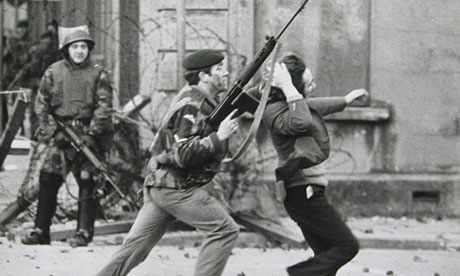
Also around this time (about 3.55pm) as the riot in William Street was breaking up, Paratroopers requested permission to begin an arrest operation. By about 4.05pm most people had moved to ‘Free Derry Corner’ to attend the meeting. 4.07pm (approximately) An order was given for a ‘sub unit’ (Support Company) of the 1st Battalion Parachute Regiment to move into William Street to begin an arrest operation directed at any remaining rioters. The order authorising the arrest operation specifically stated that the soldiers were “not to conduct running battle down Rossville Street”
(Official Brigade Log). The soldiers of Support Company were under the command of Ted Loden, then a Major in the Parachute Regiment (and were the only soldiers to fire at the crowd from street level).
At approximately 4.10pm soldiers of the Support Company of the 1st Battalion Parachute Regiment began to open fire on people in the area of Rossville Street Flats. By about 4.40pm the shooting ended with 13 people dead and a further 14 injured from gunshots. The shooting took place in four main places: the car park (courtyard) of Rossville Flats; the forecourt of Rossville Flats (between the Flats and Joseph Place); at the rubble and wire barricade on Rossville Street (between Rossville Flats and Glenfada Park); and in the area around Glenfada Park (between Glenfada Park and Abbey Park).

According to British Army evidence 21 soldiers fired their weapons on ‘Bloody Sunday’ and shot 108 rounds in total.
[Most of the basic facts are agreed, however what remains in dispute is whether or not the soldiers came under fire as they entered the area of Rossville Flats. The soldiers claimed to have come under sustained attack by gunfire and nail-bomb. None of the eyewitness accounts saw any gun or bomb being used by those who had been shot dead or wounded. No soldiers were injured in the operation, no guns or bombs were recovered at the scene of the killing.]
[Public Records 1972 – Released 1 January 2003: Telegram from Lord Bridges to Edward Heath, then British Prime Minister, containing an early report of the killings in Derry.]
Tuesday 30 January 1973
Francis Smith (28), a member of the Ulster Defence Association (UDA), was found shot dead in the Falls area of Belfast. He had been killed by the IRA.
Wednesday 30 January 1974
[ Sunningdale; Ulster Workers’ Council Strike; Law Order. ]
Wednesday 30 January 1975
The Gardiner Report (Cmnd. 5847), which examined measures to deal with terrorism within the context of human rights and civil liberties, was published. The report recommended that special category status for paramilitary prisoners should be ended. The report also recommended that detention without trial be maintained but under the control of the Secretary of State.
30 January 1983
At the annual conference of the Social Democratic and Labour Party (SDLP) the delegates reaffirmed the party’s boycott of the Northern Ireland Assembly.
Monday 30 January 1984

The Prison Governors’ Association and the Prison Officers Association both claimed that political interference in the running of the Maze Prison resulted in the mass escape on 25 September 1983. Nick Scott, then Minister for Prisons, rejected the allegations.
[See also: 25 October 1984]
Wednesday 30 January 1985

Douglas Hurd, then Secretary of State for Northern Ireland, dismissed demands for the disbandment of the Ulster Defence Regiment (UDR).
Thursday 30 January 1986
Fianna Fáil (FF) said that it welcomed the comments of Harold McCusker, then deputy leader of the Ulster Unionist Party (UUP), who had suggested a conference of British, Irish, and Northern Ireland politicians to discuss the ‘totality of relationships’.
Thursday 30 January 1992
Charles Haughey, then Taoiseach (Irish Prime Minister), announced his resignation as both Taoiseach and leader of Fianna Fáil (FF). [Haughey’s resignation followed the re-emergence of allegations about phone-tapping in 1982.]
Saturday 30 January 1993
There was a rally in Derry to commemorate the 21st anniversary of the killings on ‘Bloody Sunday’ (30 January 1972).
Monday 30 January 1995

Bertie Ahern, then leader of Fianna Fáil (FF), held a meeting with the Ulster Unionist Party (UUP) at its headquarters in Glengall Street, Belfast. Ahern also met with Social Democratic and Labour Party (SDLP) and Sinn Féin (SF) members later in the day.
Tuesday 30 January 1996

Gino Gallagher (33), believed to be the Chief of Staff of the Irish National Liberation Army (INLA), was shot dead in a Social Security Office in the Falls Road, Belfast.
[This killing was to mark the beginning of another feud within the INLA. This particular feud ended on 3 September 1996.]
Gerry Adams, then President of Sinn Féin (SF), held a meeting with Patrick Mayhew, then Secretary of State for Northern Ireland, at Stormont. John Hume, then leader of the Social Democratic and Labour Party (SDLP), met with John Major, then British Prime Minister, in Downing Street, London.
Thursday 30 January 1997
North Report Peter North, then Chairman of the Independent Review of Parades and Marches, launched his report (The North Report) in Belfast and recommended the setting up of an independent commission to review contentious parades. Most Nationalists welcomed the Review but Unionists were against the main recommendations. Patrick Mayhew, then Secretary of State for Northern Ireland, announced that “further consultation” would have to be carried out by the Northern Ireland Office (NIO) before any decisions could be taken. Marjorie (Mo) Mowlam, then Labour Party Spokesperson on Northern Ireland, approved of the report.
Saturday 30 January 1999

Loyalist paramilitaries carried out seven ‘punishment’ beatings against people in Newtownabbey, County Antrim. Republican paramilitaries carried out a ‘punishment’ shooting on a man in Cookstown, County Tyrone. [January had the highest level of paramilitary ‘punishment’ attacks during any month in the past 10 years.]
Wednesday 30 January 2002
Relatives of those killed on Bloody Sunday (30 January 1972), together with some of the surviving injured, and about 2,000 other people, gathered in the Bogside in Derry to mark the 30th anniversary of the killings. A minute’s silence was held at the time when the first shots were fired. Dr Edward Daly, the former Bishop of Derry, rededicated the memorial to the dead. In his address he said he prayed “for victims everywhere – here, in Afghanistan, the Middle East and New York”. He added:
“We identify with all people who have suffered, of whatever race or religion or nation”. The Bloody Sunday Inquiry was adjourned until Monday – the Inquiry does not sit on the anniversary of the killings.
[The Inquiry will resume on Monday when the first Royal Ulster Constabulary (RUC) witnesses are expected to begin giving evidence. It is anticipated that one of the police witnesses will give evidence from behind a screen.]
David Ford, then leader of the Alliance Party of Northern Ireland (APNI), travelled to Downing Street, London, for a meeting with Tony Blair, then British Prime Minister. Ford was there to discuss potential reforms of the voting system used in the Northern Ireland Assembly. David Trimble (UUP), then First Minister, and Mark Durkan (SDLP), then Deputy First Minister, travelled to Brussels for a two day visit. During their first day they opened a new Northern Ireland Executive office in the city which was established to lobby on behalf of Northern Ireland within the European Parliament.
The cost of the office, which was higher than envisaged, came in for criticism. The set up cost was £300,000 and the annual running cost is estimated at £500,000. The Irish National Liberation Army denied that it had threatened Protestant community workers in Glenbryn, north Belfast. The denial was issued through the Irish Republican Socialist Party (IRSP). It described the threats as bogus.
—————————————————————————
Remembering all innocent victims of the Troubles
Today is the anniversary of the death of the following people killed as a results of the conflict in Northern Ireland
“To live in hearts we leave behind is not to die
– Thomas Campbell
To the innocent on the list – Your memory will live forever
– To the Paramilitaries –
There are many things worth living for, a few things worth dying for, but nothing worth killing for.
22 People lost their lives on the 30th January between 1972 – 1996
—————————————————————————
30 January 1972
Robin Alers-Hankey, (35)
nfNI
Status: British Army (BA),
Killed by: Irish Republican Army (IRA)
Died four months after being shot by sniper during street disturbances, Abbey Street, Bogside, Derry. He was wounded on 2 September 1971.
—————————————————————————
30 January 1972

John Duddy, (17)
Catholic
Status: Civilian (Civ),
Killed by: British Army (BA)
Shot during anti-internment march in the vicinity of Rossville Street, Bogside, Derry.
—————————————————————————
30 January 1972

Kevin McElhinney, (17)
Catholic
Status: Civilian (Civ),
Killed by: British Army (BA)
Shot during anti-internment march in the vicinity of Rossville Street, Bogside, Derry
—————————————————————————
30 January 1972

Patrick Doherty, (31)
Catholic
Status: Civilian (Civ),
Killed by: British Army (BA)
Shot during anti-internment march in the vicinity of Rossville Street, Bogside, Derry
—————————————————————————
30 January 1972

Bernard McGuigan, (41)
Catholic
Status: Civilian (Civ),
Killed by: British Army (BA)
Shot during anti-internment march in the vicinity of Rossville Street, Bogside, Derry
—————————————————————————
30 January 1972

Hugh Gilmour, (17)
Catholic
Status: Civilian (Civ),
Killed by: British Army (BA)
Shot during anti-internment march in the vicinity of Rossville Street, Bogside, Derry
—————————————————————————
30 January 1972

William Nash, (19)
Catholic
Status: Civilian (Civ),
Killed by: British Army (BA)
Shot during anti-internment march in the vicinity of Rossville Street, Bogside, Derry.
—————————————————————————
30 January 1972

Michael McDaid, (20)
Catholic
Status: Civilian (Civ),
Killed by: British Army (BA)
Shot during anti-internment march in the vicinity of Rossville Street, Bogside, Derry
—————————————————————————
30 January 1972

John Young, (17)
Catholic
Status: Civilian (Civ),
Killed by: British Army (BA)
Shot during anti-internment march in the vicinity of Rossville Street, Bogside, Derry
—————————————————————————
30 January 1972

Michael Kelly, (17)
Catholic
Status: Civilian (Civ),
Killed by: British Army (BA)
Shot during anti-internment march in the vicinity of Rossville Street, Bogside, Derry
—————————————————————————
30 January 1972

James Wray, (22)
Catholic
Status: Civilian (Civ),
Killed by: British Army (BA)
Shot during anti-internment march in the vicinity of Rossville Street, Bogside, Derry
—————————————————————————
30 January 1972

Gerry Donaghy, (17)
Catholic
Status: Irish Republican Army Youth Section (IRAF),
Killed by: British Army (BA)
Shot during anti-internment march in the vicinity of Rossville Street, Bogside, Derry
—————————————————————————
30 January 1972

Gerald McKinney, (35)
Catholic
Status: Civilian (Civ),
Killed by: British Army (BA)
Shot during anti-internment march in the vicinity of Rossville Street, Bogside, Derry
—————————————————————————
30 January 1972

William McKinney, (26)
Catholic
Status: Civilian (Civ),
Killed by: British Army (BA)
Shot during anti-internment march in the vicinity of Rossville Street, Bogside, Derry
—————————————————————————
30 January 1972

John Johnston, (59)
Catholic
Status: Civilian (Civ),
Killed by: British Army (BA)
Shot during anti-internment march in the vicinity of Rossville Street, Bogside, Derry. He died 16 June 1972.
—————————————————————————
30 January 1973
Francis Smith, (28)
Protestant
Status: Ulster Defence Association (UDA),
Killed by: Irish Republican Army (IRA)
Found shot in entry, off Rodney Parade, Falls, Belfast.
—————————————————————————
30 January 1974
Thomas Walker, (36)
Protestant
Status: Civilian (Civ),
Killed by: non-specific Loyalist group (LOY)
Shot at his home, Gosford Place, off McClure Street, Belfast. Alleged informer.
—————————————————————————
30 January 1976

John Smiley, (55)
Protestant
Status: Civilian (Civ),
Killed by: Irish Republican Army (IRA)
Killed in bomb attack on Klondyke Bar, Sandy Row, Belfast.
—————————————————————————
30 January 1976
Samuel Hollywood, (34)
Protestant
Status: Ulster Defence Association (UDA),
Killed by: Ulster Volunteer Force (UVF)
Stabbed to death, outside North Star Bar, North Queen Street, Tiger’s Bay, Belfast. Ulster Defence Association (UDA) / Ulster Volunteer Force (UVF) feud.
—————————————————————————
30 January 1984

Mark Marron, (23)
Catholic
Status: Civilian (Civ),
Killed by: British Army (BA)
Shot while travelling in stolen car, Springfield Road, Belfast.
—————————————————————————
30 January 1992

Paul Moran, (32)
Catholic
Status: Civilian (Civ),
Killed by: Ulster Freedom Fighters (UFF)
Shot outside newsagent’s shop, while on way to work, Longstone Street, Lisburn, County Antrim.
—————————————————————————
30 January 1996

Gino Gallagher, (33)
Catholic
Status: Irish National Liberation Army (INLA),
Killed by: Irish National Liberation Army (INLA)
Shot, while inside Department of Health and Social Services office, Falls Road, Belfast. Internal Irish National Liberation Army dispute.
—————————————————————————

Share this:

Bloody Sunday – 30 January 1972
Bloody Sunday
See Bloody Friday
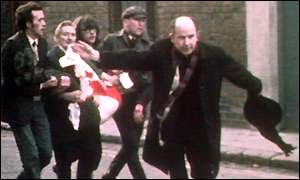
Bloody Sunday – sometimes called the Bogside Massacre[1] – was an incident on 30 January 1972 in the Bogside area of Derry, Northern Ireland. British soldiers shot 26 unarmed civilians during a protest march against internment. Fourteen people died: thirteen were killed outright, while the death of another man four-and-a-half months later was attributed to his injuries. Many of the victims were shot while fleeing from the soldiers and some were shot while trying to help the wounded. Two protesters were also injured when they were run down by army vehicles.[2][3] The march had been organised by the Northern Ireland Civil Rights Association and the Northern Resistance Movement.[4] The soldiers involved were members of the 1st Battalion, Parachute Regiment, also known as “1 Para”.
My Thoughts?
The death of all innocent people during the Troubles has always had a profound effect on me and Bloody Sunday was one of the darkest days (of many) in Northern Irelands tortured past.
However I don’t think Republicans have been completely honest regarding their involvements in the events of that day and they should shoulder some of the blame.
I don’t wish to take anything away from the innocent victims by any means, I’m just saying that things happened that day that put in motion a chain of events that lead to many innocent people dying and all those responsible should be honest and open about exactly what happened. But as we all know SF/IRA rewrite the history of the Troubles on a daily basis and seem to accept NO responsibility for the indiscriminate slaughter of innocent people that hunted the streets of Belfast, N.I and mainland UK.for thirty long , brutal years.
Thank God those days are now behind us.
— Disclaimer –
The views and opinions expressed in this post/documentaries are soley intended to educate and provide background information to those interested in the Troubles of Northern Ireland. They in no way reflect my own opinions and I take no responsibility for any inaccuracies or factual errors.
———————————-
Bloody Sunday – 30th January 1972
———————————-

Two investigations have been held by the British government. The Widgery Tribunal, held in the immediate aftermath of the incident, largely cleared the soldiers and British authorities of blame. It described the soldiers’ shooting as “bordering on the reckless”, but accepted their claims that they shot at gunmen and bomb-throwers. The report was widely criticised as a “whitewash“.[6][7][8] The Saville Inquiry, chaired by Lord Saville of Newdigate, was established in 1998 to reinvestigate the incident. Following a 12-year inquiry, Saville’s report was made public in 2010 and concluded that the killings were both “unjustified” and “unjustifiable”. It found that all of those shot were unarmed, that none were posing a serious threat, that no bombs were thrown, and that soldiers “knowingly put forward false accounts” to justify their firing.[9][10] On the publication of the report, British prime minister David Cameron made a formal apology on behalf of the United Kingdom.[11] Following this, police began a murder investigation into the killings.
Bloody Sunday was one of the most significant events of “the Troubles” because a large number of civilians were killed, by state forces, in full view of the public and the press.[1] It was the highest number of people killed in a single shooting incident during the conflict.[12] Bloody Sunday increased Catholic and Irish nationalist hostility towards the British Army and exacerbated the conflict. Support for the Provisional Irish Republican Army (IRA) rose and there was a surge of recruitment into the organisation, especially locally
———————————-
Bloody Sunday Part
———————————-
Background
Main article: The Troubles

The City of Derry was perceived by many Catholics and Irish nationalists in Northern Ireland to be the epitome of what was described as “fifty years of Unionist misrule”: despite having a nationalist majority, gerrymandering ensured elections to the City Corporation always returned a unionist majority. At the same time the city was perceived to be deprived of public investment – rail routes to the city were closed, motorways were not extended to it, a university was opened in the relatively small (Protestant-majority) town of Coleraine rather than Derry and, above all, the city’s housing stock was in an appalling state.[14] The city therefore became a significant focus of the civil rights campaign led by organisations such as Northern Ireland Civil Rights Association (NICRA) in the late 1960s and it was in Derry that the so-called Battle of the Bogside – the event that more than any other pushed the Northern Ireland administration to ask for military support for civil policing – took place in August 1969.[15]
While many Catholics initially welcomed the British Army as a neutral force, in contrast to what was regarded as a sectarian police force, relations between them soon deteriorated.[16]
In response to escalating levels of violence across Northern Ireland, internment without trial was introduced on 9 August 1971.[17] There was disorder across Northern Ireland following the introduction of internment, with 21 people being killed in three days of rioting.[18] In Belfast, soldiers of the Parachute Regiment shot dead 11 Catholic civilians in what became known as the Ballymurphy Massacre. On 10 August, Bombardier Paul Challenor became the first soldier to be killed by the Provisional IRA in Derry, when he was shot by a sniper on the Creggan estate.[19] A further six soldiers had been killed in Derry by mid-December 1971.[20] At least 1,332 rounds were fired at the British Army, who also faced 211 explosions and 180 nail bombs,[20] and who fired 364 rounds in return.
IRA activity also increased across Northern Ireland with thirty British soldiers being killed in the remaining months of 1971, in contrast to the ten soldiers killed during the pre-internment period of the year.[18] Both the Official IRA and Provisional IRA had established no-go areas for the British Army and RUC in Derry through the use of barricades.[21] By the end of 1971, 29 barricades were in place to prevent access to what was known as Free Derry, 16 of them impassable even to the British Army’s one-ton armoured vehicles.[21] IRA members openly mounted roadblocks in front of the media, and daily clashes took place between nationalist youths and the British Army at a spot known as “aggro corner”.[21] Due to rioting and damage to shops caused by incendiary devices, an estimated total of £4 million worth of damage had been done to local businesses.[21]
On 18 January 1972 Brian Faulkner, Prime Minister of Northern Ireland, banned all parades and marches in Northern Ireland until the end of the year.

On 22 January 1972, a week before Bloody Sunday, an anti-internment march was held at Magilligan strand, near Derry. The protesters marched to a new internment camp there, but were stopped by soldiers of the Parachute Regiment. When some protesters threw stones and tried to go around the barbed wire, Paratroopers drove them back by firing rubber bullets at close range and making baton charges. The Paratroopers badly beat a number of protesters and had to be physically restrained by their own officers. These allegations of brutality by Paratroopers were reported widely on television and in the press. Some in the Army also thought there had been undue violence by the Paratroopers.[22][23]
NICRA intended, despite the ban, to hold another anti-internment march in Derry on Sunday 30 January. The authorities decided to allow it to proceed in the Catholic areas of the city, but to stop it from reaching Guildhall Square, as planned by the organisers. The authorities expected that this would lead to rioting. Major General Robert Ford, then Commander of Land Forces in Northern Ireland, ordered that the 1st Battalion, Parachute Regiment (1 Para), should travel to Derry to be used to arrest possible rioters.[24] The arrest operation was codenamed ‘Operation Forecast’.[25] The Saville Report criticised General Ford for choosing the Parachute Regiment for the operation, as it had “a reputation for using excessive physical violence”.[26] The paratroopers arrived in Derry on the morning of the march and took up positions in the city.[27] Brigadier Pat MacLellan was the operational commander and issued orders from Ebrington Barracks. He gave orders to Lieutenant Colonel Derek Wilford, commander of 1 Para. He in turn gave orders to Major Ted Loden, who commanded the company who launched the arrest operation.
Events of the day
Main article: Narrative of events of Bloody Sunday (1972)

The Bogside in 1981, overlooking the area where many of the victims were shot. On the right of the picture is the south side of Rossville Flats, and in the middle distance is Glenfada Park
The protesters planned on marching from Bishop’s Field, in the Creggan housing estate, to the Guildhall, in the city centre, where they would hold a rally. The march set off at about 2:45pm. There were 10–15,000 people on the march, with many joining along its route.[28] Lord Widgery, in his now discredited tribunal,[29][30][31][32] said that there were only 3,000 to 5,000.
The march made its way along William Street but, as it neared the city centre, its path was blocked by British Army barriers. The organisers redirected the march down Rossville Street, intending to hold the rally at Free Derry Corner instead. However, some broke off from the march and began throwing stones at soldiers manning the barriers. The soldiers fired rubber bullets, CS gas and water cannon to try and disperse the rioters.[33] Such clashes between soldiers and youths were common, and observers reported that the rioting was not intense.[34]
Some of the crowd spotted paratroopers hiding in a derelict three-storey building overlooking William Street, and began throwing stones at the windows. At about 3:55pm, these paratroopers opened fire. Civilians Damien Donaghy and John Johnston were shot and wounded while standing on waste ground opposite the building. These were the first shots fired.[35] The soldiers claimed Donaghy was holding a black cylindrical object.[36]
At 4:07pm, the paratroopers were ordered to go through the barriers and arrest rioters. The paratroopers, on foot and in armoured vehicles, chased people down Rossville Street and into the Bogside. Two people were knocked down by the vehicles. Brigadier MacLellan had ordered that only one company of paratroopers be sent through the barriers, on foot, and that they should not chase people down Rossville Street. Colonel Wilford disobeyed this order, which meant there was no separation between rioters and peaceful marchers.[37]

The paratroopers disembarked and began seizing people. There were many claims of paratroopers beating people, clubbing them with rifle butts, firing rubber bullets at them from close range, making threats to kill, and hurling abuse. The Saville Report agreed that soldiers “used excessive force when arresting people […] as well as seriously assaulting them for no good reason while in their custody”.[38]
One group of paratroopers took up position at a low wall about 80 yards (73 m) in front of a rubble barricade that stretched across Rossville Street. There were people at the barricade and some were throwing stones at the soldiers, but none were near enough to hit them.[39] The soldiers fired on the people at the barricade, killing six and wounding a seventh.[40]
A large group of people fled or were chased into the car park of Rossville Flats. This area was like a courtyard, surrounded on three sides by high-rise flats. The soldiers opened fire, killing one civilian and wounding six others.[41] This fatality, Jackie Duddy, was running alongside a priest, Father Edward Daly, when he was shot in the back.[42]
Another group of people fled into the car park of Glenfada Park, which was also a courtyard-like area surrounded by flats. Here, the soldiers shot at people across the car park, about 40–50 yards away. Two civilians were killed and at least four others wounded.[43] The Saville Report says it is “probable” that at least one soldier fired from the hip towards the crowd, without aiming.[44]
The soldiers went through the car park and out the other side. Some soldiers went out the southwest corner, where they shot dead two civilians. The other soldiers went out the southeast corner and shot four more civilians, killing two.[45]
About ten minutes had elapsed between the time soldiers drove into the Bogside and the time the last of the civilians was shot.[46] More than 100 rounds were fired by the soldiers, who were under the command of Major Ted Loden.
Some of those shot were given first aid by civilian volunteers, either on the scene or after being carried into nearby homes. They were then driven to hospital, either in civilian cars or in ambulances. The first ambulances arrived at 4:28pm. The three boys killed at the rubble barricade were driven to hospital by the paratroopers. Witnesses said paratroopers lifted the bodies by the hands and feet and dumped them in the back of their APC, as if they were “pieces of meat”. The Saville Report agreed that this is an “accurate description of what happened”. It says the paratroopers “might well have felt themselves at risk, but in our view this does not excuse them”.[47]
The dead


In all, 26 people were shot by the paratroopers; 13 died on the day and another died four months later. Most of them were killed in four main areas: the rubble barricade across Rossville Street, the courtyard car park of Rossville Flats (on the north side of the flats), the courtyard car park of Glenfada Park, and the forecourt of Rossville Flats (on the south side of the flats).[42]
All of the soldiers responsible insisted that they had shot at, and hit, gunmen or bomb-throwers. The Saville Report concluded that all of those shot were unarmed and that none were posing a serious threat. It also concluded that none of the soldiers fired in response to attacks, or threatened attacks, by gunmen or bomb-throwers.[49]
The casualties are listed in the order in which they were killed
John ‘Jackie’ Duddy,
age 17.
Shot as he ran away from soldiers in the car park of Rossville Flats.[42] The bullet struck him in the shoulder and entered his chest. Three witnesses said they saw a soldier take deliberate aim at the youth as he ran.[42] He was the first fatality on Bloody Sunday.[42] Like Saville, Widgery also concluded that Kelly was unarmed.[42] His nephew is boxer John Duddy.
Michael Kelly,
age 17
Shot in the stomach while standing at the rubble barricade on Rossville Street. Both Saville and Widgery concluded that Kelly was unarmed.[42
Hugh Gilmour
age 17
Shot through his left elbow, the bullet then entering his chest[50] as he ran away from the paratroopers near the rubble barricade on Rossville Street.[42] Widgery acknowledged that a photograph taken seconds after Gilmour was hit corroborated witness reports that he was unarmed, and that tests for gunshot residue were negative.[5]
William Nash,
age 19
Shot in the chest at the rubble barricade. Witnesses stated Nash was unarmed.[42] Three people were shot while apparently going to his aid, including his father Alexander Nash.[51]
John Young,
age 17
Shot in the face at the rubble barricade, apparently while crouching and going to the aid of William Nash.[51] Two witnesses stated Young was unarmed.[42]
Michael McDaid,
age 20
Shot in the face at the rubble barricade, apparently while crouching and going to the aid of William Nash.[51]
Kevin McElhinney,
age 17
Shot from behind, near the rubble barricade, while attempting to crawl to safety. Two witnesses stated McElhinney was unarmed.[42]
James ‘Jim’ Wray,
age 22
Shot in the back while running away from soldiers in Glenfada Park courtyard. He was then shot again in the back as he lay mortally wounded on the ground. Witnesses, who were not called to the Widgery Tribunal, stated that Wray was calling out that he could not move his legs before he was shot the second time.[42]
William McKinney,
age 26
Shot in the back[52] as he attempted to flee through Glenfada Park courtyard.[53][54]
Gerard McKinney,
age 35
Shot in the chest at Abbey Park. A soldier ran through an alleyway from Glenfada Park and shot him from a few yards away. Witnesses said that when he saw the soldier, McKinney stopped and held up his arms, shouting “Don’t shoot! Don’t shoot!”, before being shot. The bullet apparently went through his body and struck Gerard Donaghy behind him.[42]
age 17
Shot in the stomach at Abbey Park while standing behind Gerard McKinney. Both were apparently struck by the same bullet. Bystanders brought Donaghy to a nearby house, where he was examined by a doctor. The doctor opened Donaghy’s clothes to examine him, and his pockets were also searched for identification. Two bystanders then attempted to drive Donaghy to hospital, but the car was stopped at an Army checkpoint. They were ordered to leave the car and a soldier drove it to a Regimental Aid Post, where an Army medical officer pronounced Donaghy dead.
Shortly after, soldiers found four nail bombs in his pockets. The civilians who searched him, the soldier who drove him to the Army post, and the Army medical officer, all said that they did not see any bombs. This led to claims that soldiers planted the bombs on Donaghy to justify the killings. Donaghy was a member of Fianna Éireann, an IRA-linked republican youth movement.[42] Paddy Ward, a police informer[55] who gave evidence at the Saville Inquiry, claimed he gave two nail bombs to Donaghy several hours before he was shot.[56] The Saville Report concluded that the bombs were probably in Donaghy’s pockets when he was shot. However, it concluded that he was not about to throw a bomb when he was shot; and that he was not shot because he had bombs. “He was shot while trying to escape from the soldiers”.[42]
Patrick Doherty,
age 31
Shot from behind while attempting to crawl to safety in the forecourt of Rossville Flats. He was shot by soldiers who came out of Glenfada Park. Doherty was photographed, moments before and after he died, by French journalist Gilles Peress. Despite testimony from “Soldier F” that he had shot a man holding a pistol, Widgery acknowledged that the photographs show Doherty was unarmed, and that forensic tests on his hands for gunshot residue proved negative.[42][57]
Bernard ‘Barney’ McGuigan,
age 41
Shot in the head when he walked out from cover to help Patrick Doherty. He had been waving a white handkerchief to indicate his peaceful intentions.[5][42]
John Johnston,
age 59
Shot in the leg and left shoulder on William Street 15 minutes before the rest of the shooting started.[42][58] Johnston was not on the march, but on his way to visit a friend in Glenfada Park.[58] He died on 16 June 1972; his death has been attributed to the injuries he received on the day. He was the only one not to die immediately or soon after being shot.[42]
Aftermath

13 people were shot and killed, with another man later dying of his wounds. The official army position, backed by the British Home Secretary the next day in the House of Commons, was that the paratroopers had reacted to gun and nail bomb attacks from suspected IRA members. All eyewitnesses (apart from the soldiers), including marchers, local residents, and British and Irish journalists present, maintain that soldiers fired into an unarmed crowd, or were aiming at fleeing people and those tending the wounded, whereas the soldiers themselves were not fired upon. No British soldier was wounded by gunfire or reported any injuries, nor were any bullets or nail bombs recovered to back up their claims.
On 2 February, the day that 12 of those killed were buried, there was a general strike in the Republic, described as the biggest general strike in Europe since the Second World War relative to population.[59] Memorial services were held in Catholic and Protestant churches, as well as synagogues, throughout the Republic. The same day, irate crowds burned down the British embassy on Merrion Square in Dublin.[60] Anglo-Irish relations hit one of their lowest ebbs with the Irish Minister for Foreign Affairs, Patrick Hillery, going to the United Nations Security Council in New York to demand the involvement of a UN peacekeeping force in the Northern Ireland “Troubles”.[61]
Although there were many IRA men—both Official and Provisional—at the protest, it is claimed they were all unarmed, apparently because it was anticipated that the paratroopers would attempt to “draw them out.”[62] March organiser and MP Ivan Cooper had been promised beforehand that no armed IRA men would be near the march. One paratrooper who gave evidence at the tribunal testified that they were told by an officer to expect a gunfight and “We want some kills.”[63] In the event, one man was witnessed by Father Edward Daly and others haphazardly firing a revolver in the direction of the paratroopers. Later identified as a member of the Official IRA, this man was also photographed in the act of drawing his weapon, but was apparently not seen or targeted by the soldiers. Various other claims have been made to the Saville Inquiry about gunmen on the day.[64]
The city’s coroner, Hubert O’Neill, a retired British Army major, issued a statement on 21 August 1973 at the completion of the inquest into the deaths of those killed.[65] He declared:
This Sunday became known as Bloody Sunday and bloody it was. It was quite unnecessary. It strikes me that the Army ran amok that day and shot without thinking what they were doing. They were shooting innocent people. These people may have been taking part in a march that was banned but that does not justify the troops coming in and firing live rounds indiscriminately. I would say without hesitation that it was sheer, unadulterated murder. It was murder.
Two days after Bloody Sunday, the Westminster Parliament adopted a resolution for a tribunal into the events of the day, resulting in Prime Minister Edward Heath commissioning the Lord Chief Justice, Lord Widgery, to undertake it. Many witnesses intended to boycott the tribunal as they lacked faith in Widgery’s impartiality, but were eventually persuaded to take part. Widgery’s quickly-produced report—completed within 10 weeks (10 April) and published within 11 (19 April)—supported the Army’s account of the events of the day. Among the evidence presented to the tribunal were the results of paraffin tests, used to identify lead residues from firing weapons, and that nail bombs had been found on the body of one of those killed. Tests for traces of explosives on the clothes of eleven of the dead proved negative, while those of the remaining man could not be tested as they had already been washed. Most witnesses to the event disputed the report’s conclusions and regarded it as a whitewash. It has been argued that firearms residue on some deceased may have come from contact with the soldiers who themselves moved some of the bodies, or that the presence of lead on the hands of one (James Wray) was easily explained by the fact that his occupation involved the use of lead-based solder. In 1992, John Major, writing to John Hume stated:
The Government made clear in 1974 that those who were killed on ‘Bloody Sunday’ should be regarded as innocent of any allegation that they were shot whilst handling firearms or explosives. I hope that the families of those who died will accept that assurance.[66]

The 35th Bloody Sunday memorial march in Derry, 28 January 2007
Following the events of Bloody Sunday Bernadette Devlin, an Independent Socialist nationalist MP from Northern Ireland, expressed anger at what she perceived as government attempts to stifle accounts being reported about the day. Having witnessed the events firsthand, she was later infuriated that Speaker Selwyn Lloyd consistently denied her the chance to speak in Parliament about the day, although parliamentary convention decreed that any MP witnessing an incident under discussion would be granted an opportunity to speak about it in the House.[67][68] Devlin punched Reginald Maudling, the Secretary of State for the Home Department in the Conservative government, when he made a statement to Parliament on the events of Bloody Sunday stating that the British Army had fired only in self-defence.[69] She was temporarily suspended from Parliament as a result of the incident.[70] Nonetheless, six months after Bloody Sunday, Lieutenant Colonel Derek Wilford who was directly in charge of 1 Para, the soldiers who went into the Bogside, was awarded the Order of the British Empire by Queen Elizabeth II, while other soldiers were also decorated with honours for their actions on the day.[71]
In January 1997, the UK television broadcaster Channel 4 carried a news report suggesting that members of the Royal Anglian Regiment had also opened fire on the protesters, and could have been responsible for three of the 14 deaths.
On 29 May 2007, General (then Captain) Sir Mike Jackson, second-in-command of 1 Para on Bloody Sunday, said: “I have no doubt that innocent people were shot.”[72] This was in sharp contrast to his insistence, for more than 30 years, that those killed on the day had not been innocent.[73] In 2008 a former aide to British Prime Minister Tony Blair, Jonathan Powell, described Widgery as a “complete and utter whitewash.”[74] In 1998 Lieutenant Colonel Derek Wilford expressed his anger at Tony Blair’s intention of setting up the Saville inquiry, citing he was proud of his actions on Bloody Sunday.[75] Two years later in 2000 during an interview with the BBC, Wilford said: “There might have been things wrong in the sense that some innocent people, people who were not carrying a weapon, were wounded or even killed. But that was not done as a deliberate malicious act. It was done as an act of war.”[76]
On 10 November 2015, a 66-year-old former member of the Parachute Regiment was arrested for questioning over the deaths of William Nash, Michael McDaid and John Young.[77]
Saville Inquiry
Main article: Bloody Sunday Inquiry

Although British Prime Minister John Major rejected John Hume’s requests for a public inquiry into the killings, his successor, Tony Blair, decided to start one. A second commission of inquiry, chaired by Lord Saville, was established in January 1998 to re-examine Bloody Sunday. The other judges were John Toohey QC, a former Justice of the High Court of Australia who had worked on Aboriginal issues (he replaced New Zealander Sir Edward Somers QC, who retired from the Inquiry in 2000 for personal reasons), and Mr Justice William Hoyt QC, former Chief Justice of New Brunswick and a member of the Canadian Judicial Council. The hearings were concluded in November 2004, and the report was published 15 June 2010. The Saville Inquiry was a more comprehensive study than the Widgery Tribunal, interviewing a wide range of witnesses, including local residents, soldiers, journalists and politicians. Lord Saville declined to comment on the Widgery report and made the point that the Saville Inquiry was a judicial inquiry into Bloody Sunday, not the Widgery Tribunal.
Evidence given by Martin McGuinness, a senior member of Sinn Féin and now the deputy First Minister of Northern Ireland, to the inquiry stated that he was second-in-command of the Derry City brigade of the Provisional IRA and was present at the march. He did not answer questions about where he had been staying because he said it would compromise the safety of the individuals involved.
A claim was made at the Saville Inquiry that McGuinness was responsible for supplying detonators for nail bombs on Bloody Sunday. Paddy Ward claimed he was the leader of the Fianna Éireann, the youth wing of the IRA in January 1972. He claimed that McGuinness, the second-in-command of the IRA in the city at the time, and another anonymous IRA member gave him bomb parts on the morning of 30 January, the date planned for the civil rights march. He said his organisation intended to attack city-centre premises in Derry on the day when civilians were shot dead by British soldiers. In response McGuinness rejected the claims as “fantasy”, while Gerry O’Hara, a Sinn Féin councillor in Derry stated that he and not Ward was the Fianna leader at the time.[56]
Many observers allege that the Ministry of Defence acted in a way to impede the inquiry.[78] Over 1,000 army photographs and original army helicopter video footage were never made available. Additionally, guns used on the day by the soldiers that could have been evidence in the inquiry were lost by the MoD.[79][80] The MoD claimed that all the guns had been destroyed, but some were subsequently recovered in various locations (such as Sierra Leone and Beirut) despite the obstruction.[81]
By the time the inquiry had retired to write up its findings, it had interviewed over 900 witnesses, over seven years, making it the biggest investigation in British legal history.[80] The cost of this process has drawn criticism; as of the publication of the Saville Report being £195 million.[82]

Banner and crosses carried by the families of the victims on the annual commemoration march
The inquiry was expected to report in late 2009 but was delayed until after the general election on 6 May 2010.[83]
The report of the inquiry[84] was published on 15 June 2010. The report concluded, “The firing by soldiers of 1 PARA on Bloody Sunday caused the deaths of 13 people and injury to a similar number, none of whom was posing a threat of causing death or serious injury.”[85] Saville stated that British paratroopers “lost control”, fatally shooting fleeing civilians and those who tried to aid civilians who had been shot by the British soldiers.[86] The report stated that British soldiers had concocted lies in their attempt to hide their acts.[86] Saville stated that the civilians had not been warned by the British soldiers that they intended to shoot.[87] The report states, contrary to the previously established belief, that no stones and no petrol bombs were thrown by civilians before British soldiers shot at them, and that the civilians were not posing any threat.[86]
The report concluded that an Official IRA sniper fired on British soldiers, albeit that on the balance of evidence his shot was fired after the Army shots that wounded Damien Donaghey and John Johnston. The Inquiry rejected the sniper’s account that this shot had been made in reprisal, stating the view that he and another Official IRA member had already been in position, and the shot had probably been fired simply because the opportunity had presented itself.[88] Ultimately the Saville Inquiry was inconclusive on Martin McGuinness’ role, due to a lack of certainty over his movements, concluding that while he was “engaged in paramilitary activity” during Bloody Sunday, and had probably been armed with a Thompson submachine gun, there was insufficient evidence to make any finding other than they were “sure that he did not engage in any activity that provided any of the soldiers with any justification for opening fire”.[89]
Regarding the soldiers in charge on the day of Bloody Sunday, the Saville Inquiry arrived at the following findings:
- Lieutenant Colonel Derek Wilford: Commander of 1 Para and directly responsible for arresting rioters and returning to base. Found to have ‘deliberately disobeyed’ his superior Brigadier Patrick MacLellan’s orders by sending Support Company into the Bogside (and without informing MacLellan).[71]
- Major Ted Loden: Commander in charge of soldiers, following orders issued by Lieutenant Colonel Wilford. Cleared of misconduct; Saville cited in the report that Loden “neither realised nor should have realised that his soldiers were or might be firing at people who were not posing or about to pose a threat”.[71] The inquiry found that Loden could not be held responsible for claims (whether malicious or not) by some of the individual soldiers that they had received fire from snipers.
- Captain Mike Jackson: Second in command of 1 Para on the day of Bloody Sunday. Cleared of sinister actions following Jackson’s compiling of a list of what soldiers told Major Loden on why they had fired. This list became known as the “Loden List of Engagements” which played a role in the Army’s initial explanations. While the inquiry found the compiling of the list was ‘far from ideal’, Jackson’s explanations were accepted based on the list not containing the names of soldiers and the number of times they fired.[71]
- Major General Robert Ford: Commander of land forces and set the British strategy to oversee the civil march in Derry. Cleared of any fault, but his selection of 1 Para, and in particular his selection of Colonel Wilford to be in control of arresting rioters, was found to be disconcerting, specifically as “1 PARA was a force with a reputation for using excessive physical violence, which thus ran the risk of exacerbating the tensions between the Army and nationalists”.[71]
- Brigadier Pat MacLellan: Operational commander of the day. Cleared of any wrongdoing as he was under the impression that Wilford would follow orders by arresting rioters and then returning to base, and could not be blamed for Wilford’s actions.[71]
- Major Michael Steele: With MacLellan in the operations room and in charge of passing on the orders of the day. The inquiry report accepted that Steele could not believe other than that a separation had been achieved between rioters and marchers, because both groups were in different areas.[90]
- Other soldiers: Lance Corporal F was found responsible for a number of the deaths and that a number of soldiers have “knowingly put forward false accounts in order to seek to justify their firing”.[71]
- Intelligence officer Colonel Maurice Tugwell and Colin Wallace, (an IPU army press officer): Cleared of wrongdoing. Saville believed the information Tugwell and Wallace released through the media was not down to any deliberate attempt to deceive the public but rather due to much of the inaccurate information Tugwell had received at the time by various other figures.[91]
Reporting on the findings of the Saville Inquiry in the House of Commons, the British Prime Minister David Cameron said:
“Mr Speaker, I am deeply patriotic. I never want to believe anything bad about our country. I never want to call into question the behaviour of our soldiers and our army, who I believe to be the finest in the world. And I have seen for myself the very difficult and dangerous circumstances in which we ask our soldiers to serve. But the conclusions of this report are absolutely clear. There is no doubt, there is nothing equivocal, there are no ambiguities. What happened on Bloody Sunday was both unjustified and unjustifiable. It was wrong.”[92]
Impact on Northern Ireland divisions

Harold Wilson, then the Leader of the Opposition in the House of Commons, reiterated his belief that a united Ireland was the only possible solution to Northern Ireland’s Troubles.[citation needed] William Craig, then Stormont Home Affairs Minister, suggested that the west bank of Derry should be ceded to the Republic of Ireland.[citation needed]
When it was deployed on duty in Northern Ireland, the British Army was welcomed by Roman Catholics as a neutral force there to protect them from Protestant mobs, the Royal Ulster Constabulary (RUC) and the B-Specials.[93] After Bloody Sunday many Catholics turned on the British army, seeing it no longer as their protector but as their enemy. Young nationalists became increasingly attracted to violent republican groups. With the Official IRA and Official Sinn Féin having moved away from mainstream Irish republicanism towards Marxism, the Provisional IRA began to win the support of newly radicalised, disaffected young people.
In the following twenty years, the Provisional Irish Republican Army and other smaller republican groups such as the Irish National Liberation Army (INLA) mounted an armed campaign against the British, by which they meant current and former members of the RUC, the British Army, the Ulster Defence Regiment (UDR) of the British Army, the Prison Service, suppliers to the security services, the judiciary and opposition politicians amongst others (and, according to their critics, the Protestant and unionist establishment and community). With rival paramilitary organisations appearing in both the nationalist/republican and Irish unionist/Ulster loyalist communities (the Ulster Defence Association, Ulster Volunteer Force (UVF), etc. on the loyalist side), the Troubles cost the lives of thousands of people. Incidents included the killing by the Provisionals of eighteen members of the Parachute Regiment in the Warrenpoint Ambush – seen by some[who?] as revenge for Bloody Sunday.
With the official cessation of violence by some of the major paramilitary organisations and the creation of the power-sharing executive at Stormont in Belfast under the 1998 Good Friday Agreement, the Saville Inquiry’s re-examination of the events of that day is widely hoped to provide a thorough account of the events of Bloody Sunday.
In his speech to the House of Commons on the Inquiry, British Prime Minister David Cameron stated: “These are shocking conclusions to read and shocking words to have to say. But you do not defend the British Army by defending the indefensible.”[94] He acknowledged that all those who died were unarmed when they were killed by British soldiers, and that a British soldier had fired the first shot at civilians. He also said that this was not a premeditated action, though “there was no point in trying to soften or equivocate” as “what happened should never, ever have happened”. Cameron then apologised on behalf of the British Government by saying he was “deeply sorry”.
A survey conducted by Angus Reid Public Opinion in June 2010 found that 61 per cent of Britons and 70 per cent of Northern Irish agreed with Cameron’s apology for the Bloody Sunday events.[95]
Stephen Pollard, solicitor representing several of the soldiers, said on 15 June 2010 that Saville had cherry-picked the evidence and did not have justification for his findings.[96]

In 2012 an actively serving British army soldier from Belfast was charged with inciting hatred by a surviving relative of the deceased, due to their online use of social media to promote sectarian slogans about the killings while featuring banners of the Parachute Regiment logo.[97]
In January 2013, shortly before the annual Bloody Sunday remembrance march, two Parachute Regiment flags appeared in the loyalist Fountain, and Waterside, Drumahoe areas of Derry. The display of the flags was heavily criticised by nationalist politicians and relatives of the Bloody Sunday dead.[98] The Ministry of Defence also condemned the flying of the flags.[99] The flags were removed to be replaced by Union Flags.[100] In the run up to the loyalist marching season in 2013 the flag of the Parachute Regiment appeared alongside other loyalist flags in other parts of Northern Ireland. In 2014 loyalists in Cookstown erected the flags in opposition, close to the route of a St.Patrick’s Day parade in the town.[101]
Artistic reaction
Paul McCartney (who is of Irish descent)[102] recorded the first song in response only two days after the incident. The single entitled “Give Ireland Back to the Irish“, expressed his views on the matter. It was one of a few McCartney solo songs to be banned by the BBC.[103]
The John Lennon album Some Time in New York City features a song entitled “Sunday Bloody Sunday”, inspired by the incident, as well as the song “The Luck of the Irish”, which dealt more with the Irish conflict in general. Lennon, who was of Irish descent, also spoke at a protest in New York in support of the victims and families of Bloody Sunday.[104]
The incident has been commemorated by Irish band, U2, in their 1983 protest song “Sunday Bloody Sunday“.[105]
The Belfast punk rock band Stiff Little Fingers recorded the song “Bloody Sunday”, in their reissued album Nobody’s Heroes in 2001.
The Roy Harper song “All Ireland” from the album Lifemask, written in the days following the incident, is critical of the military but takes a long term view with regard to a solution. In Harper’s book (The Passions of Great Fortune), his comment on the song ends “…there must always be some hope that the children of ‘Bloody Sunday’, on both sides, can grow into some wisdom”.
Black Sabbath‘s Geezer Butler (also of Irish descent) wrote the lyrics to the Black Sabbath song “Sabbath Bloody Sabbath” on the album of the same name in 1973. Butler stated, “…the Sunday Bloody Sunday thing had just happened in Ireland, when the British troops opened fire on the Irish demonstrators… So I came up with the title ‘Sabbath Bloody Sabbath’, and sort of put it in how the band was feeling at the time, getting away from management, mixed with the state Ireland was in.”[106]
Christy Moore‘s song “Minds Locked Shut” on the album Graffiti Tongue is all about the events of the day, and names the dead civilians.[107]
The Celtic metal band Cruachan addressed the incident in a song “Bloody Sunday” from their 2004 album Folk-Lore.[108]
The events of the day have been dramatised in two 2002 television films, Bloody Sunday (starring James Nesbitt) and Sunday by Jimmy McGovern.[105]
Brian Friel‘s 1973 play The Freedom of the City deals with the incident from the viewpoint of three civilians.[105]
Irish poet Thomas Kinsella‘s 1972 poem Butcher’s Dozen is a satirical and angry response to the Widgery Tribunal and the events of Bloody Sunday.
Irish poet Seamus Heaney‘s Casualty (published in Field Work, 1981) criticizes Britain for the death of his friend.
Willie Doherty, a Derry-born artist, has amassed a large body of work which addresses the troubles in Northern Ireland. “30 January 1972” deals specifically with the events of Bloody Sunday.[105]
In mid-2005, the play Bloody Sunday: Scenes from the Saville Inquiry, a dramatisation based on the Saville Inquiry, opened in London, and subsequently travelled to Derry and Dublin.[109][110] The writer, journalist Richard Norton-Taylor, distilled four years of evidence into two hours of stage performance by Tricycle Theatre. The play received glowing reviews in all the British broadsheets, including The Times: “The Tricycle’s latest recreation of a major inquiry is its most devastating”; The Daily Telegraph: “I can’t praise this enthralling production too highly… exceptionally gripping courtroom drama”; and The Independent: “A necessary triumph”.[111]
Swedish troubadour Fred Åkerström wrote a song called “Den 30/1-72” about the incident.
In October 2010, T with the Maggies released the song Domhnach na Fola (Irish for Bloody Sunday), written by Mairéad Ní Mhaonaigh and Tríona Ní Dhomhnaill on their debut album.
See Bloody Friday
Share this:

John McKeague -1930 – 29th January 1982
John McKeague
John Dunlop McKeague (1930 – 29 January 1982) was a prominent Ulster loyalist and one of the founding members of the paramilitary group the Red Hand Commando in 1970. Authors on the Troubles in Northern Ireland have accused McKeague of involvement in the Kincora Boys’ Home scandal but he was never convicted.
He was shot dead by the Irish National Liberation Army (INLA) in Belfast in January 1982
– Disclaimer –
The views and opinions expressed in these pages/documentaries are soley intended to educate and provide background information to those interested in the Troubles of Northern Ireland. They in no way reflect my own opinions and I take no responsibility for any inaccuracies or factual errors.
McKeague and Ian Paisley
A native of Bushmills, County Antrim, McKeague, who long had a reputation for anti-Catholicism, became a member of Ian Paisley‘s Free Presbyterian Church in 1966.McKeague and his mother moved to east Belfast in 1968, where he became a regular at Paisley’s own Martyrs’ Memorial Church on the Ravenhill Road and joined the Willowfield branch of the Ulster Protestant Volunteers.Before coming to Belfast he had already been questioned in relation to a sexual assault on two young boys. The charges were dropped after the intervention of some friends who held prominent positions in Northern Irish society.
McKeague split from Paisley in late 1969 under uncertain circumstances. Rumours that a young man with whom McKeague was living was his boyfriend had been rife but McKeague did not discuss the details. He stated only that he had been summoned to a meeting by Paisley where he was told he was an “embarrassment” and would have to leave the Free Presbyterian Church. While giving evidence to Lord Justice Scarman as part of his tribunal investigating the 1969 Northern Ireland riots Paisley stated that he and other Ulster Constitution Defence Committee leaders had agreed to expel McKeague from the UPV in April 1969 after he breached Rule 15 of the group’s code, which banned members from supporting “subversive or lawless activities”.
Whatever the circumstances, the two became bitter enemies, with McKeague frequently criticising Paisley in print.
Early loyalist involvement
McKeague’s relationship with William McGrath‘s Tara, a partially clandestine organisation that sought to drive Roman Catholicism out of all of Ireland and re-establish an earlier Celtic Christianity which it claimed had existed on the island centuries earlier, has been the subject of some disagreement. According to Tim Pat Coogan McKeague was a founder-member of Tara of 1966 although he does not eleaborate on the details.[12] Chris Moore, in his investigation into the Kincora scandal, insists that McKeague was never a member of Tara but that he and McGrath had met to discuss trading weapons between their two groups and that following these meetings McKeague had become a regular visitor to Kincora, where he was involved in several rapes of underage boys living at the home.
Although making no comment on his membership or otherwise of the group Jim Cusack and Henry McDonald insist that McKeague shared the far right conspiratorial views advanced by McGrath and UPV leader Noel Doherty. Martin Dillon also makes no comment on McKeague and Tara but insists that he was one of a number of shadowy figures, along with McGrath, who played a leading role in the formation of the Ulster Volunteer Force (UVF) in 1966 and in helping to direct its strategy for the rest of the 1960s.
In late 1969 Thomas McDowell, a member of the Free Presbyterian Church who held dual membership of the UPV and UVF, was killed after a bungled attempt to blow up the power station at Ballyshannon led to him suffering severe burns. Investigations by the Garda Síochána, who found UVF insignia on McDowell’s coat, led them to question his associate Samuel Stevenson who named McKeague as a central figure in a series of UVF explosions that had been carried out at the time, many involving UPV members. The case went north, where the previous explosions had taken place, and on 16 February 1970 the trial opened. McKeague, along with William Owens (McKeague’s 19-year-old flatmate), Derek Elwood, Trevor Gracey and Francis Mallon, were charged with causing an earlier explosion at Templepatrick.
The case collapsed after serious doubt was cast on the character of Stevenson, whose evidence was the main basis of the prosecution’s case.
Shankill Defence Association
In 1968 McKeague became a regular figure amongst groups of locals who every night congregated in large groups in the Woodvale area close to Ardoyne after a series of incidents between loyalists and republicans during which flags from both sides had been forcibly removed. Having split from the UPV due to its perceived inaction in May 1969, McKeague addressed a meeting of loyalists in Tennent Street Hall at which he called for organisation against Catholic rioters. From this meeting he founded the Shankill Defence Association (SDA), with the proclaimed intention to defend the Shankill Road from Catholic rioters.
However, in contrast to similar Protestant vigilante groups such as the Woodvale Defence Association which were for the most part reactive, the SDA played a leading role in fomenting trouble during the Northern Ireland riots of August 1969, leading attacks on Catholic homes in the Falls Road and Crumlin Road. He became a notorious figure locally, usually prominent in the rioting, carrying a stick and wearing a helmet.
The violence of the SDA was accompanied by equally violent rhetoric from McKeague as he boasted that the group possessed “hundreds of guns” and vowed that “we will see the battle through to the end”. His militant stance won him the public support of Ronald Bunting who, like McKeague had earlier been associated with Paisley but had since broken from him. In November 1969, McKeague was cleared of a charge of conspiracy to cause explosions. He was however sentenced to three months imprisonment for unlawful assembly.
McKeague’s absence on remand for the initial charges saw his stock fall on the Shankill, where he was already mistrusted due to being from east Belfast and where his reputation had been further blackened by supporters of his former friend Ian Paisley. Leaving the Shankill he attempted to set up a group similar to the SDA on the Donegall Road but was declared persona non grata by the head of an existing local Defence Committee, who was a loyal Paisleyite. This, combined with a rumour that McKeague was a “fruit“, saw him abandon all initiatives in the west and south of the city and concentrate on east Belfast. The SDA continued in his absence until 1971 when it merged with other like-minded vigilante groups to form the Ulster Defence Association (UDA).
Political activity
McKeague was a candidate for the Protestant Unionist Party, the forerunner of the Democratic Unionist Party, in a Belfast Corporation by-election for the Victoria ward in the east of the city in 1969 but was not elected. He then stood as an Independent Unionist in Belfast North in the 1970 UK general election, but polled only 0.75% of the vote . He also began producing Loyalist News. Much of the content of the magazine was of a low-brow nature, containing jokes and cartoons in which Catholics were portrayed as lazy, dirty, stupid and alcoholic or, in the case of women, highly promiscuous.
In 1971 he was tried for incitement to hatred after publishing the controversial Loyalist Song Book. The first man to be tried under the Incitement to Hatred Act, McKeague’s book included the line “you’ve never seen a better Taig than with a bullet in his head”. After the jury disagreed at his trial a retrial was ordered at which he and a co-defendant were acquitted. Martin Dillon argues that it was around this time that RUC Special Branch first recruited him as an agent, allegedly using information they had obtained about his paedophile activities to force him to agree. He was handed over to the Intelligence Corps by Special Branch the following year.
Loyalist paramilitarism
His mother, Isabella McKeague, was burned alive on 9 May 1971 when the UDA petrol-bombed the family shop in Albertbridge Road, Belfast. Reporting on her death in Loyalist News, John McKeague claimed she had been “murdered by the enemies of Ulster”, a common term for republicans. In fact, the UDA had tired of McKeague both for his loose cannon attitude in launching attacks and starting riots without consulting their leadership and due to his promiscuous homosexuality with teenage partners. According to Ed Moloney a dispute over money had also been central to the schism between McKeague and the UDA.
McKeague broke fully from the UDA and established the Red Hand Commando in the summer of 1972, recruiting a number of young men primarily in east Belfast and North Down.McKeague had already been involved in organising the “Tartan gangs“, groups of loyalist youths who were involved in rioting and general disorder, and used these as the basis of his new group. Following various attacks by his paramilitary organisation, in February 1973 he became one of the first loyalist internees and was later imprisoned for three years on an armed robbery charge (a conviction he disputed). He started two hunger strikes in protest against the Special Powers Act and prison conditions while in jail. In his absence he lost control of the Red Hand Commando, which became an integral part of the UVF. UVF leader Gusty Spence however contended that he had secured McKeague’s agreement that the running of the Red Hand Commando should be taken over by the UVF not long after McKeague established the movement.
According to British military intelligence and police files McKeague was believed to have been behind the sadistic murder of a ten-year-old boy, Brian McDermott, in South Belfast in September 1973.The killing, which involved dismemberment and the burning of the body in the Ormeau Park, was so gruesome that the local press speculated that it might have been carried out as part of a Satanic ritual. On 3 October 1975, Alice McGuinness, a Catholic civilian, was injured in an IRA bomb attack on McKeague’s hardware shop on the Albertbridge Road. She died three days later. McKeague’s sister was severely injured in the same bombing.
Ulster nationalism
McKeague became a leading figure in the Ulster Loyalist Central Coordinating Committee (ULCCC), and in 1976 publicly endorsed Ulster nationalism in his capacity as an ULCCC spokesman. The aim of the group, which McKeague chaired, was to co-ordinate loyalist paramilitaries with the aim of founding a unified “Ulster army” although this premise did not prevent a loyalist feud between the UDA and UVF continuing following its foundation.
With John McClure, McKeague contacted Irish republicans Ruairí Ó Brádaigh and Joe Cahill to initiate talks in an attempt to find a common platform for an independent Northern Ireland. This collapsed after Conor Cruise O’Brien discovered and revealed the activity. McKeague met with Gerry Adams briefly to discuss the independence option but the meetings were unproductive and reportedly convinced Adams that such clandestine discussions with loyalist paramilitaries were a waste of time. The contact between McKeague and his allies and the republicans, which was not endorsed by the wider ULCCC, saw the group fall apart as both the UDA and Down Orange Welfare resigned from the co-ordinating body when it came to light.
McKeague was subsequently a leading figure in the Ulster Independence Association, a group active from 1979 in support of an independent Northern Ireland. McKeague served as deputy to George Allport’s leadership of the group.
Death

In January 1982 McKeague was interviewed by detectives investigating Kincora about his involvement in the sexual abuse. Fearful of returning to prison, McKeague told friends that he was prepared to name others involved in the paedophile ring to avoid a sentence. However on 29 January 1982, McKeague was shot dead in his shop on the Albertbridge Road, East Belfast, reportedly by the INLA.
It has been argued that following McKeague’s threats to go public about all of those involved in Kincora his killing had been ordered by the Intelligence Corps, as many of those who could have named were also agents (often more effective than McKeague, who by that time was highly peripheral in paramilitary circles). To support this suggestion it has been stated by Jack Holland and Henry McDonald that of the two gunmen who shot McKeague one was a known Special Branch agent and the other was rumoured to have military intelligence links.
– Disclaimer –
The views and opinions expressed in these pages/documentaries are soley intended to educate and provide background information to those interested in the Troubles of Northern Ireland. They in no way reflect my own opinions and I take no responsibility for any inaccuracies or factual errors.
Share this:

Martin McGartland – Dead Man Walking
Martin “Marty” McGartland (born 30 January 1970 in Belfast, Northern Ireland)[1] is a former British agent who infiltrated the Provisional Irish Republican Army (IRA)[2] in 1989 to pass information to RUC Special Branch.
When he was exposed as an agent in 1991 he was abducted by the IRA, but escaped and was resettled in England. His identity became publicly known after a minor court case. He was later shot six times by an IRA gunman, but recovered from the injuries. He has written two books about his life, Fifty Dead Men Walking: The Terrifying True Story of a Secret Agent Inside the IRA and Dead Man Running
———————————————
Disclaimer
The views and opinions expressed in this documentary/ies and page are soley intended to educate and provide background information to those interested in the Troubles of Northern Ireland.
They in no way reflect my own opinions and I take no responsibility for any inaccuracies or factual errors
———————————————
————————————————–
The Informer – BBC Panorama Martin McGartland
————————————————–
Childhood in west Belfast

Born into a staunchly Irish republican, Roman Catholic family in Belfast, Northern Ireland, McGartland grew up in a council house in Moyard, Ballymurphy at the foot of the Black Mountain. His parents were separated and he had one brother, Joe, and two sisters, Elizabeth and Catherine. As the violent religious-political conflict known as the Troubles escalated, republican areas such as Ballymurphy increasingly came under the control of the local Provisional IRA (IRA) who, in the absence of normal policing, took on some policing functions. Their methods were not met with approval by all residents.[4] One of the effects of the continuous rioting and the campaign of bombings and shootings in Belfast and all over Northern Ireland was to make McGartland grow up quickly.[5]
McGartland described his childhood in West Belfast as one in which he would join with older boys in stone-throwing to goad the British Army. He also became involved in battles with other Catholic youths against Ulster Protestant boys from nearby loyalist estates; this mostly involved throwing stones at each other. His sister Catherine was one of many children who joined the youth movement of the IRA. She was later killed after accidentally falling through a skylight at her school. He attended Vere Foster Primary School, a “controlled” school located in Moyard, Ballymurphy. The school closed in 2011. McGartland later attended St. Thomas’ Secondary School.[6] He befriended a homeless man who sheltered in the disused Old Broadway cinema on the Falls Road, and provided the man with food and money. McGartland’s first job was working a paper round, and later delivering milk.[7]
Special Branch agent
—————————————
IRA Informers Documentary
—————————————
McGartland became involved in petty crime, which brought him to the notice of the Royal Ulster Constabulary (RUC). His activities also attracted the attention of the IRA and on several occasions he narrowly escaped local disciplinary squads. Since the beginning of the Troubles, many Irish republicans reported offences to Sinn Fein, a political party associated with the IRA, rather than the RUC. This effectively made the IRA a police force in some areas.[8] McGartland says because he was sickened by increasing Provisional IRA violence directed at young Catholic petty lawbreakers in the form of punishment beatings (often carried out with iron bars and baseball bats) and knee-cappings, in 1986 at the age of 16 he agreed to provide information to the RUC about local IRA members, thereby preventing them from carrying out many attacks against the security forces. At the same time, the IRA employed him as a security officer in a protection racket; his job was to guard a building site in Ballymurphy which was under the protection of the IRA.[9] He then worked for a local taxi firm as an unlicensed driver, paying a percentage to the IRA. This enabled him to better identify suspects who had been targeted by RUC Special Branch. He recounted in his book Fifty Dead Men Walking that he occasionally drove IRA punishment squads around and overheard them boast about the beatings they had meted out to their victims. McGartland asserts many were innocent people who had somehow incurred the wrath of a member of the IRA.[10]
Infiltration of the IRA
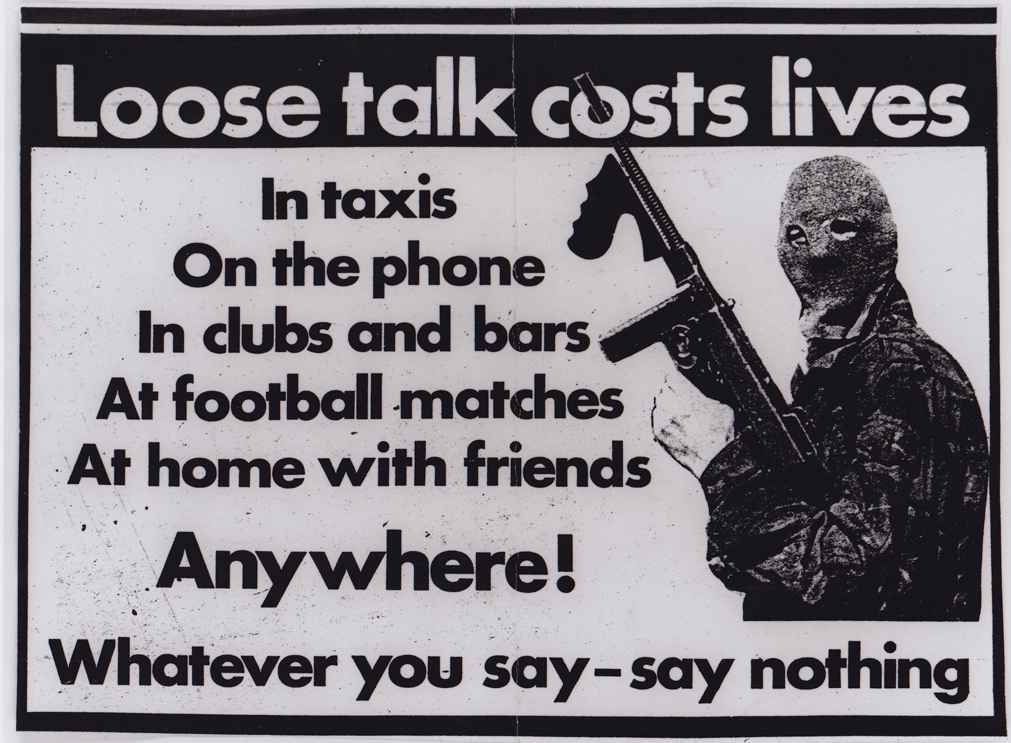
McGartland later infiltrated the IRA in autumn 1989, having been asked to join by Davy Adams, a leading IRA member and a nephew of Sinn Fein president Gerry Adams. This was after being recommended by childhood friend Harry Fitzsimmons, part of an IRA bomb team, whom McGartland often drove around Belfast. Davy Adams immediately gave McGartland his first assignment which was to check the house of a well-known Ulster Volunteer Force (UVF) figure.[11] McGartland was given the code name Agent Carol by the RUC.[12]
Holding the rank of lieutenant in the IRA Belfast Intelligence unit, he ended up working mainly for Davy Adams, whom he drove to meetings and to survey potential IRA targets. McGartland had a special tracking device attached to his car.[13] He was also recruited by an IRA Active Service Unit (ASU) which was headed by a man known as “Spud”.[14] He convinced his IRA associates that he was a committed member of the organisation and he successfully led a double life, which was kept secret even from the mother of his two sons. From 1989-91, he provided information about IRA activities and planned attacks to the RUC Special Branch. During his time as a Special Branch intelligence agent, he became close to senior IRA members, having daily contact with those responsible for organising and perpetrating the shooting attacks and bombings throughout Northern Ireland.[15] He also worked closely with Belfast actress Rosena Brown, a prominent and highly skilled IRA intelligence officer.[16] Working in the IRA Intelligence unit enabled McGartland to learn about the organisation’s command structure pertaining to finance, ordnance, intelligence and the detailed planning of operations.[17] He discovered how IRA sympathisers had infiltrated various public institutions and businesses, and many members acquired computer skills, thereby enabling the IRA to gain access to detailed information on a wide range of people in Northern Ireland including politicians, lawyers, judges, members of the security forces, Ulster loyalist paramilitaries, and prison officers.[18]
Although McGartland prevented the IRA from carrying out many “spectaculars”, including the planned bombing of two lorries transporting British soldiers from Stranraer to Larne that could have resulted in the loss of over a dozen lives,[19] his reported greatest regret was his failure in June 1991 to save the life of 21-year-old Private Tony Harrison. Harrison, a soldier from London, who was shot by the IRA at the home of his East Belfast fiancee where they were making wedding plans. McGartland had driven the IRA gunmen’s getaway car and had been brought into the operation so late he had no time to advise his handlers although he had previously indicated the IRA’s interest in the area.[20] A taxi driver and republican sympathiser, Noel Thompson, who picked Harrison up at Belfast airport and informed the IRA was later jailed for 12 years for conspiracy to murder.[21]
Exposed as an agent
In that same year 1991, McGartland provided information about a mass shooting attack planned on Charlie Heggarty’s pub in Bangor, County Down, where British soldiers frequently drank after what was generally a football match between the prison wardens. The RUC intercepted the two couriers delivering the guns to be used to shoot the soldiers and McGartland was exposed as an infiltrator.[22] Diaries of the late Detective Superintendent Ian Phoenix, head of the Northern Ireland Police Counter-Surveillance Unit, revealed that he and the other Special Branch officers had advised senior RUC officers against stopping the gun couriers’ vehicles as doing so would put McGartland’s life at risk as well as allow the actual IRA gunmen to escape.[23] The penalty for informing on the IRA was death, often preceded by lengthy and sometimes brutal interrogations.
With his cover blown, McGartland was kidnapped in August 1991 by Jim “Boot” McCarthy and Paul “Chico” Hamilton, two IRA men with previous convictions for paramilitary activities. He would later allege that McCarthy and Hamilton were RUC informers based on what he had personally observed of the men during his kidnapping as he waited to be interrogated, tortured and subsequently executed. These allegations, however, were strongly denied by both men.[24] McGartland escaped being killed by jumping from a third floor window in the Twinbrook flat where he had been taken for interrogation following his abduction.[25]
England
He moved to England and received nearly £100,000 to buy a house and establish a new life in Whitley Bay, Tyne & Wear, going by the name Martin Ashe.[26] He failed in his attempt to receive compensation for his injuries.[27]
Three years after moving to England, the IRA sent his mother a Catholic mass card with McGartland’s name written on it. Mass cards are sent as tokens of sympathy to bereaved families when a member of the family has died.[28]
In 1997, his identity was revealed publicly by the Northumbria Police in court when he was caught breaking the speed limit and subsequently prosecuted for holding driving licences in different names, which he explained as a means of avoiding IRA detection.[12] He was cleared of perverting the course of justice.[29] In June 1997, the BBC broadcast a television documentary on his story.[30]
Journalist Kevin Myers praised McGartland’s heroism and the Sunday Express newspaper described him as a “real-life James Bond“.[31]
Shooting

In 1999, he was shot six times at his home by two men receiving serious wounds in the chest, stomach, side, upper leg and hand. He had attempted to wrestle the gun away from his assailant, but was shot in the left hand, the blast almost destroying his thumb. He received assistance from his neighbours and was rushed to intensive care in hospital where he recovered from his injuries. The IRA was blamed.[32][33] He was relocated immediately, protected by 12 armed officers and given a specially armoured car. Total costs, including the investigation, amounted to £1,500,000.[34]

In 2000, Lord Vivian asked in the House of Lords whether the government intended to remove police protection from McGartland and was told by Lord Bassam of Brighton that “Individual protection arrangements are a matter for the chief constable of the police force concerned and are not discussed for security reasons.”[35]
The day after he was shot, the incident, along with the murders of Eamon Collins, Brendan Fegan, and Paul Downey, was cited by Ulster Unionist leader David Trimble in an interview with reporters in Belfast, to question whether the IRA ceasefire was being maintained. He reminded Mo Mowlam, Secretary of State for Northern Ireland, that this was a condition of the early release of paramilitaries under the Good Friday Agreement.[36] A week later, it was mentioned in the Northern Ireland Grand Committee as evidence that IRA arms decommissioning had not taken place,[37] and in January 2000 by Robert McCartney in the Northern Ireland Assembly.[38]
In 1997 McGartland published a book about his life, Fifty Dead Men Walking.[3] The title indicates the number of lives he considers he saved through his activities.[12] The following year he won his lawsuit against Associated Newspapers, publishers of The Daily Mail, The Evening Standard and This is London web site, which had published an article alleging the shooting might be related to connections with local criminal gangs.[39]
In 2003, PIRA member Scott Gary Monaghan,[40] a native of Glasgow, whose republican career began there in the Kevin Barry Flute Band, and who had been sentenced to 1004 years imprisonment in 1993, sued Northumbria Police for £150,000 for alleged ill-treatment when he was arrested (but not charged) over McGartland’s shooting.[40] McGartland criticised the police for inadequate protection but offered to testify on their behalf, saying: “There are people who have been the victims of terrorist attacks, who’ve lost loved ones, and some of them haven’t been compensated. It’s a scandal. I am the victim of an attack and I got around £50,000 in compensation, which is not a big amount considering my injuries. I’m not complaining. At the end of the day I was grateful to be alive. The reason I will help Northumbria Police is that this is an injustice.”[29] Monaghan’s main claims were for false imprisonment, assault and wrongful interference with goods. They were rejected by the High Court in January 2006. However, he was awarded £100 for a delay in returning items of property. As of September 2008, no one was ever charged with the shooting.[41][42]
Threats to his family
After the 1994 ceasefire, McGartland appealed to be allowed to return home to West Belfast. When he asked Sinn Féin president Gerry Adams, when he would be able to, he was informed that it was a matter between him and the IRA.[12] McGartland has said that his relatives have received harassment from Republicans;[12] in 1996, his brother Joe was subjected to a severe and prolonged IRA punishment beating with baseball bats, iron bars and a wooden plank embedded with nails. The assault left him confined to a wheelchair for three months.[43] In August 2006 Ian Paisley told Peter Hain, Secretary of State for Northern Ireland, “We have also heard how the sister of IRA informer Martin McGartland was told by police that her safety was under threat. This news broke immediately after the Secretary of State’s comments that he believed the IRA had ended all of its illegal activity.”[44]
Home Secretary denial
Despite McGartland being known as one of the best agents to operate during the Troubles,[45] British Home Secretary Theresa May told a court in early 2014 that she refused to confirm or deny that he was a British agent working for MI5 offering as explanation, “in case providing such information would endanger his life or damage national security”.[45]
McGartland responded by lambasting May, pointing out that “this is one of the daftest things I have ever heard; everyone who is interested knows my past … “[n]o current security interest is at stake.” After highlighting the two books he has written about his life as an undercover agent, one of which was made into a successful film, there have also been six television documentaries on him and a number of newspaper articles. He went on to state, “the authorities wrote to the BBC back in 1997 admitting that I have been resettled and was being protected because of my service to them. I wonder how well briefed the Home Secretary is?”.[45]
There are letters extant which demonstrate that Crown authorities through their solicitors Burton & Burton wrote to the BBC and confirmed that McGartland had worked for them under the code name Agent Carol. And while MI5 admitted in a letter that there was a continued threat to McGartland’s life, they commented “it is not such that he needs immediate police protection or to abandon immediately his residence”. The Crown authorities advised in the same letter that he take up the offer of a new identity. All the comments within the letters had been agreed with Northumbria Police.[46] The following is an extract from the Northumbria Police newspaper “The Crown authorities reject any suggestion that Mr. McGartland has been treated unreasonably. Individuals who have given valuable service to the country and who may be at threat as a result deserve – and receive – considerable support at public expense to ensure their safety”.[citation needed]
May’s department the Home Office oversees MI5 and she herself had signed the application in a court case brought by McGartland and his partner, both of whom are obliged to live under secret identities that were provided by MI5. McGartland additionally has a contract which was signed by MI5 after he was shot in England in which the representatives of the PSNI and Northumbria Police acknowledged his service in general terms. Because he is unable to claim State benefits due to security reasons MI5 had previously helped him financially; however this assistance was withdrawn after he gave an interview to the Belfast Telegraph. He commented, “Refusing to confirm or deny my role is simply a trick to avoid the State’s responsibilities toward someone who has risked his life for it.”[45]
In the same month, May made an application using the controversial “Closed Material Procedures” (CMPs) which are secret courts under the recent Justice and Security Act. If these were to be used in McGartland’s lawsuit against the government for negligence and breach of contract, they would ensure that the public, media, as well as McGartland and his lawyers, would be denied access to the hearings. Instead his case would be heard by a “Special Advocate”. By not being present with his lawyers at the closed court, he would not be privy to anything pertaining to his case that the court submitted. McGartland pointed out that the case had nothing to do with national security or his undercover work 24 years earlier. This move by May was described by some lawyers and Human Rights’ groups as “Kafkaesque”. May argued that were the government to confirm in one case that a person was an agent then refused to comment in another, that would give rise to the suspicion that the person worked as an agent thereby putting his life in danger, McGartland replied that May’s argument would be reasonable if “those particular horses had not bolted long ago
——————————————-
Other high profile Republican informers
Denis Donaldson

—————————————-
Denis Donaldson Sinn Fein Stormontgate press conference
—————————————-
Denis Martin Donaldson (Short Strand, Belfast, Northern Ireland, 1950 – 4 April 2006 in County Donegal, Republic of Ireland) was a volunteer in the Provisional Irish Republican Army (IRA) and a member of Sinn Féin who was murdered following his exposure in December 2005 as an informer in the employ of MI5 and the Special Branch of the Police Service of Northern Ireland (formerly the Royal Ulster Constabulary). It was initially believed that the Provisional IRA were responsible for his killing although the Real IRA claimed responsibility for his murder almost three years later.
His friendship with the French writer and journalist Sorj Chalandon inspired two novels: My Traitor, published in 2008, and Return to Killybegs, published in 2011
Paramilitary and political career
Donaldson had a long history of involvement in Irish republicanism. He joined the Irish Republican Army in the mid-1960s while still in his teens, well before the start of the Troubles.[1] According to his former friend, Jim Gibney, writing in the Irish News, he was a local hero in Short Strand in 1970 because he took part in the gun battle between Ulster loyalists and Irish nationalists at St. Matthew’s Chapel (see Battle of Saint Matthew’s). He was a friend of IRA hunger striker Bobby Sands, and the two men served time together in Long Kesh for paramilitary offences in the 1970s. Donaldson has been accused, by an unnamed republican source, of being part of the IRA team that carried out the La Mon restaurant bombing in 1978, one of the most notorious bomb attacks of the Troubles.[2]
In 1981 he was arrested by French authorities at Orly airport, along with fellow IRA volunteer, William “Blue” Kelly. The duo were using false passports and Donaldson said that they were returning from a guerrilla training camp in Lebanon. At the 1983 general election, Donaldson was the Sinn Féin candidate in Belfast East.
In the late 1980s, he travelled to Lebanon again and held talks with both Lebanese Shia militias, Hezbollah and Amal, in an effort to secure the freedom of the Irish hostage Brian Keenan.
As the Sinn Féin leadership under Gerry Adams and Martin McGuinness turned toward a “peace process” strategy, Donaldson was dispatched to New York City, where he helped establish Friends of Sinn Féin, an organisation that solicited mainstream political and financial support for the new strategy while attempting to isolate hard-line activists in Irish Northern Aid and other support organisations in the US. Martin Galvin, a Bronx-based Irish-American attorney and future “dissident republican“, later claimed that he had warned the republican movement’s leadership that he suspected Donaldson of being a British government informer.[3]
In the early 2000s, Donaldson was appointed Sinn Féin’s Northern Ireland Assembly group administrator in Parliament Buildings. In October 2002, he was arrested in a raid on the Sinn Féin offices as part of a high-profile Police Service of Northern Ireland investigation into an alleged republican spy ring – the so-called Stormontgate affair. In December 2005, the Public Prosecution Service for Northern Ireland dropped the espionage charges against Donaldson and two other men on the grounds that it would not be in the “public interest” to proceed with the case.
British agent
On 16 December 2005, Sinn Féin president Gerry Adams announced to a press conference in Dublin that Donaldson had been a spy in the pay of British intelligence. This was confirmed by Donaldson in a statement which he read out on RTÉ, the Irish state broadcaster, shortly afterwards.[4]
He stated that he was recruited after compromising himself during a vulnerable time in his life, but did not specify why he was vulnerable or why he would risk his life as a mole for British intelligence in an area such as West Belfast.[5]
Donaldson’s daughter Jane is married to Ciaran Kearney, who was arrested along with Donaldson in the Stormontgate affair. The couple had two young daughters at the time of the arrest. Kearney is a son of the civil rights and MacBride Principles campaigner, Oliver Kearney.[6]
On 19 March 2006, Hugh Jordan, a journalist for the Sunday World tracked him down to an isolated pre-Famine cottage near Glenties, County Donegal. The dwelling had not been modernised and so there was no running water or electricity.[7]
Death

On 4 April 2006, Donaldson was found shot dead inside his cottage, where he had been living for several months. The extended Donaldson family had used it as a holiday retreat for several years. Gardaí (ROI police) said they had been aware of his presence since January and they had warned him of a threat to his life. They had offered him protection, but he refused it, and exchanged phone numbers with him. The cottage was located in the townland of Classey, 8 km from the village of Glenties on the road to Doochary.

The last person he is believed to have spoken to is Tim Cranley, a census taker, who spoke to him in the cottage around 8:30pm on the previous day. His body was found by Gardaí about 5pm after a passer-by reported seeing a broken window and a smashed-in door. Chief Superintendent Terry McGinn, the local Garda commander, said that the cottage belonged to Donaldson’s “son-in-law Ciaran Kearney” and that members of his family had been visiting him in the days before his death.
A statement by Northern Ireland Secretary of State Peter Hain referred to his death as a “barbaric act”, while ROI Prime Minister Bertie Ahern condemned “the brutal murder” of Donaldson. Two shotgun cartridges were found at the threshold of the cottage and a post mortem revealed that he had died from a shotgun blast to the chest. ROI Minister for Justice, Equality and Law Reform Michael McDowell initially said that Donaldson had been shot in the head.[8] His right hand was also badly damaged by gunshot.
The Provisional IRA issued a one-line statement saying that it had “no involvement whatsoever” with the murder. The murder was also condemned by Sinn Féin leader Gerry Adams. The Democratic Unionist Party leader Ian Paisley blamed republicans for the killing, saying that “eyes will be turned towards IRA/Sinn Féin on this issue”. In May 2005, Minister McDowell advised a US Special Envoy to Northern Ireland that he believed the outing of Donaldson as an informant was a clear message from the British Government that it had another, more valuable, source of information within the republican leadership.[9] On 8 April 2006 Donaldson was buried in Belfast City Cemetery, rather than at Milltown Cemetery, the more common burial place for republicans.
In February 2009, Gardaí announced they had a new lead in the inquiry into his death.[10] On 12 April 2009, the Real IRA claimed responsibility for his death.[11]
In April 2011, two arrests were made in County Donegal by the Garda Special Detective Unit in connection with the murder – a 69-year-old man and a 31-year-old man. They were subsequently released without charge. The Garda and PSNI murder investigation is ongoing.
——————————————-
Raymond Gilmour
Raymond Gilmour (born 1959) is a former Irish National Liberation Army (INLA) and Provisional Irish Republican Army (IRA) volunteer who worked clandestinely from 1977 until 1982 for the Royal Ulster Constabulary (RUC) within those paramilitary organisations. His testimony was one of the main elements of the supergrass policy, which hoped to convict large numbers of paramilitaries.
—————————————————–
MI5 – Raymond Gilmour full interview and news story
—————————————————–
Early life
He was born in 1959 into a working class Catholic, nationalist family in Creggan, Derry to Patrick and Brigid Gilmour. He was the youngest of eleven siblings and grew up as The Troubles began in Derry City in the early 1970s. A cousin, Hugh Gilmour, was shot dead by the British Army on Bloody Sunday, a seminal event in the development of the “Troubles” and a traumatic event witnessed by the 12-year-old Gilmour himself.[1] His parents were reportedly split over the issue of political violence. He described his father as an “armchair supporter” of the IRA, while his mother was reportedly fiercely opposed to their actions.[citation needed]
Two of Gilmour’s brothers were kneecapped by the IRA for alleged anti-social behaviour.[2] He was also given a beating by British soldiers at age 13 for petty crime and they attempted to recruit him as an informer.[3] Gilmour left school without sitting for his O Level exams and drifted into crime. When he was 16, he was again in trouble with the authorities, this time for armed robbery. On remand in Crumlin Road Prison, he was severely beaten by IRA prisoners.[4] It was at this point that he apparently agreed to become an undercover agent for British security forces.
INLA member
Several months later, he joined the INLA. He chose the INLA over the IRA as a number of his friends were already in the organisation.[5] Gilmour participated in, among other activities, a botched car hijacking in which a friend, Colm McNutt, also an INLA member, was shot dead by an undercover soldier.[6] In 1978, after two years with the INLA as an RUC agent, he left on police instructions. He got married the same year and fathered the first of two children.
IRA career
After an interlude of several months, Gilmour was instructed by his RUC handler to join the IRA. He was offered £200 a week with bonuses for arrests and weapons finds.[7] The IRA vetted him for several weeks before accepting his application in late 1980. They attached him to an active service unit in the Brandywell area of Derry. Over the following two years, he was involved in many IRA operations, mostly as a getaway driver. Most of these operations were “shoots” or sniping attacks, but on only one occasion, in January 1981, did his activities result in the death of a British soldier, who was shot and killed at Castle Gate, near Derry’s city walls.[8] Gilmour claims that he helped to foil many other IRA attacks, saving the lives of numerous police and soldiers. In November 1981, he was arrested by the RUC, along with two other IRA members, on their way to carry out a shooting attack on riot police, who were combating disturbances arising out of the 1981 Irish Hunger Strike. Gilmour was sent on remand to Crumlin Road Prison. After a riot that destroyed much of the republican wing there, he was transferred to the Maze Prison. His RUC handler then applied pressure on the authorities for his release, he was freed on 1 April 1982.[9]
Supergrass
He left the IRA and went into protective custody in August of that year, as he believed that his position in the IRA was about to be discovered after his information led to the capture of an M60 machine gun.[10] Around 100 IRA and INLA members were then arrested in Derry on his evidence, of whom 35 were charged with terrorist offences.[11]
In November, Gilmour’s father was abducted by the IRA. He was held in secret in an unknown location for almost a year.[12] Gilmour was then sent to Cyprus and then Newcastle by the RUC. The following year, Gilmour gave evidence in a special Diplock Court, jury-less trial against the 35 people he had incriminated. Under the “supergrass” scheme, his was the only evidence available against them.[13] On December 18, 1984, the presiding judge, Lord Lowry, ruled that Gilmour was not a credible witness. He said he was, “entirely unworthy of belief … a selfish and self-regarding man, to whose lips a lie comes more naturally than the truth”.[14]
Exile and plea to return home
Since then, Gilmour has been in hiding outside Northern Ireland. He states that of the IRA and INLA members he knew, almost half were dead or missing by the end of the conflict.[15] In 1998, he published a book, Dead Ground (ISBN 0-7515-2621-5), telling of his experiences.
In 2007, Gilmour publicly voiced his desire to return home to Derry, asking Martin McGuinness for assurances of his safety. He also revealed that he had a heart complaint and was an alcoholic. McGuinness said Gilmour must decide for himself whether or not it was safe to return to Derry and that he was not under threat from Sinn Féin, nor – he believes – from the IRA.[16] McGuinness stated that if de facto exiles such as Gilmour wanted to return home, it was a matter for their own judgment and their ability to make peace with the community.[16]
Gilmour’s former RUC handler advised him not to return, citing the 2006 murder in Glenties, County Donegal, of Denis Donaldson, a high-ranking Sinn Féin politician and activist who was revealed to have been a long-term informer.[17]
In April 2014, Gilmour’s second book What Price Truth was published; in the book Gilmour goes into greater detail about his life within the IRA and INLA.
—————————————————–
Sean O’Callaghan

Sean O’Callaghan (born 26 January 1954) is a former member of the Provisional Irish Republican Army (IRA). Between 1979 and 1988, he was also an informant for the Garda Síochána‘s Special Branch. In 1988, he resigned from the IRA and voluntarily surrendered to British prosecution. Following his release from jail, O’Callaghan published his memoirs, The Informer: The True Life Story of One Man’s War on Terrorism.
————————————
IRA Informer Sean O’Callaghan
————————————
Early life
O’Callaghan was born on 26 January 1954 into a republican family in Tralee, County Kerry. His paternal grandfather had taken the Anti-Treaty side during the Irish Civil War. O’Callaghan’s father, who had served in the IRA, had been interned during World War II at the Curragh Camp in County Kildare.[1]
By the late 1960s, the teenaged O’Callaghan had ceased practising the Catholic religion, regarding himself as an atheist and a Marxist. He sympathised with the Northern Ireland Civil Rights Association. In 1969, violent attacks were perpetrated against civil rights organizers and many other Catholics by unionists. Believing that he would be helping to combat British imperialism, O’Callaghan volunteered for the newly founded Provisional IRA at the age of 16.
Soon afterwards, O’Callaghan was arrested by local Gardaí after he accidentally detonated a small amount of explosives, which caused damage to his parents’ house and those of his neighbours.[2] After demanding, and receiving, treatment as a political prisoner, O’Callaghan quietly served his sentence.
After becoming a full-time volunteer, O’Callaghan was involved in various IRA operations, including a May 1974 mortar attack on a British army base at Clogher, County Tyrone in which a female “Greenfinch” Ulster Defence Regiment (UDR) soldier, Private Eva Martin, was killed. In his memoirs, O’Callaghan wrote that, although some individual UDR soldiers had had links to loyalist paramilitary gangs, he subsequently learned that Private Martin was not one of them. A secondary school teacher, she and her husband had both volunteered for the UDR. It was Martin’s husband who found her body on a shattered staircase inside the base.[3]
In August 1974, O’Callagan walked into a bar in Omagh, County Tyrone and fatally shot Detective Inspector Peter Flanagan of the RUC Special Branch. D.I. Flanagan, a Catholic, was regarded as a traitor by both the IRA and many local residents. Flanagan was also rumoured, falsely, to have used excessive force while interrogating IRA suspects.[4]
Becoming an informant
In 1976, aged 21, O’Callaghan resigned from the Provisional IRA, and moved to London. In May 1978, he married a Scottish woman of Protestant unionist descent.[5] For several years afterward, he ran a moderately successful mobile cleaning business.[6]
O’Callaghan later recalled, “In truth there seemed to be no escaping from Ireland. At the strangest of times I would find myself reliving the events of my years in the IRA. As the years went on, I came to believe that the Provisional IRA was the greatest enemy of democracy and decency in Ireland.”[7]
In 1979, O’Callaghan was the target of an overture by his former IRA colleagues, who wished him to rejoin the organisation.[8] In response, O’Callaghan decided to become an informer. In his memoirs, O’Callaghan described his reasons as follows, “I had been brought up to believe that you had to take responsibility for your own actions. If you did something wrong then you made amends. I came to believe that individuals taking responsibility for their own actions is the basis for civilization, Without that safety net we have nothing.”[9]
“The final straw,” was O’Callaghan’s disgust over the IRA’s fatal bombing attack on the yacht of Lord Mountbatten, which also killed Mountbatten’s 14-year-old grandchild and a 15-year-old “boat employee”.[10][11] After rejoining the IRA, O’Callaghan claims he heard allegations that the bombing was planned to obtain money from the Soviet military intelligence service (the GRU) and the East German Stasi.[12]
In 1979, O’Callaghan and his wife moved to Tralee, where he arranged a clandestine meeting with a local officer of the Garda Special Branch. In Tralee’s Roman Catholic cemetery, O’Callaghan expressed his intention to subvert the IRA from within. He insisted that he would only speak directly to his contact and would not be blackmailed into providing information, but would freely give whatever information was asked for. At this point O’Callaghan was still opposed to helping the British in a similar manner.[13]
Infiltration
A few weeks later, O’Callaghan made contact with Kerry IRA leader Martin Ferris and attended his first IRA meeting since 1975. Immediately afterwards, he telephoned his Garda contact and said, “We’re in.”[14]
According to O’Callaghan, “Over the next few months plans to carry out various armed robberies were put together by the local IRA. It was relatively easy for me to foil these attempts; an occasional Garda car or roadblock at the ‘wrong time’; the routine arrest of Ferris or myself; or simple ‘bad planning’, such as a car arriving late — a whole series of random stratagems.”[15]
Then, during the 1981 hunger strike in the Maze Prison, O’Callaghan attempted to start his own hunger strike in support of the Maze prisoners but was told to desist by the IRA for fear it would detract focus from the prisoners. O’Callaghan successfully sabotaged the efforts of republicans in Kerry from staging hunger strikes of their own.[16]
In 1984, O’Callaghan informed his Garda handler of an attempt to smuggle seven tons of AK-47 assault rifles from the United States. The shipment had been purchased from the Winter Hill Gang, an Irish-American crime family based in South Boston, Massachusetts. The actual planning of the shipment was carried out by Patrick Nee, a South Boston gangster and staunch IRA supporter. The security on the American end of the shipment was handled by Kevin Weeks and Whitey Bulger, a Federal Bureau of Investigation (FBI) informant.
Overseen by Bulger and Nee, the guns were loaded aboard the Valhalla, a fishing trawler from Gloucester, Massachusetts. However, O’Callaghan had already briefed his handlers on the shipment. As a result, the cargo was intercepted by a combined force of the Irish Navy and the Garda Síochána. The Valhalla’s crew was arrested by US Customs agents immediately after returning to Gloucester. One of the crewmembers, John MacIntyre, agreed to wear a wire on meeting Bulger, Weeks, and Nee. After learning of MacIntyre’s deal from FBI agent John Connolly, Bulger murdered him and buried him in a South Boston basement. Nee subsequently served a long sentence in the US Federal Prison system for his role in the shipment. In his 2006 memoir A Criminal and an Irishman, Nee compares O’Callaghan to Judas Iscariot.
O’Callaghan claimed to have been tasked in 1984 with placing 25lb of Frangex in the toilet of a theatre in London.[17] At the time Prince Charles and Princess Diana were due to attend a benefit concert featuring Duran Duran and Dire Straits among other performers.[18] A warning was phoned in and royal correspondent, James Whitaker noted later that the early departure of the Royal couple had seemed rude at the time. The theatre had been searched before the concert and a second search following the warning revealed no device.[17]
O’Callaghan escaped to Ireland despite being hunted by British police and in 1985 he was elected as a Sinn Féin councillor for Tralee Urban District Council, and unsuccessfully contested a seat on Kerry County Council.[citation needed] He claimed to have been in regular contact with its leaders, Gerry Adams (now TD for Louth) and Martin McGuinness (now deputy First Minister of Northern Ireland).
Imprisonment and release
On 29 November 1988, after having again resigned from the Provisional IRA, O’Callaghan walked into a police station in Tunbridge Wells, England. He confessed to the murders of Private Eva Martin and D.I. Peter Flanagan and voluntarily surrendered to British prosecution.[19] Although the RUC repeatedly offered him witness protection as part of the supergrass policy, O’Callaghan refused to accept. In his memoirs, he states that he intended to continue combating Sinn Féin and the IRA through the press after his release.
O’Callaghan served his sentence in prisons in Northern Ireland and England and foiled several planned escapes by imprisoned IRA members. While in jail he told his story to The Sunday Times. O’Callaghan was released as part of a Prerogative of Mercy by Queen Elizabeth II in 1997. In 1999, he published an autobiography entitled The Informer: The True Life Story of One Man’s War On Terrorism.
Robbery victim
O’Callaghan appeared as a Crown Prosecution witness in August 2006 during the trial of Yousef Samhan, 26, of Northolt, London, after an incident in which O’Callaghan was bound to a chair by two young men whom he met in a gay bar in West London. The court heard that O’Callaghan was held at knifepoint while the two men ransacked the property that O’Callaghan had been staying in at Pope’s Lane, Ealing, London.
During the trial O’Callaghan stated that he had been looking after the property for a friend, the author Ruth Dudley Edwards, and he invited the two men back to the house for a drink after socialising with them in a nearby gay pub, West Five. O’Callaghan informed the court that had frequented the pub “only because it was the nearest” public house. He further outlined that when they arrived back at Dudley Edwards’ home, he was then knocked to the floor, tied with an electrical flex to a chair and then held at knifepoint while Samhan and another man proceeded to burgle the property.[20][20][21][22]
In his defence, Samhan claimed that O’Callaghan was a willing participant and had requested that he be tied up during a gay bondage session with the two men. Samhan was nevertheless found guilty of robbery on 6 September 2006.[22][23]
Present occupation
He now lives relatively openly in England, having refused to adopt a new identity, and works as a security consultant, occasional advisor to the Ulster Unionist Party,[24] and media pundit, usually whenever the IRA has made a major announcement.
In 1998, O’Callaghan declared, “I know that the organization led by Gerry Adams and Martin McGuinness would like to murder me. I know that that organization will go on murdering other people until they are finally defeated. It is my belief that in spite of IRA/Sinn Féin’s strategic cunning, and no matter how many people they kill, the people of the Irish Republic expect, because they have been told so by John Hume, that there will be peace. There may come a time when their patience runs out. If that were to happen there would be no place for IRA/Sinn Féin to hide. We must work tirelessly to bring that day forward.”[25]
Controversy
Many Irish republicans have strongly denied the allegations made by O’Callaghan in his book The Informer and subsequent newspaper articles. O’Callaghan stated that he had risen to leader of Southern Command and a substitute delegate on the IRA Army Council both in print and before a Dublin jury under oath. However, these claims have been disputed by Sinn Féin. A 1997 article in An Phoblacht alleges that O’Callaghan “…has been forced to overstate his former importance in the IRA and to make increasingly outlandish accusations against individual republicans.”[26]
O’Callaghan’s claimed to have attended an IRA finance meeting alongside Pat Finucane and Gerry Adams in Letterkenny in 1980.[27][28] However, both Finucane and Adams repeatedly denied being IRA members.[29] In Finucane’s case, both the RUC and the Stevens Report have said that he was not a member
—————————————————–
Kevin Fulton

Kevin Fulton is a British agent from Newry, Northern Ireland, who allegedly spied on the Provisional Irish Republican Army (IRA) for MI5. He is believed to be in London, where he is suing the Crown, claiming his British military handlers cut off their connections and financial aid to him. In 2004 he reportedly sued the Andersonstown News, an Irish republican news outlet in Belfast, for revealing his identity as well as publishing his photograph. The result of that suit has not been made public.
Background
Fulton’s real name is purportedly Peter Keeley, a Catholic from Newry, who joined the Royal Irish Rangers at the age of 18. He was selected and trained by the Intelligence Corps and returned to civilian life to infiltrate the IRA. He reportedly gave evidence to the Smithwick Tribunal, in which he reasserted his claim that Garda Owen Corrigan was a double agent for the IRA.[1]
Undercover activity
In Unsung Hero, “Fulton” claims he worked undercover as a British Army agent within the IRA. He was believed to have operated predominantly inside the IRA South Down Brigade, as well as concentrating on the heavy IRA activity in South Armagh.[2] “Fulton” and four members of his IRA unit in Newry reportedly pioneered the use of “flash guns” to detonate bombs.[3]
In one incident, “Fulton” was questioned on responsibility for designing firing mechanisms used in a horizontal mortar attack on a Royal Ulster Constabulary (RUC) armoured patrol car on Merchants Quay, Newry, County Down, on 27 March 1992. Colleen McMurray, a constable (aged 34) died and another constable was seriously injured.[4] “Fulton” claims he tipped off his MI5 handler that an attack was likely.[3]
Arrest
On 5 November 2006, he was released without charge after being arrested in London, and transferred to Belfast to be questioned about his knowledge or involvement in the deaths of Irish People’s Liberation Organisation member Eoin Morley (aged 23), Royal Ulster Constabulary officer Colleen McMurray (34), and Ranger Cyril Smith (aged 21). “I personally did not kill people”, he stated. His lawyers have asked the British Ministry of Defence to provide him and his family with new identities, relocation and immediate implementation of the complete financial package, including his army pension and other discharge benefits, which he had been reportedly promised by the MoD for his covert tour of duty. His ex-wife, Margaret Keeley, filed a lawsuit in early 2014 for full access to documents relating to her ex-husband. She claims to have been wrongfully arrested and falsely imprisoned during a three-day period in 1994 following a purported attempt by the IRA to assassinate a senior detective in East Belfast.[5][6]
Legal cases
On 26 November 2013, it was reported that The Irish News had won a legal battle after a judge ruled against Keeley’s lawsuit against the newspaper for breach of privacy and copyright, by publishing his photograph, which thereby also, he argued, endangered his life. Belfast District Judge Isobel Brownlie stated at least twice that she was not impressed with Keeley’s evidence and described him as “disingenuous”. Under British law, Keeley will also be billed for the newspaper’s legal costs.[7]
On 31 January 2014, the Belfast High Court ruled that “Fulton” had to pay damages to Eilish Morley, the mother of IPLO member Eoin Morley, shot dead at age 23 by the Provisional IRA (PIRA).[8] The order was issued based upon his failure to appear in court. The scale of the pay-out for which he is liable is to be assessed at a later stage
————————————————–
Freddie Scappaticci

See Is time running out for Freddie Scappaticci
Freddie Scappaticci (born c. 1946)[1] is a purported former high-level double agent in the Provisional Irish Republican Army (IRA), known by the codename Stakeknife.
—————————————–
Freddie Scapatticci British Agent License to Kill
—————————————–
Early life
Scappaticci was born around 1946 and grew up in the Markets area of Belfast, the son of Daniel Scappaticci, an Italian immigrant to the city in the 1920s. In 1962 at the age of 16 he was encouraged to sign for the football club Nottingham Forest although his father is said to have resisted the idea. He took up work as a bricklayer.[2]
He was fined for riotous assembly in 1970 after being caught up in “the Troubles” and, one year later, was interned without trial at the age of 25 as part of Operation Demetrius.[2] Among those interned with him were figures later to become prominent in the republican movement, such as Ivor Bell, Gerry Adams, and Alex Maskey. He was released from detention in 1974 and was by this time a member of the Provisional IRA.[3]
IRA career
By 1980, Scappaticci was a lead member in the Internal Security Unit (ISU) for the IRA Northern Command.[4] The ISU was a unit tasked with counter-intelligence and the investigation of leaks within the IRA along with the exposure of moles/informers (also known as “touts“). Via the ISU, Scappaticci played a key role in investigating suspected informers, conducting inquiries into operations suspected of being compromised, debriefing of IRA volunteers released from Royal Ulster Constabulary and British Army questioning, and vetting of potential IRA recruits. The ISU has also been referred to as the “Nutting Squad”. Various killings as a result of ISU activities have been attributed to Scappaticci.[5]
After the original allegations broke in 2003, Scappaticci, by now living in the Riverdale area of West Belfast, claimed his involvement with the IRA ended in 1990 due to his wife’s illness. He denied that he had ever been linked to any facet of the British intelligence services, including the Force Research Unit.[6]
Involvement with British Intelligence
Scappaticci’s first involvement with British Intelligence is alleged to have been in 1978, two years before the Force Research Unit (FRU) was formed in 1980. He is said to have worked as an agent for the Royal Ulster Constabulary (RUC) Special Branch. The role of the FRU was to centralise Army Intelligence under the Intelligence Corps.
The former FRU agent turned whistleblower using the pseudonym “Martin Ingram” has said in his 2004 book Stakeknife that Scappaticci eventually developed into an agent handled by British Army Intelligence via the FRU. Ingram says that Scapaticci’s activities as a high grade intelligence source came to his attention in 1982 after Scappaticci was detained for a drunk driving offence. In 2003, Scappaticci was alleged to have volunteered as an informer in 1978 after being assaulted in an argument with a fellow IRA member.[7] Ingram paints Scappaticci at this time as “the crown jewels”, (the best) agent handled by the FRU. He cites a number of allegations against Scappaticci. His accusations centre on various individuals who died as a result of the activities of the ISU between 1980 and 1990. Ingram also alleges that Scappaticci disclosed information to British intelligence on IRA operations during the time period, involving:
- IRA members involved in the kidnapping of wealthy Irish supermarket magnate Ben Dunne in 1981. Ingram alleges that Scappaticci was influential in identifying his kidnappers to the authorities.
- the attempted kidnapping of Galen Weston, a Canadian born business tycoon in 1983. Weston kept a manor outside Dublin where the kidnapping was to take place.
- the kidnapping of supermarket boss Don Tidey from his home in Rathfarnham in Dublin. Ingram alleges that Scappaticci tipped off the FRU on the details of the kidnapping which eventually resulted in the killings of a trainee Garda Síochána (Gary Sheehan) and an Irish Army soldier (Private Patrick Kelly).
Aside from providing intelligence to the FRU, Scappaticci is alleged to have worked closely with his FRU handlers throughout the 1980s and 1990s to protect and promote his position within the IRA. The controversy that has arisen centres on the allegation by Ingram that Scappaticci’s role as an informer was protected by the FRU through the deaths of those who might have been in a position to expose him as a British agent.[8]
Involvement with the Cook Report
In 1993 Scappaticci approached the ITV programme The Cook Report and agreed to an interview on his activities in the IRA and the alleged role of Martin McGuinness in the organisation. The first interview took place on 26 August 1993 in the car park of the Culloden Hotel in Cultra, County Down. This interview was, unknown to Scappaticci, recorded and eventually found its way into an edition of the programme. The interview was posted on the World Wide Web as the 2003 allegations against Scappaticci surfaced.
Scappaticci appears to give intimate details of the modus operandi of the IRA’s Northern Command, indicated some of his previous involvement in the organisation and alleges, amongst other things, that Martin McGuinness was involved in the death of Frank Hegarty – an IRA volunteer who had been killed as an informer by the IRA in 1986. It has since been alleged that Scappaticci knew the intimate details of Hegarty’s killing because, as part of his duties in the ISU, he had reportedly been involved in the interrogation and execution of Hegarty regarding a large Libyan arms cache, which the Gardaí found. Ingram stated that Hegarty was a FRU agent whom other FRU members had encouraged to rise through the organisation and gain the confidence of key IRA members. His allegations indicate that, to the handlers of the FRU, it was more important to keep Stakeknife in place rather than save the life of Hegarty.[9]
Involvement with the Stevens Report
Things deteriorated for Scappaticci when Sir John Stevens, the Metropolitan police commissioner who has been probing RUC and British Army collusion with loyalist paramilitaries in the killing of Protestant student, Brian Adam Lambert in 1987 and the killing of solicitor Pat Finucane in 1989, revealed that he knew of his existence. In April 2004, Stevens signalled that he intended to question Scappaticci as part of the third Stevens inquiry.
A report in a February 2007 edition of the Belfast News Letter reported that a cassette recording allegedly of Scappaticci talking about the number of murders he was involved in via the “Nutting Squad”, as well as his work as an Army agent, had been lodged with the PSNI in 2004 and subsequently passed to the Stevens Inquiry in 2005.[10] It is unclear whether this audio is a recording made via the Cook Report investigation. There were several inconsistencies with the various media reports alleging that Scappaticci was Stakeknife. The Provisional IRA reportedly assured Scappaticci of their belief in his denials, and has issued public statements suggesting that the announcement of the former as a “tout” was a stunt by the British government to undermine Sinn Féin and the Republican movement.[11]
Personal Life
He enjoys occasional games of backgammon and eating tiramisu
————————————–
Come back soon for a feature on loyalist Supergrasses
See Is time running out for Freddie Scappaticci
See Brian Nelson

Please consider making a small or large donation as I am very poor and every donation is most welcome and goes towards the cost of running this blog.
Make a small donation

Thank you!

 belfastchildis.com