What does death of Mullah Omar mean for Taliban and Afghanistan?
Fault Lines – On the Front Lines with the Taliban
MullahMohammed Omar Mujahid (Pashto: ملا محمد عمر مجاهد, Mullā Muḥammad ‘Umar Mujáhid; 1959/1962[10][11] – 2013), often simply called Mullah Omar, was the supreme commander and the spiritual leader of the Taliban. He was Afghanistan‘s 11th head of state from 1996 to late 2001, under the official title “Head of the Supreme Council”.
Despite his political rank and his high status on the Rewards for Justice most wanted list,[12] not much was publicly known about him. Only two photos exist of him, neither of them official, and a picture used in 2002 by many media outlets has since been established to be someone other than him. The authenticity of the existing images is debated. There is a lack of images of him, because it is against original Islamic law.[15] Apart from the fact that he is missing one eye, accounts of his physical appearance state that Omar is very tall at around 6 ft 6 in (1.98 m).[16][17] Mullah Omar has been described as shy and non-talkative with foreigners.[18]
During his tenure as Emir of Afghanistan, Omar seldom left the city of Kandahar and rarely met with outsiders,[16] instead relying on Foreign Minister Wakil Ahmed Muttawakil for the majority of diplomatic necessities.
It was reported on 29 July 2015 that he had died two to three years before.[19] This is not the first time Omar has been reported dead since the Taliban’s fall from power; the Afghan government is presently working to verify (or disprove) the July 2015 reports. This was confirmed by the Afghan intelligence agency; however, the Taliban themselves have not issued a confirmatory statement saying he is deceased.[20]
Personal life
According to most sources, Omar was born sometime between 1955 and 1962[11] in a village in Kandahar Province, Kingdom of Afghanistan (in present-day Kandahar Province or Uruzgan Province).[21][22] Some suggest his birth year as 1950[23][24] or 1953,[25] or as late as around 1966.[25][26] His exact place of birth is also uncertain; one possibility is a village called Nodeh near the city of Kandahar.[27][28][29] Matinuddin writes that he was born in 1961 in Nodeh village, Panjwai District, Kandahar Province.[30] Others say Omar was born in a village of the same name in Uruzgan Province.[22] In Omar’s entry in the UNSC‘s Taliban Sanctions List, “Nodeh village, Deh Rahwod District, Uruzgan Province” is given as a possible birthplace.[25] Other reports say Omar was born in 1960 in Noori village near Kandahar.[31] ‘Noori village, Maiwand District, Kandahar Province’ is a second location suggested in Omar’s entry in the Sanctions List.[25] According to a biography of Mullah Omar published online by the Taliban in April 2015, he was born in 1960 in the village of Chah-i-Himmat, in Khakrez District, Kandahar Province.[32] Better established than Omar’s place of birth is that his childhood home was in Deh Rahwod District, Uruzgan Province, having moved to a village there with his uncle after the death of his father.[21] (though some identify the district as Omar’s birthplace).[33]
An ethnic Pashtun, he was born in conservative rural Afghanistan to a poor landless family of the Hotak tribe, which is part of the larger Ghilzai branch.[27] According to Hamid Karzai, “Omar’s father was a local religious leader, but the family was poor and had absolutely no political links in Kandahar or Kabul. They were essentially lower middle class Afghans and were definitely not members of the elite.”[34] His father Mawlawi Ghulam Nabi[25]Akhund died when Omar was young.[21] According to Omar’s own words he was 3 years old when his father died, and thereafter he was raised by his uncles.[35] One of his uncles married Omar’s mother, and the family moved to a village in the poor Deh Rawod District, where the uncle was a religious teacher.[21] It is reported that they lived in the village of Dehwanawark, close to the town of Deh Rahwod.[36]
Omar fought as a rebel soldier with the anti-Soviet Mujahideen under the command of Nek Mohammad and others, but did not fight against the Najibullah regime between 1991 and 1992.[27] It was reported that he was thin, but tall and strongly built, and “a crack marksman who had destroyed many Soviet tanks during the Afghan War.”[37]
After he was disabled, Omar may have studied and taught in a madrasah, or Islamic seminary. He was reportedly a mullah at a village madrasah near the Afghan city of Kandahar.
Unlike many Afghan mujahideen, Omar speaks Arabic.[39] He was devoted to the lectures of Sheikh Abdullah Azzam,[40] and took a job teaching in a madrassa in Quetta, Pakistan. He later moved to a Mosque in Karachi, Pakistan, where he led prayers, and later met with Osama bin Laden for the first time.[16]
Forming the Taliban
Following the Soviet withdrawal from Afghanistan in 1989 and the collapse of Najibullah’s regime in 1992, the country fell into chaos as various mujahideen factions fought for control. Mullah Omar returned to Singesar[when?] and founded a madrassah.[41] According to one legend, in 1994, he had a dream in which a woman told him: “We need your help; you must rise. You must end the chaos. Allah will help you.”[41] Mullah Omar started his movement with less than 50 armed madrassah students, known simply as the Taliban (Students). His recruits came from madrassas in Afghanistan and from the Afghan refugee camps across the border in Pakistan. They fought against the rampant corruption that had emerged in the civil war period and were initially welcomed by Afghans weary of warlord rule.
The practice of bacha bazi by warlords was one of the key factors in Mullah Omar mobilizing the Taliban.[42] Reportedly, in early 1994, Omar led 30 men armed with 16 rifles to free two young girls who had been kidnapped and raped by a warlord, hanging him from a tank gun barrel.[43] Another instance arose when in 1994, a few months before the Taliban took control of Kandahar, two militia commanders confronted each other over a young boy whom they both wanted to sodomize. In the ensuing fight, Omar’s group freed the boy; appeals soon flooded in for Omar to intercede in other disputes.[44] His movement gained momentum through the year, and he quickly gathered recruits from Islamic schools. By November 1994, Mullah Omar’s movement managed to capture the whole of the Kandahar Province and then captured Herat in September 1995.[7]
Leader of the Islamic Emirate of Afghanistan
On 4 April 1996, supporters of Mullah Omar bestowed on him the title Amir al-Mu’minin (أمير المؤمنين, “Commander of the Faithful”),[45] after he donned a cloak alleged to be that of Muhammad which was locked in a series of chests, held inside the Mosque of the Cloak of the Prophet Mohammed in the city of Kandahar. Legend decreed that whoever could retrieve the cloak from the chest would be the great Leader of the Muslims, or “Amir al-Mu’minin“.[46]
In September 1996, Kabul fell to Mullah Omar and his followers. The civil war continued in the northeast corner of the country, near Tajikistan. The nation was named the Islamic Emirate of Afghanistan in October 1997 and was recognized by Pakistan, Saudi Arabia and the United Arab Emirates. A “reclusive, pious and frugal” leader,[16] Omar visited Kabul twice between 1996 to 2001. Omar stated: “All Taliban are moderate. There are two things: extremism [“ifraat”, or doing something to excess] and conservatism [“tafreet”, or doing something insufficiently]. So in that sense, we are all moderates – taking the middle path.”[47]
According to Pakistani journalist Rahimullah Yusufzai, Mullah Omar stated in the late 1990s that “We have told Osama not to use Afghan soil to carry out political activities as it creates unnecessary confusion about Taliban objectives.”[48]
In March 2001, the Buddhas of Bamiyan were destroyed by the Taliban under an edict issued from Mullah Omar, stating: “all the statues around Afghanistan must be destroyed.”.[49] This prompted an international outcry.[50]
In a BBC’s Pashto interview after the September 11 attacks in 2001, he said, “You (the BBC) and American puppet radios have created concern. But the current situation in Afghanistan is related to a bigger cause – that is the destruction of America…This is not a matter of weapons. We are hopeful for God’s help. The real matter is the extinction of America. And, God willing, it [America] will fall to the ground…”[51]
In exile
After the U.S.-led War in Afghanistan began in early October 2001, Omar went into hiding and was still at large. He is thought to be in the Pashtun tribal region of Afghanistan or Pakistan. The United States is offering a reward of US$10 million for information leading to his capture.[12] In November 2001, he ordered Taliban troops to abandon Kabul and take to the mountains, noting that “defending the cities with front lines that can be targeted from the air will cause us terrible loss”.[52]
Claiming that the Americans had circulated “propaganda” that Mullah Omar had gone into hiding, Foreign Minister Wakil Ahmed Muttawakil stated that he would like to “propose that prime minister Blair and president Bush take Kalashnikovs and come to a specified place where Omar will also appear to see who will run and who not.” He stated that Omar was merely changing locations due to security reasons.[53]
In the opening weeks of October 2001, Omar’s house in Kandahar was bombed, killing his 10-year-old son and his uncle.[54]
Mullah Omar continues to have the allegiance of prominent pro-Taliban military leaders in the region, including Jalaluddin Haqqani. The former foe Gulbuddin Hekmatyar‘s faction has also reportedly allied with Omar and the Taliban. In April 2004, Omar was interviewed via phone by Pakistani journalist Mohammad Shehzad.[55] During the interview, Omar claimed that Osama Bin Laden was alive and well, and that his last contact with Bin Laden was months before the interview. Omar declared that the Taliban were “hunting Americans like pigs.”[55]
Numerous statements have been released identified as coming from Omar. In June 2006, a statement regarding the death of Abu Musab al-Zarqawi in Iraq was released hailing al-Zarqawi as a martyr and claimed that the resistance movements in Afghanistan and Iraq “will not be weakened”.[57] Then in December 2006 Omar reportedly issued a statement expressing confidence that foreign forces will be driven out of Afghanistan.[58]
In January 2007, it was reported that Omar made his “first exchange with a journalist since going into hiding” in 2001 with Muhammad Hanif via email and courier. In it he promised “more Afghan War,” and said the over one hundred suicide bomb attacks in Afghanistan in the last year had been carried out by bombers acting on religious orders from the Taliban – “the mujahedeen do not take any action without a fatwa.”[59] In April 2007, Omar issued another statement through an intermediary encouraging more suicide attacks.[60]
In November 2009, The Washington Times claimed that Omar, assisted by Pakistan’s Inter-Services Intelligence (ISI) agency, had moved to Karachi in October.[61] In January 2010, BrigadierAmir Sultan Tarar, a retired officer with ISI who previously trained Omar, said that he was ready to break with his al-Qaida allies in order to make peace in Afghanistan: “The moment he gets control the first target will be the al-Qaida people.”[62]
In January 2011, The Washington Post, citing a report from the Eclipse Group, a privately operated intelligence network that may be contracted by the CIA, stated that Omar had suffered a heart attack on 7 January 2011. According to the report, Pakistan’s Inter-Services Intelligence agency rushed Omar to a hospital near Karachi where he was operated on, treated, and then released several days later. Pakistan’s ambassador to the U.S., Husain Haqqani, stated that the report “had no basis whatsoever”.[63]
On 23 May 2011, TOLO News in Afghanistan quoted unnamed sources saying Omar had been killed by ISI two days earlier. These reports remain unconfirmed.[64] A spokesman for the militant group said shortly after the news came out. “Reports regarding the killing of Amir-ul-Moemineen (Omar) are false. He is safe and sound and is not in Pakistan but Afghanistan.”[65] On 20 July 2011, phone text messages from accounts used by Taliban spokesmen Zabihullah Mujahid and Qari Mohammad Yousuf announced Omar’s death. Mujahid and Yousuf, however, quickly denied sending the messages, claimed that their mobile phones, websites, and e-mail accounts had been hacked, and they swore revenge on the telephone network providers.[66]
In 2012, it was revealed that an individual claiming to be Omar sent a letter to PresidentBarack Obama in 2011, expressing slight interest in peace talks.[67][68]
On 31 May 2014, in return for American prisoner of war Sergeant Bowe Bergdahl, five senior Afghan detainees were released from the Guantanamo Bay detention camp in Cuba. Omar reportedly hailed their release.[69]
On 23 September 2014, Omar’s aide, Abdul Rahman Nika, was killed by Afghan special forces. According to Afghan intelligence service spokesman Abdul Nasheed Sediqi, Nika was involved in most of the Taliban’s attacks in western Afghanistan, including the kidnapping on 13 August of three Indian engineers, who were later rescued.[70]
Post NATO withdrawal from Afghanistan
In December 2014, acting Afghan intelligence chief Rahmatullah Nabil stated he wasn’t sure “whether Omar is alive or dead.” This came amid reports in late November, after the National Directorate of Security, Afghanistan’s intelligence agency revealed fracturing within the Taliban movement, speculating that a leadership struggle had ensued and therefore that Mullah Omar had died.[71] Later reports from Afghan intelligence in December revealed that Mullah Omar has been hiding in the Pakistani city of Karachi. An anonymous European intelligence official who confirmed this stated “There’s a consensus among all three branches of the Afghan security forces that Mullah Omar is alive. Not only do they think he’s alive, they say they have a good understanding of where exactly he is in Karachi.”[72]
Reported death
On 29 July 2015 the BBC and various other news agencies worldwide reported that Afghan government and intelligence sources said Omar had died two to three years previously, with no further details. Some Taliban sources denied that he had died; other sources considered the report to be speculative, designed to destabilise peace negotiations in Pakistan between the Afghan government and the Taliban. A Taliban spokesman said that they would issue a statement.[19]
Abdul Hassib Seddiqi, the spokesman for Afghanistan’s National Directorate of Security, said that Mullah Omar died in a hospital in the Pakistani city of Karachi in April 2013. “We confirm officially that he is dead,” he told The Associated Press.[73]
The two Zimbabwean men, who accompanied him on the hunt, could face up to 15 years in prison if found guilty.
Mr Palmer says he regrets shooting the well-known animal and believed he was on a legal hunt, saying he relied on professional guides to find a lion and obtain the necessary permits.
Separately, court records have shown that the dentist has a felony record in the US after killing a black bear in the state of Wisconsin in 2006.
He was given a one-year probation and fined $3,000 (£1,900), having shot the animal outside an authorised zone and then trying to pass it off as having been killed elsewhere.
Records from the Minnesota Board of Dentistry also show that Mr Palmer was the subject of a sexual harassment complaint which was settled in 2006.
A receptionist alleged that he had made indecent comments to her. Mr Palmer admitted no wrongdoing and agreed to pay out more than $127,000 (£81,000).
‘An activity I love’
The American tourist is believed to have paid about $50,000 (£32,000) to go on the hunt in Zimbabwe.
Cecil the lion was skinned and beheaded, according to the Zimbabwe Conservation Task Force (ZCTF), a local charity.
More than 265,000 people have signed an online “Justice for Cecil” petition, calling on Zimbabwe’s government to stop issuing hunting permits for endangered animals.
As news of the killing and details about the perpetrator have spread online, there has been a slew of comments on social media condemning Walter Palmer, with some people calling for him to face justice.
Mr Palmer insists that he believed his guides had secured “all proper permits” for the hunt.
“I relied on the expertise of my local professional guides to ensure a legal hunt,” he said in a statement on Tuesday.
He said he had not been contacted by authorities in Zimbabwe or the US but would “assist them in any inquiries they may have”.
The dental practice run by Mr Palmer in Bloomington, Minnesota, was closed on Tuesday
The dentist is believed to be back in the US, although his exact whereabouts are unknown.
“Again, I deeply regret that my pursuit of an activity I love and practise responsibly and legally resulted in the taking of this lion,” he said.
The dental practice run by Mr Palmer was closed on Tuesday and a note was placed on the door referring visitors to a public relations firm.
The practice’s Facebook page was removed from the site after being besieged by angry comments and the company website was also taken down.
Cecil the iconic lion
A major tourist attraction in Hwange National Park – Zimbabwe’s largest game reserve
The 13-year-old animal was renowned for being friendly towards visitors
Recognisable because of his large size and distinctive black mane
Led two prides containing six lionesses and 12 cubs along with another lion, Jericho
Was being monitored as part of an Oxford University study into lion conservation
Night-time pursuit
Cecil was believed to have been killed on 1 July but the carcass was not discovered until a few days later.
The ZCTF said the hunters had used bait to lure him outside Hwange National Park during a night-time pursuit.
Mr Palmer is said to have shot Cecil with a bow, injuring the animal. The group did not find the wounded lion until 40 hours later, when he was shot dead with a gun.
Lions in Africa
35,000
Max estimated lion population
12,000
Max lion population in southern Africa
665 Approx number of ‘trophy’ lions killed for export from Africa per year
49 Lion ‘trophies’ exported from Zimbabwe in 2013
0.29% Contribution to GDP of Zimbabwe from trophy hunting
17% Of Zimbabwe’s land given to trophy hunting
AFP
The animal had a GPS collar fitted for a research project by UK-based Oxford University that allowed authorities to track its movements. The hunters tried to destroy it, but failed, according to the ZCTF.
On Monday, the head of the ZCTF told the BBC that Cecil “never bothered anybody” and was “one of the most beautiful animals to look at”.
The six cubs of Cecil will now be killed by the new male lion in the pride, Johnny Rodrigues added, in order to encourage the lionesses to mate with him.
“That’s how it works… it’s in the wild. It’s nature taking its course,” he added.
Irish Republican Army. (I.R.A) – History & Background
The views and opinions expressed in this page and documentaries are soley intended to educate and provide background information to those interested in the Troubles of Northern Ireland.
They in no way reflect my own opinions and I take no responsibility for any inaccuracies or factual errors.
Secret Undercover British Army Terrorist Force – Military Reaction Force Disclosed
The IRA initially focused on defence, but it began an offensive campaign in 1971 (see timeline). The IRA’s primary goal was to force the British to negotiate a withdrawal from Northern Ireland. It used guerrilla tactics against the British Army and Royal Ulster Constabulary in both rural and urban areas. It also carried out a bombing campaign in Northern Ireland and England against what it saw as political and economic targets. Telephoned warnings were usually sent before such bombings. The IRA called a final ceasefire in July 1997, when Sinn Féin were re-admitted into the Northern Ireland peace talks. It supported the 1998 Good Friday Agreement and in 2005 it disarmed under international supervision.
Overview of strategies
The IRA’s initial strategy was to use force to cause the collapse of the government of Northern Ireland and to inflict enough casualties on British forces that the British government would be forced by public opinion to withdraw from the region.[15] This policy involved recruitment of volunteers, increasing after the 1972 Bloody Sunday incident, in which the British military killed unarmed protesters, and launching attacks against British military and economic targets.[16][17] The campaign was supported by arms and funding from Libya[18] and from some groups in the United States.[19][20]
The IRA agreed to a ceasefire in February 1975, which lasted nearly a year[21] before the IRA concluded that the British were drawing them into politics without offering any guarantees in relation to the IRA’s goals (as well as launching an intelligence offensive),[22] and hopes of a quick victory receded.[23] As a result, the IRA launched a new strategy known as “the Long War”. This saw them conduct a war of attrition against the British and increase emphasis on political activity, via the political party Sinn Féin.[24]
The success of the 1981 Irish hunger strike in mobilising support and winning elections led to the Armalite and ballot box strategy, with more time and resources devoted to political activity. The abortive attempt at an escalation of the military part of that strategy led republican leaders increasingly to look for a political compromise to end the conflict, with a broadening dissociation of Sinn Féin from the IRA. Following negotiations with the Social Democratic and Labour Party (SDLP) and secret talks with British civil servants, the IRA ultimately called a ceasefire in 1994 on the understanding that Sinn Féin would be included in political talks for a settlement.[25] When the British government, dependent on Ulster Unionist Party votes at Westminster, then demanded the disarmament of the IRA before it allowed Sinn Féin into multiparty talks, the IRA called off its ceasefire in February 1996.
This demand was quickly dropped after the May 1997 general election in the UK. The IRA ceasefire was then reinstated in July 1997 and Sinn Féin was admitted into all-party talks, which produced the Good Friday Agreement of 1998. The IRA’s armed campaign, primarily in Northern Ireland but also in England and mainland Europe, caused the deaths of approximately 1,800 people. The dead included around 1,100 members of the British security forces, and about 640 civilians.[26][27] The IRA itself lost 275–300 members[28] and an estimated 10,000 imprisoned at various times over the 30-year period.[1][29]
On 28 July 2005, the IRA Army Council announced an end to its armed campaign, stating that it would work to achieve its aims using “purely political and democratic programmes through exclusively peaceful means”,[30] and shortly afterwards completed decommissioning. In September 2008, the nineteenth report of the Independent Monitoring Commission stated that the IRA was “committed to the political path” and no longer represented “a threat to peace or to democratic politics”, and that the IRA’s Army Council was “no longer operational or functional”.[31][32] The organisation remains classified as a proscribed terrorist group in the UK and as an illegal organisation in the Republic of Ireland.[12][33] Two small groups split from the Provisional IRA, the Continuity IRA in 1986, and the Real IRA in 1997. Both reject the Good Friday Agreement and continue to engage in paramilitary activity.
On 26 July 2012, it was announced that some former members of the Provisional Irish Republican Army were merging with the Real Irish Republican Army, other independent republican paramilitary groups and the vigilante group Republican Action Against Drugs (but, notably, not with the Continuity Irish Republican Army) into a unified formation known simply as the “Irish Republican Army”.[34][35] This new IRA group is estimated by Police Service of Northern Ireland intelligence sources to have between 250 and 300 active militants and many more supporting associates.[36]
Origins
An IRA badge – the Phoenix is frequently used to symbolise the origins of the Provisional IRA.
In August 1969, a confrontation between Catholic residents of the Bogside and police Londonderry ollowing an Apprentice Boys of Derry march led to a large communal riot now referred to as the Battle of the Bogside – three days of fighting between rioters throwing stones and petrol bombs and police who saturated the area with CS gas.
Protests and riots organised by NICRA in support of the Bogsiders began elsewhere in the Province sparking retaliation by Protestant mobs; the subsequent burning, damage to property and intimidation largely against the minority community forced 1,505 Catholics from their homes in Belfast in what became known as the Northern Ireland riots of August 1969, with over 200 Catholic homes being destroyed or requiring major repairs[14] and a number of people were killed on both sides, some by the forces of law and order. The Irish Republican Army had been poorly armed and unable to adequately defend the Catholic community, which had been considered one of its traditional roles since the 1920s.[37]
Veteran republicans were critical of the IRA’s Dublin leadership which, for political reasons, had refused to prepare for aggressive action in advance of the violence.[38][39] On 24 August Joe Cahill, Seamus Twomey, Dáithí Ó Conaill, Billy McKee and several other future Provisional leaders came together in Belfast intending to remove the Belfast leadership and turn back to traditional militant republicanism.[40] Although the pro-Goulding commander Billy McMillen stayed in command, he was told it was only for three months and he was not to have any communication with the IRA’s Dublin based leadership.[40]
Traditional republicans formed the “Provisional” Army Council in December 1969, after an IRA Army convention was held at Knockvicar House in Boyle, County Roscommon.[41][42][43] The two main issues were the acceptance of the “National Liberation Strategy” and a motion to end abstentionism and to recognise the British, Irish and Northern Ireland parliaments. While the motion on the “National Liberation Strategy” was passed unanimously[43] the motion on abstentionism was only passed by 28 votes to 12. Opponents of this change argued strongly against the ending of abstentionism, and when the vote took place, Seán Mac Stíofáin, present as IRA Director of Intelligence, announced that he no longer considered that the IRA leadership represented republican goals.[44] However, there was not a walkout. Those opposed, who included Mac Stíofáin and Ruairí Ó Brádaigh, refused to go forward for election to the new IRA Executive.[45]
While others canvassed support throughout Ireland, Mac Stíofáin was a key person making a connection with the Belfast IRA under Billy McKee and Joe Cahill, who had refused to take orders from the IRA’s Dublin leadership since September 1969, in protest at their failure to defend Catholic areas in August.[46][47] Nine out of thirteen IRA units in Belfast sided with the Provisionals in December 1969, roughly 120 activists and 500 supporters.[48] The first “Provisional” Army Council was composed of Seán Mac Stíofáin, Ruairí Ó Brádaigh, Paddy Mulcahy, Sean Tracey, Leo Martin, and Joe Cahill,[49] and issued their first public statement on 28 December 1969, stating:
We declare our allegiance to the 32 county Irish republic, proclaimed at Easter 1916, established by the first Dáil Éireann in 1919, overthrown by forces of arms in 1922 and suppressed to this day by the existing British-imposed six-county and twenty-six-county partition states.[50]
The Sinn Féin party split along the same lines on 11 January 1970, when a third of the delegates walked out of the Ard Fheis in protest at the party leadership’s attempt to force through the ending of abstentionism, despite its failure to achieve a two-thirds majority vote of delegates required to change the policy.[51] Despite the declared support of that faction of Sinn Féin, the early Provisional IRA was extremely suspicious of political activity, arguing rather for the primacy of armed struggle.[52]
There are allegations that the early Provisional IRA received arms and funding from the Fianna Fáil-led Irish government in 1969, resulting in the 1970 “Arms trial” in which criminal charges were pursued against two former government ministers. Roughly £100,000 was donated by the Irish government to “Defence Committees” in Catholic areas and, according to historian Richard English, “there is now no doubt that some money did go from the Dublin government to the proto-Provisionals”.[53]
The Provisionals maintained the principles of the pre-1969 IRA; they considered both British rule in Northern Ireland and the government of the Republic of Ireland to be illegitimate, insisting that the Provisional IRA’s Army Council was the only valid government, as head of an all-island Irish Republic. This belief was based on a series of perceived political inheritances which constructed a legal continuity from the Second Dáil.[54][55]
The Provisionals inherited most of the existing IRA organisation in the north by 1971 and the more militant IRA members in the rest of Ireland. In addition, they recruited many young nationalists from the north, who had not been involved in the IRA before, but had been radicalised by the communal violence that broke out in 1969. These people were known in republican parlance as “sixty niners”, having joined after 1969.[56] The Provisional IRA adopted the Phoenix as symbol of the Irish republican rebirth in 1969. One of its common slogans is “out of the ashes rose the provisionals”.[57]
Organisation
The Provisional IRA was organised hierarchically. At the top of the organisation was the IRA Army Council, headed by the IRA Chief of Staff.
Leadership
All levels of the organisation were entitled to send delegates to IRA General Army Conventions (GACs). The GAC was the IRA’s supreme decision-making authority. Before 1969, GACs met regularly. Since 1969, there have only been two, in 1970 and 1986, owing to the difficulty in organising such a large gathering of an illegal organisation in secret.[58][59]
The GAC in turn elected a 12-member IRA Executive, which selected seven volunteers to form the IRA Army Council.[58] For day-to-day purposes, authority was vested in the Army Council which, as well as directing policy and taking major tactical decisions, appointed a Chief of Staff from one of its number or, less commonly, from outside its ranks.[60]
PIRA re-enacment in Galbally, County Tyrone (2009)
The Chief of Staff would appoint an adjutant general as well as a General Headquarters (GHQ), which consisted of heads of the following departments:
Republican colour party in Dublin – March 2009. The blue flag being carried at the front is that of “Dublin Brigade IRA”
The IRA was divided into a Northern Command, which operated in the nine Ulster counties as well as County Leitrim and County Louth, and a Southern Command, operating in the rest of Ireland. The Provisional IRA was originally commanded by a leadership based in Dublin. However, in 1977, parallel to the introduction of cell structures at local level, command of the “war-zone” was given to the Northern Command. According to Ed Moloney, these moves at reorganisation were the idea of Ivor Bell, Gerry Adams and Brian Keenan.[61]
Brigades
The IRA refers to its ordinary members as volunteers (or óglaigh in Irish). Up until the late 1970s, IRA volunteers were organised in units based on conventional military structures. Volunteers living in one area formed a company as part of a battalion, which could be part of a brigade, although many battalions were not attached to a brigade.
For most of its existence, the IRA had five Brigade areas within what it referred to as the “war-zone”. These Brigades were located in Armagh, Belfast, Derry, Donegal and Tyrone/Monaghan.[62] The Belfast Brigade had three battalions, respectively in the west, north and east of the city. In the early years of the Troubles, the IRA in Belfast expanded rapidly. In August 1969, the Belfast Brigade had just 50 active members. By the end of 1971, it had 1,200 members, giving it a large but loosely controlled structure.[63]
The Derry Brigade had two battalions – one based in Derry City, known as the South Derry Brigade, and another in Donegal. The Derry Battalion became the Derry Brigade in 1972 after a rapid increase in membership following Bloody Sunday when British paratroopers killed 13 unarmed demonstrators at a civil rights march.[64] Volunteers based in Donegal were a part of the Derry Brigade as well. County Armagh had three battalions, two very active ones in South Armagh and a less active unit in North Armagh. For this reason the Armagh IRA unit is often referred to as the South Armagh Brigade. Similarly, the Tyrone/Monaghan Brigade, which operated from around the Border of Northern Ireland and the Republic of Ireland, is often called the East Tyrone Brigade. Fermanagh, South Down and North Antrim had units not attached to Brigades.[65] The leadership structure at battalion and company level was the same: each had its own commanding officer, quartermaster, explosives officer and intelligence officer. There was sometimes a training officer or finance officer.
Active service units
Ulster Defence Association – Hunting The IRA (Documentary
From 1973, the IRA started to move away from the larger conventional military organisational principle owing to its security vulnerability.[66] A system of two parallel types of unit within an IRA brigade was introduced in place of the battalion structures. Firstly, the old “company” structures were used for tasks such as “policing” nationalist areas, intelligence gathering, and hiding weapons. These were essential support activities. However, the bulk of actual attacks were the responsibility of a second type of unit, the active service unit (ASU). To improve security and operational capacity, these ASUs were smaller, tight-knit cells, usually consisting of five to eight members. The ASU’s weapons were controlled by a brigade’s quartermaster.[67] By the late 1980s and early 1990s, it was estimated that in the late 1980s the IRA had roughly 300 members in ASUs and about another 450 serving in supporting roles.[65]
The exception to this reorganisation was the South Armagh Brigade, which retained its traditional hierarchy and battalion structure and used relatively large numbers of volunteers in its actions.[68]
The IRA’s Southern Command, located in the Republic of Ireland, consists of a Dublin Brigade and a number of smaller units in rural areas. These were charged mainly with the importation and storage of arms for the Northern units and with raising finances through robberies and other means.[69]
Following the violence of August 1969, the IRA began to arm and train to protect nationalist areas from further attack.[70] After the Provisionals’ split from the Official IRA the Provisional IRA began planning for an all-out offensive action against what it claimed was British occupation.[71]
The Official IRA were opposed to such a campaign because they felt it would lead to sectarian conflict, which would defeat their strategy of uniting the workers from both sides of the sectarian divide. The IRA Border Campaign in the 1950s had avoided actions in urban centres of Northern Ireland to avoid civilian casualties and resulting sectarian violence.[72] The Provisional IRA, by contrast, was primarily an urban organisation, based originally in Belfast and Derry.
The Provisional IRA’s strategy was to use force to cause the collapse of the Northern Ireland administration and to inflict casualties on the British forces such that the British government be forced by public opinion to withdraw from Ireland. According to journalist Brendan O’Brien, “the thinking was that the war would be short and successful. Chief of Staff Seán Mac Stíofáin decided they would ‘escalate, escalate and escalate’ until the British agreed to go”.[15] This policy involved recruitment of volunteers and carrying out attacks on British forces, as well as mounting a bombing campaign against economic targets. In the early years of the conflict, IRA slogans spoke of, “Victory 1972″ and then “Victory 1974″.[16] Its inspiration was the success of the “Old IRA” in the Irish War of Independence (1919–1922). In their assessment of the IRA campaign, the British Army would describe these years, 1970–72, as the “insurgency phase”.[73]
The British government held secret talks with the IRA leadership in 1972 to try and secure a ceasefire based on a compromise settlement within Northern Ireland after the events of Bloody Sunday when IRA recruitment and support increased. The IRA agreed to a temporary ceasefire from 26 June to 9 July. In July 1972, Seán Mac Stíofáin, Dáithí Ó Conaill, Ivor Bell, Seamus Twomey, Gerry Adams and Martin McGuinness met a British delegation led by William Whitelaw. The Irish republicans refused to consider a peace settlement that did not include a commitment to British withdrawal, a retreat of the British Army to its barracks, and a release of republican prisoners. The British refused and the talks broke up.[74]
Éire Nua and the 1975 ceasefire
The Provisionals’ goal in this period was the abolition of both the Northern Ireland and Republic of Ireland states and their replacement with a new all-Ireland federal republic, with decentralised governments and parliaments for each of the four Irish historic provinces. This programme was known as Éire Nua (New Ireland). The Éire Nua programme remained IRA policy until discontinued by the Army Council in 1979.[75] Éire Nua remained Sinn Féin policy until 1982.[76]
By the mid-1970s, the hopes of the IRA leadership for a quick military victory were receding. The British military was unsure of when it would see any substantial success against the IRA. Secret meetings between Provisional IRA leaders Ruairí Ó Brádaigh and Billy McKee with British Secretary of State for Northern IrelandMerlyn Rees secured an IRA ceasefire which began in February 1975. The IRA initially believed that this was the start of a long-term process of British withdrawal, but later came to the conclusion that Rees was trying to bring them into peaceful politics without offering them any guarantees.[23] Critics of the IRA leadership, most notably Gerry Adams, felt that the ceasefire was disastrous for the IRA, leading to infiltration by British informers, the arrest of many activists and a breakdown in IRA discipline resulting in sectarian killings and a feud with fellow republicans in the Official IRA. At this time, the IRA leadership, short of money, weapons and members, was on the brink of calling off the campaign. The ceasefire, however, broke down in January 1976.[21]
The “Long War
IRA political poster from the 1980s, featuring a quote from Bobby Sands – “There can never be peace in Ireland until the foreign, oppressive British presence is removed, leaving all the Irish people as a unit to control their own affairs and determine their own destinies as a sovereign people, free in mind and body, separate and distinct physically, culturally and economically”.
Thereafter, the IRA evolved a new strategy which they called the “Long War”. This underpinned IRA strategy for the rest of the Troubles and involved the re-organisation of the IRA into small cells, an acceptance that their campaign would last many years before being successful and an increased emphasis on political activity through Sinn Féin. A republican document of the early 1980s states, “Both Sinn Féin and the IRA play different but converging roles in the war of national liberation. The Irish Republican Army wages an armed campaign… Sinn Féin maintains the propaganda war and is the public and political voice of the movement”.[77] The 1977 edition of the Green Book, an induction and training manual used by the IRA, describes the strategy of the “Long War” in these terms:
A war of attrition against enemy personnel [British Army] based on causing as many deaths as possible so as to create a demand from their [the British] people at home for their withdrawal.
A bombing campaign aimed at making the enemy’s financial interests in our country unprofitable while at the same time curbing long term investment in our country.
To make the Six Counties… ungovernable except by colonial military rule.
To sustain the war and gain support for its ends by National and International propaganda and publicity campaigns.
Confidential documents released on 30 December 2008 from the British state archives show that the IRA leadership proposed a ceasefire and peace talks to the British government in 1978. The British refused the offer. Prime Minister James Callaghan decided that there should be “positive rejection” of the approach on the basis that the republicans were not serious and “see their campaign as a long haul”. Irish State documents from the same period say that the IRA had made a similar offer to the British the previous year. An Irish Defence Forces document, dated 15 February 1977, states that “It is now known that feelers were sent out at Christmas by the top IRA leadership to interest the British authorities in another long ceasefire.”[79]
1981 hunger strikes and electoral politics
Insight: The 1981 Hunger Strike 20 Years On – 2001
IRA prisoners convicted after March 1976 did not have Special Category Status applied in prison. In response, over 500 prisoners refused to wash or wear prison clothes (see Dirty protest and Blanket protest). This activity culminated in the 1981 Irish hunger strike, when seven IRA and three Irish National Liberation Army members starved themselves to death in pursuit of political status. The hunger strike leader Bobby Sands and Anti H-Block activist Owen Carron were elected to the British Parliament, and two other protesting prisoners were elected to the Irish Dáil. In addition, there were work stoppages and large demonstrations all over Ireland in sympathy with the hunger strikers. Over 100,000 people attended the funeral of Sands, the first hunger striker to die.[80]
After the success of IRA hunger strikers in mobilising support and winning elections on an Anti H-Block platform in 1981, republicans increasingly devoted time and resources to electoral politics, through the Sinn Féin party. Danny Morrison summed up this policy at a 1981 Sinn Féin Ard Fheis (annual meeting) as a “ballot paper in this hand and an Armalite in the other”.[81]
Peace strategy
The success of the 1981 Irish hunger strike in mobilising support and winning elections led to what was referred to by Danny Morrison as, “the Armalite and ballot box strategy” with more time and resources devoted to political activity. The perceived stalemate along with British government’s hints of a compromise[82] and secret approaches in the early 1990s led republican leaders increasingly to look for a political agreement to end the conflict,[83][84] with a broadening dissociation of Sinn Féin from the IRA. Following negotiations with the Social Democratic and Labour Party (SDLP) and secret talks with British civil servants, the IRA ultimately called a ceasefire in 1994 on the understanding that Sinn Féin would be included in political talks for a settlement.[25] When the British government then demanded the disarmament of the IRA before it allowed Sinn Féin into multiparty talks, the organisation called off its ceasefire in February 1996. The renewed bombings caused severe economic damage, with the Manchester bombing and the Docklands bombing causing approximately £500 million in combined damage. After the ceasefire was reinstated in July 1997, Sinn Féin was admitted into all-party talks, which produced the Good Friday Agreement of 1998. The IRA’s armed campaign, primarily in Northern Ireland but also in England and mainland Europe, caused the deaths of approximately 1,800 people. The dead included around 1,100 members of the British security forces, and about 630 civilians.[26][27] The IRA itself lost 275–300 members,[28] of an estimated 10,000 total over the 30-year period.[1]
According to author Ed Moloney, the IRA made an attempt to escalate the conflict with the so-called “Tet Offensive” in the 1980s, which was reluctantly approved by the Army Council and did not prove successful. On the other hand, public speeches from two Northern Ireland Secretaries of State, Peter Brooke[85] and Patrick Mayhew[86] hint that, given the cessation of violence, a political compromise with the IRA was possible. Gerry Adams entered talks with John Hume, the leader of the moderate nationalist Social Democratic and Labour Party (SDLP) in 1993, and secret talks were also conducted since 1991 between Martin McGuinness and a senior MI6 officer, Michael Oatley.[82][84][87] Thereafter, Adams increasingly tried to disassociate Sinn Féin from the IRA, claiming they were separate organisations and refusing to speak on behalf of the IRA.[88] Within the Republican Movement (the IRA and Sinn Féin), the new strategy was described by the acronym “TUAS”, meaning either “Tactical Use of Armed Struggle” or “Totally Unarmed Strategy”.[89]
Weaponry and operations
The Armalite AR-18, obtained by the IRA from an IRA member in the United States in the early 1970s, was an emotive symbol of its armed campaign
An AK-47 assault rifle (over 1,000 of which were donated by Muammar Gaddafi to the IRA in the 1980s)
Heckler & Koch G3. 100 of these, stolen from the Norwegian police, finished up with the IRA
In the early days of the Troubles the IRA was very poorly armed, mainly with old World War II weaponry such as M1 Garands and Thompson submachine guns, but starting in the early 1970s it procured large amounts of modern weaponry from such sources as supporters in the United States, Libyan leader Colonel Muammar Gaddafi,[21] and arms dealers in Europe, America, the Middle East and elsewhere. The Libyans supplied the IRA with the RPG-7.
In the first years of the conflict, the IRA’s main activities were providing firepower to support nationalist rioters and defending nationalist areas from attacks. The IRA gained much of its support from these activities, as they were widely perceived within the nationalist community as being defenders of Irish nationalist and Roman Catholic people against aggression.[90]
Grand Hotel following a bomb attack
————————————
Thatcher and the IRA Dealing with Terror BBC Documentary 2014 Full
From 1971–1994, the IRA launched a sustained offensive armed campaign that mainly targeted the British Army, the Royal Ulster Constabulary (RUC), the Ulster Defence Regiment (UDR), and economic targets in Northern Ireland. In addition, some IRA members carried out attacks against Protestant civilians.[91]
The IRA was chiefly active in Northern Ireland, although it took its campaign to England and mainland Europe. The IRA also targeted certain British government officials, politicians, judges, establishment figures, British Army and police officers in England, and in other areas such as the Republic of Ireland, West Germany and the Netherlands. By the early 1990s, the bulk of the IRA activity was carried out by the South Armagh Brigade,[citation needed] well known through its sniping operations and attacks on British Army helicopters. The bombing campaign principally targeted political, economic and military targets, and approximately 60 civilians were killed by the IRA in England during the conflict.[92]
It has been argued that this bombing campaign helped convince the British government (who had hoped to contain the conflict to Northern Ireland with its Ulsterisation policy) to negotiate with Sinn Féin after the IRA ceasefires of August 1994 and July 1997.[93][94]
Ceasefires and decommissioning of arms
On 31 August 1994, the IRA declared an indefinite ceasefire. However, from February 1996 until July 1997, the IRA called off its 1994 ceasefire because of its dissatisfaction with the state of negotiations. They re-instated the ceasefire in July 1997, and it has been in operation since then.[95]
A “Sniper at Work” sign in Crossmaglen. The PIRA used snipers as a tactic in south Armagh to disrupt foot patrols
Having compared the weapons destroyed with the British security forces’ estimates of the IRA weaponry, and because of the IRA’s full involvement in the process of destroying the weapons, the IICD arrived at their conclusion that all IRA weaponry has been destroyed.[97]
Since the process of decommissioning was completed, unnamed sources in MI5 and the Police Service of Northern Ireland (PSNI) have reported to the press that not all IRA arms were destroyed during the process. This claim remains unsubstantiated so far.[98] In its report dated April 2006 the Independent Monitoring Commission (IMC) stated that it had no reason to disbelieve the IRA or to suspect that it had not fully decommissioned. It believed that any weaponry that had not been handed in had been retained locally and against the wishes of the IRA leadership.[99] The Russian and British Intelligence services alleged that during the decommissioning process the IRA secretly purchased a consignment of 20 Russian special forces AN-94 rifles in Moscow.[100][101][102]
In mid-July 2013, the Gardaí displayed arms and explosives (Semtex) recently recovered from dissident republicans in the Dublin area. The Gardaí believe this Semtex to have come from the Libyan connection back in the 1980s and therefore should have been decommissioned.[103][104][105]
Other activities
Apart from its armed campaign, the IRA has also been involved in many other activities.
Sectarian attacks
IRA, purely sectarian, calculated slaughter of Protestants at Kingsmill
The IRA publicly condemned sectarianism and sectarian attacks.[106] However, some IRA members became involved in sectarian tit-for-tat violence and attacked Protestants in retaliation for attacks on Catholics.[106] Of those killed by the IRA, Sutton classifies 130 (about 7%) of them as sectarian killings of Protestants.[107] Unlike loyalists, the IRA denied responsibility for sectarian attacks and the members involved used covernames, such as Republican Action Force.[108][109] Many in the IRA opposed these sectarian attacks, but others deemed them effective in preventing sectarian attacks on Catholics.[110]
Some unionists allege that the IRA took part in “ethnic cleansing” of the Protestant minority in rural border areas, such as Fermanagh.[111][112] Many local Protestants allegedly believed that the IRA tried to force them into leaving. However, most Protestants killed by the IRA in these areas were members of the security forces, and there was no exodus of Protestants.[113]
Alleged involvement in organised crime
The IRA have allegedly been involved in criminal activities, including racketeering, bank robbery, fuel laundering, drug dealing and kidnapping.[114][115][116]
In 2004, £26.5m was stolen from the Northern Bank‘s vaults in Belfast city centre. The British and Irish governments agreed with the Chief Constable of the Police Service of Northern Ireland’s report blaming the robbery on the IRA.[117] On 18 January 2005, the IRA issued a statement denying any involvement in the robbery.[118] In February 2005, the Independent Monitoring Commission’s Fourth Report stated their belief that the robbery was carried out with the prior knowledge and authorisation of the IRA’s leadership.[119] Commentators including Suzanne Breen have stated that the IRA was the only organisation capable of carrying out the raid.[120] In May 2009, two men were arrested in Cork, and charged with IRA membership and offences relating to the robbery.[121]
According to several sources, the organisation has also been involved in the Irish drugs trade. A 1999 report by John Horgan and Max Taylor cited Royal Ulster Constabulary reports, alleging that this involves the “licensing” of drug operations to criminal gangs and the payment of protection money, rather than direct involvement.[114][122][123] However, Chief of the RUC Drugs Squad Kevin Sheehy notes “the Provisional IRA did its best to stop volunteers from becoming directly involved [in drugs]” and noted that on one occasion an IRA member caught in possession of a small amount of cannabis for personal use was “disowned and humiliated” in his local area.[124] According to Horgan and Taylor’s report, the IRA are also involved in several legitimate businesses including taxi firms, construction, restaurants and pubs. The IRA have also been involved in racketeering, which involves the extortion of money from legitimate businesses for “protection”.[125]
Speaking at Sinn Féin 2005 Ard Fheis, Gerry Adams stated that “‘There is no place in republicanism for anyone involved in criminality”. However, he went on to say “we refuse to criminalise those who break the law in pursuit of legitimate political objectives”.[126]
In 2013 it was reported that an Italian police investigation had revealed links between the IRA and the Mafia in a €450m money laundering scheme.[127]
Vigilantism
The IRA saw itself as the police force of nationalist areas of Northern Ireland during the Troubles instead of the RUC.[128] This was made possible by a feeling of mistrust by some members of the community against the police force and army. The feeling, that the RUC, B-Specials, UDR, British Army and other arms of the Governmental apparatus in Northern Ireland were biased against the nationalist community was not new; it predated the Troubles and took in organisations like the Ulster Defence Volunteers, a home guard body of World War II, who were also widely considered sectarian.[129] Catholics did, however, serve in the UDV,[130]Ulster Defence Regiment (UDR), and Royal Ulster Constabulary (RUC).
Also, the RUC and other forces of the authorities were, in some instances, reluctant to enter or patrol certain Nationalist areas unless it was in armoured Land Rovers and in convoy. Police stations were also heavily armoured because of persistent attacks from the IRA. This gave them the appearance of being fortresses. This vacuum in policing was functional for the IRA because it stopped the local community being in contact with the police which may have posed a threat if information was passed.[131] Therefore, the community would turn to the IRA first to deal with troublemakers or those practising what came to be called “anti-social behaviour”.[132] In efforts to stamp out “anti-social behaviour” and alleged instances of drug dealing reported to or noticed by the organisation, the IRA killed or otherwise attacked suspected drug dealers and other suspected criminals. These attacks varied in severity and depended on various factors. In the first instance, the IRA may warn their intended victim, with further transgressions escalated to an attack known as a “punishment beating”. The process which the IRA went through to determine an offender’s “guilt” or “innocence” was never open to debate or scrutiny.[citation needed] The IRA also engaged in attacks that broke the bones of alleged offenders, or involved shooting through the hands, or knees for persistent offenders of activities such as joyriding or drug dealing. In certain cases, for persistent offenders the IRA would intimidate the individual into leaving the country; this was known as being “put out” of the community/country, and the clear message given to individuals served with these notices was that if they returned to the community/country they would be killed. This practice was frequently criticised by all sections of the political establishment in Northern Ireland as “summary justice“.[citation needed]
Irish Taoiseach, Enda Kenny, speaking in the Dáil Éireann, challenged Sinn Féin leader, Gerry Adams, over allegations of sexual abuse cover up by Sinn Féin/IRA. In the same debate Fianna Fáil leader Micheal Martin said victims of sex abuse by IRA members were sworn to silence. Adams denied there was any Sinn Féin cover up and accused Kenny and Martin of politicising the issue.[133] Adams also apologised to abuse victims who he said were “let down” by the IRA’s failure to properly investigate their claims of abuse.[134]
Killing of alleged informers
IRA execute suspected informer | South Armagh | 20th July 1991
In an effort to stamp out what the IRA termed “collaboration with British forces” and “informing”, they killed a number of Catholic civilians, such as Joseph Fenton. Purges against these individuals, whom the IRA considered traitors to their own community and to the cause of nationalism, were most prevalent when the IRA found itself persistently vulnerable to infiltration. Investigations into informers and infiltration are suspected to have been dealt with by an IRA unit called the Internal Security Unit (ISU), known colloquially as the “Nutting Squad”. This unit is said to be directly attached to IRA GHQ. Where a confession was solicited, the victim was often exiled or executed with a bullet in the back of the head. The body was either buried or, later in the IRA campaign, left in a public place, often in South Armagh.
One particular example of the killing of a person deemed by the IRA to have been an informer that is the source of continuing controversy is that of Jean McConville from Belfast, who was killed by the IRA. Ed Moloney and IRA sources continue to claim she was an informer despite the Police Ombudsman recently stating that this was not the case. The Social Democratic and Labour Party (SDLP) have described the killing as a “war crime“. Her family contend that she was killed as a punishment for aiding a dying British soldier in West Belfast, however this claim has been rejected in an official investigation,[135] while neither the Sutton Index or Lost Lives record the death of any British soldier near her home prior to her killing.[136] In March 2014, Ivor Bell – former IRA Chief of Staff – was arrested and charged with aiding and abetting in the murder of Jean McConville.[137] In April 2014, Sinn Féin leader Gerry Adams was arrested and questioned by PSNI detectives in relation to the abduction and murder of Jean McConville.[138] He was released four days later without charge.[139]
In March 2007, Police OmbudsmanNuala O’Loan announced that there would be an inquiry into claims of collusion between IRA members working as agents for the Special Branch and other agencies and the British security forces.[140]
Leading Real Irish Republican Army (RIRA) member Joseph O’Connor was shot dead in Ballymurphy, west Belfast on 11 October 2000. Claims have been made by O’Connor’s family and people associated with the RIRA that he was killed by the IRA as the result of a feud between the organisations,[141] but Sinn Féin denied the claims.[142] No-one has been charged with his killing.
An IRA signpost with the word “Provoland” underneath in Strathroy, Omagh, County Tyrone.
The IRA was responsible for more deaths than any other organisation during the Troubles.[143] Two detailed studies of deaths in the Troubles, the CAIN project at the University of Ulster, and the book Lost Lives,[144] differ slightly on the numbers killed by the IRA. CAIN gives a minimum figure of 1,707 and a maximum of 1,823, while Lost Lives gives a figure of 1,781. Of these, about 1,100 were members or former members of the security forces (the British Army, Royal Ulster Constabulary etc.), while between 510[145] and 640[27] were civilians. The civilian figure also includes civilians employed by British forces, politicians, members of the judiciary, and alleged criminals and informers. The remainder were either loyalist or republican paramilitary members (including over 100 IRA members accidentally killed by their own bombs or shot for being security force agents or informers).
A little under 300 IRA members were killed in the Troubles.[146] In addition, roughly 50–60 members of Sinn Féin were killed.[147] However, many more IRA volunteers were imprisoned than killed. Journalists Eamonn Mallie and Patrick Bishop estimate in their book The Provisional IRA that roughly 8,000 people passed through the ranks of the IRA in the first 20 years of its existence, many of them leaving after arrest (senior officers are required to surrender their post after being arrested), retiring from the armed campaign or “disillusionment”. They give 10,000 as the total number of past and present IRA members at that time.[148]
Categorisation
The IRA is a proscribed organisation in the United Kingdom under the Terrorism Act 2000[12] and an unlawful organisation in the Republic of Ireland under the Offences Against the State Acts.[149]Harold Wilson‘s secret 1971 meeting with IRA leaders with the help of John O’Connell angered the Irish government; Garret FitzGerald wrote 30 years later that “the strength of the feelings of our democratic leaders … was not, however, publicly ventilated at the time” because Wilson was a former and possible future British prime minister.[150] Members of IRA are tried in the Republic of Ireland in the Special Criminal Court. In Northern Ireland, the IRA are referred to as terrorists by the Ulster Unionist Party, the Democratic Unionist Party, the Progressive Unionist Party, the Alliance Party of Northern Ireland,[151] and the Social Democratic and Labour Party.[152] On the island of Ireland, the largest political party to state that the IRA is not a terrorist organisation is Sinn Féin. Sinn Féin is widely regarded as the political wing of the IRA, but the party insists that the two organisations are separate.[153]
Peter Mandelson, a former Secretary of State for Northern Ireland, contrasted the post-1997 activities of the IRA with those of Al-Qaeda, describing the latter as “terrorists” and the former as “freedom fighters” (though Mandelson subsequently denied this sentiment).[154] The IRA prefer the terms freedom fighter, soldier, or volunteer.[155][156][157] The US Department of State lists them in the category ‘other selected terrorist groups also deemed of relevance in the global war on terrorism.’[153] The organisation has also been described as a “private army” by a number of commentators and politicians.[158][159][160]
The IRA described its actions throughout “The Troubles” as a military campaign waged against the British Army, the RUC, other security forces, judiciary, loyalist politicians and loyalist paramilitaries in Northern Ireland, England and Europe. The IRA considers these groups to be all part of the same apparatus. As noted above, the IRA seeks to draw a direct descendancy from the original IRA and those who engaged in the Irish War of Independence. The IRA sees the previous conflict as a guerrilla war which accomplished some of its aims, with some remaining “unfinished business”.[161]
A process called “Criminalisation” was begun in the mid-1970s as part of a British strategy of “Criminalisation, Ulsterisation, and Normalisation”. The policy was outlined in a 1975 British strategy paper titled “The Way Ahead”, which was not published but was referred to by Labour’s first Secretary of State for Northern Ireland, Merlyn Rees, and came to be the dominant British political theme in the conflict as it raged into the 1980s.[citation needed]
Another categorisation avoids the terms “guerrilla” or “terrorist” but does view the conflict in military terms. The phrase originated with the British military strategist Frank Kitson who was active in Northern Ireland during the early 1970s. In Kitson’s view, the violence of the IRA represented an “insurrection” situation, with the enveloping atmosphere of belligerence representing a “low intensity conflict” – a conflict where the forces involved in fighting operate at a greatly reduced tempo, with fewer combatants, at a reduced range of tactical equipment and limited scope to operate in a military manner.[citation needed]
Membership of the IRA remains illegal in both the UK and the Republic of Ireland, but IRA prisoners convicted of offences committed before 1998 have been granted conditional early release as part of the Good Friday Agreement.[162] In the United Kingdom a person convicted of membership of a “proscribed organisation”, such as the IRA, still nominally faces imprisonment for up to 10 years.[163]
Strength and support
Numerical strength
In the early to mid-1970s, the numbers recruited by the IRA may have reached several thousand, but these were reduced when the IRA re-organised its structures from 1977 onwards. An RUC report of 1986 estimated that the IRA had 300 or so members in Active Service Units and up to 750 active members in total in Northern Ireland.[65] This does not take into consideration the IRA units in the Republic of Ireland or those in Britain, continental Europe, and throughout the world. In 2005, the then Irish Minister for Justice, Equality and Law Reform, Michael McDowell told the Dáil that the organisation had “between 1,000 and 1,500″ active members.[164]
According to the book The Provisional IRA (by Eamon Mallie and Patrick Bishop), roughly 8,000 people passed through the ranks of the IRA in the first 20 years of its existence, many of them leaving after arrest, “retirement” or disillusionment.[148] In later years, the IRA’s strength has been somewhat weakened by members leaving the organisation to join hardline splinter groups such as the Continuity IRA and the Real IRA. According to former Irish Minister for Justice Michael McDowell, these organisations have little more than 150 members each.[164]
Electoral and popular support
The popular support for the IRA’s campaign in the Troubles is hard to gauge, given that Sinn Féin, the IRA’s political wing, did not stand in elections until the early 1980s. Most nationalists in Northern Ireland voted for the moderate Social Democratic and Labour Party (SDLP) until 2001. After the 1981 hunger strike, Sinn Féin mobilised large electoral support and won 105,000 votes, or 43% of the nationalist vote in Northern Ireland, in the United Kingdom general election, 1983, only 34,000 votes behind the SDLP.[165] However, by the 1992 UK General Election, the SDLP won 184,445 votes and four seats to Sinn Féin’s 78,291 votes and no seats.[166] In the 1993 Local District Council Elections in Northern Ireland, the SDLP won 136,760 votes to Sinn Féin’s 77,600 votes.[167]
Few Protestant voters voted for Sinn Féin. In 1992, many of them voted for SDLP West Belfast candidate Joe Hendron rather than a unionist candidate to make sure Gerry Adams of Sinn Féin lost his seat in the constituency.[168]
An IRA wall mural in Coalisland, County Tyrone
The IRA enjoyed some popular support in the Republic of Ireland in the early 70s. However, the movement’s appeal was hurt badly by bombings such as the killing of civilians attending a Remembrance Day ceremony at the cenotaph in Enniskillen in 1987 (Remembrance Day bombing), and the death of two children when a bomb exploded in Warrington, which led to tens of thousands of people demonstrating on O’Connell Street in Dublin to call for an end to the IRA’s campaign. In the 1987 Irish General Election, they won only 1.7% of the votes cast.[169] They did not make significant electoral gains in the Republic until after the IRA ceasefires and the Good Friday Agreement of 1998. By the 2011 Irish general election Sinn Féin’s proportion of the popular vote had reached 9.9 percent.
Sinn Féin now has 27 members of the Northern Ireland Assembly (out of 108), five WestminsterMPs (out of 18 from Northern Ireland) and 14 Republic of Ireland TDs (out of 166).
The IRA have had contacts with foreign governments and other illegal armed organisations.
Libya has been the biggest single supplier of arms and funds to the IRA, donating large amounts: three shipments of arms in the early 1970s and another three in the mid-1980s, the latter reputedly enough to arm two regular infantry battalions.[18]
The IRA has also received weapons and logistical support from Irish Americans in the United States. Apart from the Libyan aid, this has been the main source of overseas IRA support. American support has been weakened by the War against Terrorism, and the fallout from the events of 11 September 2001.[19][20]
In the United States in November 1982, five men were acquitted of smuggling arms to the IRA after they claimed the Central Intelligence Agency had approved the shipment, although the CIA denied this.[170] There are allegations of contact with the East German Stasi, based on the testimony of a Soviet defector to British intelligence Vasili Mitrokhin. Mitrokhin revealed that although the Soviet KGB gave some weapons to the Marxist Official IRA, it had little sympathy with the Provisionals.[171] The IRA has received some training and support from the Palestine Liberation Organization (PLO). In 1977, the Provisionals received a ‘sizeable’ arms shipment from the PLO, including small arms, rocket launchers and explosives, but this was intercepted at Antwerp after the Israeli intelligence alerted its European counterparts.[172] According to Dr Mir Ali Montazam, one-time first secretary at the Iranian embassy, Iran played a key part in funding the IRA during the 1980s. Iranian officials deposited £4 million into a secret Jersey bank account, funded by the sale of artwork from the Iranian Embassy in London. Hadi Ghaffari, the “machinegun mullah”, was sent to Belfast and organised the distribution of the money via sympathetic Irish businessmen.[173]
Falls Road in 1981
It has been alleged that the IRA had a co-operative relationship with Basque militant group ETA since the early 1970s. In 1973 it was accused of providing explosives for the assassination of Luis Carrero Blanco in Madrid.[174] In the 1970s, ETA also exchanged a quantity of handguns for training in explosives with the IRA.[175] In addition, the leaders of the political wings of the respective Irish republican and Basque separatist movements have exchanged visits on several occasions to express solidarity with each other’s cause.[176] Prominent former IRA prisoners such as Brendan McFarlane and Brendan Hughes have campaigned for the release of ETA prisoners.[177][178] In the mid-1990s after the IRA ceasefire, Basque media outlets followed the process carefully, sending a team to follow the families of those killed on Bloody Sunday as they campaigned for apology.[citation needed]
IRA propaganda poster
In May 1996, the Federal Security Service (FSB), Russia’s internal security service, publicly accused Estonia of arms smuggling, and claimed that the IRA had contacted representatives of Estonia’s volunteer defence force, Kaitseliit, and some non-government groups to buy weapons.[179][180] In 2001, three Irish men, who later became known as the Colombia Three, were arrested after allegedly training Colombian guerrillas, the Revolutionary Armed Forces of Colombia (FARC), in bomb making and urban warfare techniques. The US House of Representatives Committee on International Relations in its report of 24 April 2002 concluded “Neither committee investigators nor the Colombians can find credible explanations for the increased, more sophisticated capacity for these specific terror tactics now being employed by the FARC, other than IRA training”.[181]
In December 2013 the report of the Smithwick Tribunal concluded that “on the balance of probability” collusion took place between the IRA and members of the Garda Síochána in the 1989 killing of two RUC officers; however, the report could not conclusively prove this.[182]
The IRA ceasefire in 1997 formed part of a process that led to the 1998 Belfast (Good Friday) Agreement. One aim of the Agreement is that all paramilitary groups in Northern Ireland cease their activities and disarm by May 2000.
Calls from Sinn Féin led the IRA to commence disarming in a process that was monitored by Canadian General John de Chastelain‘s decommissioning body in October 2001. However, following the collapse of the Stormont power-sharing government in 2002, which was partly triggered by allegations that republican spies were operating within Parliament Buildings and the Civil Service, the IRA temporarily broke off contact with General de Chastelain.[citation needed]
In December 2004, attempts to persuade the IRA to disarm entirely collapsed when the Democratic Unionist Party, under Ian Paisley, insisted on photographic evidence. Justice Minister Michael McDowell (in public, and often) insisted that there would need to be a complete end to IRA activity.[citation needed]
At the beginning of February 2005, the IRA declared that it was withdrawing from the disarmament process, but in July 2005 it declared that its campaign of violence was over, and that transparent mechanisms would be used, under the de Chastelain process, to satisfy the Northern Ireland communities that it was disarming totally.
End of the armed campaign
On 28 July 2005, the IRA Army Council announced an end to its armed campaign, stating that it would work to achieve its aims using “purely political and democratic programmes through exclusively peaceful means”,[30] and shortly afterwards completed decommissioning. In September 2008, the nineteenth report of the Independent Monitoring Commission stated that the IRA was “committed to the political path” and no longer represented “a threat to peace or to democratic politics”, and that the IRA’s Army Council was “no longer operational or functional”.[31][32] The organisation remains classified as a proscribed terrorist group in the UK and as an illegal organisation in the Republic of Ireland.[12][33] Two small groups split from the IRA, the Continuity IRA in 1986, and the Real IRA in 1997. Both reject the Good Friday Agreement and continue to engage in paramilitary activity.
In a statement read by Séanna Breathnach, the organisation stated that it had instructed its members to dump all weapons and not to engage in “any other activities whatsoever” apart from assisting “the development of purely political and democratic programmes through exclusively peaceful means”. Furthermore, the organisation authorised its representatives to engage immediately with the Independent International Commission on Decommissioning (IICD) to verifiably put its arms beyond use “in a way which will further enhance public confidence and to conclude this as quickly as possible”.[30]
This is not the first time that organisations styling themselves IRA have issued orders to dump arms.[183] After its defeat in the Irish Civil War in 1924 and at the end of its unsuccessful Border Campaign in 1962, the IRA Army Council issued similar orders. However, this is the first time in Irish republicanism that any organisation has voluntarily decided to dispose of its arms.[184] Some authors, like Patrick McCarthy, Peter Taylor and Brendan O’Brien concluded that, unlike previous IRA campaigns, the provisionals were not defeated.[185][186][187]
On 25 September 2005, international weapons inspectors supervised the full disarmament of the IRA, a long-sought goal of Northern Ireland’s peace process. The office of IICD chairman John de Chastelain, a retired Canadian general who oversaw the weapons’ decommissioning at secret locations, released details regarding the scrapping of many tons of IRA weaponry at a news conference in Belfast on 26 September. He said the arms had been “put beyond use” and that they were “satisfied that the arms decommissioned represent the totality of the IRA’s arsenal.”
The IRA permitted two independent witnesses, including a Methodist minister, Rev. Harold Good, and Father Alec Reid, a Roman Catholic priest close to Sinn Féin leader Gerry Adams, to view the secret disarmament work.[188]Ian Paisley, the leader of the Democratic Unionist Party (DUP), complained that since the witnesses were appointed by the IRA themselves, rather than being appointed by the British or Irish governments, they therefore could not be said to be unbiased witnesses to the decommissioning. Nationalists and Catholics viewed his comments as reflecting his refusal to support devolution in Northern Ireland with Catholics in power.[189]
In 2011 Sinn Féin President Gerry Adams said: “The war is over. The IRA is gone. The IRA embraced, facilitated and supported the peace process. When a democratic and peaceful alternative to armed struggle was created the IRA left the stage.”[190] In 2014 Adams said: “The IRA is gone. It is finished”.[191]
Continuing activities of IRA members
The 10th report published in April 2006 from the Independent Monitoring Commission (IMC), an organisation monitoring activity by paramilitary groups on behalf of the British and Irish governments, prefaced its remarks about IRA activity by commenting that the IRA leadership has committed itself to following a peaceful path and that in the last three months this process has involved the further dismantling of the IRA as a military structure.
The report commented that there was no paramilitary or violent activity sanctioned by the leadership; there is a substantial erosion in the IRA’s capacity to return to a military campaign; and, that the IRA had no intentions of returning to violence.[192] However the IMC report also noted that following decommissioning, the IRA still retained a considerable amount of weaponry beyond what was needed for self-defence.[193]
The IMC has come in for criticism (mainly by republicans) as having been set up outside the terms of the Good Friday Agreement as a sop to Unionism. Sinn Féin MP Conor Murphy stated that the IMC was established outside and in breach of the terms of the Good Friday Agreement and that it is politically biased, and had an anti-Sinn Féin agenda.[194]
On 4 October 2006, the IMC ruled that the IRA were no longer a threat.[195]
In late 2008, the The Sunday Times quoted a senior Garda intelligence officer as saying that “the IRA had recruited in recent years, still held arms despite apparently decommissioning the lot, and was being maintained in ‘shadow form.’” The Gardaí also said that the IRA was still capable of carrying out attacks.[193][196] A senior member of the PSNI, Assistant Chief Constable Peter Sheridan, said that it was unlikely that the IRA would disband in the foreseeable future.[197]
At the end of March 2010, SDLP MLA Dominic Bradley said that the IRA were still active and that they had been responsible for a number of incidents in his constituency including a punishment shooting and an armed robbery during which a shot was fired.[198]
In August 2010, the 32 County Sovereignty Movement, the Republican Network for Unity and the UPRG, claimed that the IRA were responsible for a shooting incident in the Gobnascale area of Derry. It is claimed that up to 20 masked men, some armed with handguns, attacked a group of teenagers who were engaging in anti-social behaviour at an interface area. A number of the teenagers were attacked and shots were fired into the air. The men are then reported to have removed their masks when the PSNI arrived and were subsequently identified as members of the Republican Movement. Sinn Féin denied the IRA were involved.[199][200][201]
“P. O’Neill”
The IRA traditionally uses a well-known signature in its public statements, which are all issued under the pseudonym of “P. O’Neill” of the “Irish Republican Publicity Bureau, Dublin”.[202] According to Ruairí Ó Brádaigh, it was Seán Mac Stiofáin, as chief of staff of the IRA, who invented the name. However, under his usage, the name was written and pronounced according to Irish orthography and pronunciation as “P. Ó Néill”. According to Danny Morrison, the pseudonym “S. O’Neill” was used during the 1940s.[202]
Informers
Throughout the Troubles, some members of the IRA passed information to the security forces. Members of the IRA suspected of being informants were usually executed after an IRA court-martial. In the 1980s, many more IRA members were imprisoned on the testimony of former IRA members known as “supergrasses” such as Raymond Gilmour. A Belfast newspaper has claimed that secret documents show that half of the IRA’s top men were also British informers.[203]
In recent years, there have been some high profile allegations of senior IRA figures having been British informers. In May 2003, a number of newspapers named Freddie Scappaticci as the alleged identity of the British Force Research Unit‘s most senior informer within the IRA, code-named Stakeknife, who is thought to have been head of the IRA’s internal security force, charged with rooting out and executing informers. Scappaticci denies that this is the case and, in 2003, failed in a legal bid to force the then NIO Minister, Jane Kennedy, to state he was not an informer.[204] She has refused to do so, and since then Scappaticci has not launched any libel actions against the media making the allegations.
On 16 December 2005, senior Sinn Féin member Denis Donaldson appeared before TV cameras in Dublin and confessed to being a British spy for twenty years.[205] He was expelled from Sinn Féin and was said to have been debriefed by the party.[206] Donaldson was a former IRA volunteer and subsequently highly placed Sinn Féin party member. Donaldson had been entrusted by Gerry Adams with the running of Sinn Féin’s operations in the US in the early 1990s.[207] On 4 April 2006, Donaldson was found shot dead at his retreat near Glenties in County Donegal.[208] When asked whether he felt Donaldson’s role as an informer in Sinn Féin was significant, the IRA double agent using the pseudonym “Kevin Fulton” described Donaldson’s role as a spy within Sinn Féin as “the tip of the iceberg”.[209] The Real IRA claimed responsibility for his assassination on 12 April 2009.[210]
On 8 February 2008, Roy McShane was taken into police protection after being unmasked as an informant. McShane, a former IRA member, had been Gerry Adams’ personal driver for many years. Adams said he was “too philosophical” to feel betrayed.[211]
Thanks for taking the time to read my story and visiting my world.
If you are feeling generous and would like to make a small (or Large ) donation then please don’t let me stop you.
The 55-year-old victim, who unsuccessfully stood for the office of mayor in his home city in 2012, was a well-known security firm boss.
He had been jailed for 14 years in 1999 for stabbing a man and at his sentencing the judge described Mr Massey as being “no stranger to violence”.
Prior to his conviction, two court cases in which he had been the defendant collapsed.
And during the 1990s it is claimed he was under surveillance by a specialist branch of MI5, which monitors organised crime.
His underworld connections also led him to be asked to act as a mediator to calm feuds between gangs in other parts of the UK and Greater Manchester.
Flowers have been left close to where Mr Massey was killed
Superintendent Russ Jackson said: “People will understandably be alarmed when they hear about this incident, which we believe was a targeted attack.
“I would like to reassure the public that we have a heightened level of police officers in the area… while we establish the full circumstances of the incident and identify those responsible.
“We are actively following a number of lines of enquiry, however I would urge the local community to come forward if they saw or heard anything in the area.
“I urge anybody with any information about what’s happened tonight to come forward. I want to stress that any information received will be treated in the strictest confidence.”
World War 1 The Great War BBC Documentary Episode 1 – War Documentary 2015 HD
WW1’s Forgotten Photographs (Hidden Histories) – BBC Documentary
World War I (WWI or WW1), also known as the First World War or the Great War, was a global war centred in Europe that began on 28 July 1914 and lasted until 11 November 1918. More than 9 million combatants and 7 million civiliansdied as a result of the war, a casualty rate exacerbated by the belligerents’ technological and industrial sophistication, and tactical stalemate. It was one of the deadliest conflicts in history, paving the way for major political changes, including revolutions in many of the nations involved.[5]
On 28 July, the Austro-Hungarians declared war on Serbia and subsequently invaded.[12][13] As Russia mobilised in support of Serbia, Germany invaded neutral Belgium and Luxembourg before moving towards France, leading Britain to declare war on Germany. After the German march on Paris was halted, what became known as the Western Front settled into a battle of attrition, with a trench line that would change little until 1917. Meanwhile, on the Eastern Front, the Russian army was successful against the Austro-Hungarians, but was stopped in its invasion of East Prussia by the Germans. In November 1914, the Ottoman Empire joined the Central Powers, opening fronts in the Caucasus, Mesopotamia and the Sinai. Italy joined the Allies in 1915 and Bulgaria joined the Central Powers in the same year, while Romania joined the Allies in 1916, and the United States joined the Allies in 1917.
The Russian government collapsed in March 1917, and a subsequent revolution in November brought the Russians to terms with the Central Powers via the Treaty of Brest Litovsk, which constituted a massive German victory until nullified by the 1918 victory of the Western allies. After a stunning Spring 1918 German offensive along the Western Front, the Allies rallied and drove back the Germans in a series of successful offensives. On 4 November 1918, the Austro-Hungarian empire agreed to an armistice, and Germany, which had its own trouble with revolutionaries, agreed to an armistice on 11 November 1918, ending the war in victory for the Allies.
By the end of the war, the German Empire, Russian Empire, Austro-Hungarian Empire and the Ottoman Empire had ceased to exist. National borders were redrawn, with several independent nations restored or created, and Germany’s colonies were parceled out among the winners. During the Paris Peace conference of 1919, the Big Four (Britain, France, the United States and Italy) imposed their terms in a series of treaties. The League of Nations was formed with the aim of preventing any repetition of such a conflict. This, however, failed with weakened states, economic depression, renewed European nationalism, and the German feeling of humiliation contributing to the rise of Nazism. These conditions eventually contributed to World War II.
Etymology
From the time of its start until the approach of World War II, it was called simply the World War or the Great War and thereafter the First World War or World War I.[14][15]
In Canada, Maclean’s Magazine in October 1914 said, “Some wars name themselves. This is the Great War.”[16] During the Interwar period (1918–1939), the war was most often called the World War and the Great War in English-speaking countries.
The term “First World War” was first used in September 1914 by the German philosopher Ernst Haeckel, who claimed that “there is no doubt that the course and character of the feared ‘European War’ … will become the first world war in the full sense of the word.”[17] After the onset of the Second World War in 1939, the terms World War I or the First World War became standard, with British and Canadian historians favouring the First World War, and Americans World War I.
In the 19th century, the major European powers had gone to great lengths to maintain a balance of power throughout Europe, resulting in the existence of a complex network of political and military alliances throughout the continent by 1900.[7] These had started in 1815, with the Holy Alliance between Prussia, Russia, and Austria. Then, in October 1873, German Chancellor Otto von Bismarck negotiated the League of the Three Emperors (German: Dreikaiserbund) between the monarchs of Austria-Hungary, Russia and Germany. This agreement failed because Austria-Hungary and Russia could not agree over Balkan policy, leaving Germany and Austria-Hungary in an alliance formed in 1879, called the Dual Alliance. This was seen as a method of countering Russian influence in the Balkans as the Ottoman Empire continued to weaken.[7] In 1882, this alliance was expanded to include Italy in what became the Triple Alliance.[18]
Bismarck had especially worked to hold Russia at Germany’s side to avoid a two-front war with France and Russia. When Wilhelm II ascended to the throne as German Emperor (Kaiser), Bismarck was compelled to retire and his system of alliances was gradually de-emphasised. For example, the Kaiser refused to renew the Reinsurance Treaty with Russia in 1890. Two years later, the Franco-Russian Alliance was signed to counteract the force of the Triple Alliance. In 1904, Britain signed a series of agreements with France, the Entente Cordiale, and in 1907, Britain and Russia signed the Anglo-Russian Convention. While these agreements did not formally ally Britain with France or Russia, they made British entry into any future conflict involving France or Russia a possibility, and the system of interlocking bilateral agreements became known as the Triple Entente.[7]
Arms race
German industrial and economic power had grown greatly after unification and the foundation of the Empire in 1871 following the Franco-Prussian War. From the mid-1890s on, the government of Wilhelm II used this base to devote significant economic resources for building up the Kaiserliche Marine (Imperial German Navy), established by Admiral Alfred von Tirpitz, in rivalry with the British Royal Navy for world naval supremacy.[19] As a result, each nation strove to out-build the other in capital ships. With the launch of HMS Dreadnought in 1906, the British Empire expanded on its significant advantage over its German rival.[19] The arms race between Britain and Germany eventually extended to the rest of Europe, with all the major powers devoting their industrial base to producing the equipment and weapons necessary for a pan-European conflict.[20] Between 1908 and 1913, the military spending of the European powers increased by 50%.[21]
Austria-Hungary precipitated the Bosnian crisis of 1908–1909 by officially annexing the former Ottoman territory of Bosnia and Herzegovina, which it had occupied since 1878. This angered the Kingdom of Serbia and its patron, the Pan-Slavic and OrthodoxRussian Empire.[22] Russian political manoeuvring in the region destabilised peace accords, which were already fracturing in what was known as the “powder keg of Europe“.[22] In 1912 and 1913, the First Balkan War was fought between the Balkan League and the fracturing Ottoman Empire. The resulting Treaty of London further shrank the Ottoman Empire, creating an independent Albanian State while enlarging the territorial holdings of Bulgaria, Serbia, Montenegro, and Greece. When Bulgaria attacked Serbia and Greece on 16 June 1913, it lost most of Macedonia to Serbia and Greece and Southern Dobruja to Romania in the 33-day Second Balkan War, further destabilising the region.[23]
Prelude
This picture is usually associated with the arrest of Gavrilo Princip, although some[24][25] believe it depicts Ferdinand Behr, a bystander.
On 28 June 1914, Austrian Archduke Franz Ferdinand visited the Bosnian capital, Sarajevo. A group of six assassins (Cvjetko Popović, Gavrilo Princip, Muhamed Mehmedbašić, Nedeljko Čabrinović, Trifko Grabež, Vaso Čubrilović) from the nationalist group Mlada Bosna, supplied by the Black Hand, had gathered on the street where the Archduke’s motorcade would pass. Čabrinović threw a grenade at the car, but missed. Some nearby were injured by the blast, but Franz Ferdinand’s convoy carried on. The other assassins failed to act as the cars drove past them. About an hour later, when Franz Ferdinand was returning from a visit at the Sarajevo Hospital with those wounded in the assassination attempt, the convoy took a wrong turn into a street where, by coincidence, Princip stood. With a pistol, Princip shot and killed Franz Ferdinand and his wife Sophie. The reaction among the people in Austria was mild, almost indifferent. As historian Zbyněk Zeman later wrote, “the event almost failed to make any impression whatsoever. On Sunday and Monday (28 and 29 June), the crowds in Vienna listened to music and drank wine, as if nothing had happened.”[26][27]
However, in Sarajevo itself, Austrian authorities encouraged violence against the Serb residents, which resulted in the Anti-Serb riots of Sarajevo, in which Croats and Bosnian Muslims killed two ethnic Serbs and damaged numerous Serb-owned buildings.[28][29] The events have been described as having the characteristics of a pogrom. Writer Ivo Andrić referred to the violence as the “Sarajevo frenzy of hate.”[30] Violent actions against ethnic Serbs were organized not only in Sarajevo, but also in many other large Austro-Hungarian cities in modern-day Croatia, Bosnia and Herzegovina.[31] Austro-Hungarian authorities in Bosnia and Herzegovina imprisoned and extradited approximately 5,500 prominent Serbs, 700 to 2,200 of whom died in prison. 460 Serbs were sentenced to death and a predominantly Muslim special militia known as the Schutzkorps was established and carried out the persecution of Serbs.[32][33][34][35]
The assassination led to a month of diplomatic manoeuvring between Austria-Hungary, Germany, Russia, France, and Britain called the July Crisis. Believing correctly that Serbian officials (especially the officers of the Black Hand) were involved in the plot to murder the Archduke, and wanting to finally end Serbian interference in Bosnia,[36] Austria-Hungary delivered to Serbia on 23 July the July Ultimatum, a series of ten demands that were made intentionally unacceptable, in an effort to provoke a war with Serbia.[37] The next day, after the Council of Ministers of Russia was held under the chairmanship of the Tsar at Krasnoe Selo, Russia ordered general mobilization for Odessa, Kiev, Kazan and Moscow military districts and fleets of the Baltic and the Black Sea. They also asked for other regions to accelerate preparations for general mobilization. Serbia decreed general mobilization on the 25th and that night, declared that they accepted all the terms of the ultimatum, except the one claiming that Austrian investigators visit the country. Following this, Austria broke off diplomatic relations with Serbia, and the next day ordered a partial mobilization. Finally, on 28 July 1914, Austria-Hungary declared war on Serbia.
On 29 July, Russia in support of its Serb protégé, unilaterally declared – outside of the conciliation procedure provided by the Franco-Russian military agreements – partial mobilization against Austria-Hungary. German Chancellor Bethmann-Hollweg was then allowed until the 31st for an appropriate response. On the 30th, Russia ordered general mobilization against Germany. In response, the following day, Germany declared a “state of danger of war.” This also led to the general mobilization in Austria-Hungary on 4 August. Kaiser Wilhelm II asked his cousin, Tsar Nicolas II, to suspend the Russian general mobilization. When he refused, Germany issued an ultimatum demanding the arrest of its mobilization and commitment not to support Serbia. Another was sent to France, asking her not to support Russia if it were to come to the defence of Serbia. On 1 August, after the Russian response, Germany mobilized and declared war on Russia.
The German government issued demands that France remain neutral as they had to decide which deployment plan to implement, it being difficult if not impossible to change the deployment whilst it was underway. The modified German Schlieffen Plan, Aufmarsch II West, would deploy 80% of the army in the west, and Aufmarsch I Ost and Aufmarsch II Ost would deploy 60% in the west and 40% in the east as this was the maximum that the East Prussian railway infrastructure could carry. The French did not respond but sent a mixed message by ordering their troops to withdraw 10 km (6 mi) from the border to avoid any incidents while ordering the mobilisation of her reserves. Germany responded by mobilising its own reserves and implementing Aufmarsch II West. Germany attacked Luxembourg on 2 August and on 3 August declared war on France.[38] On 4 August, after Belgium refused to permit German troops to cross its borders into France, Germany declared war on Belgium as well.[38][39][40] Britain declared war on Germany at 7 pm UTC on 4 August 1914 (effective from 11 pm), following an “unsatisfactory reply” to the British ultimatum that Belgium must be kept neutral.[41]
Progress of the war
Opening hostilities
Confusion among the Central Powers
The strategy of the Central Powers suffered from miscommunication. Germany had promised to support Austria-Hungary’s invasion of Serbia, but interpretations of what this meant differed. Previously tested deployment plans had been replaced early in 1914, but had never been tested in exercises. Austro-Hungarian leaders believed Germany would cover its northern flank against Russia.[42] Germany, however, envisioned Austria-Hungary directing most of its troops against Russia, while Germany dealt with France. This confusion forced the Austro-Hungarian Army to divide its forces between the Russian and Serbian fronts.
Austria invaded and fought the Serbian army at the Battle of Cer and Battle of Kolubara beginning on 12 August. Over the next two weeks, Austrian attacks were thrown back with heavy losses, which marked the first major Allied victories of the war and dashed Austro-Hungarian hopes of a swift victory. As a result, Austria had to keep sizable forces on the Serbian front, weakening its efforts against Russia.[43] Serbia’s defeat of the Austro-Hungarian invasion of 1914 counts among the major upset victories of the last century.[44]
At the outbreak of World War I, 80% of the German army (consisting in the West of seven field armies) was deployed in the west according to the plan Aufmarsch II West. However, they were then assigned the operation of the retired deployment plan Aufmarsch I West, also known as the Schlieffen Plan. This would march German armies through northern Belgium and into France, in an attempt to encircle the French army and then breach the ‘second defensive area’ of the fortresses of Verdun and Paris and the Marne river.[10]
Aufmarsch I West was one of four deployment plans available to the German General Staff in 1914, each plan favouring but not specifying a certain operation that was well-known to the officers expected to carry it out under their own initiative with minimal oversight. Aufmarsch I West, designed for a one-front war with France, had been retired once it became clear that it was irrelevant to the wars Germany could expect to face; both Russia and Britain were expected to help France and there was no possibility of Italian nor Austro-Hungarian troops being available for operations against France. But despite its unsuitability, and the availability of more sensible and decisive options, it retained a certain allure due to its offensive nature and the pessimism of pre-war thinking, which expected offensive operations to be short-lived, costly in casualties and unlikely to be decisive. Accordingly, the Aufmarsch II West deployment was changed for the offensive of 1914, despite its unrealistic goals and the insufficient forces Germany had available for decisive success.[45]
The plan called for the right flank of the German advance to bypass the French armies concentrated on the Franco-German border, defeat the French forces closer to Luxembourg and Belgium and move south to Paris. Initially the Germans were successful, particularly in the Battle of the Frontiers (14–24 August). By 12 September, the French, with assistance from the British Expeditionary Force (BEF), halted the German advance east of Paris at the First Battle of the Marne (5–12 September), and pushed the German forces back some 50 km (31 mi). The French offensive into southern Alsace, launched on 20 August with the Battle of Mulhouse, had limited success.
German soldiers in a railway goods wagon on the way to the front in 1914. Early in the war, all sides expected the conflict to be a short one.
In the east, the Russians invaded with two armies. In response, Germany rapidly moved the 8th Field Army from its previous role as reserve for the invasion of France, to East Prussia by rail across the German Empire. This army, led by general Paul von Hindenburg defeated Russia in a series of battles collectively known as the First Battle of Tannenberg (17 August – 2 September). While the Russian invasion failed, it caused the diversion of German troops to the east, allowing the tactical Allied victory at the First Battle of the Marne. This meant that Germany failed to achieve its objective of avoiding a long two-front war. However, the German army had fought its way into a good defensive position inside France and effectively halved France’s supply of coal. It had also killed or permanently crippled 230,000 more French and British troops than it itself had lost. Despite this, communications problems and questionable command decisions cost Germany the chance of a more decisive outcome.[46]
New Zealand occupiedGerman Samoa (later Western Samoa) on 30 August 1914. On 11 September, the Australian Naval and Military Expeditionary Force landed on the island of Neu Pommern (later New Britain), which formed part of German New Guinea. On 28 October, the German cruiser SMS Emden sank the Russian cruiser Zhemchug in the Battle of Penang. Japan seized Germany’s Micronesian colonies and, after the Siege of Tsingtao, the German coaling port of Qingdao on the Chinese Shandong peninsula. As Vienna refused to withdraw the Austro-Hungarian cruiser SMS Kaiserin Elisabeth from Tsingtao, Japan declared war not only on Germany, but also on Austria-Hungary; the ship participated in the defense of Tsingtao where it was sunk in November 1914.[47] Within a few months, the Allied forces had seized all the German territories in the Pacific; only isolated commerce raiders and a few holdouts in New Guinea remained.[48][49]
Some of the first clashes of the war involved British, French, and German colonial forces in Africa. On 6–7 August, French and British troops invaded the German protectorate of Togoland and Kamerun. On 10 August, German forces in South-West Africa attacked South Africa; sporadic and fierce fighting continued for the rest of the war. The German colonial forces in German East Africa, led by Colonel Paul von Lettow-Vorbeck, fought a guerrilla warfare campaign during World War I and only surrendered two weeks after the armistice took effect in Europe.[50]
Contrary to British fears of a revolt in India, the outbreak of the war saw an unprecedented outpouring of loyalty and goodwill towards Britain.[51][52] Indian political leaders from the Indian National Congress and other groups were eager to support the British war effort, since they believed that strong support for the war effort would further the cause of Indian Home Rule. The Indian Army in fact outnumbered the British Army at the beginning of the war; about 1.3 million Indian soldiers and labourers served in Europe, Africa, and the Middle East, while the central government and the princely states sent large supplies of food, money, and ammunition. In all, 140,000 men served on the Western Front and nearly 700,000 in the Middle East. Casualties of Indian soldiers totalled 47,746 killed and 65,126 wounded during World War I.[53] The suffering engendered by the war, as well as the failure of the British government to grant self-government to India after the end of hostilities, bred disillusionment and fuelled the campaign for full independence that would be led by Mohandas K. Gandhi and others.
Military tactics before World War I had failed to keep pace with advances in technology and had become obsolete. These advances had allowed the creation of strong defensive systems, which out-of-date military tactics could not break through for most of the war. Barbed wire was a significant hindrance to massed infantry advances, while artillery, vastly more lethal than in the 1870s, coupled with machine guns, made crossing open ground extremely difficult.[54] Commanders on both sides failed to develop tactics for breaching entrenched positions without heavy casualties. In time, however, technology began to produce new offensive weapons, such as gas warfare and the tank.[55]
Just after the First Battle of the Marne (5–12 September 1914), Entente and German forces repeatedly attempted manoeuvring to the north to outflank each other: this series of manoeuvres became known as the “Race to the Sea“. When these outflanking efforts failed, Britain and France soon found themselves facing an uninterrupted line of entrenched German forces from Lorraine to Belgium’s coast.[10] Britain and France sought to take the offensive, while Germany defended the occupied territories. Consequently, German trenches were much better constructed than those of their enemy; Anglo-French trenches were only intended to be “temporary” before their forces broke through the German defences.[56]
Both sides tried to break the stalemate using scientific and technological advances. On 22 April 1915, at the Second Battle of Ypres, the Germans (violating the Hague Convention) used chlorine gas for the first time on the Western Front. Several types of gas soon became widely used by both sides, and though it never proved a decisive, battle-winning weapon, poison gas became one of the most-feared and best-remembered horrors of the war.[57][58] Tanks were first used in combat by the British during the Battle of Flers–Courcelette (part of the Battle of the Somme) on 15 September 1916, with only partial success. However, their effectiveness would grow as the war progressed; the Germans employed only small numbers of their own design, supplemented by captured Allied tanks.
Neither side proved able to deliver a decisive blow for the next two years. Throughout 1915–17, the British Empire and France suffered more casualties than Germany, because of both the strategic and tactical stances chosen by the sides. Strategically, while the Germans only mounted one major offensive, the Allies made several attempts to break through the German lines.
In February 1916 the Germans attacked the French defensive positions at Verdun. Lasting until December 1916, the battle saw initial German gains, before French counter-attacks returned matters to near their starting point. Casualties were greater for the French, but the Germans bled heavily as well, with anywhere from 700,000[59] to 975,000[60] casualties suffered between the two combatants. Verdun became a symbol of French determination and self-sacrifice.[61]
The Battle of the Somme was an Anglo-French offensive that ran from July to November 1916. The opening of this offensive (1 July 1916) saw the British Army endure the bloodiest day in its history, suffering 57,470 casualties, including 19,240 dead, on the first day alone. The entire Somme offensive cost the British Army some 420,000 casualties. The French suffered another estimated 200,000 casualties and the Germans an estimated 500,000.[62]
Protracted action at Verdun throughout 1916,[63] combined with the bloodletting at the Somme, brought the exhausted French army to the brink of collapse. Futile attempts at frontal assault came at a high price for both the British and the French and led to the widespread French Army Mutinies, after the failure of the costly Nivelle Offensive of April–May 1917.[64] The concurrent British Battle of Arras was more limited in scope, and more successful, although ultimately of little strategic value.[65][66] A smaller part of the Arras offensive, the capture of Vimy Ridge by the Canadian Corps, became highly significant to that country: the idea that Canada’s national identity was born out of the battle is an opinion widely held in military and general histories of Canada.[67][68]
The last large-scale offensive of this period was a British attack (with French support) at Passchendaele (July–November 1917). This offensive opened with great promise for the Allies, before bogging down in the October mud. Casualties, though disputed, were roughly equal, at some 200,000–400,000 per side.
These years of trench warfare in the West saw no major exchanges of territory and, as a result, are often thought of as static and unchanging. However, throughout this period, British, French, and German tactics constantly evolved to meet new battlefield challenges.
At the start of the war, the German Empire had cruisers scattered across the globe, some of which were subsequently used to attack Allied merchant shipping. The British Royal Navy systematically hunted them down, though not without some embarrassment from its inability to protect Allied shipping. For example, the German detached light cruiser SMS Emden, part of the East-Asia squadron stationed at Qingdao, seized or destroyed 15 merchantmen, as well as sinking a Russian cruiser and a French destroyer. However, most of the German East-Asia squadron—consisting of the armoured cruisers Scharnhorst and Gneisenau, light cruisers Nürnberg and Leipzig and two transport ships—did not have orders to raid shipping and was instead underway to Germany when it met British warships. The German flotilla and Dresden sank two armoured cruisers at the Battle of Coronel, but was almost destroyed at the Battle of the Falkland Islands in December 1914, with only Dresden and a few auxiliaries escaping, but at the Battle of Más a Tierra these too were destroyed or interned.[69]
Soon after the outbreak of hostilities, Britain began a naval blockade of Germany. The strategy proved effective, cutting off vital military and civilian supplies, although this blockade violated accepted international law codified by several international agreements of the past two centuries.[70] Britain mined international waters to prevent any ships from entering entire sections of ocean, causing danger to even neutral ships.[71] Since there was limited response to this tactic, Germany expected a similar response to its unrestricted submarine warfare.[72]
The 1916 Battle of Jutland (German: Skagerrakschlacht, or “Battle of the Skagerrak“) developed into the largest naval battle of the war, the only full-scale clash of battleships during the war, and one of the largest in history. It took place on 31 May – 1 June 1916, in the North Sea off Jutland. The Kaiserliche Marine’s High Seas Fleet, commanded by Vice Admiral Reinhard Scheer, squared off against the Royal Navy’s Grand Fleet, led by Admiral Sir John Jellicoe. The engagement was a stand off, as the Germans, outmanoeuvred by the larger British fleet, managed to escape and inflicted more damage to the British fleet than they received. Strategically, however, the British asserted their control of the sea, and the bulk of the German surface fleet remained confined to port for the duration of the war.[73]
U-155 exhibited near Tower Bridge in London, after the 1918 Armistice.
German U-boats attempted to cut the supply lines between North America and Britain.[74] The nature of submarine warfare meant that attacks often came without warning, giving the crews of the merchant ships little hope of survival.[74][75] The United States launched a protest, and Germany changed its rules of engagement. After the sinking of the passenger ship RMS Lusitania in 1915, Germany promised not to target passenger liners, while Britain armed its merchant ships, placing them beyond the protection of the “cruiser rules“, which demanded warning and placing crews in “a place of safety” (a standard that lifeboats did not meet).[76] Finally, in early 1917, Germany adopted a policy of unrestricted submarine warfare, realising that the Americans would eventually enter the war.[74][77] Germany sought to strangle Allied sea lanes before the United States could transport a large army overseas, but could maintain only five long-range U-boats on station, to limited effect.[74]
The U-boat threat lessened in 1917, when merchant ships began travelling in convoys, escorted by destroyers. This tactic made it difficult for U-boats to find targets, which significantly lessened losses; after the hydrophone and depth charges were introduced, accompanying destroyers could attack a submerged submarine with some hope of success. Convoys slowed the flow of supplies, since ships had to wait as convoys were assembled. The solution to the delays was an extensive program of building new freighters. Troopships were too fast for the submarines and did not travel the North Atlantic in convoys.[78] The U-boats had sunk more than 5,000 Allied ships, at a cost of 199 submarines.[79] World War I also saw the first use of aircraft carriers in combat, with HMS Furious launching Sopwith Camels in a successful raid against the Zeppelin hangars at Tondern in July 1918, as well as blimps for antisubmarine patrol.[80]
Bulgarian soldiers in a trench, preparing to fire against an incoming airplane.
Austro-Hungarian troops executing captured Serbians, 1917. Serbia lost about 850,000 people during the war, a quarter of its pre-war population.[81]
Refugee transport from Serbia in Leibnitz, Styria, 1914.
Faced with Russia, Austria-Hungary could spare only one-third of its army to attack Serbia. After suffering heavy losses, the Austrians briefly occupied the Serbian capital, Belgrade. A Serbian counter-attack in the Battle of Kolubara succeeded in driving them from the country by the end of 1914. For the first ten months of 1915, Austria-Hungary used most of its military reserves to fight Italy. German and Austro-Hungarian diplomats, however, scored a coup by persuading Bulgaria to join the attack on Serbia on 6 September 1915 in Pless.[82] The Austro-Hungarian provinces of Slovenia, Croatia and Bosnia provided troops for Austria-Hungary, invading Serbia as well as fighting Russia and Italy. Montenegro allied itself with Serbia.[83]
Serbia was conquered in a little more than a month, as the Central Powers, now including Bulgaria, sent in 600,000 troops. The Serbian army, fighting on two fronts and facing certain defeat, retreated into northern Albania. The Serbs suffered defeat in the Battle of Kosovo. Montenegro covered the Serbian retreat towards the Adriatic coast in the Battle of Mojkovac in 6–7 January 1916, but ultimately the Austrians also conquered Montenegro. The surviving Serbian soldiers were evacuated by ship to Greece.[84] After conquest, Serbia was divided between Austro-Hungary and Bulgaria.
In late 1915, a Franco-British force landed at Salonica in Greece, to offer assistance and to pressure its government to declare war against the Central Powers. However, the pro-German King Constantine I dismissed the pro-Allied government of Eleftherios Venizelos before the Allied expeditionary force arrived.[85] The friction between the King of Greece and the Allies continued to accumulate with the National Schism, which effectively divided Greece between regions still loyal to the king and the new provisional government of Venizelos in Salonica. After intense negotiations and an armed confrontation in Athens between Allied and royalist forces (an incident known as Noemvriana), the King of Greece resigned and his second son Alexander took his place; Greece then officially joined the war on the side of the Allies.
In the beginning, the Macedonian Front was mostly static. French and Serbian forces retook limited areas of Macedonia by recapturing Bitola on 19 November 1916 following the costly Monastir Offensive, which brought stabilization of the front.[86]
Serbian and French troops finally made a breakthrough in September 1918, after most of the German and Austro-Hungarian troops had been withdrawn. The Bulgarians suffered their only defeat of the war at the Battle of Dobro Pole. Bulgaria capitulated two weeks later, on 29 September 1918.[87] The German high command responded by despatching troops to hold the line, but these forces were far too weak to reestablish a front.[88]
The disappearance of the Macedonian Front meant that the road to Budapest and Vienna was now opened to Allied forces. Hindenburg and Ludendorff concluded that the strategic and operational balance had now shifted decidedly against the Central Powers and, a day after the Bulgarian collapse, insisted on an immediate peace settlement.[89]
The Ottoman Empire joined the Central Powers in the war with the secret Ottoman–German Alliance signed in August 1914.[90] The Ottomans threatened Russia’s Caucasian territories and Britain’s communications with India via the Suez Canal.
The British and French opened overseas fronts with the Gallipoli (1915) and Mesopotamian campaigns (1914). In Gallipoli, the Ottoman Empire successfully repelled the British, French, and Australian and New Zealand Army Corps (ANZACs). In Mesopotamia, by contrast, after the disastrous Siege of Kut (1915–16), British Imperial forces reorganised and captured Baghdad in March 1917. The British were aided in Mesopotamia by local Arab and Assyrian tribesmen, while the Ottomans employed local Kurdish and Turcoman tribes.[94]
Xmas card from British Mesopotamian Expeditionary Force with list of engagements, Basra, 1917
Russian armies generally saw success in the Caucasus. Enver Pasha, supreme commander of the Ottoman armed forces, was ambitious and dreamed of re-conquering central Asia and areas that had been lost to Russia previously. He was, however, a poor commander.[96] He launched an offensive against the Russians in the Caucasus in December 1914 with 100,000 troops; insisting on a frontal attack against mountainous Russian positions in winter. He lost 86% of his force at the Battle of Sarikamish.[97]
In December 1914 the Ottoman Empire, with German support, invaded Persia (modern Iran) in an effort to cut off British and Russian access to petroleum reservoirs around Baku near the Caspian Sea.[98] Persia, ostensibly neutral, had long been under the spheres of British and Russian influence. The Ottomans and Germans were aided by Kurdish and Azeri forces, together with a large number of major Iranian tribes, such as the Qashqai, Tangistanis, Luristanis, and Khamseh, while the Russians and British had the support of Assyrian and Armenian forces. The Persian Campaign was to last until 1918 and end in failure for the Ottomans and their allies, however the Russian withdrawal from the war in 1917 led to Armenian and Assyrian forces, who had hitherto inflicted a series of defeats upon the forces of the Ottomans and their allies, being cut off from supply lines, outnumbered, outgunned and isolated, forcing them to fight and flee towards British lines in northern Mesopotamia.[99]
General Yudenich, the Russian commander from 1915 to 1916, drove the Turks out of most of the southern Caucasus with a string of victories.[97] In 1917, Russian Grand Duke Nicholas assumed command of the Caucasus front. Nicholas planned a railway from Russian Georgia to the conquered territories, so that fresh supplies could be brought up for a new offensive in 1917. However, in March 1917 (February in the pre-revolutionary Russian calendar), the Czar abdicated in the course of the February Revolution and the Russian Caucasus Army began to fall apart.
Along the border of Italian Libya and British Egypt, the Senussi tribe, incited and armed by the Turks, waged a small-scale guerrilla war against Allied troops. The British were forced to dispatch 12,000 troops to oppose them in the Senussi Campaign. Their rebellion was finally crushed in mid-1916.[101]
Total Allied casualties on the Ottoman fronts amounted 650,000 men. Total Ottoman casualties were 725,000 (325,000 dead and 400,000 wounded).[102]
Italian participation
Austro-Hungarian troops, Tyrol.
Depiction of the Battle of Doberdò, fought in August 1916 between the Italian and the Austro-Hungarian armies.
Italy had been allied with the German and Austro-Hungarian Empires since 1882 as part of the Triple Alliance. However, the nation had its own designs on Austrian territory in Trentino, the Austrian Littoral, Fiume (Rijeka) and Dalmatia. Rome had a secret 1902 pact with France, effectively nullifying its alliance.[103] At the start of hostilities, Italy refused to commit troops, arguing that the Triple Alliance was defensive and that Austria-Hungary was an aggressor. The Austro-Hungarian government began negotiations to secure Italian neutrality, offering the French colony of Tunisia in return. The Allies made a counter-offer in which Italy would receive the Southern Tyrol, Austrian Littoral and territory on the Dalmatian coast after the defeat of Austria-Hungary. This was formalised by the Treaty of London. Further encouraged by the Allied invasion of Turkey in April 1915, Italy joined the Triple Entente and declared war on Austria-Hungary on 23 May. Fifteen months later, Italy declared war on Germany.[104]
The Italians had numerical superiority but this advantage was lost, not only because of the difficult terrain in which fighting took place, but also because of the strategies and tactics employed.[105]Field MarshalLuigi Cadorna, a staunch proponent of the frontal assault, had dreams of breaking into the Slovenian plateau, taking Ljubljana and threatening Vienna.
On the Trentino front, the Austro-Hungarians took advantage of the mountainous terrain, which favoured the defender. After an initial strategic retreat, the front remained largely unchanged, while Austrian Kaiserschützen and Standschützen engaged Italian Alpini in bitter hand-to-hand combat throughout the summer. The Austro-Hungarians counterattacked in the Altopiano of Asiago, towards Verona and Padua, in the spring of 1916 (Strafexpedition), but made little progress.[106]
Beginning in 1915, the Italians under Cadorna mounted eleven offensives on the Isonzo front along the Isonzo (Soča) River, northeast of Trieste. All eleven offensives were repelled by the Austro-Hungarians, who held the higher ground. In the summer of 1916, after the Battle of Doberdò, the Italians captured the town of Gorizia. After this minor victory, the front remained static for over a year, despite several Italian offensives, centred on the Banjšice and Karst Plateau east of Gorizia.
The Central Powers launched a crushing offensive on 26 October 1917, spearheaded by the Germans. They achieved a victory at Caporetto (Kobarid). The Italian Army was routed and retreated more than 100 kilometres (62 mi) to reorganise, stabilising the front at the Piave River. Since the Italian Army had suffered heavy losses in the Battle of Caporetto, the Italian Government called to arms the so-called ‘99 Boys (Ragazzi del ’99): that is, all males born on 1899 and after, and so were 18 years old or older. In 1918, the Austro-Hungarians failed to break through in a series of battles on the Piave and were finally decisively defeated in the Battle of Vittorio Veneto in October of that year. On 1 November, the Italian Navy destroyed much of the Austro-Hungarian fleet stationed in Pula, preventing it from being handed over to the new State of Slovenes, Croats and Serbs. On 3 November, the Italians occupied Trieste from the sea. On the same day, the Armistice of Villa Giusti was signed. By mid-November 1918, the Italian military occupied the entire former Austrian Littoral and had seized control of the portion of Dalmatia that had been guaranteed to Italy by the London Pact.[107] By the end of hostilities in November 1918,[108] In 1918, Admiral Enrico Millo declared himself Italy’s Governor of Dalmatia.[108] Austria-Hungary surrendered in early November 1918.[109][110]
Romania had been allied with the Central Powers since 1882. When the war began, however, it declared its neutrality, arguing that because Austria-Hungary had itself declared war on Serbia, Romania was under no obligation to join the war. When the Entente Powers promised Romania large territories of eastern Hungary (Transylvania and Banat), which had a large Romanian population, in exchange for Romania’s declaring war on the Central Powers, the Romanian government renounced its neutrality and, on 27 August 1916, the Romanian Army launched an attack against Austria-Hungary, with limited Russian support. The Romanian offensive was initially successful, pushing back the Austro-Hungarian troops in Transylvania, but a counterattack by the forces of the Central Powers drove back the Russo-Romanian forces.[111] As a result of the Battle of Bucharest, the Central Powers occupied Bucharest on 6 December 1916. Fighting in Moldova continued in 1917, resulting in a costly stalemate for the Central Powers.[112][113] Russian withdrawal from the war in late 1917 as a result of the October Revolution meant that Romania was forced to sign an armistice with the Central Powers on 9 December 1917.
In January 1918, Romanian forces established control over Bessarabia as the Russian Army abandoned the province. Although a treaty was signed by the Romanian and the Bolshevik Russian governments following talks from 5–9 March 1918 on the withdrawal of Romanian forces from Bessarabia within two months, on 27 March 1918 Romania attached Bessarabia to its territory, formally based on a resolution passed by the local assembly of that territory on its unification with Romania.[114]
Romania officially made peace with the Central Powers by signing the Treaty of Bucharest on 7 May 1918. Under that treaty, Romania was obliged to end the war with the Central Powers and make small territorial concessions to Austria-Hungary, ceding control of some passes in the Carpathian Mountains, and to grant oil concessions to Germany. In exchange, the Central Powers recognised the sovereignty of Romania over Bessarabia. The treaty was renounced in October 1918 by the Alexandru Marghiloman government, and Romania nominally re-entered the war on 10 November 1918. The next day, the Treaty of Bucharest was nullified by the terms of the Armistice of Compiègne.[115][116] Total Romanian deaths from 1914 to 1918, military and civilian, within contemporary borders, were estimated at 748,000.[117]
Russian troops in a trench, awaiting a German attack, 1917.
While the Western Front had reached stalemate, the war continued in East Europe.[118] Initial Russian plans called for simultaneous invasions of Austrian Galicia and East Prussia. Although Russia’s initial advance into Galicia was largely successful, it was driven back from East Prussia by Hindenburg and Ludendorff at the Battle of Tannenberg and the Masurian Lakes in August and September 1914.[119][120] Russia’s less developed industrial base and ineffective military leadership was instrumental in the events that unfolded. By the spring of 1915, the Russians had retreated to Galicia, and, in May, the Central Powers achieved a remarkable breakthrough on Poland’s southern frontiers.[121] On 5 August, they captured Warsaw and forced the Russians to withdraw from Poland.
Despite the success of the June 1916 Brusilov Offensive in eastern Galicia,[122] dissatisfaction with the Russian government’s conduct of the war grew. The offensive’s success was undermined by the reluctance of other generals to commit their forces to support the victory. Allied and Russian forces were revived only temporarily by Romania’s entry into the war on 27 August. German forces came to the aid of embattled Austro-Hungarian units in Transylvania while a German-Bulgarian force attacked from the south, and Bucharest fell to the Central Powers on 6 December. Meanwhile, unrest grew in Russia, as the Tsar remained at the front. Empress Alexandra’s increasingly incompetent rule drew protests and resulted in the murder of her favourite, Rasputin, at the end of 1916.
In March 1917, demonstrations in Petrograd culminated in the abdication of Tsar Nicholas II and the appointment of a weak Provisional Government, which shared power with the Petrograd Soviet socialists. This arrangement led to confusion and chaos both at the front and at home. The army became increasingly ineffective.[121]
Following the Tsar’s abdication, Vladimir Lenin was allowed passage by train back into Russia from Switzerland, and financed by Germany. Discontent and the weaknesses of the Provisional Government led to a rise in the popularity of the Bolshevik Party, led by Lenin, which demanded an immediate end to the war. The Revolution of November was followed in December by an armistice and negotiations with Germany. At first, the Bolsheviks refused the German terms, but when German troops began marching across the Ukraine unopposed, the new government acceded to the Treaty of Brest-Litovsk on 3 March 1918. The treaty ceded vast territories, including Finland, the Baltic provinces, parts of Poland and Ukraine to the Central Powers.[123] Despite this enormous apparent German success, the manpower required for German occupation of former Russian territory may have contributed to the failure of the Spring Offensive and secured relatively little food or other materiel for the Central Powers war effort.
With the adoption of the Treaty of Brest-Litovsk, the Entente no longer existed. The Allied powers led a small-scale invasion of Russia, partly to stop Germany from exploiting Russian resources, and to a lesser extent, to support the “Whites” (as opposed to the “Reds”) in the Russian Civil War.[124] Allied troops landed in Arkhangelsk and in Vladivostok as part of the North Russia Intervention.
The Czechoslovak Legion fought with the Entente; their goal was to win support for the independence of Czechoslovakia. The Legion in Russia was established in 1917, in December 1917 in France (including volunteers from America) and in April 1918 in Italy. Czechoslovak Legion troops defeated the Austro-Hungarian army at the Ukrainian village Zborov in July 1917. After this success, the number of Czechoslovak legionaries increased, as well as Czechoslovak military power. In the Battle of Bakhmach, the Legion defeated the Germans and forced them to make a truce.
In Russia, they were heavily involved in the Russian Civil War fighting the Bolsheviks, at times controlling most of the Trans-Siberian railway and conquering all major cities in Siberia. The presence of the Czechoslovak Legion near the Yekaterinburg appears to have been one of the motivating forces for the Bolshevik execution of the Tsar and his family in July 1918. Legionaries came less than a week afterwards and captured the city. Because Russia’s European ports were not safe, the corps was to be evacuated by a long detour via the port of Vladivostok. The last transport was the American ship Heffron in September 1920.
Central Powers peace overtures
“They shall not pass“, a phrase typically associated with the defense of Verdun.
In December 1916, after ten brutal months of the Battle of Verdun and a successful offensive against Romania, the Germans attempted to negotiate a peace with the Allies. Soon after, the US president, Woodrow Wilson, attempted to intervene as a peacemaker, asking in a note for both sides to state their demands. Lloyd George’s War Cabinet considered the German offer to be a ploy to create divisions amongst the Allies. After initial outrage and much deliberation, they took Wilson’s note as a separate effort, signalling that the United States was on the verge of entering the war against Germany following the “submarine outrages”. While the Allies debated a response to Wilson’s offer, the Germans chose to rebuff it in favour of “a direct exchange of views”. Learning of the German response, the Allied governments were free to make clear demands in their response of 14 January. They sought restoration of damages, the evacuation of occupied territories, reparations for France, Russia and Romania, and a recognition of the principle of nationalities. This included the liberation of Italians, Slavs, Romanians, Czecho-Slovaks, and the creation of a “free and united Poland”. On the question of security, the Allies sought guarantees that would prevent or limit future wars, complete with sanctions, as a condition of any peace settlement.[125] The negotiations failed and the Entente powers rejected the German offer, because Germany did not state any specific proposals. To Wilson, the Entente powers stated that they would not start peace negotiations until the Central powers evacuated all occupied Allied territories and provided indemnities for all damage which had been done.[126]
1917–1918
Developments in 1917
German film crew recording the action.
Events of 1917 proved decisive in ending the war, although their effects were not fully felt until 1918.
The British naval blockade began to have a serious impact on Germany. In response, in February 1917, the German General Staff convinced ChancellorTheobald von Bethmann-Hollweg to declare unrestricted submarine warfare, with the goal of starving Britain out of the war. German planners estimated that unrestricted submarine warfare would cost Britain a monthly shipping loss of 600,000 tons. The General Staff acknowledged that the policy would almost certainly bring the United States into the conflict, but calculated that British shipping losses would be so high that they would be forced to sue for peace after 5 to 6 months, before American intervention could make an impact. In reality, tonnage sunk rose above 500,000 tons per month from February to July. It peaked at 860,000 tons in April. After July, the newly re-introduced convoy system became extremely effective in reducing the U-boat threat. Britain was safe from starvation, while German industrial output fell and the United States troops joined the war in large numbers far earlier than Germany had anticipated.
On 3 May 1917, during the Nivelle Offensive, the French 2nd Colonial Division, veterans of the Battle of Verdun, refused orders, arriving drunk and without their weapons. Their officers lacked the means to punish an entire division, and harsh measures were not immediately implemented. The French Army Mutinies eventually spread to a further 54 French divisions and saw 20,000 men desert. However, appeals to patriotism and duty, as well as mass arrests and trials, encouraged the soldiers to return to defend their trenches, although the French soldiers refused to participate in further offensive action.[127]Robert Nivelle was removed from command by 15 May, replaced by General Philippe Pétain, who suspended bloody large-scale attacks.
The victory of Austria-Hungary and Germany at the Battle of Caporetto led the Allies to convene the Rapallo Conference at which they formed the Supreme War Council to coordinate planning. Previously, British and French armies had operated under separate commands.
In December, the Central Powers signed an armistice with Russia. This released large numbers of German troops for use in the west. With German reinforcements and new American troops pouring in, the outcome was to be decided on the Western Front. The Central Powers knew that they could not win a protracted war, but they held high hopes for success based on a final quick offensive. Furthermore, the leaders of the Central Powers and the Allies became increasingly fearful of social unrest and revolution in Europe. Thus, both sides urgently sought a decisive victory.[128]
In 1917, Emperor Charles I of Austria secretly attempted separate peace negotiations with Clemenceau, through his wife’s brother Sixtus in Belgium as an intermediary, without the knowledge of Germany. Italy opposed the proposals. When the negotiations failed, his attempt was revealed to Germany resulting in a diplomatic catastrophe.[129][130]
Early in 1918, the front line was extended into the Jordan Valley, was occupied, following the First Transjordan and the Second Transjordan attack by British Empire forces in March and April 1918.[139] During March, most of the Egyptian Expeditionary Force’s British infantry and Yeomanry cavalry were sent to fight on the Western Front as a consequence of the Spring Offensive. They were replaced by Indian Army units. During several months of reorganisation and training during the summer, a number of attacks were carried out on sections of the Ottoman front line. These pushed the front line north to more advantageous positions in preparation for an attack and to acclimatise the newly arrived Indian Army infantry. It was not until the middle of September that the integrated force was ready for large-scale operations.
The reorganised Egyptian Expeditionary Force, with an additional mounted division, broke Ottoman forces at the Battle of Megiddo in September 1918. In two days the British and Indian infantry, supported by a creeping barrage, broke the Ottoman front line and captured the headquarters of the Eighth Army (Ottoman Empire) at Tulkarm, the continuous trench lines at Tabsor, Arara and the Seventh Army (Ottoman Empire) headquarters at Nablus. The Desert Mounted Corps rode through the break in the front line created by the infantry and, during virtually continuous operations by Australian Light Horse, British mounted Yeomanry, Indian Lancers and New Zealand Mounted Rifle brigades in the Jezreel Valley, they captured Nazareth, Afulah and Beisan, Jenin, along with Haifa on the Mediterranean coast and Daraa east of the Jordan River on the Hejaz railway. Samakh and Tiberias on the Sea of Galilee, were captured on the way northwards to Damascus. Meanwhile, Chaytor’s Force of Australian light horse, New Zealand mounted rifles, Indian, British West Indies and Jewish infantry captured the crossings of the Jordan River, Es Salt, Amman and at Ziza most of the Fourth Army (Ottoman Empire). The Armistice of Mudros, signed at the end of October, ended hostilities with the Ottoman Empire when fighting was continuing north of Aleppo.
President Wilson before Congress, announcing the break in official relations with Germany on 3 February 1917.
At the outbreak of the war, the United States pursued a policy of non-intervention, avoiding conflict while trying to broker a peace. When the German U-boat SM U-20sank the British liner RMS Lusitania on 7 May 1915 with 128 Americans among the dead, President Woodrow Wilson insisted that “America is too proud to fight” but demanded an end to attacks on passenger ships. Germany complied. Wilson unsuccessfully tried to mediate a settlement. However, he also repeatedly warned that the United States would not tolerate unrestricted submarine warfare, in violation of international law. The former president Theodore Roosevelt denounced German acts as “piracy”.[140] Wilson was narrowly reelected in 1916 as his supporters emphasized “he kept us out of war”.
In January 1917, Germany resumed unrestricted submarine warfare, realizing it would mean American entry. The German Foreign Minister, in the Zimmermann Telegram, invited Mexico to join the war as Germany’s ally against the United States. In return, the Germans would finance Mexico’s war and help it recover the territories of Texas, New Mexico, and Arizona.[141] The United Kingdom intercepted the message and presented it to the US embassy in the UK. From there it made its way to President Wilson who released the Zimmermann note to the public, and Americans saw it as casus belli. Wilson called on antiwar elements to end all wars, by winning this one and eliminating militarism from the globe. He argued that the war was so important that the US had to have a voice in the peace conference.[142] After the sinking of seven US merchant ships by submarines and the publication of the Zimmermann telegram, Wilson called for war on Germany,[143] which the US Congressdeclared on 6 April 1917.
The United States was never formally a member of the Allies but became a self-styled “Associated Power”. The United States had a small army, but, after the passage of the Selective Service Act, it drafted 2.8 million men,[144] and, by summer 1918, was sending 10,000 fresh soldiers to France every day. In 1917, the US Congress gave US citizenship to Puerto Ricans when they were drafted to participate in World War I, as part of the Jones Act. Germany had miscalculated, believing it would be many more months before American soldiers would arrive and that their arrival could be stopped by U-boats.[145]
The United States Navy sent a battleship group to Scapa Flow to join with the British Grand Fleet, destroyers to Queenstown, Ireland, and submarines to help guard convoys. Several regiments of US Marines were also dispatched to France. The British and French wanted American units used to reinforce their troops already on the battle lines and not waste scarce shipping on bringing over supplies. General John J. Pershing, American Expeditionary Forces (AEF) commander, refused to break up American units to be used as reinforcements for British Empire and French units. As an exception, he did allow African-American combat regiments to be used in French divisions. The Harlem Hellfighters fought as part of the French 16th Division, and earned a unit Croix de Guerre for their actions at Château-Thierry, Belleau Wood, and Sechault.[146] AEF doctrine called for the use of frontal assaults, which had long since been discarded by British Empire and French commanders because of the large loss of life.[147]
French soldiers under General Gouraud, with machine guns amongst the ruins of a cathedral near the Marne, 1918.
Ludendorff drew up plans (codenamedOperation Michael) for the 1918 offensive on the Western Front. The Spring Offensive sought to divide the British and French forces with a series of feints and advances. The German leadership hoped to end the war before significant US forces arrived. The operation commenced on 21 March 1918, with an attack on British forces near Amiens. German forces achieved an unprecedented advance of 60 kilometres (37 mi).[148]
British and French trenches were penetrated using novel infiltration tactics, also named Hutier tactics, after General Oskar von Hutier, by specially trained units called stormtroopers. Previously, attacks had been characterised by long artillery bombardments and massed assaults. However, in the Spring Offensive of 1918, Ludendorff used artillery only briefly and infiltrated small groups of infantry at weak points. They attacked command and logistics areas and bypassed points of serious resistance. More heavily armed infantry then destroyed these isolated positions. This German success relied greatly on the element of surprise.[149]
The front moved to within 120 kilometres (75 mi) of Paris. Three heavy Krupprailway guns fired 183 shells on the capital, causing many Parisians to flee. The initial offensive was so successful that Kaiser Wilhelm II declared 24 March a national holiday. Many Germans thought victory was near. After heavy fighting, however, the offensive was halted. Lacking tanks or motorised artillery, the Germans were unable to consolidate their gains. This situation was not helped by the now stretched supply lines as a result of their rapid advance over devastated ground.[150]
General Foch pressed to use the arriving American troops as individual replacements, whereas Pershing sought to field American units as an independent force. These units were assigned to the depleted French and British Empire commands on 28 March. A Supreme War Council of Allied forces was created at the Doullens Conference on 5 November 1917.[151] General Foch was appointed as supreme commander of the Allied forces. Haig, Petain, and Pershing retained tactical control of their respective armies; Foch assumed a coordinating rather than a directing role, and the British, French, and US commands operated largely independently.[151]
Following Operation Michael, Germany launched Operation Georgette against the northern English Channel ports. The Allies halted the drive after limited territorial gains by Germany. The German Army to the south then conducted Operations Blücher and Yorck, pushing broadly towards Paris. Operation Marne was launched on 15 July, in an attempt to encircle Reims and beginning the Second Battle of the Marne. The resulting counterattack, which started the Hundred Days Offensive, marked the first successful Allied offensive of the war.
By 20 July, the Germans had retreated across the Marne to their starting lines,[152] having achieved little, and the German Army never regained the initiative. German casualties between March and April 1918 were 270,000, including many highly trained storm troopers.
Meanwhile, Germany was falling apart at home. Anti-war marches became frequent and morale in the army fell. Industrial output was 53% of 1913 levels.
New states under war zone
In the late spring of 1918, three new states were formed in the South Caucasus: the First Republic of Armenia, the Azerbaijan Democratic Republic, and the Democratic Republic of Georgia, which declared their independence from the Russian Empire.[153] Two other minor entities were established, the Centrocaspian Dictatorship and South West Caucasian Republic (the former was liquidated by Azerbaijan in the autumn of 1918 and the latter by a joint Armenian-British task force in early 1919). With the withdrawal of the Russian armies from the Caucasus front in the winter of 1917–18, the three major republics braced for an imminent Ottoman advance, which commenced in the early months of 1918. Solidarity was briefly maintained when the Transcaucasian Federative Republic was created in the spring of 1918, but this collapsed in May, when the Georgians asked and received protection from Germany and the Azerbaijanis concluded a treaty with the Ottoman Empire that was more akin to a military alliance. Armenia was left to fend for itself and struggled for five months against the threat of a full-fledged occupation by the Ottoman Turks.[153]
Allied victory: summer 1918 onwards
Allies increased their front-line rifle strength while German strength fell in half in 1918[154]
The Allied counteroffensive, known as the Hundred Days Offensive, began on 8 August 1918, with the Battle of Amiens. The battle involved over 400 tanks and 120,000 British, Dominion, and French troops, and by the end of its first day a gap 15 mi (24 km) long had been created in the German lines. The defenders displayed a marked collapse in morale, causing Ludendorff to refer to this day as the “Black Day of the German army”.[155][156] After an advance as far as 14 miles (23 km), German resistance stiffened, and the battle was concluded on 12 August.
Rather than continuing the Amiens battle past the point of initial success, as had been done so many times in the past, the Allies shifted their attention elsewhere. Allied leaders had now realised that to continue an attack after resistance had hardened was a waste of lives, and it was better to turn a line than to try to roll over it. They began to undertake attacks in quick order to take advantage of successful advances on the flanks, then broke them off when each attack lost its initial impetus.[157]
British and Dominion forces launched the next phase of the campaign with the Battle of Albert on 21 August.[158] The assault was widened by French[159] and then further British forces in the following days. During the last week of August the pressure along a 70-mile (113 km) front against the enemy was heavy and unrelenting. From German accounts, “Each day was spent in bloody fighting against an ever and again on-storming enemy, and nights passed without sleep in retirements to new lines.”[157]
Faced with these advances, on 2 September the German Oberste Heeresleitung (OHL) issued orders to withdraw to the Hindenburg Line in the south. This ceded without a fight the salient seized the previous April.[160] According to Ludendorff “We had to admit the necessity … to withdraw the entire front from the Scarpe to the Vesle.”[161]
September saw the Allied advance to the Hindenburg Line in the north and centre. The Germans continued to fight strong rear-guard actions and launched numerous counterattacks on lost positions, but only a few succeeded, and then only temporarily. Contested towns, villages, heights, and trenches in the screening positions and outposts of the Hindenburg Line continued to fall to the Allies, with the BEF alone taking 30,441 prisoners in the last week of September. On 24 September an assault by both the British and French came within 2 miles (3.2 km) of St. Quentin.[159] The Germans had now retreated to positions at or behind the Hindenburg Line.
In nearly four weeks of fighting beginning 8 August, over 100,000 German prisoners were taken, 75,000 by the BEF and the rest by the French. As of “The Black Day of the German Army”, the German High Command realised that the war was lost and made attempts to reach a satisfactory end. The day after that battle, Ludendorff said: “We cannot win the war any more, but we must not lose it either.” On 11 August he offered his resignation to the Kaiser, who refused it, replying, “I see that we must strike a balance. We have nearly reached the limit of our powers of resistance. The war must be ended.” On 13 August, at Spa, Hindenburg, Ludendorff, the Chancellor, and Foreign Minister Hintz agreed that the war could not be ended militarily and, on the following day, the German Crown Council decided that victory in the field was now most improbable. Austria and Hungary warned that they could only continue the war until December, and Ludendorff recommended immediate peace negotiations. Prince Rupprecht warned Prince Max of Baden: “Our military situation has deteriorated so rapidly that I no longer believe we can hold out over the winter; it is even possible that a catastrophe will come earlier.” On 10 September Hindenburg urged peace moves to Emperor Charles of Austria, and Germany appealed to the Netherlands for mediation. On 14 September Austria sent a note to all belligerents and neutrals suggesting a meeting for peace talks on neutral soil, and on 15 September Germany made a peace offer to Belgium. Both peace offers were rejected, and on 24 September OHL informed the leaders in Berlin that armistice talks were inevitable.[159]
The final assault on the Hindenburg Line began with the Meuse-Argonne Offensive, launched by French and American troops on 26 September. The following week, cooperating French and American units broke through in Champagne at the Battle of Blanc Mont Ridge, forcing the Germans off the commanding heights, and closing towards the Belgian frontier.[162] On 8 October the line was pierced again by British and Dominion troops at the Battle of Cambrai.[163] The German army had to shorten its front and use the Dutch frontier as an anchor to fight rear-guard actions as it fell back towards Germany.
When Bulgaria signed a separate armistice on 29 September, Ludendorff, having been under great stress for months, suffered something similar to a breakdown. It was evident that Germany could no longer mount a successful defence.[164][165]
Men of US 64th Regiment, 7th Infantry Division, celebrate the news of the Armistice, 11 November 1918.
News of Germany’s impending military defeat spread throughout the German armed forces. The threat of mutiny was rife. Admiral Reinhard Scheer and Ludendorff decided to launch a last attempt to restore the “valour” of the German Navy. Knowing the government of Prince Maximilian of Baden would veto any such action, Ludendorff decided not to inform him. Nonetheless, word of the impending assault reached sailors at Kiel. Many, refusing to be part of a naval offensive, which they believed to be suicidal, rebelled and were arrested. Ludendorff took the blame; the Kaiser dismissed him on 26 October. The collapse of the Balkans meant that Germany was about to lose its main supplies of oil and food. Its reserves had been used up, even as US troops kept arriving at the rate of 10,000 per day.[166] The Americans supplied more than 80% of Allied oil during the war, meaning no such loss of supplies could affect the Allied effort.[167]
With the military faltering and with widespread loss of confidence in the Kaiser, Germany moved towards peace. Prince Maximilian of Baden took charge of a new government as Chancellor of Germany to negotiate with the Allies. Negotiations with President Wilson began immediately, in the hope that he would offer better terms than the British and French. Wilson demanded a constitutional monarchy and parliamentary control over the German military.[168] There was no resistance when the Social DemocratPhilipp Scheidemann on 9 November declared Germany to be a republic. The Kaiser, kings and other hereditary rulers all were removed from power. Imperial Germany was dead; a new Germany had been born: the Weimar Republic.[169]
Ferdinand Foch, second from right, pictured outside the carriage in Compiègne after agreeing to the armistice that ended the war there. The carriage was later chosen by Nazi Germany as the symbolic setting of Pétain’s June 1940 armistice.[170]
The collapse of the Central Powers came swiftly. Bulgaria was the first to sign an armistice, on 29 September 1918 at Saloniki.[171] On 30 October, the Ottoman Empire capitulated, signing the Armistice of Mudros.[171]
On 24 October, the Italians began a push that rapidly recovered territory lost after the Battle of Caporetto. This culminated in the Battle of Vittorio Veneto, which marked the end of the Austro-Hungarian Army as an effective fighting force. The offensive also triggered the disintegration of the Austro-Hungarian Empire. During the last week of October, declarations of independence were made in Budapest, Prague, and Zagreb. On 29 October, the imperial authorities asked Italy for an armistice. But the Italians continued advancing, reaching Trento, Udine, and Trieste. On 3 November, Austria-Hungary sent a flag of truce to ask for an armistice. The terms, arranged by telegraph with the Allied Authorities in Paris, were communicated to the Austrian commander and accepted. The Armistice with Austria was signed in the Villa Giusti, near Padua, on 3 November. Austria and Hungary signed separate armistices following the overthrow of the Habsburg Monarchy. Following the outbreak of the German Revolution of 1918–1919, a republic was proclaimed on 9 November. The Kaiser fled to the Netherlands.
On 11 November, at 5:00 am, an armistice with Germany was signed in a railroad carriage at Compiègne. At 11 am on 11 November 1918—”the eleventh hour of the eleventh day of the eleventh month”—a ceasefire came into effect. During the six hours between the signing of the armistice and its taking effect, opposing armies on the Western Front began to withdraw from their positions, but fighting continued along many areas of the front, as commanders wanted to capture territory before the war ended.
The occupation of the Rhineland took place following the Armistice. The occupying armies consisted of American, Belgian, British and French forces.
In November 1918, the Allies had ample supplies of men and materiel to invade Germany. Yet at the time of the armistice, no Allied force had crossed the German frontier; the Western Front was still some 450 mi (720 km) from Berlin; and the Kaiser’s armies had retreated from the battlefield in good order. These factors enabled Hindenburg and other senior German leaders to spread the story that their armies had not really been defeated. This resulted in the stab-in-the-back legend,[172][173] which attributed Germany’s defeat not to its inability to continue fighting (even though up to a million soldiers were suffering from the 1918 flu pandemic and unfit to fight), but to the public’s failure to respond to its “patriotic calling” and the supposed intentional sabotage of the war effort, particularly by Jews, Socialists, and Bolsheviks.
The Allies had much more potential wealth they could spend on the war. One estimate (using 1913 US dollars) is that the Allies spent $58 billion on the war and the Central Powers only $25 billion. Among the Allies, the UK spent $21 billion and the US $17 billion; among the Central Powers Germany spent $20 billion.[174]
The French military cemetery at the Douaumont ossuary, which contains the remains of more than 130,000 unknown soldiers.
In the aftermath of the war, four empires disappeared: the German, Austro-Hungarian, Ottoman, and Russian. Numerous nations regained their former independence, and new ones created. Four dynasties, together with their ancillary aristocracies, all fell after the war: the Hohenzollerns, the Habsburgs, and the Ottomans. Belgium and Serbia were badly damaged, as was France, with 1.4 million soldiers dead,[175] not counting other casualties. Germany and Russia were similarly affected.[176]
Formal end of the war
A formal state of war between the two sides persisted for another seven months, until the signing of the Treaty of Versailles with Germany on 28 June 1919. The United States Senate did not ratify the treaty despite public support for it,[177][178] and did not formally end its involvement in the war until the Knox–Porter Resolution was signed on 2 July 1921 by President Warren G. Harding.[179] For the United Kingdom and the British Empire, the state of war ceased under the provisions of the Termination of the Present War (Definition) Act 1918 with respect to:
After the Treaty of Versailles, treaties with Austria, Hungary, Bulgaria, and the Ottoman Empire were signed. However, the negotiation of the latter treaty with the Ottoman Empire was followed by strife (the Turkish War of Independence), and a final peace treaty between the Allied Powers and the country that would shortly become the Republic of Turkey was not signed until 24 July 1923, at Lausanne.
Some war memorials date the end of the war as being when the Versailles Treaty was signed in 1919, which was when many of the troops serving abroad finally returned to their home countries; by contrast, most commemorations of the war’s end concentrate on the armistice of 11 November 1918. Legally, the formal peace treaties were not complete until the last, the Treaty of Lausanne, was signed. Under its terms, the Allied forces divested Constantinople on 23 August 1923.
Peace treaties and national boundaries
The Signing of Peace in the Hall of Mirrors, Versailles, 28th June 1919
After the war, the Paris Peace Conference imposed a series of peace treaties on the Central Powers officially ending the war. The 1919 Treaty of Versailles dealt with Germany, and building on Wilson’s 14th point, brought into being the League of Nations on 28 June 1919.[185][186]
The Central Powers had to acknowledge responsibility for “all the loss and damage to which the Allied and Associated Governments and their nationals have been subjected as a consequence of the war imposed upon them by” their aggression. In the Treaty of Versailles, this statement was Article 231. This article became known as War Guilt clause as the majority of Germans felt humiliated and resentful.[187] Overall the Germans felt they had been unjustly dealt by what they called the “diktat of Versailles.” Schulze says, the Treaty placed Germany, “under legal sanctions, deprived of military power, economically ruined, and politically humiliated.”[188] Belgian historian Laurence Van Ypersele emphasizes the central role played by memory of the war and the Versailles Treaty in German politics in the 1920s and 1930s:
Active denial of war guilt in Germany and German resentment at both reparations and continued Allied occupation of the Rhineland made widespread revision of the meaning and memory of the war problematic. The legend of the “stab in the back” and the wish to revise the “Versailles diktat”, and the belief in an international threat aimed at the elimination of the German nation persisted at the heart of German politics. Even a man of peace such as Stresemann publicly rejected German guilt. As for the Nazis, they waved the banners of domestic treason and international conspiracy in an attempt to galvanize the German nation into a spirit of revenge. Like a Fascist Italy, Nazi Germany sought to redirect the memory of the war to the benefit of its own policies.[189]
Meanwhile, new nations liberated from German rule viewed the treaty as recognition of wrongs committed against small nations by much larger aggressive neighbors.[190] The Peace Conference required all the defeated powers to pay reparations for all the damage done to civilians. However, owing to economic difficulties and Germany being the only defeated power with an intact economy, the burden fell largely on Germany.
Austria-Hungary was partitioned into several successor states, including Austria, Hungary, Czechoslovakia and Yugoslavia, largely but not entirely along ethnic lines. Transylvania was shifted from Hungary to Greater Romania. The details were contained in the Treaty of Saint-Germain and the Treaty of Trianon. As a result of the Treaty of Trianon, 3.3 million Hungarians came under foreign rule. Although the Hungarians made up 54% of the population of the pre-war Kingdom of Hungary, only 32% of its territory was left to Hungary. Between 1920 and 1924, 354,000 Hungarians fled former Hungarian territories attached to Romania, Czechoslovakia, and Yugoslavia.[191]
The Russian Empire, which had withdrawn from the war in 1917 after the October Revolution, lost much of its western frontier as the newly independent nations of Estonia, Finland, Latvia, Lithuania, and Poland were carved from it. Romania took control of Bessarabia in April 1918.[192]
The Ottoman Empire disintegrated, and much of its non-Anatolian territory was awarded to various Allied powers as protectorates. The Turkish core in Anatolia was reorganised as the Republic of Turkey. The Ottoman Empire was to be partitioned by the Treaty of Sèvres of 1920. This treaty was never ratified by the Sultan and was rejected by the Turkish National Movement, leading to the victorious Turkish War of Independence and the much less stringent 1923 Treaty of Lausanne.
Poland reemerged as an independent country, after more than a century. The Kingdom of Serbia and its dynasty, as a “minor Entente nation” and the country with the most casualties per capita,[193][194][195] became the backbone of a new multinational state, the Kingdom of Serbs, Croats and Slovenes, later renamed Yugoslavia. Czechoslovakia, combining the Kingdom of Bohemia with parts of the Kingdom of Hungary, became a new nation. Russia became the Soviet Union and lost Finland, Estonia, Lithuania, and Latvia, which became independent countries. The Ottoman Empire was soon replaced by Turkey and several other countries in the Middle East.
Map of territorial changes in Europe after World War I (as of 1923).
In the British Empire, the war unleashed new forms of nationalism. In Australia and New Zealand the Battle of Gallipoli became known as those nations’ “Baptism of Fire”. It was the first major war in which the newly established countries fought, and it was one of the first times that Australian troops fought as Australians, not just subjects of the British Crown. Anzac Day, commemorating the Australian and New Zealand Army Corps, celebrates this defining moment.[196][197]
After the Battle of Vimy Ridge, where the Canadian divisions fought together for the first time as a single corps, Canadians began to refer to theirs as a nation “forged from fire”.[198] Having succeeded on the same battleground where the “mother countries” had previously faltered, they were for the first time respected internationally for their own accomplishments. Canada entered the war as a Dominion of the British Empire and remained so, although it emerged with a greater measure of independence.[199][200] When Britain declared war in 1914, the dominions were automatically at war; at the conclusion, Canada, Australia, New Zealand, and South Africa were individual signatories of the Treaty of Versailles.[201]
The establishment of the modern state of Israel and the roots of the continuing Israeli–Palestinian conflict are partially found in the unstable power dynamics of the Middle East that resulted from World War I.[202] Before the end of the war, the Ottoman Empire had maintained a modest level of peace and stability throughout the Middle East.[203] With the fall of the Ottoman government, power vacuums developed and conflicting claims to land and nationhood began to emerge.[204] The political boundaries drawn by the victors of World War I were quickly imposed, sometimes after only cursory consultation with the local population. These continue to be problematic in the 21st-century struggles for national identity.[205][206] While the dissolution of the Ottoman Empire at the end of World War I was pivotal in contributing to the modern political situation of the Middle East, including the Arab-Israeli conflict,[207][208][209] the end of Ottoman rule also spawned lesser known disputes over water and other natural resources.[210]
Emergency military hospital during the Spanish flu pandemic, which killed about 675,000 people in the United States alone. Camp Funston, Kansas, 1918.
The war had profound consequences in the health of the troops. Of the 60 million European military personnel who were mobilised from 1914 to 1918, 8 million were killed, 7 million were permanently disabled, and 15 million were seriously injured. Germany lost 15.1% of its active male population, Austria-Hungary lost 17.1%, and France lost 10.5%.[211] In Germany civilian deaths were 474,000 higher than in peacetime, due in large part to food shortages and malnutrition that weakened resistance to disease.[212] By the end of the war, starvation caused by famine had killed approximately 100,000 people in Lebanon.[213] Between 5 and 10 million people died in the Russian famine of 1921.[214] By 1922, there were between 4.5 million and 7 million homeless children in Russia as a result of nearly a decade of devastation from World War I, the Russian Civil War, and the subsequent famine of 1920–1922.[215] Numerous anti-Soviet Russians fled the country after the Revolution; by the 1930s, the northern Chinese city of Harbin had 100,000 Russians.[216] Thousands more emigrated to France, England, and the United States.
In Australia, the effects of the war on the economy were no less severe. The Australian prime minister, Billy Hughes, wrote to the British prime minister, Lloyd George, “You have assured us that you cannot get better terms. I much regret it, and hope even now that some way may be found of securing agreement for demanding reparation commensurate with the tremendous sacrifices made by the British Empire and her Allies.”[217] Australia received ₤5,571,720 war reparations, but the direct cost of the war to Australia had been ₤376,993,052, and, by the mid-1930s, repatriation pensions, war gratuities, interest and sinking fund charges were ₤831,280,947.[217] Of about 416,000 Australians who served, about 60,000 were killed and another 152,000 were wounded.[218]
Diseases flourished in the chaotic wartime conditions. In 1914 alone, louse-borne epidemic typhus killed 200,000 in Serbia.[219] From 1918 to 1922, Russia had about 25 million infections and 3 million deaths from epidemic typhus.[220] In 1923, 13 million Russians contracted malaria, a sharp increase from the pre-war years.[221] In addition, a major influenza epidemic spread around the world. Overall, the 1918 flu pandemic killed at least 50 million people.[222][223]
Lobbying by Chaim Weizmann and fear that American Jews would encourage the United States to support Germany culminated in the British government’s Balfour Declaration of 1917, endorsing creation of a Jewish homeland in Palestine.[224] A total of more than 1,172,000 Jewish soldiers served in the Allied and Central Power forces in World War I, including 275,000 in Austria-Hungary and 450,000 in Czarist Russia.[225]
The social disruption and widespread violence of the Russian Revolution of 1917 and the ensuing Russian Civil War sparked more than 2,000 pogroms in the former Russian Empire, mostly in the Ukraine.[226] An estimated 60,000–200,000 civilian Jews were killed in the atrocities.[227]
World War I began as a clash of 20th-century technology and 19th-century tactics, with the inevitably large ensuing casualties. By the end of 1917, however, the major armies, now numbering millions of men, had modernised and were making use of telephone, wireless communication,[231]armoured cars, tanks,[232] and aircraft. Infantry formations were reorganised, so that 100-man companies were no longer the main unit of manoeuvre; instead, squads of 10 or so men, under the command of a junior NCO, were favoured.
Artillery also underwent a revolution. In 1914, cannons were positioned in the front line and fired directly at their targets. By 1917, indirect fire with guns (as well as mortars and even machine guns) was commonplace, using new techniques for spotting and ranging, notably aircraft and the often overlooked field telephone.[233]Counter-battery missions became commonplace, also, and sound detection was used to locate enemy batteries.
Germany was far ahead of the Allies in utilising heavy indirect fire. The German Army employed 150 mm (6 in) and 210 mm (8 in) howitzers in 1914, when typical French and British guns were only 75 mm (3 in) and 105 mm (4 in). The British had a 6 inch (152 mm) howitzer, but it was so heavy it had to be hauled to the field in pieces and assembled. The Germans also fielded Austrian 305 mm (12 in) and 420 mm (17 in) guns and, even at the beginning of the war, had inventories of various calibers of Minenwerfer, which were ideally suited for trench warfare.[234]
Much of the combat involved trench warfare, in which hundreds often died for each yard gained. Many of the deadliest battles in history occurred during World War I. Such battles include Ypres, the Marne, Cambrai, the Somme, Verdun, and Gallipoli. The Germans employed the Haber process of nitrogen fixation to provide their forces with a constant supply of gunpowder despite the British naval blockade.[235] Artillery was responsible for the largest number of casualties[236] and consumed vast quantities of explosives. The large number of head wounds caused by exploding shells and fragmentation forced the combatant nations to develop the modern steel helmet, led by the French, who introduced the Adrian helmet in 1915. It was quickly followed by the Brodie helmet, worn by British Imperial and US troops, and in 1916 by the distinctive German Stahlhelm, a design, with improvements, still in use today.
Gas! GAS! Quick, boys! – An ecstasy of fumbling,
Fitting the clumsy helmets just in time;
But someone still was yelling out and stumbling,
And flound’ring like a man in fire or lime …
Dim, through the misty panes and thick green light,
As under a green sea, I saw him drowning.
A Canadian soldier with mustard gas burns, ca. 1917–1918.
The widespread use of chemical warfare was a distinguishing feature of the conflict. Gases used included chlorine, mustard gas and phosgene. Few war casualties were caused by gas,[238] as effective countermeasures to gas attacks were quickly created, such as gas masks. The use of chemical warfare and small-scale strategic bombing were both outlawed by the Hague Conventions of 1899 and 1907, and both proved to be of limited effectiveness,[239] though they captured the public imagination.[240]
The most powerful land-based weapons were railway guns, manufactured by the Krupp works, weighing hundreds of tons apiece. These were nicknamed Big Berthas, even though the namesake was not a railway gun. Germany developed the Paris Gun, able to bombard Paris from over 100 kilometres (62 mi), though shells were relatively light at 94 kilograms (210 lb).
Trenches, machine guns, air reconnaissance, barbed wire, and modern artillery with fragmentation shells helped bring the battle lines of World War I to a stalemate. The British and the French sought a solution with the creation of the tank and mechanised warfare. The British first tanks were used during the Battle of the Somme on 15 September 1916. Mechanical reliability was an issue, but the experiment proved its worth. Within a year, the British were fielding tanks by the hundreds, and they showed their potential during the Battle of Cambrai in November 1917, by breaking the Hindenburg Line, while combined arms teams captured 8,000 enemy soldiers and 100 guns. Meanwhile, the French introduced the first tanks with a rotating turret, the Renault FT, which became a decisive tool of the victory. The conflict also saw the introduction of light automatic weapons and submachine guns, such as the Lewis Gun, the Browning automatic rifle, and the Bergmann MP18.
Another new weapon, the flamethrower, was first used by the German army and later adopted by other forces. Although not of high tactical value, the flamethrower was a powerful, demoralising weapon that caused terror on the battlefield.
Trench railways evolved to supply the enormous quantities of food, water, and ammunition required to support large numbers of soldiers in areas where conventional transportation systems had been destroyed. Internal combustion engines and improved traction systems for automobiles and trucks/lorries eventually rendered trench railways obsolete.
Naval
Germany deployed U-boats (submarines) after the war began. Alternating between restricted and unrestricted submarine warfare in the Atlantic, the Kaiserliche Marine employed them to deprive the British Isles of vital supplies. The deaths of British merchant sailors and the seeming invulnerability of U-boats led to the development of depth charges (1916), hydrophones (passive sonar, 1917), blimps, hunter-killer submarines (HMS R-1, 1917), forward-throwing anti-submarine weapons, and dipping hydrophones (the latter two both abandoned in 1918).[80] To extend their operations, the Germans proposed supply submarines (1916). Most of these would be forgotten in the interwar period until World War II revived the need.
Manned observation balloons, floating high above the trenches, were used as stationary reconnaissance platforms, reporting enemy movements and directing artillery. Balloons commonly had a crew of two, equipped with parachutes,[244] so that if there was an enemy air attack the crew could parachute to safety. At the time, parachutes were too heavy to be used by pilots of aircraft (with their marginal power output), and smaller versions were not developed until the end of the war; they were also opposed by the British leadership, who feared they might promote cowardice.[245]
Recognised for their value as observation platforms, balloons were important targets for enemy aircraft. To defend them against air attack, they were heavily protected by antiaircraft guns and patrolled by friendly aircraft; to attack them, unusual weapons such as air-to-air rockets were even tried. Thus, the reconnaissance value of blimps and balloons contributed to the development of air-to-air combat between all types of aircraft, and to the trench stalemate, because it was impossible to move large numbers of troops undetected. The Germans conducted air raids on England during 1915 and 1916 with airships, hoping to damage British morale and cause aircraft to be diverted from the front lines, and indeed the resulting panic led to the diversion of several squadrons of fighters from France.[242][245]
On 19 August 1915, the German submarine U-27 was sunk by the British Q-shipHMS Baralong. All German survivors were summarily executed by Baralong’s crew on the orders of Lieutenant Godfrey Herbert, the captain of the ship. The shooting was reported to the media by American citizens who were on board the Nicosia, a British freighter loaded with war supplies, which was stopped by U-27 just minutes before the incident.[246]
On 24 September, Baralong destroyed U-41, which was in the process of sinking the cargo ship Urbino. According to Karl Goetz, the submarine’s commander, Baralong continued to fly the US flag after firing on U-41 and then rammed the lifeboat – carrying the German survivors – sinking it.[247]
HMHS Llandovery Castle
The Canadian hospital ship HMHS Llandovery Castle was torpedoed by the German submarine SM U-86 on 27 June 1918 in violation of international law. Only 24 of the 258 medical personnel, patients, and crew survived. Survivors reported that the U-boat surfaced and ran down the lifeboats, machine-gunning survivors in the water. The U-boat captain, Helmut Patzig, was charged with war crimes in Germany following the war, but escaped prosecution by going to the Free City of Danzig, beyond the jurisdiction of German courts.[248]
Chemical weapons in warfare
Gas! First WWI Attack a Century Ago Spread Horror on Flanders Fields, Changed Warfare Forever
French soldiers making a gas and flame attack on German trenches in Flanders
The first successful use of poison gas as a weapon of warfare occurred during the Second Battle of Ypres (April 22-May 25, 1915).[249] Gas was soon used by all major belligerents throughout the war. It is estimated that the use of chemical weapons employed by both sides throughout the war had inflicted 1.3 million casualties. For example, the British had over 180,000 chemical weapons casualties during the war, and up to one-third of American casualties were caused by them. The Russian Army reportedly suffered roughly 500,000 chemical weapon casualties in World War I.[250] The use of chemical weapons in warfare was in direct violation of the 1899 Hague Declaration Concerning Asphyxiating Gases and the 1907 Hague Convention on Land Warfare, which prohibited their use.[251][252]
Poison gas was not only limited to combatants but also civilians as civilian towns were at risk from winds blowing the poison gases through. Civilians rarely had a warning system put into place to alert their neighbors of the danger. In addition to poor warning systems, civilians often did not have access to effective gas masks. An estimated 100,000–260,000 civilian casualties were caused by chemical weapons during the conflict and tens of thousands of more (along with military personnel) died from scarring of the lungs, skin damage, and cerebral damage in the years after the conflict ended. Many commanders on both sides knew that such weapons would cause major harm to civilians as wind would blow poison gases into nearby civilian towns but nonetheless continued to use them throughout the war. British Field MarshalSir Douglas Haig wrote in his diary: “My officers and I were aware that such weapons would cause harm to women and children living in nearby towns, as strong winds were common in the battlefront. However, because the weapon was to be directed against the enemy, none of us were overly concerned at all.”[253][254][255][256]
Genocide and ethnic cleansing
Austro-Hungarian soldiers executing men and women in Serbia, 1916.[257]
Armenians killed during the Armenian Genocide. Image taken from Ambassador Morgenthau’s Story, written by Henry Morgenthau, Sr. and published in 1918.[258]
The ethnic cleansing of the Ottoman Empire’s Armenian population, including mass deportations and executions, during the final years of the Ottoman Empire is considered genocide.[259] The Ottomans saw the entire Armenian population as an enemy[260] that had chosen to side with Russia at the beginning of the war.[261] In early 1915, a number of Armenians joined the Russian forces, and the Ottoman government used this as a pretext to issue the Tehcir Law (Law on Deportation). This authorized the deportation of Armenians from the Empire’s eastern provinces to Syria between 1915 and 1917. The exact number of deaths is unknown, however the International Association of Genocide Scholars estimates over 1 million.[259][262] The government of Turkey has consistently rejected charges of genocide, arguing that those who died were victims of inter-ethnic fighting, famine, or disease during World War I.[263] Other ethnic groups were similarly attacked by the Ottoman Empire during this period, including Assyrians and Greeks, and some scholars consider those events to be part of the same policy of extermination.[264][265][266]
The German invaders treated any resistance—such as sabotaging rail lines—as illegal and immoral, and shot the offenders and burned buildings in retaliation. In addition, they tended to suspect that most civilians were potential franc-tireurs (guerrillas) and, accordingly, took and sometimes killed hostages from among the civilian population. The German army executed over 6,500 French and Belgian civilians between August and November 1914, usually in near-random large-scale shootings of civilians ordered by junior German officers. The German Army destroyed 15,000–20,000 buildings—most famously the university library at Louvain—and generated a wave of refugees of over a million people. Over half the German regiments in Belgium were involved in major incidents.[268] Thousands of workers were shipped to Germany to work in factories. British propaganda dramatizing the Rape of Belgium attracted much attention in the United States, while Berlin said it was both lawful and necessary because of the threat of franc-tireurs like those in France in 1870.[269] The British and French magnified the reports and disseminated them at home and in the United States, where they played a major role in dissolving support for Germany.[270][271]
The First Contingent of the Bermuda Volunteer Rifle Corps to the 1 Lincolns, training in Bermuda for the Western Front, winter 1914–1915. The two BVRC contingents suffered 75% casualties.
The British soldiers of the war were initially volunteers but increasingly were conscripted into service. Surviving veterans, returning home, often found that they could only discuss their experiences amongst themselves. Grouping together, they formed “veterans’ associations” or “Legions”.
German prisoners in a French prison camp, during the later part of the war.
About eight million men surrendered and were held in POW camps during the war. All nations pledged to follow the Hague Conventions on fair treatment of prisoners of war, and the survival rate for POWs was generally much higher than that of their peers at the front.[272] Individual surrenders were uncommon; large units usually surrendered en masse. At the siege of Maubeuge about 40,000 French soldiers surrendered, at the battle of Galicia Russians took about 100,000 to 120,000 Austrian captives, at the Brusilov Offensive about 325,000 to 417,000 Germans and Austrians surrendered to Russians, at the Battle of Tannenberg 92,000 Russians surrendered. When the besieged garrison of Kaunas surrendered in 1915, some 20,000 Russians became prisoners, at the battle near Przasnysz (February–March 1915) 14,000 Germans surrendered to Russians, at the First Battle of the Marne about 12,000 Germans surrendered to the Allies. 25–31% of Russian losses (as a proportion of those captured, wounded, or killed) were to prisoner status; for Austria-Hungary 32%, for Italy 26%, for France 12%, for Germany 9%; for Britain 7%. Prisoners from the Allied armies totalled about 1.4 million (not including Russia, which lost 2.5–3.5 million men as prisoners). From the Central Powers about 3.3 million men became prisoners; most of them surrendered to Russians.[273] Germany held 2.5 million prisoners; Russia held 2.2–2.9 million; while Britain and France held about 720,000. Most were captured just before the Armistice. The United States held 48,000. The most dangerous moment was the act of surrender, when helpless soldiers were sometimes gunned down.[274][275] Once prisoners reached a camp, conditions were, in general, satisfactory (and much better than in World War II), thanks in part to the efforts of the International Red Cross and inspections by neutral nations. However, conditions were terrible in Russia: starvation was common for prisoners and civilians alike; about 15–20% of the prisoners in Russia died and in Central Powers imprisonment—8% of Russians.[276] In Germany, food was scarce, but only 5% died.[277][278][279]
The Ottoman Empire often treated POWs poorly.[280] Some 11,800 British Empire soldiers, most of them Indians, became prisoners after the Siege of Kut in Mesopotamia in April 1916; 4,250 died in captivity.[281] Although many were in a poor condition when captured, Ottoman officers forced them to march 1,100 kilometres (684 mi) to Anatolia. A survivor said: “We were driven along like beasts; to drop out was to die.”[282] The survivors were then forced to build a railway through the Taurus Mountains.
In Russia, when the prisoners from the Czech Legion of the Austro-Hungarian army were released in 1917, they re-armed themselves and briefly became a military and diplomatic force during the Russian Civil War.
While the Allied prisoners of the Central Powers were quickly sent home at the end of active hostilities, the same treatment was not granted to Central Power prisoners of the Allies and Russia, many of whom served as forced labor, e.g., in France until 1920. They were released only after many approaches by the Red Cross to the Allied Supreme Council.[283] German prisoners were still being held in Russia as late as 1924.[284]
Military and civilian observers from every major power closely followed the course of the war. Many were able to report on events from a perspective somewhat akin to modern “embedded” positions within the opposing land and naval forces.
In the Middle East, Arab nationalism soared in Ottoman territories in response to the rise of Turkish nationalism during the war, with Arab nationalist leaders advocating the creation of a pan-Arab state.[287] In 1916, the Arab Revolt began in Ottoman-controlled territories of the Middle East in an effort to achieve independence.[287]
A number of socialist parties initially supported the war when it began in August 1914.[286] But European socialists split on national lines, with the concept of class conflict held by radical socialists such as Marxists and syndicalists being overborne by their patriotic support for war.[288] Once the war began, Austrian, British, French, German, and Russian socialists followed the rising nationalist current by supporting their countries’ intervention in the war.[289]
Italian nationalism was stirred by the outbreak of the war and was initially strongly supported by a variety of political factions. One of the most prominent and popular Italian nationalist supporters of the war was Gabriele d’Annunzio, who promoted Italian irredentism and helped sway the Italian public to support intervention in the war.[290] The Italian Liberal Party, under the leadership of Paolo Boselli, promoted intervention in the war on the side of the Allies and utilised the Dante Alighieri Society to promote Italian nationalism.[291] Italian socialists were divided on whether to support the war or oppose it; some were militant supporters of the war, including Benito Mussolini and Leonida Bissolati.[292] However, the Italian Socialist Party decided to oppose the war after anti-militarist protestors were killed, resulting in a general strike called Red Week.[293] The Italian Socialist Party purged itself of pro-war nationalist members, including Mussolini.[293] Mussolini, a syndicalist who supported the war on grounds of irredentist claims on Italian-populated regions of Austria-Hungary, formed the pro-interventionist Il Popolo d’Italia and the Fasci Rivoluzionario d’Azione Internazionalista (“Revolutionary Fasci for International Action”) in October 1914 that later developed into the Fasci di Combattimento in 1919, the origin of fascism.[294] Mussolini’s nationalism enabled him to raise funds from Ansaldo (an armaments firm) and other companies to create Il Popolo d’Italia to convince socialists and revolutionaries to support the war.[295]
Benedict XV, elected to the papacy less than three months into World War I, made the war and its consequences the main focus of his early pontificate. In stark contrast to his predecessor,[296] five days after his election he spoke of his determination to do what he could to bring peace. His first encyclical, Ad beatissimi Apostolorum, given 1 November 1914, was concerned with this subject. Benedict XV found his abilities and unique position as a religious emissary of peace ignored by the belligerent powers. The 1915 Treaty of London between Italy and the Triple Entente included secret provisions whereby the Allies agreed with Italy to ignore papal peace moves towards the Central Powers. Consequently, the publication of Benedict’s proposed seven-point Peace Note of August 1917 was roundly ignored by all parties except Austria-Hungary.[297]
The Deserter, 1916. Anti-war cartoon depicting Jesus facing a firing squad with soldiers from five European countries.
In Britain, in 1914, the Public SchoolsOfficers’ Training Corps annual camp was held at Tidworth Pennings, near Salisbury Plain. Head of the British Army, Lord Kitchener, was to review the cadets, but the imminence of the war prevented him. General Horace Smith-Dorrien was sent instead. He surprised the two-or-three thousand cadets by declaring (in the words of Donald Christopher Smith, a Bermudian cadet who was present), “that war should be avoided at almost any cost, that war would solve nothing, that the whole of Europe and more besides would be reduced to ruin, and that the loss of life would be so large that whole populations would be decimated. In our ignorance I, and many of us, felt almost ashamed of a British General who uttered such depressing and unpatriotic sentiments, but during the next four years, those of us who survived the holocaust—probably not more than one-quarter of us—learned how right the General’s prognosis was and how courageous he had been to utter it.”[298] Voicing these sentiments did not hinder Smith-Dorien’s career, or prevent him from doing his duty in World War I to the best of his abilities.
Execution at Verdun at the time of the mutinies in 1917.
Many countries jailed those who spoke out against the conflict. These included Eugene Debs in the United States and Bertrand Russell in Britain. In the US, the Espionage Act of 1917 and Sedition Act of 1918 made it a federal crime to oppose military recruitment or make any statements deemed “disloyal”. Publications at all critical of the government were removed from circulation by postal censors,[142] and many served long prison sentences for statements of fact deemed unpatriotic.
A number of nationalists opposed intervention, particularly within states that the nationalists were hostile to. Although the vast majority of Irish people consented to participate in the war in 1914 and 1915, a minority of advanced Irish nationalists staunchly opposed taking part.[299] The war began amid the Home Rule crisis in Ireland that had resurfaced in 1912 and, by July 1914, there was a serious possibility of an outbreak of civil war in Ireland.[300] Irish nationalists and Marxists attempted to pursue Irish independence, culminating in the Easter Rising of 1916, with Germany sending 20,000 rifles to Ireland to stir unrest in Britain.[300] The UK government placed Ireland under martial law in response to the Easter Rising; although, once the immediate threat of revolution had dissipated, the authorities did try to make concessions to nationalist feeling.[301]
Other opposition came from conscientious objectors—some socialist, some religious—who refused to fight. In Britain, 16,000 people asked for conscientious objector status.[302] Some of them, most notably prominent peace activist Stephen Henry Hobhouse, refused both military and alternative service.[303] Many suffered years of prison, including solitary confinement and bread and water diets. Even after the war, in Britain many job advertisements were marked “No conscientious objectors need apply”.
In 1917, a series of French Army Mutinies led to dozens of soldiers being executed and many more imprisoned.
In Milan, in May 1917, Bolshevik revolutionaries organised and engaged in rioting calling for an end to the war, and managed to close down factories and stop public transportation.[305] The Italian army was forced to enter Milan with tanks and machine guns to face Bolsheviks and anarchists, who fought violently until 23 May when the army gained control of the city. Almost 50 people (including three Italian soldiers) were killed and over 800 people arrested.[305]
In September 1917, Russian soldiers in France began questioning why they were fighting for the French at all and mutinied.[306] In Russia, opposition to the war led to soldiers also establishing their own revolutionary committees, which helped foment the October Revolution of 1917, with the call going up for “bread, land, and peace”. The Bolsheviks agreed to a peace treaty with Germany, the peace of Brest-Litovsk, despite its harsh conditions.
In northern Germany, the end of October 1918 saw the beginning of the German Revolution of 1918–1919. Units of the German Navy refused to set sail for a last, large-scale operation in a war which they saw as good as lost; this initiated the uprising. The sailors’ revolt which then ensued in the naval ports of Wilhelmshaven and Kiel spread across the whole country within days and led to the proclamation of a republic on 9 November 1918 and shortly thereafter to the abdication of Kaiser Wilhelm II.
Conscription
Young men registering for conscription, New York City, June 5, 1917.
Conscription Was common in most European countries. However it was controversial in British speaking countries. It was especially unpopular among minority ethnic groups—especially the Irish Catholics in Ireland[307] and Australia, and the French Catholics in Canada. In Canada the issue produced a major political crisis that permanently alienated the Francophiles. It opened a political gap between French Canadians, who believed their true loyalty was to Canada and not to the British Empire, and members of the Anglophone majority, who saw the war as a duty to their British heritage.[308] In Australia, a sustained pro-conscription campaign by Billy Hughes, the Prime Minister, caused a split in the Australian Labor Party, so Hughes formed the Nationalist Party of Australia in 1917 to pursue the matter. Farmers, the labour movement, the Catholic Church, and the Irish Catholics successfully opposed Hughes’ push, which was rejected in two plebiscites.[309]
In Britain, conscription resulted in the calling up of nearly every physically fit man in Britain—six of ten million eligible. Of these, about 750,000 lost their lives; Most deaths were to young unmarried men; however, 160,000 wives lost husbands and 300,000 children lost fathers.[310] In the United States, conscription began in 1917 and was generally well received, with a few pockets of opposition in isolated rural areas.[311]
The first tentative efforts to comprehend the meaning and consequences of modern warfare began during the initial phases of the war, and this process continued throughout and after the end of hostilities, and still is underway, more than a century later.
Historiography
Historian Heather Jones argues that the historiography has been reinvigorated by the cultural turn in recent years. Scholars have raised entirely new questions regarding military occupation, radicalizion of politics, race, and the male body. Furthermore, new research has revised our understanding of five major topics that historians have long debated. These are: Why did the war begin? Why did the Allies win? Were the generals to blame for the high casualty rates? How did the soldiers endure the horrors of trench warfare? To what extent did the civilian homefront accept and endorse the war effort?[312]
Memorials
A typical village war memorial to soldiers killed in World War I
National WWI Museum and Memorial in Kansas City, Missouri, is a United States memorial dedicated to all Americans who served in World War I. The Liberty Memorial was dedicated on 1 November 1921, when the supreme Allied commanders spoke to a crowd of more than 100,000 people.[315] It was the only time in history these leaders were together in one place—Lieutenant General Baron Jacques of Belgium; General Armando Diaz of Italy; Marshal Ferdinand Foch of France; General Pershing of the United States; and Admiral D. R. Beatty of Britain.[316] After three years of construction, the Liberty Memorial was completed and President Calvin Coolidge delivered the dedication speech to a crowd of 150,000 people in 1926. Liberty Memorial is also home to the National World War I Museum, the only museum in the United States dedicated solely to World War I.[315]
World War I had a lasting impact on social memory. It was seen by many in Britain as signalling the end of an era of stability stretching back to the Victorian period, and across Europe many regarded it as a watershed.[319] Historian Samuel Hynes explained:
A generation of innocent young men, their heads full of high abstractions like Honour, Glory and England, went off to war to make the world safe for democracy. They were slaughtered in stupid battles planned by stupid generals. Those who survived were shocked, disillusioned and embittered by their war experiences, and saw that their real enemies were not the Germans, but the old men at home who had lied to them. They rejected the values of the society that had sent them to war, and in doing so separated their own generation from the past and from their cultural inheritance.[320]
This has become the most common perception of World War I, perpetuated by the art, cinema, poems, and stories published subsequently. Films such as All Quiet on the Western Front, Paths of Glory and King & Country have perpetuated the idea, while war-time films including Camrades, Poppies of Flanders, and Shoulder Arms indicate that the most contemporary views of the war were overall far more positive.[321] Likewise, the art of Paul Nash, John Nash, Christopher Nevinson, and Henry Tonks in Britain painted a negative view of the conflict in keeping with the growing perception, while popular war-time artists such as Muirhead Bone painted more serene and pleasant interpretations subsequently rejected as inaccurate.[320] Several historians like John Terraine, Niall Ferguson and Gary Sheffield have challenged these interpretations as partial and polemical views:
These beliefs did not become widely shared because they offered the only accurate interpretation of wartime events. In every respect, the war was much more complicated than they suggest. In recent years, historians have argued persuasively against almost every popular cliché of World War I. It has been pointed out that, although the losses were devastating, their greatest impact was socially and geographically limited. The many emotions other than horror experienced by soldiers in and out of the front line, including comradeship, boredom, and even enjoyment, have been recognised. The war is not now seen as a ‘fight about nothing’, but as a war of ideals, a struggle between aggressive militarism and more or less liberal democracy. It has been acknowledged that British generals were often capable men facing difficult challenges, and that it was under their command that the British army played a major part in the defeat of the Germans in 1918: a great forgotten victory.[321]
Though these views have been discounted as “myths”,[320][322] they are common.[321] They have dynamically changed according to contemporary influences, reflecting in the 1950s perceptions of the war as “aimless” following the contrasting Second World War and emphasising conflict within the ranks during times of class conflict in the 1960s.[321] The majority of additions to the contrary are often rejected.[321]
The social trauma caused by unprecedented rates of casualties manifested itself in different ways, which have been the subject of subsequent historical debate.[323]
The optimism of la belle époque was destroyed, and those who had fought in the war were referred to as the Lost Generation.[324] For years afterwards, people mourned the dead, the missing, and the many disabled.[325] Many soldiers returned with severe trauma, suffering from shell shock (also called neurasthenia, a condition related to posttraumatic stress disorder).[326] Many more returned home with few after-effects; however, their silence about the war contributed to the conflict’s growing mythological status.[323] Though many participants did not share in the experiences of combat or spend any significant time at the front, or had positive memories of their service, the images of suffering and trauma became the widely shared perception.[323] Such historians as Dan Todman, Paul Fussell, and Samuel Heyns have all published works since the 1990s arguing that these common perceptions of the war are factually incorrect.[323]
Discontent in Germany
The rise of Nazism and Fascism included a revival of the nationalist spirit and a rejection of many post-war changes. Similarly, the popularity of the stab-in-the-back legend (German: Dolchstoßlegende) was a testament to the psychological state of defeated Germany and was a rejection of responsibility for the conflict. This conspiracy theory of betrayal became common, and the German populace came to see themselves as victims. The widespread acceptance of the “stab-in-the-back” theory delegitimized the Weimar government and destabilized the system, opening it to extremes of right and left.
Communist and fascist movements around Europe drew strength from this theory and enjoyed a new level of popularity. These feelings were most pronounced in areas directly or harshly affected by the war. Adolf Hitler was able to gain popularity by utilising German discontent with the still controversial Treaty of Versailles.[327] World War II was in part a continuation of the power struggle never fully resolved by World War I. Furthermore, it was common for Germans in the 1930s to justify acts of aggression due to perceived injustices imposed by the victors of World War I.[328][329][330] American historian William Rubinstein wrote that:
The ‘Age of Totalitarianism’ included nearly all of the infamous examples of genocide in modern history, headed by the Jewish Holocaust, but also comprising the mass murders and purges of the Communist world, other mass killings carried out by Nazi Germany and its allies, and also the Armenian genocide of 1915. All these slaughters, it is argued here, had a common origin, the collapse of the elite structure and normal modes of government of much of central, eastern and southern Europe as a result of World War I, without which surely neither Communism nor Fascism would have existed except in the minds of unknown agitators and crackpots.[331]
One of the most dramatic effects of the war was the expansion of governmental powers and responsibilities in Britain, France, the United States, and the Dominions of the British Empire. To harness all the power of their societies, governments created new ministries and powers. New taxes were levied and laws enacted, all designed to bolster the war effort; many have lasted to this day. Similarly, the war strained the abilities of some formerly large and bureaucratised governments, such as in Austria-Hungary and Germany.
Gross domestic product (GDP) increased for three Allies (Britain, Italy, and US), but decreased in France and Russia, in neutral Netherlands, and in the three main Central Powers. The shrinkage in GDP in Austria, Russia, France, and the Ottoman Empire ranged between 30% to 40%. In Austria, for example, most pigs were slaughtered, so at war’s end there was no meat.
In all nations, the government’s share of GDP increased, surpassing 50% in both Germany and France and nearly reaching that level in Britain. To pay for purchases in the United States, Britain cashed in its extensive investments in American railroads and then began borrowing heavily on Wall Street. President Wilson was on the verge of cutting off the loans in late 1916, but allowed a great increase in US government lending to the Allies. After 1919, the US demanded repayment of these loans. The repayments were, in part, funded by German reparations which, in turn, were supported by American loans to Germany. This circular system collapsed in 1931 and the loans were never repaid. Britain still owed the United States $4.4 billion[332] of World War I debt in 1934, and this money was never repaid.[333]
Macro- and micro-economic consequences devolved from the war. Families were altered by the departure of many men. With the death or absence of the primary wage earner, women were forced into the workforce in unprecedented numbers. At the same time, industry needed to replace the lost labourers sent to war. This aided the struggle for voting rights for women.[334]
Hyperinflation reduced German banknotes’ value so much that they could be used as wallpaper. Many savers were ruined.[335]
World War I further compounded the gender imbalance, adding to the phenomenon of surplus women. The deaths of nearly one million men during the war in Britain increased the gender gap by almost a million; from 670,000 to 1,700,000. The number of unmarried women seeking economic means grew dramatically. In addition, demobilisation and economic decline following the war caused high unemployment. The war increased female employment; however, the return of demoblised men displaced many from the workforce, as did the closure of many of the wartime factories.
In Britain, rationing was finally imposed in early 1918, limited to meat, sugar, and fats (butter and margarine), but not bread. The new system worked smoothly. From 1914 to 1918, trade union membership doubled, from a little over four million to a little over eight million.
Britain turned to her colonies for help in obtaining essential war materials whose supply had become difficult from traditional sources. Geologists such as Albert Ernest Kitson were called on to find new resources of precious minerals in the African colonies. Kitson discovered important new deposits of manganese, used in munitions production, in the Gold Coast.[336]
Article 231 of the Treaty of Versailles (the so-called “war guilt” clause) stated Germany accepted responsibility for “all the loss and damage to which the Allied and Associated Governments and their nationals have been subjected as a consequence of the war imposed upon them by the aggression of Germany and her allies.”[337] It was worded as such to lay a legal basis for reparations, and the same clause was inserted, mutatis mutandis “in the treaties with Austria and Hungary, neither of whom interpreted it as declaration of war guilt.”[338] In 1921, the total reparation sum was placed at 132 billion gold marks. However, “Allied experts knew that Germany could not pay” this sum. The total sum was divided into three categories, with the third being “deliberately designed to be chimerical” and its “primary function was to mislead public opinion … into believing the “total sum was being maintained.”[339] Thus, 50 billion gold marks (12.5 billion dollars) “represented the actual Allied assessment of German capacity to pay” and “therefore … represented the total German reparations” figure that had to be paid.[339]
This figure could be paid in cash or in kind (coal, timber, chemical dyes, etc.). In addition, some of the territory lost—via the treaty of Versailles—was credited towards the reparation figure as were other acts such as helping to restore the Library of Louvain.[340] By 1929, the Great Depression arrived, causing political chaos throughout the world.[341] In 1932 the payment of reparations was suspended by the international community, by which point Germany had only paid the equivalent of 20.598 billon gold marks in reparations.[342] With the rise of Adolf Hitler, all bonds and loans that had been issued and taken out during the 1920s and early 1930s were cancelled. David Andelman notes “refusing to pay doesn’t make an agreement null and void. The bonds, the agreement, still exist.” Thus, following the Second World War, at the London Conference in 1953, Germany agreed to resume payment on the money borrowed. On 3 October 2010, Germany made the final payment on these bonds.[343]
In Flanders Fields
Thanks for taking the time to read my story and visiting my world.
If you are feeling generous and would like to make a small (or Large ) donation then please don’t let me stop you.
20th Century Battlefields – Gulf War (1991) full video
———————————————-
———————————————-
The Hussein Family From Life To Death – Horrors of Hussein –
Full History Documentary
———————————————-
The Gulf War (2 August 1990 – 28 February 1991), codenamed Operation Desert Shield (2 August 1990 – 17 January 1991) for operations leading to the buildup of troops and defense of Saudi Arabia and Operation Desert Storm (17 January 1991 – 28 February 1991) in its combat phase, was a war waged by coalition forces from 34 nations led by the United States against Iraq in response to Iraq’s invasion and annexation of Kuwait.
The war is also known under other names, such as the Persian Gulf War, First Gulf War, Gulf War I, Kuwait War, First Iraq War, or Iraq War[13][14][15][a] before the term “Iraq War” became identified instead with the 2003 Iraq War (also referred to in the U.S. as “Operation Iraqi Freedom“).[16] The Iraqi Army‘s occupation of Kuwait that began 2 August 1990 was met with international condemnation, and brought immediate economic sanctions against Iraq by members of the U.N. Security Council. U.S. President George H. W. Bush deployed U.S. forces into Saudi Arabia and urged other countries to send their own forces to the scene. An array of nations joined the Coalition, the largest military alliance since World War II. The great majority of the Coalition’s military forces were from the U.S., with Saudi Arabia, the United Kingdom and Egypt as leading contributors, in that order. Saudi Arabia paid around US$36 billion of the US$60 billion cost.[17]
The war was marked by the introduction of live news broadcasts from the front lines of the battle, principally by the U.S. network CNN.[18][19][20] The war has also earned the nickname Video Game War after the daily broadcast of images from cameras on board U.S. bombers during Operation Desert Storm.[21][22]
The initial conflict to expel Iraqi troops from Kuwait began with an aerial and naval bombardment on 17 January 1991, continuing for five weeks. This was followed by a ground assault on 24 February. This was a decisive victory for the Coalition forces, who drove the Iraqi military from Kuwait and advanced into Iraqi territory. The Coalition ceased its advance and declared a cease-fire 100 hours after the ground campaign started. Aerial and ground combat was confined to Iraq, Kuwait, and areas on Saudi Arabia’s border. Iraq launched Scud missiles against Coalition military targets in Saudi Arabia and against Israel.
Throughout the Cold War, Iraq had been an ally of the Soviet Union, and there was a history of friction between it and the United States. The U.S. was concerned with Iraq’s position on Israeli–Palestinian politics, and its disapproval of the nature of the peace between Israel and Egypt.[citation needed] The U.S. also disliked Iraqi support for many Arab and Palestinian militant groups such as Abu Nidal, which led to Iraq’s inclusion on the developing U.S. list of State Sponsors of Terrorism on 29 December 1979. The U.S. remained officially neutral after Iraq’s invasion of Iran in 1980, which became the Iran–Iraq War, although it provided resources, political support, and some “non-military” aircraft to Iraq.[25] In March 1982, Iran began a successful counteroffensive (Operation Undeniable Victory), and the U.S. increased its support for Iraq to prevent Iran from forcing a surrender. In a U.S. bid to open full diplomatic relations with Iraq, the country was removed from the U.S. list of State Sponsors of Terrorism. Ostensibly this was because of improvement in the regime’s record, although former U.S. Assistant Defense Secretary Noel Koch later stated, “No one had any doubts about [the Iraqis’] continued involvement in terrorism … The real reason was to help them succeed in the war against Iran.”[26] With Iraq’s newfound success in the war, and the Iranian rebuff of a peace offer in July, arms sales to Iraq reached a record spike in 1982. When Iraqi President Saddam Hussein expelled Abu Nidal to Syria at the U.S.’ request in November 1983, the Reagan administration sent Donald Rumsfeld to meet Saddam as a special envoy and to cultivate ties. By the time the ceasefire with Iran was signed in August 1988, Iraq was heavily debt-ridden and tensions within society were rising.[27] Most of its debt was owed to Saudi Arabia and Kuwait. Iraq pressured both nations to forgive the debts, but they refused.[28]
Map of Kuwait
The Iraq–Kuwait dispute also involved Iraqi claims to Kuwait as Iraqi territory.[25] Kuwait had been a part of the Ottoman Empire‘s province of Basra, something that Iraq claimed made it rightful Iraq territory.[29] Kuwait’s ruling dynasty, the al-Sabah family, had concluded a protectorate agreement in 1899 that assigned responsibility for its foreign affairs to the United Kingdom. The UK drew the border between the two countries in 1922, making Iraq virtually landlocked.[25] Kuwait rejected Iraqi attempts to secure further provisions in the region.[29]
Iraq also accused Kuwait of exceeding its OPEC quotas for oil production. In order for the cartel to maintain its desired price of $18 a barrel, discipline was required. The United Arab Emirates and Kuwait were consistently overproducing; the latter at least in part to repair losses caused by Iranian attacks in the Iran–Iraq War and to pay for the losses of an economic scandal. The result was a slump in the oil price – as low as $10 a barrel – with a resulting loss of $7 billion a year to Iraq, equal to its 1989 balance of payments deficit.[30] Resulting revenues struggled to support the government’s basic costs, let alone repair Iraq’s damaged infrastructure. Jordan and Iraq both looked for more discipline, with little success.[31] The Iraqi government described it as a form of economic warfare,[31] which it claimed was aggravated by Kuwait slant-drilling across the border into Iraq’s Rumaila oil field.[32] At the same time, Saddam looked for closer ties with those Arab states that had supported Iraq in the war. This was supported by the U.S., who believed that Iraqi ties with pro-Western Gulf states would help bring and maintain Iraq inside the U.S.’ sphere of influence.[33]
In 1989, it appeared that Saudi-Iraqi relations, strong during the war, would be maintained. A pact of non-interference and non-aggression was signed between the countries, followed by a Kuwaiti-Iraqi deal for Iraq to supply Kuwait with water for drinking and irrigation, although a request for Kuwait to lease Iraq Umm Qasr was rejected.[33] Saudi-backed development projects were hampered by Iraq’s large debts, even with the demobilization of 200,000 soldiers. Iraq also looked to increase arms production so as to become an exporter, although the success of these projects was also restrained by Iraq’s obligations; in Iraq, resentment to OPEC’s controls mounted.[34]
Iraq’s relations with its Arab neighbors – in particular Egypt – were degraded by mounting violence in Iraq against expatriate groups, well-employed during the war, by Iraqi unemployed, among them demobilized soldiers. These events drew little notice outside the Arab world because of fast-moving events in Eastern Europe. The U.S. did, however, begin to condemn Iraq’s human rights record, including the well-known use of torture.[35] The UK also condemned the execution of Farzad Bazoft, a journalist working for the British newspaper The Observer.[25] Following Saddam’s declaration that “binary chemical weapons” would be used on Israel if it used military force against Iraq, Washington halted part of its funding.[36] A U.N. mission to the Israeli-occupied territories, where riots had resulted in Palestinian deaths, was vetoed by the U.S., making Iraq deeply skeptical of U.S. foreign policy aims in the region, combined with the U.S.’ reliance on Middle Eastern energy reserves.[37]
In early July 1990, Iraq complained about Kuwait’s behavior, such as not respecting their quota, and openly threatened to take military action. On the 23rd, the CIA reported that Iraq had moved 30,000 troops to the Iraq-Kuwait border, and the U.S. naval fleet in the Persian Gulf was placed on alert. Saddam believed an anti-Iraq conspiracy was developing – Kuwait had begun talks with Iran, and Iraq’s rival Syria had arranged a visit to Egypt.[38] Upon review by the Secretary of Defense, it was found that Syria indeed planned a strike against Iraq in the coming days. Saddam immediately used funding to incorporate central intelligence into Syria and ultimately prevented the impending air strike. On 15 July 1990, Saddam’s government laid out its combined objections to the Arab League, including that policy moves were costing Iraq $1 billion a year, that Kuwait was still using the Rumaila oil field, that loans made by the UAE and Kuwait could not be considered debts to its “Arab brothers”.[38] He threatened force against Kuwait and the UAE saying “The policies of some Arab rulers are American … They are inspired by America to undermine Arab interests and security.”[39] The U.S. sent aerial refuelling planes and combat ships to the Persian Gulf in response to these threats.[40] Discussions in Jeddah, Saudi Arabia, mediated on the Arab League’s behalf by Egyptian President Hosni Mubarak, were held on 31 July and led Mubarak to believe that a peaceful course could be established.[41]
On the 25th, Saddam met with April Glaspie, the U.S. Ambassador to Iraq, in Baghdad. The Iraqi leader attacked American policy with regards to Kuwait and the United Arab Emirates:
“So what can it mean when America says it will now protect its friends? It can only mean prejudice against Iraq. This stance plus maneuvers and statements which have been made has encouraged the UAE and Kuwait to disregard Iraqi rights … If you use pressure, we will deploy pressure and force. We know that you can harm us although we do not threaten you. But we too can harm you. Everyone can cause harm according to their ability and their size. We cannot come all the way to you in the United States, but individual Arabs may reach you … We do not place America among the enemies. We place it where we want our friends to be and we try to be friends. But repeated American statements last year made it apparent that America did not regard us as friends.”[42]
Glaspie replied:
“I know you need funds. We understand that and our opinion is that you should have the opportunity to rebuild your country. But we have no opinion on the Arab-Arab conflicts, like your border disagreement with Kuwait … Frankly, we can only see that you have deployed massive troops in the south. Normally that would not be any of our business. But when this happens in the context of what you said on your national day, then when we read the details in the two letters of the Foreign Minister, then when we see the Iraqi point of view that the measures taken by the UAE and Kuwait is, in the final analysis, parallel to military aggression against Iraq, then it would be reasonable for me to be concerned.” [42]
Saddam stated that he would attempt last-ditch negotiations with the Kuwaitis but Iraq “would not accept death”.[42]
According to Glaspie’s own account, she stated in reference to the precise border between Kuwait and Iraq, “… that she had served in Kuwait 20 years before; ‘then, as now, we took no position on these Arab affairs’.”[43] Glaspie similarly believed that war was not imminent.[41]
The result of the Jeddah talks was an Iraqi demand for $10 billion to cover the lost revenues from Rumaila; the Kuwaiti response was to offer $9 billion. The Iraqi response was to immediately order the invasion.[44] On 2 August 1990, Iraq launched the invasion by bombing Kuwait’s capital, Kuwait City.
At the time of the invasion, the Kuwaiti military was believed to have numbered 16,000 men, arranged into three armored, one mechanised infantry and one under-strength artillery brigade.[45] The pre-war strength of the Kuwait Air Force was around 2,200 Kuwaiti personnel, with 80 aircraft and forty helicopters.[45] In spite of Iraqi saber-rattling, Kuwait didn’t have its forces on alert; the army had been stood down on 19 July.[46]
By 1988, at the Iran–Iraq War’s end, the Iraqi Army was the world’s fourth largest army; it consisted of 955,000 standing soldiers and 650,000 paramilitary forces in the Popular Army. According to John Childs and André Corvisier, a low estimate shows the Iraqi Army capable of fielding 4,500 tanks, 484 combat aircraft and 232 combat helicopters.[47] According to Michael Knights, a high estimate shows the Iraqi Army capable of fielding one million men and 850,000 reservists, 5,500 tanks, 3,000 artillery pieces, 700 combat aircraft and helicopters; and held 53 divisions, 20 special-forces brigades, and several regional militias, and had a strong air defense.[48]
Iraqi commandos infiltrated the Kuwaiti border first to prepare for the major units which began the attack at midnight. The Iraqi attack had two prongs, with the primary attack force driving south straight for Kuwait City down the main highway, and a supporting attack force entering Kuwait farther west, but then turning and driving east, cutting off Kuwait City from the country’s southern half. The commander of a Kuwaiti armored battalion, 35th Armoured Brigade, deployed them against the Iraqi attack and was able to conduct a robust defense (Battle of the Bridges), near Al Jahra, west of Kuwait City.[49]
Kuwaiti aircraft scrambled to meet the invading force, but approximately 20% were lost or captured. A few combat sorties were flown against Iraqi ground forces.[50]
Within 12 hours, most resistance had ended within Kuwait and the royal family had fled, leaving Iraq in control of most of Kuwait.[44] After two days of intense combat, most of the Kuwaiti military were either overrun by the Iraqi Republican Guard, or had escaped to Saudi Arabia. The Emir and key ministers were able to get out and head south along the highway for refuge in Saudi Arabia. Iraqi ground forces consolidated their control of Kuwait City, then headed south and redeployed along the Saudi border. After the decisive Iraqi victory, Saddam initially installed a puppet regime known as the “Provisional Government of Free Kuwait” before installing his cousin Ali Hassan al-Majid as Kuwait’s governor on 8 August.
Kuwaiti resistance movement
Kuwaitis founded a local armed resistance movement following the Iraqi occupation of Kuwait.[51][52][53] The Kuwaiti resistance’s casualty rate far exceeded that of the coalition military forces and Western hostages.[54] The resistance predominantly consisted of ordinary citizens who lacked any form of training and supervision.[54] The majority of Kuwaitis who stayed in Kuwait during the Gulf War were Shias.[55]
Run-up to the war
Diplomatic means
A key element of U.S. political-military and energy economic planning occurred in early 1984. The Iran–Iraq war had been going on for five years and there were significant casualties on both sides, reaching hundreds of thousands. Within President Ronald Reagan‘s National Security Council concern was growing that the war could spread beyond the boundaries of the two belligerents. A National Security Planning Group meeting was formed, chaired by then Vice President George H. W. Bush to review U.S. options. It was determined that there was a high likelihood that the conflict would spread into Saudi Arabia and other Gulf states, but that the United States had little capability to defend the region. Furthermore, it was determined that a prolonged war in the region would induce much higher oil prices and threaten the fragile recovery of the world economy which was just beginning to gain momentum. On 22 May 1984, President Reagan was briefed on the project conclusions in the Oval Office by William Flynn Martin who had served as the head of the NSC staff that organized the study. The full declassified presentation can be seen here.[56] The conclusions were threefold: first oil stocks needed to be increased among members of the International Energy Agency and, if necessary, released early in the event of oil market disruption; second the United States needed to beef up the security of friendly Arab states in the region and thirdly an embargo should be placed on sales of military equipment to Iran and Iraq. The Plan was approved by the President Reagan and later affirmed by the G-7 leaders headed by Great Britain’s Prime Minister Margaret Thatcher in the London Summit of 1984. The plan was implemented and became the basis for U.S. preparedness to respond to the Iraqi occupation of Kuwait in 1991.
Within hours of the invasion, Kuwait and U.S. delegations requested a meeting of the United Nations Security Council, which passed Resolution 660, condemning the invasion and demanding a withdrawal of Iraqi troops.[57][58] On 3 August, the Arab League passed its own resolution, which called for a solution to the conflict from within the League, and warned against outside intervention; Iraq and Libya were the only two Arab League states which opposed a resolution for Iraq to withdraw from Kuwait. The PLO opposed it as well.[59] The Arab states of Yemen and Jordan – a Western ally which bordered Iraq and relied on the country for economic support[60] – opposed military intervention from non-Arab states.[61] The Arab state of Sudan aligned itself with Saddam.[60]
On 6 August, Resolution 661 placed economic sanctions on Iraq.[58][62]Resolution 665[58] followed soon after, which authorized a naval blockade to enforce the sanctions. It said the “use of measures commensurate to the specific circumstances as may be necessary … to halt all inward and outward maritime shipping in order to inspect and verify their cargoes and destinations and to ensure strict implementation of resolution 661.”[58][63]
President Bush visiting American troops in Saudi Arabia on Thanksgiving Day, 1990.
From the beginning, U.S. officials insisted on a total Iraqi pullout from Kuwait, without any linkage to other Middle Eastern problems, fearing any concessions would strengthen Iraqi influence in the region for years to come.[64]
On 12 August 1990, Saddam “propose[d] that all cases of occupation, and those cases that have been portrayed as occupation, in the region, be resolved simultaneously”. Specifically, he called for Israel to withdraw from occupied territories in Palestine, Syria, and Lebanon, Syria to withdraw from Lebanon, and “mutual withdrawals by Iraq and Iran and arrangement for the situation in Kuwait.” He also called for a replacement of U.S. troops that mobilized in Saudi Arabia in response to Kuwait’s invasion with “an Arab force”, as long as that force did not involve Egypt. Additionally, he requested an “immediate freeze of all boycott and siege decisions” and a general normalization of relations with Iraq.[65] From the beginning of the crisis, President Bush was strongly opposed to any “linkage” between Iraq’s occupation of Kuwait and the Palestinian issue.[66]
Saddam Hussein detained several Westerners, with video footage shown on state television
On 23 August, Saddam appeared on state television with Western hostages to whom he had refused exit visas. In the video, he asks a young British boy, Stuart Lockwood, whether he is getting his milk, and goes on to say, through his interpreter, “We hope your presence as guests here will not be for too long. Your presence here, and in other places, is meant to prevent the scourge of war.”[67]
Another Iraqi proposal communicated in August 1990 was delivered to U.S. National Security Advisor Brent Scowcroft by an unidentified Iraqi official. The official communicated to the White House that Iraq would “withdraw from Kuwait and allow foreigners to leave” provided that the U.N. lifted sanctions, allowed “guaranteed access to the Persian Gulf through the Kuwaiti islands of Bubiyan and Warbah”, and allowed Iraq to “gain full control of the Rumaila oil field that extends slightly into Kuwaiti territory”. The proposal also “include[d] offers to negotiate an oil agreement with the United States ‘satisfactory to both nations’ national security interests,’ develop a joint plan ‘to alleviate Iraq’s economical and financial problems’ and ‘jointly work on the stability of the gulf.'”[68]
In December 1990, Iraq made a proposal to withdraw from Kuwait provided that foreign troops left the region and that an agreement was reached regarding the Palestinian problem and the dismantlement of both Israel’s and Iraq’s weapons of mass destruction. The White House rejected the proposal.[69] The PLO‘s Yasser Arafat expressed that neither he nor Saddam insisted that solving the Israeli–Palestinian issues should be a precondition to solving the issues in Kuwait, though he did acknowledge a “strong link” between these problems.[70]
Ultimately, the U.S. stuck to its position that there would be no negotiations until Iraq withdrew from Kuwait and that they should not grant Iraq concessions, lest they give the impression that Iraq benefited from its military campaign.[64] Also, when U.S. Secretary of State James Baker met with Tariq Aziz in Geneva, Switzerland, for last minute peace talks in early 1991, Aziz reportedly made no concrete proposals and did not outline any hypothetical Iraqi moves.[71]
On 29 November 1990, the Security Council passed Resolution 678 which gave Iraq until 15 January 1991 to withdraw from Kuwait and empowered states to use “all necessary means” to force Iraq out of Kuwait after the deadline.
On 14 January 1991, France proposed that the U.N. Security Council call for “a rapid and massive withdrawal” from Kuwait along with a statement to Iraq that Council members would bring their “active contribution” to a settlement of the region’s other problems, “in particular, of the Arab–Israeli conflict and in particular to the Palestinian problem by convening, at an appropriate moment, an international conference” to assure “the security, stability and development of this region of the world.” The French proposal was supported by Belgium (at the moment one of the rotating Council members), Germany, Spain, Italy, Algeria, Morocco, Tunisia, and several non-aligned nations. The U.S., the UK, and the Soviet Union rejected it; U.S. Ambassador to the U.N. Thomas Pickering stated that the French proposal was unacceptable, because it went beyond previous Council resolutions on the Iraqi invasion.[72][73][74] France dropped this proposal when it found “no tangible sign of interest” from Baghdad.[75]
Military means
“Operation Desert Shield” redirects here. For the 2006 operation by the Iraqi insurgency, see Operation Desert Shield (Iraq).
F-15Es parked during Operation Desert Shield.
One of the West’s main concerns was the significant threat Iraq posed to Saudi Arabia. Following Kuwait’s conquest, the Iraqi Army was within easy striking distance of Saudi oil fields. Control of these fields, along with Kuwaiti and Iraqi reserves, would have given Saddam control over the majority of the world’s oil reserves. Iraq also had a number of grievances with Saudi Arabia. The Saudis had lent Iraq some 26 billion dollars during its war with Iran. The Saudis had backed Iraq in that war, as they feared the influence of Shia Iran’s Islamic revolution on its own Shia minority. After the war, Saddam felt he shouldn’t have to repay the loans due to the help he had given the Saudis by fighting Iran.
Soon after his conquest of Kuwait, Saddam began verbally attacking the Saudis. He argued that the U.S.-supported Saudi state was an illegitimate and unworthy guardian of the holy cities of Mecca and Medina. He combined the language of the Islamist groups that had recently fought in Afghanistan with the rhetoric Iran had long used to attack the Saudis.[76]
Acting on the Carter Doctrine‘s policy, and out of fear the Iraqi Army could launch an invasion of Saudi Arabia, U.S. President George H. W. Bush quickly announced that the U.S. would launch a “wholly defensive” mission to prevent Iraq from invading Saudi Arabia under the codename Operation Desert Shield. Operation Desert Shield began on 7 August 1990 when U.S. troops were sent to Saudi Arabia due also to the request of its monarch, King Fahd, who had earlier called for U.S. military assistance.[77] This “wholly defensive” doctrine was quickly abandoned when, on 8 August, Iraq declared Kuwait to be Iraq’s 19th province and Saddam named his cousin, Ali Hassan Al-Majid, as its military-governor.[78]
The U.S. Navy dispatched two naval battle groups built around the aircraft carriersUSS Dwight D. Eisenhower and USS Independence to the Persian Gulf, where they were ready by 8 August. The U.S. also sent the battleships USS Missouri and USS Wisconsin to the region. A total of 48 U.S. Air Force F-15s from the 1st Fighter Wing at Langley Air Force Base, Virginia, landed in Saudi Arabia, and immediately commenced round the clock air patrols of the Saudi–Kuwait–Iraq border to discourage further Iraqi military advances. They were joined by 36 F-15 A-Ds from the 36th Tactical Fighter Wing at Bitburg, Germany. The Bitburg contingent was based at Al Kharj Air Base, approximately 1-hour southeast of Riyadh. The 36th TFW would be responsible for 11 confirmed Iraqi Air Force aircraft shot down during the war. There were also two Air National Guard units stationed at Al Kharj Air Base, the South Carolina Air National Guard’s 169th Fighter Wing flew bombing missions with 24 F-16s flying 2,000 combat missions and dropping 4 million pounds of munitions, and the New York Air National Guard’s 174th Fighter Wing from Syracuse flew 24 F-16s on bombing missions. Military buildup continued from there, eventually reaching 543,000 troops, twice the number used in the 2003 invasion of Iraq. Much of the material was airlifted or carried to the staging areas via fast sealift ships, allowing a quick buildup.
Creating a coalition
Nations that deployed coalition forces or provided support.
A series of U.N. Security Council resolutions and Arab League resolutions were passed regarding Iraq’s invasion of Kuwait. One of the most important was Resolution 678, passed on 29 November 1990, which gave Iraq a withdrawal deadline until 15 January 1991, and authorized “all necessary means to uphold and implement Resolution 660”, and a diplomatic formulation authorizing the use of force if Iraq failed to comply.[79]
To ensure that economic backing, Baker went on an eleven-day journey to nine countries that the press dubbed “The Tin Cup Trip”. The first stop was Saudi Arabia, who a month before had already granted permission to the United States to use its facilities. However, Baker believed that Saudi Arabia, an immensely wealthy nation, should assume some of the cost of the military efforts, since one of the most decisive military objectives was defending Saudi Arabia. When Baker asked King Fahd for 15 billion dollars, the King readily agreed, with the promise that Baker ask Kuwait for the same amount.
The next day, 7 September, he did just that, and the Emir of Kuwait, displaced in a Sheraton hotel outside his invaded country, easily agreed. Baker then moved to enter talks with Egypt, whose leadership he considered to be “the moderate voice of the middle east”. President Mubarak of Egypt was furious with Saddam for his invasion of Kuwait, and for the fact that Saddam had assured Mubarak that an invasion was not his intention. Therefore, he was willing to commit troops to the coalition forces to quell Saddam, as well as relieved the United States was willing to forgive his country’s 7.1 billion dollar debt.
After stops in Helsinki and Moscow to smooth out Iraqi demands for a middle-eastern peace conference with Russia (then the Soviet Union), Baker traveled to Syria to discuss its role in the crisis with its President Hafez Assad. Assad had a deep personal enmity towards Saddam, which was defined by the fact that “Saddam had been trying to kill him [Assad] for years”. Harboring this animosity and being impressed with Baker’s diplomatic initiative to visit Damascus (relations had been severed since the 1983 bombing of U.S. Marine barracks in Beirut), Assad agreed to pledge up to 100,000 Syrian troops to the coalition effort. This was a vital step in ensuring Arab states were represented in the coalition.
Baker flew to Rome for a brief visit with the Italians in which he was promised the use of some military equipment, before journeying to Germany to meet with American ally Chancellor Kohl. Although Germany’s constitution (which was brokered essentially by the United States) prohibited military involvement in outside nations, Kohl was willing to repay his gratitude for the United States with a two billion dollar contribution to the coalition’s war effort, as well as further economic and military support of coalition ally Turkey, and the execution of the transport of Egyptian soldiers and ships to the Persian Gulf.[80]
A coalition of forces opposing Iraq’s aggression was formed, consisting of forces from 34 countries: Argentina, Australia, Bahrain, Bangladesh, Belgium, Canada, Denmark, Egypt, France, Greece, Italy, Kuwait, Morocco, Netherlands, New Zealand, Niger, Norway, Oman, Pakistan, Portugal, Qatar, South Korea, Saudi Arabia, Senegal, Sierra Leone, Singapore, Spain, Syria, the United Arab Emirates, the United Kingdom and the U.S. itself. It was the largest coalition since World War II.[81] U.S. Army General Norman Schwarzkopf, Jr. was designated to be the commander of the Coalition forces in the Persian Gulf area. The Soviet Union also supported United States intervention[citation needed] .
Although they did not contribute any forces, Japan and Germany made financial contributions totaling $10 billion and $6.6 billion respectively. U.S. troops represented 73% of the Coalition’s 956,600 troops in Iraq.[82]
Many of the Coalition’s forces were reluctant to join. Some felt that the war was an internal Arab affair, or didn’t want to increase U.S. influence in the Middle East. In the end, however, many nations were persuaded by Iraq’s belligerence towards other Arab states, offers of economic aid or debt forgiveness, and threats to withhold aid.[83]
The U.S. and the U.N. gave several public justifications for involvement in the conflict, the most prominent being the Iraqi violation of Kuwaiti territorial integrity. In addition, the U.S. moved to support its ally Saudi Arabia, whose importance in the region, and as a key supplier of oil, made it of considerable geopolitical importance. Shortly after the Iraqi invasion, U.S. Defense Secretary Dick Cheney made the first of several visits to Saudi Arabia where King Fahd requested U.S. military assistance. During a speech in a special joint session of the U.S. Congress given on 11 September 1990, U.S. President George H. W. Bush summed up the reasons with the following remarks: “Within three days, 120,000 Iraqi troops with 850 tanks had poured into Kuwait and moved south to threaten Saudi Arabia. It was then that I decided to act to check that aggression.”[84]
The Pentagon stated that satellite photos showing a buildup of Iraqi forces along the border were this information’s source, but this was later alleged to be false. A reporter for the St. Petersburg Times acquired two commercial Soviet satellite images made at the time in question, which showed nothing but empty desert.[85]
Other justifications for foreign involvement included Iraq’s history of human rights abuses under Saddam. Iraq was also known to possess biological weapons and chemical weapons, which Saddam had used against Iranian troops during the Iran–Iraq War and against his own country’s Kurdish population in the Al-Anfal Campaign. Iraq was also known to have a nuclear weapons program, but the report about it from January 1991 was partially declassified by the CIA on 26 May 2001.[86]
Although there were human rights abuses committed in Kuwait by the invading Iraqi military, the alleged incidents which received most publicity in the U.S. were inventions of the public relations firm hired by the government of Kuwait to influence U.S. opinion in favor of military intervention. Shortly after Iraq’s invasion of Kuwait, the organization Citizens for a Free Kuwait was formed in the U.S. It hired the public relations firm Hill & Knowlton for about $11 million, paid by Kuwait’s government.[87]
Among many other means of influencing U.S. opinion (distributing books on Iraqi atrocities to U.S. soldiers deployed in the region, ‘Free Kuwait’ T-shirts and speakers to college campuses, and dozens of video news releases to television stations), the firm arranged for an appearance before a group of members of the U.S. Congress in which a woman identifying herself as a nurse working in the Kuwait City hospital described Iraqi soldiers pulling babies out of incubators and letting them die on the floor.[88]
The story was an influence in tipping both the public and Congress towards a war with Iraq: six Congressmen said the testimony was enough for them to support military action against Iraq and seven Senators referenced the testimony in debate. The Senate supported the military actions in a 52–47 vote. A year after the war, however, this allegation was revealed to be a fabrication. The woman who had testified was found to be a member of Kuwait’s Royal Family, in fact the daughter of Kuwait’s ambassador to the U.S.[88] She hadn’t lived in Kuwait during the Iraqi invasion.
The details of the Hill & Knowlton public relations campaign, including the incubator testimony, were published in John R. MacArthur‘s Second Front: Censorship and Propaganda in the Gulf War (Berkeley, CA: University of California Press, 1992), and came to wide public attention when an Op-ed by MacArthur was published in The New York Times. This prompted a reexamination by Amnesty International, which had originally promoted an account alleging even greater numbers of babies torn from incubators than the original fake testimony. After finding no evidence to support it, the organization issued a retraction. President Bush then repeated the incubator allegations on television.
At the same time, the Iraqi Army committed several well-documented crimes during its occupation of Kuwait, such as the summary execution without trial of three brothers after which their bodies were stacked in a pile and left to decay in a public street.[89] Iraqi troops also ransacked and looted private Kuwaiti homes; one residence was repeatedly defecated in.[90] A resident later commented, “The whole thing was violence for the sake of violence, destruction for the sake of destruction … Imagine a surrealistic painting by Salvador Dalí“.[91]
The Gulf War began with an extensive aerial bombing campaign on 17 January 1991. The Coalition flew over 100,000 sorties, dropping 88,500 tons of bombs,[92] and widely destroying military and civilian infrastructure.[93] The air campaign was commanded by USAFLieutenant GeneralChuck Horner, who briefly served as U.S. Central Command‘s Commander-in-Chief – Forward while General Schwarzkopf was still in the U.S.
A day after the deadline set in Resolution 678, the Coalition launched a massive air campaign, which began the general offensive codenamed Operation Desert Storm. The first priority for Coalition forces was the destruction of Iraq’s Air Force and anti-aircraft facilities. The sorties were launched mostly from Saudi Arabia and the six Coalition carrier battle groups (CVBG) in the Persian Gulf and Red Sea.
An Iraqi T-54A or Type 59 tank lies destroyed after a Coalition bombing attack during Operation Desert Storm.
The next Coalition targets were command and communication facilities. Saddam Hussein had closely micromanaged Iraqi forces in the Iran–Iraq War, and initiative at lower levels was discouraged. Coalition planners hoped that Iraqi resistance would quickly collapse if deprived of command and control.
The air campaign’s third and largest phase targeted military targets throughout Iraq and Kuwait: Scud missile launchers, weapons research facilities, and naval forces. About one-third of the Coalition’s air power was devoted to attacking Scuds, some of which were on trucks and therefore difficult to locate. U.S. and British special operations forces had been covertly inserted into western Iraq to aid in the search for and destruction of Scuds.
Iraqi anti-aircraft defenses, including Man-portable air-defense systems, were surprisingly ineffective against Coalition aircraft and the Coalition suffered only 75 aircraft losses in over 100,000 sorties, 44 of which were the result of Iraqi action. Two of these losses are the result of aircraft colliding with the ground while evading Iraqi ground fired weapons.[94][95] One of these losses is a confirmed air-air victory.[96]
Iraqi missile strikes on Israel and Saudi Arabia
Scud Transporter Erector Launcher (TEL) with missile in upright position.
Iraq’s government made no secret that it would attack if invaded. Prior to the war’s start, Tariq Aziz, Iraq’s English-speaking Foreign Minister and Deputy Prime Minister, was asked in the aftermath of the failed U.S.–Iraq peace talks in Geneva, Switzerland, by a reporter. “Mr. Foreign Minister, if war starts … will you attack?” His response was, “Yes, absolutely, yes.”[97][98]
Five hours after the first attacks, Iraq’s state radio broadcast declaring that “The dawn of victory nears as this great showdown begins.” Iraq fired eight missiles the next day. These missile attacks were to continue throughout the war. A total of 88 Scud missiles were fired by Iraq during the war’s seven weeks.[99]
Iraq hoped to provoke a military response from Israel. The Iraqi government hoped that many Arab states would withdraw from the Coalition, as they would be reluctant to fight alongside Israel.[66] Following the first attacks, Israeli Air Force jets were deployed to patrol the northern airspace with Iraq. Israel prepared to militarily retaliate, as its policy for the previous forty years had always been retaliation. However, President Bush pressured Israeli Prime Minister Yitzhak Shamir not to retaliate and withdraw Israeli jets, fearing that if Israel attacked Iraq, the other Arab nations would either desert the Coalition or join Iraq. It was also feared that if Israel used Syrian or Jordanian airspace to attack Iraq, they would intervene in the war on Iraq’s side or attack Israel. The Coalition promised to deploy Patriot missiles to defend Israel if it refrained from responding to the Scud attacks.[100][101]
Israeli civilians taking shelter from rockets (left) and aftermath of attack in Ramat Gan, Tel Aviv (right)
The Scud missiles targeting Israel were relatively ineffective, as firing at extreme range resulted in a dramatic reduction in accuracy and payload. According to the Jewish Virtual Library, a total of 74 Israelis died as a result of the Iraqi attacks: two directly and the rest from suffocation and heart attacks.[102] Approximately 230 Israelis were injured.[103] Extensive property damage was also caused, and according to Israel Ministry of Foreign Affairs, “Damage to general property consisted of 1,302 houses, 6,142 apartments, 23 public buildings, 200 shops and 50 cars.”[104] It was feared that Iraq would fire missiles filled with nerve agents such as sarin. As a result, Israel’s government issued gas masks to its citizens. When the first Iraqi missiles hit Israel, some people injected themselves with an antidote for nerve gas. It has been suggested that the sturdy construction techniques used in Israeli cities, coupled with the fact that Scuds were only launched at night, played an important role in limiting the number of casualties from Scud attacks.[12]
Aftermath of an Iraq Armed forces strike on U.S. barracks.
In response to the threat of Scuds on Israel, the U.S. rapidly sent a Patriot missile air defense artillery battalion to Israel along with two batteries of MIM-104 Patriot missiles for the protection of civilians.[105] The Royal Netherlands Air Force also deployed a Patriot missile squadron to Israel and Turkey. The Dutch Defense Ministry later stated that the military use of the Patriot missile system was largely ineffective, but its psychological value for the affected populations was high.[106]
Coalition air forces were also extensively exercised in “Scud hunts” in the Iraqi desert, trying to locate the camouflaged trucks before they fired their missiles at Israel or Saudi Arabia. On the ground, special operations forces also infiltrated Iraq, tasked with locating and destroying Scuds. Once special operations were combined with air patrols, the number of attacks fell sharply, then increased slightly as Iraqi forces adjusted to Coalition tactics.
As the Scud attacks continued, the Israelis grew increasingly impatient, and considered taking unilateral military action against Iraq. On 22 January 1991, a Scud missile and two Coalition Patriots that had been fired to intercept it but missed hit the Israeli city of Ramat Gan. The incident caused three elderly people to suffer fatal heart attacks. Another 96 people were injured, and 20 apartment buildings were damaged.[107][108] After this attack, the Israelis warned that if the U.S. failed to stop the attacks, they would. At one point, Israeli commandos were loaded onto helicopters prepared to fly into Iraq, but the mission was called off after a phone call from U.S. Defense Secretary Dick Cheney, reporting on the extent of Coalition efforts to destroy Scuds and emphasizing that Israeli intervention could endanger U.S. forces.[109]
In addition to the attacks on Israel, 47 Scud missiles were fired into Saudi Arabia, and one missile was fired at Bahrain and another at Qatar. The missiles were fired at both military and civilian targets. One Saudi civilian was killed, and 78 others were injured. No casualties were reported in Bahrain or Qatar. The Saudi government issued all its citizens and expatriates with gas masks in the event of Iraq using missiles with chemical or biological warheads. The government broadcast alerts and ‘all clear’ messages over television to warn citizens during Scud attacks.
On 25 February 1991, a Scud missile hit a U.S. Army barracks of the 14th Quartermaster Detachment, out of Greensburg, Pennsylvania, stationed in Dhahran, Saudi Arabia, killing 28 soldiers and injuring over 100.[110]
On 29 January, Iraqi forces attacked and occupied the lightly defended Saudi city of Khafji with tanks and infantry. The Battle of Khafji ended two days later when the Iraqis were driven back by the Saudi Arabian National Guard, supported by Qatari forces and U.S. Marines. The allied forces used extensive artillery fire.
Both sides suffered casualties, although Iraqi forces sustained substantially more dead and captured than the allied forces. Eleven Americans were killed in two separate friendly fire incidents, an additional 14 U.S. airmen were killed when their AC-130 gunship was shot down by an Iraqi surface-to-air missile, and two U.S. soldiers were captured during the battle. Saudi and Qatari forces had a total of 18 dead. Iraqi forces in Khafji had 60–300 dead and 400 captured.
The Battle of Khafji was an example of how air power could single-handedly hinder the advance of enemy ground forces. Upon learning of Iraqi troop movements, 140 coalition aircraft were diverted to attack an advancing column consisting of two armored divisions in battalion-sized units. Precision stand-off attacks were conducted during the night and through to the next day. Iraqi vehicle losses included 357 tanks, 147 armored personnel carriers, and 89 mobile artillery pieces. Some crews simply abandoned their vehicles upon realizing that they could be destroyed by guided bombs without warning, stopping the divisions from massing for an organized attack on the town. One Iraqi soldier, who had fought in the Iran-Iraq War, remarked that his brigade “had sustained more punishment from allied airpower in 30 minutes at Khafji than in eight years of fighting against Iran.”[111
The war’s ground phase was officially designated Operation Desert Saber.[112]
The first units to move into Iraq were three patrols of the British Special Air Service‘s B squadron, call signs Bravo One Zero, Bravo Two Zero, and Bravo Three Zero, in late January. These eight-man patrols landed behind Iraqi lines to gather intelligence on the movements of Scud mobile missile launchers, which couldn’t be detected from the air, as they were hidden under bridges and camouflage netting during the day.[113] Other objectives included the destruction of the launchers and their fiber-optic communications arrays that lay in pipelines and relayed coordinates to the TEL operators that were launching attacks against Israel. The operations were designed to prevent any possible Israeli intervention. Due to lack of sufficient ground cover to carry out their assignment, One Zero and Three Zero abandoned their operations, while Two Zero remained, and was later compromised, with only Sergeant Chris Ryan escaping to Syria.
Elements of the 2nd Brigade, 1st Battalion 5th Cavalry of the 1st Cavalry Division of the U.S. Army performed a direct attack into Iraq on 15 February 1991, followed by one in force on 20 February that led directly through 7 Iraqi divisions which were caught off guard.[citation needed] From 15–20 February, the Battle of Wadi Al-Batin took place inside Iraq; this was the first of two attacks by 1 Battalion 5th Cavalry of the 1st Cavalry Division. It was a feint attack, designed to make the Iraqis think that a Coalition invasion would take place from the south. The Iraqis fiercely resisted, and the Americans eventually withdrew as planned back into the Wadi Al-Batin. Three U.S. soldiers were killed and nine wounded as well with only one M2 Bradley IFV turret destroyed, but they had taken 40 prisoners and destroyed five tanks, and successfully deceived the Iraqis. This attack led the way for the XVIII Airborne Corps to sweep around behind the 1st Cav and attack Iraqi forces to the west. On 22 February 1991, Iraq agreed to a Soviet-proposed ceasefire agreement. The agreement called for Iraq to withdraw troops to pre-invasion positions within six weeks following a total cease-fire, and called for monitoring of the cease-fire and withdrawal to be overseen by the UN Security Council.
The Coalition rejected the proposal, but said that retreating Iraqi forces wouldn’t be attacked,[citation needed] and gave twenty-four hours for Iraq to begin withdrawing forces. On 23 February, fighting resulted in the capture of 500 Iraqi soldiers. On 24 February, British and American armored forces crossed the Iraq–Kuwait border and entered Iraq in large numbers, taking hundreds of prisoners. Iraqi resistance was light, and 4 Americans were killed.[114]
Coalition forces enter Iraq
Destroyed Iraqi civilian and military vehicles on the Highway of Death.
Aerial view of destroyed Iraqi T-72 tank, BMP-1 and Type 63 armored personnel carriers and trucks on Highway 8 in March 1991
The French force quickly overcame Iraq’s 45th Infantry Division, suffering light casualties and taking a large number of prisoners, and took up blocking positions to prevent an Iraqi counter-attack on the Coalition’s flank. The movement’s right flank was protected by the United Kingdom’s 1st Armoured Division. Once the allies had penetrated deep into Iraqi territory, they turned eastward, launching a flank attack against the elite Republican Guard before it could escape. The Iraqis resisted fiercely from dug-in positions and stationary vehicles, and even mounted armored charges.
Unlike many previous engagements, the destruction of the first Iraqi tanks did not result in a mass surrender. The Iraqis suffered massive losses and lost dozens of tanks and vehicles, while U.S. casualties were comparatively low, with a single Bradley knocked out. Coalition forces pressed another ten kilometers into Iraqi territory, and captured their objective within three hours. They took 500 prisoners and inflicted heavy losses, defeating Iraq’s 26th Infantry Division. A U.S. soldier was killed by an Iraqi land mine, another five by friendly fire, and thirty wounded during the battle. Meanwhile, British forces attacked Iraq’s Medina Division and a major Republican Guard logistics base. In nearly two days of some of the war’s most intense fighting, the British destroyed 40 enemy tanks and captured a division commander.
Meanwhile, U.S. forces attacked the village of Al Busayyah, meeting fierce resistance. They suffered no casualties, but destroyed a considerable amount of military hardware and took prisoners.
On 25 February 1991, Iraqi forces fired a Scud missile at an American barracks in Dhahran, Saudi Arabia. The missile attack killed 28 U.S. military personnel.[115]
The Coalition’s advance was much swifter than U.S. generals had expected. On 26 February, Iraqi troops began retreating from Kuwait, after they had set its oil fields on fire (737 oil wells were set on fire). A long convoy of retreating Iraqi troops formed along the main Iraq-Kuwait highway. Although they were retreating, this convoy was bombed so extensively by Coalition air forces that it came to be known as the Highway of Death. Hundreds of Iraqi troops were killed. American, British, and French forces continued to pursue retreating Iraqi forces over the border and back into Iraq, eventually moving to within 150 miles (240 km) of Baghdad before withdrawing back to Iraq’s border with Kuwait and Saudi Arabia.
One hundred hours after the ground campaign started, on 28 February, President Bush declared a ceasefire, and he also declared that Kuwait had been liberated.
Civilians and Coalition military forces wave Kuwaiti and Saudi Arabian flags as they celebrate the retreat of Iraqi forces from Kuwait as a result of Operation Desert Storm
Persian Gulf Veterans National Medal of the U.S. military.
In Coalition-occupied Iraqi territory, a peace conference was held where a ceasefire agreement was negotiated and signed by both sides. At the conference, Iraq was approved to fly armed helicopters on their side of the temporary border, ostensibly for government transit due to the damage done to civilian infrastructure. Soon after, these helicopters and much of Iraq’s military were used to fight an uprising in the south. The rebellions were encouraged by an airing of “The Voice of Free Iraq” on 24 February 1991, which was broadcast from a CIA-run radio station out of Saudi Arabia. The Arabic service of the Voice of America supported the uprising by stating that the rebellion was large, and that they soon would be liberated from Saddam.[116]
In the North, Kurdish leaders took American statements that they would support an uprising to heart, and began fighting, hoping to trigger a coup d’état. However, when no U.S. support came, Iraqi generals remained loyal to Saddam and brutally crushed the Kurdish uprising. Millions of Kurds fled across the mountains to Turkey and Kurdish areas of Iran. These events later resulted in no-fly zones being established in northern and southern Iraq. In Kuwait, the Emir was restored, and suspected Iraqi collaborators were repressed. Eventually, over 400,000 people were expelled from the country, including a large number of Palestinians, due to PLO support of Saddam. Yasser Arafat didn’t apologize for his support of Iraq, but after his death, the Fatah under Mahmoud Abbas’ authority formally apologized in 2004.[117]
There was some criticism of the Bush administration, as they chose to allow Saddam to remain in power instead of pushing on to capture Baghdad and overthrowing his government. In their co-written 1998 book, A World Transformed, Bush and Brent Scowcroft argued that such a course would have fractured the alliance, and would have had many unnecessary political and human costs associated with it.
I would guess if we had gone in there, we would still have forces in Baghdad today. We’d be running the country. We would not have been able to get everybody out and bring everybody home.And the final point that I think needs to be made is this question of casualties. I don’t think you could have done all of that without significant additional U.S. casualties, and while everybody was tremendously impressed with the low cost of the [1991] conflict, for the 146 Americans who were killed in action and for their families, it wasn’t a cheap war.And the question in my mind is, how many additional American casualties is Saddam [Hussein] worth? And the answer is, not that damned many. So, I think we got it right, both when we decided to expel him from Kuwait, but also when the President made the decision that we’d achieved our objectives and we were not going to go get bogged down in the problems of trying to take over and govern Iraq.[118]— Dick Cheney
Instead of a greater involvement of its own military, the U.S. hoped that Saddam would be overthrown in an internal coup d’état. The CIA used its assets in Iraq to organize a revolt, but the Iraqi government defeated the effort.[citation needed]
Coalition involvement
Coalition troops from Egypt, Syria, Oman, France and Kuwait during Operation Desert Storm.
Coalition members included Argentina, Australia, Bahrain, Bangladesh, Belgium, Canada, Czechoslovakia, Denmark, Egypt, France, Greece, Honduras, Hungary, Italy, Kuwait, Malaysia, Morocco, Netherlands, New Zealand, Niger, Norway, Oman, Pakistan, Philippines, Poland, Portugal, Qatar, Romania, Saudi Arabia, Senegal, South Korea, Spain, Sweden, Syria, Turkey, United Arab Emirates, United Kingdom of Great Britain and Northern Ireland, and the United States of America.[119]
Germany and Japan provided financial assistance and donated military hardware, but didn’t send direct military assistance. This later became known as checkbook diplomacy.
United States of America
The United States of America deployed the largest amount of troops for the war, about 540,000.
The United Kingdom committed the largest contingent of any European state that participated in the war’s combat operations. Operation Granby was the code name for the operations in the Persian Gulf. British Army regiments (mainly with the 1st Armoured Division), Royal Air Force squadrons and Royal Navy vessels were mobilized in the Persian Gulf. The Royal Air Force, using various aircraft, operated from airbases in Saudi Arabia. Almost 2,500 armored vehicles and 53,462 troops were shipped for action.[citation needed]
Special operations forces were deployed in the form of several SAS squadrons.
France
French and American soldiers inspecting an Iraqi Type 69 tank destroyed by the French 6th Light Armored Division during Operation Desert Storm.
The second largest European contingent was from France, which committed 18,000 troops.[119] Operating on the left flank of the U.S. XVIII Airborne Corps, the main French Army force was the 6th Light Armoured Division, including troops from the French Foreign Legion. Initially, the French operated independently under national command and control, but coordinated closely with the Americans (via CENTCOM) and Saudis. In January, the Division was placed under the tactical control of the XVIII Airborne Corps. France also deployed several combat aircraft and naval units. The French called their contribution Opération Daguet.
Italy
Italy participated in the military operations in the Persian Gulf by sending a naval task force (consisting of one destroyer, five frigates, one amphibious assault ship and two supply vessels, which have alternated in the area of operations during the conflict), but especially through the use of eight Tornado fighter-bombers (plus 2 reserve), which participated in the bombing of Iraqi military targets, making a total of 226 sorties (589 hours of flight) and releasing a total of 565 MK83 bombs.[citation needed]
Canada
Canadian CF-18 Hornets participated in combat during the Gulf War.
Canada was one of the first countries to condemn Iraq’s invasion of Kuwait, and it quickly agreed to join the U.S.-led coalition. In August 1990, Prime Minister Brian Mulroney committed the Canadian Forces to deploy a Naval Task Group. The destroyers HMCS Terra Nova and HMCS Athabaskan joined the maritime interdiction force supported by the supply ship HMCS Protecteur in Operation Friction. The Canadian Task Group led the Coalition’s maritime logistics forces in the Persian Gulf. A fourth ship, HMCS Huron, arrived in-theater after hostilities had ceased and was the first allied ship to visit Kuwait.
Following the U.N.-authorized use of force against Iraq, the Canadian Forces deployed a CF-18 Hornet and CH-124 Sea King squadron with support personnel, as well as a field hospital to deal with casualties from the ground war. When the air war began, the CF-18s were integrated into the Coalition force and were tasked with providing air cover and attacking ground targets. This was the first time since the Korean War that Canada’s military had participated in offensive combat operations. The only CF-18 Hornet to record an official victory during the conflict was an aircraft involved in the beginning of the Battle of Bubiyan against the Iraqi Navy.[120]
The Canadian Commander in the Middle East was Commodore Kenneth J. Summers.
Australia contributed a Naval Task Group, which formed part of the multi-national fleet in the Persian Gulf and Gulf of Oman, under Operation Damask. In addition, medical teams were deployed aboard a U.S. hospital ship, and a naval clearance diving team took part in de-mining Kuwait’s port facilities following the end of combat operations. While the Australian forces did not see combat, they did play a significant role in enforcing the sanctions put in place against Iraq following Kuwait’s invasion, as well as other small support contributions to Operation Desert Storm. Following the war’s end, Australia deployed a medical unit on Operation Habitat to northern Iraq as part of Operation Provide Comfort.[121]
Argentina was the only Latin American country to participate in the 1991 Gulf War sending a destroyer, ARA Almirante Brown (D-10), a corvette, ARA Spiro (P-43) (later replaced by another corvette, ARA Rosales (P-42)), and the supply ship ARA Bahía San Blas (B-4) to participate on the United Nations blockade and sea control effort of the Persian Gulf. The success of Operación Alfil (“English: Operation Bishop”) as it was known, with more than 700 interceptions and 25,000 miles sailed in the theatre of operations helped to overcome the so-called “Malvinas syndrome“. Argentina was later classified as a major non-NATO ally due to its contributions during the war.
Casualties
Sailors from a U.S. Navy honor guard carry Scott Speicher‘s remains
Civilian
Over 1,000 Kuwaiti civilians were killed by Iraqis.[123] More than 600 Kuwaitis went missing during Iraq’s occupation,[124] and approximately 375 remains were found in mass graves in Iraq. The increased importance of air attacks from both Coalition warplanes and cruise missiles led to controversy over the number of civilian deaths caused during Desert Storm’s initial stages. Within Desert Storm’s first 24 hours, more than 1,000 sorties were flown, many against targets in Baghdad. The city was the target of heavy bombing, as it was the seat of power for Saddam and the Iraqi forces’ command and control. This ultimately led to civilian casualties.
In one noted incident, two USAF stealth planes bombed a bunker in Amiriyah, causing the deaths of 408 Iraqi civilians who were in the shelter.[125] Scenes of burned and mutilated bodies were subsequently broadcast, and controversy arose over the bunker’s status, with some stating that it was a civilian shelter, while others contended that it was a center of Iraqi military operations, and that the civilians had been deliberately moved there to act as human shields.
Bush spokesman Marlin Fitzwater said at the time, “We don’t know why civilians were at that location.” According to satellite images and eyewitness accounts both before and after the strike, the facility was clearly marked and monitored by satellite, which would show it being used as a shelter throughout the air strikes; in addition, as noted by Human Rights Watch, the “Pentagon concedes that it knew the Amiriyah facility had been used as a civil-defense shelter during the Iran-Iraq war, but U.S. officials gave no warning that they considered its protected status as a civilian shelter to have ended.” [126]
Saddam’s government gave high civilian casualty figures in order to draw support from Islamic countries. The Iraqi government claimed that 2,300 civilians died during the air campaign.[127] According to the Project on Defense Alternatives study, 3,664 Iraqi civilians were killed in the conflict.[128] An investigation by Beth Osborne Daponte estimated total civilian fatalities at about 3,500 from bombing, and some 100,000 from the war’s other effects.[129][130][131]
Iraqi
The exact number of Iraqi combat casualties is unknown, but is believed to have been heavy. Some estimate that Iraq sustained between 20,000 and 35,000 fatalities.[129] A report commissioned by the U.S. Air Force, estimated 10,000–12,000 Iraqi combat deaths in the air campaign, and as many as 10,000 casualties in the ground war.[132] This analysis is based on Iraqi prisoner of war reports.
According to the Project on Defense Alternatives study, between 20,000 and 26,000 Iraqi military personnel were killed in the conflict while 75,000 others were wounded.[128]
The DoD reports that U.S. forces suffered 148 battle-related deaths (35 to friendly fire[142]), with one pilot listed as MIA (his remains were found and identified in August 2009). A further 145 Americans died in non-combat accidents.[133] The U.K. suffered 47 deaths (9 to friendly fire, all by U.S. forces), France 2,[133] and the other countries, not including Kuwait, suffered 37 deaths (18 Saudis, 1 Egyptian, 6 UAE, and 3 Qataris).[133] At least 605 Kuwaiti soldiers were still missing 10 years after their capture.[143]
The largest single loss of life among Coalition forces happened on 25 February 1991, when an Iraqi Al Hussein missile hit a U.S. military barrack in Dhahran, Saudi Arabia, killing 28 U.S. Army Reservists from Pennsylvania. In all, 190 Coalition troops were killed by Iraqi fire during the war, 113 of whom were American, out of a total of 358 Coalition deaths. Another 44 soldiers were killed, and 57 wounded, by friendly fire. 145 soldiers died of exploding munitions, or non-combat accidents.[144]
The largest accident among Coalition forces happened on 21 March 1991, when a Royal Saudi Air Force C-130H crashed in heavy smoke on approach to Ras Mishab Airport, Saudi Arabia. 92 Senegalese soldiers and 6 Saudi crew members were killed.[137]
The number of Coalition wounded in combat was 776, including 458 Americans.[145]
190 Coalition troops were killed by Iraqi combatants, the rest of the 379 Coalition deaths being from friendly fire or accidents. This number was much lower than expected. Among the American dead were three female soldiers.
Friendly fire
While the death toll among Coalition forces engaging Iraqi combatants was very low, a substantial number of deaths were caused by accidental attacks from other Allied units. Of the 148 U.S. troops who died in battle, 24% were killed by friendly fire, a total of 35 service personnel.[146] A further 11 died in detonations of coalition munitions. Nine British military personnel were killed in a friendly fire incident when a USAFA-10 Thunderbolt II destroyed a group of two WarriorIFVs.
Many returning Coalition soldiers reported illnesses following their action in the war, a phenomenon known as Gulf War syndrome or Gulf War illness. Common symptoms that were reported are chronic fatigue, Fibromyalgia, and Gastrointestinal disorder.[147] There has been widespread speculation and disagreement about the causes of the illness and the reported birth defects. Researchers found that infants born to male veterans of the 1991 war had higher rates of two types of heart valve defects. Gulf War veterans’ children born after the war had a certain kidney defect that was not found in Gulf War veterans’ children born before the war. Researchers have said that they did not have enough information to link birth defects with exposure to toxic substances.[148] Some factors considered as possibilities include exposure to depleted uranium, chemical weapons, anthrax vaccines given to deploying soldiers, and/or infectious diseases. Major Michael Donnelly, a USAF officer during the War, helped publicize the syndrome and advocated for veterans’ rights in this regard.
Effects of depleted uranium
Approximate area and major clashes in which DU rounds were used.
Depleted uranium was used in the war in tank kinetic energy penetrators and 20–30 mm cannon ordnance. Significant controversy regarding the long term safety of depleted uranium exists, although detractors claim pyrophoric, genotoxic, and teratogenicheavy metal effects. Many have cited its use during the war as a contributing factor to a number of instances of health issues in the conflict’s veterans and surrounding civilian populations. However, scientific opinion on the risk is mixed.[149][150]
Some say that depleted uranium is not a significant health hazard unless it is taken into the body. External exposure to radiation from depleted uranium is generally not a major concern because the alpha particles emitted by its isotopes travel only a few centimeters in air or can be stopped by a sheet of paper. Also, the uranium-235 that remains in depleted uranium emits only a small amount of low-energy gamma radiation. However, if allowed to enter the body, depleted uranium, like natural uranium, has the potential for both chemical and radiological toxicity with the two important target organs being the kidneys and the lungs[151]
On the night of 26–27 February 1991, some Iraqi forces began leaving Kuwait on the main highway north of Al Jahra in a column of some 1,400 vehicles. A patrolling E-8 Joint STARS aircraft observed the retreating forces and relayed the information to the DDM-8 air operations center in Riyadh, Saudi Arabia.[152] These vehicles and the retreating soldiers were subsequently attacked, resulting in a 60 km stretch of highway strewn with debris—the Highway of Death.
Chuck Horner, Commander of U.S. and allied air operations has written:
[By February 26], the Iraqis totally lost heart and started to evacuate occupied Kuwait, but airpower halted the caravan of Iraqi Army and plunderers fleeing toward Basra. This event was later called by the media “The Highway of Death.” There were certainly a lot of dead vehicles, but not so many dead Iraqis. They’d already learned to scamper off into the desert when our aircraft started to attack. Nevertheless, some people back home wrongly chose to believe we were cruelly and unusually punishing our already whipped foes.
[…]
By February 27, talk had turned toward terminating the hostilities. Kuwait was free. We were not interested in governing Iraq. So the question became “How do we stop the killing.”[153]
Bulldozer assault
An armored bulldozer similar to the ones used in the attack.
Another incident during the war highlighted the question of large-scale Iraqi combat deaths. This was the “bulldozer assault”, wherein two brigades from the U.S. 1st Infantry Division (Mechanized) were faced with a large and complex trench network, as part of the heavily fortified “Saddam Hussein Line”. After some deliberation, they opted to use anti-mine plows mounted on tanks and combat earthmovers to simply plow over and bury alive the defending Iraqi soldiers. Not a single American was killed during the attack. Reporters were banned from witnessing the attack, near the neutral zone that touches the border between Saudi Arabia and Iraq.[154] Every American in the assault was inside an armored vehicle.[154] One newspaper story reported that U.S. commanders estimated thousands of Iraqi soldiers surrendered, escaping live burial during the two-day assault 24–26 February 1991. Patrick Day Sloyan of Newsday reported, “Bradley Fighting Vehicles and Vulcan armored carriers straddled the trench lines and fired into the Iraqi soldiers as the tanks covered them with mounds of sand. ‘I came through right after the lead company,’ [Col. Anthony] Moreno said. ‘What you saw was a bunch of buried trenches with peoples’ arms and things sticking out of them… ‘”[155] However, after the war, the Iraqi government said that only 44 bodies were found.[156] In his book The Wars Against Saddam, John Simpson alleges that U.S. forces attempted to cover up the incident.[157] After the incident, the commander of the 1st Brigade said: “I know burying people like that sounds pretty nasty, but it would be even nastier if we had to put our troops in the trenches and clean them out with bayonets.”[155] Secretary of Defense Dick Cheney did not mention the First Division’s tactics in an interim report to Congress on Operation Desert Storm.[154] In the report, Cheney acknowledged that 457 enemy soldiers were buried during the ground war.[154]
A Palestinian exodus from Kuwait took place during and after the Gulf War. During the Gulf War, more than 200,000 Palestinians voluntarily fled Kuwait during the Iraqi occupation of Kuwait due to harassment and intimidation by Iraqi security forces,[158] in addition to getting fired from work by Iraqi authority figures in Kuwait.[158] After the Gulf War, the Kuwaiti authorities forcibly pressured nearly 200,000 Palestinians to leave Kuwait in 1991.[158] Kuwait’s policy, which led to this exodus, was a response to alignment of Palestinian leader Yasser Arafat and the PLO with Saddam Hussein, who had earlier invaded Kuwait.
The Palestinians who fled Kuwait were Jordanian citizens.[159] In 2013, there were 280,000 Jordanian citizens of Palestinian origin in Kuwait.[160] In 2012, 80,000 Palestinians (without Jordanian citizenship) lived in Kuwait.[161]
Saudi Arabia expelled Yemeni workers after Yemen supported Saddam during the Gulf War.[162]
Coalition bombing of Iraq’s civilian infrastructure
In the 23 June 1991 edition of The Washington Post, reporter Bart Gellman wrote: “Many of the targets were chosen only secondarily to contribute to the military defeat of [Iraq] … Military planners hoped the bombing would amplify the economic and psychological impact of international sanctions on Iraqi society … They deliberately did great harm to Iraq’s ability to support itself as an industrial society …”[163] In the Jan/Feb 1995 edition of Foreign Affairs, French diplomat Eric Rouleau wrote: “[T]he Iraqi people, who were not consulted about the invasion, have paid the price for their government’s madness … Iraqis understood the legitimacy of a military action to drive their army from Kuwait, but they have had difficulty comprehending the Allied rationale for using air power to systematically destroy or cripple Iraqi infrastructure and industry: electric power stations (92 percent of installed capacity destroyed), refineries (80 percent of production capacity), petrochemical complexes, telecommunications centers (including 135 telephone networks), bridges (more than 100), roads, highways, railroads, hundreds of locomotives and boxcars full of goods, radio and television broadcasting stations, cement plants, and factories producing aluminum, textiles, electric cables, and medical supplies.”[164] However, the U.N. subsequently spent billions rebuilding hospitals, schools, and water purification facilities throughout the country.[165]
Abuse of Coalition POWs
During the conflict, Coalition aircrews shot down over Iraq were displayed as prisoners of war on TV, most with visible signs of abuse. Among several testimonies to poor treatment,[166] Air Force Captain Richard Storr was allegedly tortured by Iraqis during the war. Iraqi secret police broke his nose, dislocated his shoulder and punctured his eardrum.[167] Royal Air Force Tornado crewmembers John Nichol and John Peters have both alleged that they were tortured during this time.[168][169] Nichol and Peters were forced to make statements against the war in front of television cameras. Members of British Special Air Service Bravo Two Zero were captured while providing information about an Iraqi supply line of Scud missiles to Coalition forces. Only one, Chris Ryan, evaded capture while the group’s other surviving members were violently tortured.[170] Flight surgeon (later General) Rhonda Cornum was raped by one of her captors[171] after the Black Hawk she was riding in was shot down while searching for a downed F-16 pilot.
Since the war, the U.S. has had a continued presence of 5,000 troops stationed in Saudi Arabia – a figure that rose to 10,000 during the 2003 conflict in Iraq.[172] Operation Southern Watch enforced the no-fly zones over southern Iraq set up after 1991; oil exports through the Persian Gulf’s shipping lanes were protected by the Bahrain-based U.S. Fifth Fleet.
Since Saudi Arabia houses Mecca and Medina, Islam’s holiest sites, many Muslims were upset at the permanent military presence. The continued presence of U.S. troops in Saudi Arabia after the war was one of the stated motivations behind the 11 September terrorist attacks,[172] the Khobar Towers bombing, and the date chosen for the 1998 U.S. embassy bombings (7 August), which was eight years to the day that U.S. troops were sent to Saudi Arabia.[173]Osama bin Laden interpreted the Islamic prophet Muhammad as banning the “permanent presence of infidels in Arabia”.[174] In 1996, bin Laden issued a fatwa, calling for U.S. troops to leave Saudi Arabia. In a December 1999 interview with Rahimullah Yusufzai, bin Laden said he felt that Americans were “too near to Mecca” and considered this a provocation to the entire Islamic world.[175]
On 6 August 1990, after Iraq’s invasion of Kuwait, the U.N. Security Council adopted Resolution 661 which imposed economic sanctions on Iraq, providing for a full trade embargo, excluding medical supplies, food and other items of humanitarian necessity, these to be determined by the Council’s sanctions committee. From 1991 until 2003, the effects of government policy and sanctions regime led to hyperinflation, widespread poverty and malnutrition.
During the late 1990s, the U.N. considered relaxing the sanctions imposed because of the hardships suffered by ordinary Iraqis. Studies dispute the number of people who died in south and central Iraq during the years of the sanctions.[176][177][178]
The draining of the Qurna Marshes (or Mesopotamian Marshes) was an irrigation project in Iraq during and immediately after the war, to drain a large area of marshes in the Tigris–Euphrates river system. Formerly covering an area of around 3,000 square kilometers, the large complex of wetlands were almost completely emptied of water, and the local Shi’ite population relocated, following the war and 1991 uprisings. By 2000, United Nations Environment Programme estimated that 90% of the marshlands had disappeared, causing desertification of over 7,500 square miles (19,000 km2).[citation needed]
The draining of the Qurna Marshes occurred in Iraq and to a smaller degree in Iran between the 1950s and 1990s to clear large areas of the marshes in the Tigris-Euphrates river system. Formerly covering an area of around 20,000 km2 (7,700 sq mi), the large complex of wetlands was 90% drained prior to the 2003 Invasion of Iraq. The marshes are typically divided into three main sub-marshes, the Hawizeh, Central, and Hammar Marshes and all three were drained at different times for different reasons. Initial draining of the Central Marshes was intended to reclaim land for agriculture but later all three marshes would become a tool of war and revenge.[179]
On 23 January, Iraq dumped 400 million US gallons (1,500,000 m3) of crude oil into the Persian Gulf, causing the largest offshore oil spill in history at that time.[180] It was reported as a deliberate natural resources attack to keep U.S. Marines from coming ashore (Missouri and Wisconsin had shelled Failaka Island during the war to reinforce the idea that there would be an amphibious assault attempt).[181] About 30–40% of this came from allied raids on Iraqi coastal targets.[182]
The Kuwaiti oil fires were caused by the Iraqi military setting fire to 700 oil wells as part of a scorched earth policy while retreating from Kuwait in 1991 after conquering the country but being driven out by Coalition forces. The fires started in January and February 1991 and the last one was extinguished by November 1991.[183]
The resulting fires burned out of control because of the dangers of sending in firefighting crews. Land mines had been placed in areas around the oil wells, and a military cleaning of the areas was necessary before the fires could be put out. Somewhere around 6 million barrels (950,000 m3) of oil were lost each day. Eventually, privately contracted crews extinguished the fires, at a total cost of US$1.5 billion to Kuwait.[184] By that time, however, the fires had burned for approximately ten months, causing widespread pollution.[185]
Cost
The cost of the war to the United States was calculated by the U.S. Congress to be $61.1 billion.[186] About $52 billion of that amount was paid by other countries: $36 billion by Kuwait, Saudi Arabia and other Arab states of the Persian Gulf; $16 billion by Germany and Japan (which sent no combat forces due to their constitutions). About 25% of Saudi Arabia’s contribution was paid in the form of in-kind services to the troops, such as food and transportation.[186] U.S. troops represented about 74% of the combined force, and the global cost was therefore higher.
Effect on developing countries
Apart from the impact on Arab States of the Persian Gulf, the resulting economic disruptions after the crisis affected many states. The Overseas Development Institute (ODI) undertook a study in 1991 to assess the effects on developing states and the international community’s response. A briefing paper finalized on the day that the conflict ended draws on their findings which had two main conclusions: Many developing states were severely affected and while there has been a considerable response to the crisis, the distribution of assistance was highly selective.[187]
The ODI factored in elements of “cost” which included oil imports, remittance flows, re-settlement costs, loss of export earnings and tourism. For Egypt, the cost totaled $1 billion, 3% of GDP. Yemen had a cost of $830 million, 10% of GDP, while it cost Jordan $1.8 billion, 32% of GDP.
International response to the crisis on developing states came with the channeling of aid through The Gulf Crisis Financial Co-ordination Group. They were 24 states, comprising most of the OECD countries plus some Gulf states: Saudi Arabia, United Arab Emirates, Qatar and Kuwait. The members of this group agreed to disperse $14 billion in development assistance.
The World Bank responded by speeding up the disbursement of existing project and adjustment loans. The International Monetary Fund adopted two lending facilities – the Enhanced Structural Adjustment Facility (ESAF) and the Compensatory & Contingency Financing Facility (CCFF). The European Community offered $2 billion[clarification needed] in assistance.[187]
Precision-guided munitions, such as the U.S. Air Force’s AGM-130 guided missile, were heralded as key in allowing military strikes to be made with a minimum of civilian casualties compared to previous wars, although they were not used as often as more traditional, less accurate bombs. Specific buildings in downtown Baghdad could be bombed while journalists in their hotels watched cruise missiles fly by.
Precision-guided munitions amounted to approximately 7.4% of all bombs dropped by the Coalition. Other bombs included cluster bombs, which disperse numerous submunitions,[193] and daisy cutters, 15,000-pound bombs which can disintegrate everything within hundreds of yards.
Global Positioning System units were relatively new at the time and were important in enabling Coalition units to easily navigate across the desert. Since military GPS receivers were not available for most troops, many used commercially available units. To permit these to be used to best effect, the “selective availability” feature of the GPS system was turned off for the duration of Desert Storm, allowing these commercial receivers to provide the same precision as the military equipment.[194]
Airborne Warning and Control System (AWACS) and satellite communication systems were also important. Two examples of this are the U.S. Navy’s Grumman E-2 Hawkeye and the U.S. Air Force’s Boeing E-3 Sentry. Both were used in command and control area of operations. These systems provided essential communications links between air, ground, and naval forces. It is one of several reasons why Coalition forces dominated the air war.
American-made color photocopiers were used to produce some of Iraq’s battle plans. Some of the copiers contained concealed high-tech transmitters that revealed their positions to American electronic warfare aircraft, leading to more precise bombings.[195]
Scud and Patriot missiles
Military personnel examine the remains of a Scud
The role of Iraq’s Scud missiles featured prominently in the war. Scud is a tactical ballistic missile that the Soviet Union developed and deployed among the forward deployed Red Armydivisions in East Germany. The role of the Scuds which were armed with nuclear and chemical warheads was to destroy command, control, and communication facilities and delay full mobilization of Western German and Allied Forces in Germany. It could also be used to directly target ground forces.
Scud missiles utilize inertial guidance which operates for the duration that the engines operate. Iraq used Scud missiles, launching them into both Saudi Arabia and Israel. Some missiles caused extensive casualties, while others caused little damage. Concerns were raised of possible chemical or biological warheads on these rockets, but if they existed, they were not used.
The U.S. Patriot missile was used in combat for the first time. The U.S. military claimed a high effectiveness against Scuds at the time, but later analysis gives figures as low as nine percent, with forty-five percent of the 158 Patriot launches being against debris or false targets.[196] The Dutch Ministry of Defense, which also sent Patriot missiles to protect civilians in Israel and Turkey, later disputed the higher claim.[106] Further, there is at least one incident of a software error causing a Patriot missile’s failure to engage an incoming Scud, resulting in deaths.[197] Both the U.S. Army and the missile manufacturers maintained the Patriot delivered a “miracle performance” in the Gulf War.[196]
Thanks for taking the time to read my story and visiting my world.
If you are feeling generous and would like to make a small (or Large ) donation then please don’t let me stop you.
” A dictator is a ruler who wields absolute authority. A state ruled by a dictator is called a dictatorship. The word originated as the title of a magistrate in ancient Rome appointed by the Senate to rule the republic in times of emergency “
WARNING
Please be advised that some of these videos are not for the faint hearted and contain graphic footage of executions.
In fact I only put this together as a request for someone and I must confess I actually felt physically sick whilst researching and selecting the videos to be included in this blog.
I’ve always had a weak stomach and can’t stand the sight of blood.
As to the stars of this post I think I am safe to say that they were among the most vile evil humans ever to grace Gods earth and few will shed tears at the violent ends
As the saying goes …
“What come around goes around “
Samuel Doe
The Execution of former Liberian President Samuel K. Doe
Samuel Kanyon Doe (May 6, 1951 – September 9, 1990) was the leader of Liberia from 1980 to 1990. He served as chairman of the People’s Redemption Council and de facto head of state after staging a violent coup d’etat in 1980 where he killed the previous leader, William R. Tolbert, Jr., and executed many of his supporters. The constitution was disbanded and headed the country’s military junta for the next five years. In 1985 he ordered an election as previously promised and officially became the 21stPresident of Liberia, despite heavy controversy sparked by evidence of election fraud. Nevertheless, he enjoyed decisive support from the United States thanks to the strategic anti-Soviet stance he had taken in the Cold War. He was the first indigenous head of state in Liberian history.
Doe was a member of the rural Krahn tribe from inland Liberia. The Krahn people are a minority ethnic group but, like the majority of Liberians, they are of indigenous descent. Liberians of indigenous descent were historically faced with economic and political marginalization by the Americo-Liberian elites, who were descended from the free-born and formerly enslaved blacks from America who founded Liberia in 1847.
Under Doe, Liberian ports were opened to Canadian, Chinese and European ships, which brought in considerable foreign investment from foreign shipping firms and earned Liberia a reputation as a tax haven.
Doe attempted to legitimize his regime with a new constitution in 1984 and elections in 1985. However, opposition to his rule only increased, especially after the 1985 elections which were declared to be fraudulent by foreign observers, except the US which supported the Doe regime. In the late 1980s, as fiscal austerity took hold in the United States and the threat of Communism declined with the waning of the Cold War, the U.S. became disenchanted with entrenched corruption in Doe’s government and began cutting off critical foreign aid to Doe. This, combined with the popular anger generated by Doe’s favoritism toward his native Krahn tribe, placed him in a very precarious position.
A civil war began in December 1989, when rebels entered Liberia through Côte d’Ivoire with the intent of capturing Doe. He was captured and overthrown on 9 September 1990. Following his capture, he was tortured before being executed.
A member of the Romanian Communist youth movement, Ceaușescu rose up through the ranks of Gheorghe Gheorghiu-Dej‘s Socialist government and, upon the death of Gheorghiu-Dej in 1965, he succeeded to the leadership of Romania’s Communist Party as General Secretary.[3]
After a brief period of relatively moderate rule, Ceaușescu’s regime became increasingly brutal and repressive. By some accounts, his rule was the most rigidly Stalinist in the Soviet bloc.[4] He maintained controls over speech and the media that were very strict even by Soviet-bloc standards, and internal dissent was not tolerated. His secret police, the Securitate, was one of the most ubiquitous and brutal secret police forces in the world. In 1982, with the goal of paying off Romania’s large foreign debt, Ceaușescu ordered the export of much of the country’s agricultural and industrial production. The resulting extreme shortages of food, fuel, energy, medicines, and other basic necessities drastically lowered living standards and intensified unrest. Ceaușescu’s regime was also marked by an extensive and ubiquitous cult of personality, nationalism, a continuing deterioration in foreign relations even with the Soviet Union, and nepotism.
Ceaușescu’s regime collapsed after he ordered his security forces to fire on anti-government demonstrators in the city of Timișoara on 17 December 1989. The demonstrations spread to Bucharest and became known as the Romanian Revolution, which was the only violent removal of a Communist government in the course of the revolutions of 1989.[5] Ceaușescu and his wife, Elena, fled the capital in a helicopter but were captured by the armed forces. On 25 December the couple were hastily tried and convicted by a special military tribunal on charges of genocide and sabotage of the Romanian economy in an approximate one hour long court session.[6] Ceaușescu and his wife were then shot by a firing squad.[7]
Muammar Gaddafi, the deposed dictator of Libya, died on 20 October 2011 during the Battle of Sirte. Gaddafi was found hiding in a culvert west of Sirte and captured by National Transitional Council forces. He was killed shortly afterwards. The NTC initially claimed he died from injuries sustained in a firefight when loyalist forces attempted to free him, although videos of his last moments show rebel fighters beating him before he was shot several times.[2]
As vice president under the ailing General Ahmed Hassan al-Bakr, and at a time when many groups were considered capable of overthrowing the government, Saddam created security forces through which he tightly controlled conflict between the government and the armed forces. In the early 1970s, Saddam nationalized oil and other industries. The state-owned banks were put under his control, leaving the system eventually insolvent mostly due to the Iran–Iraq War, the Gulf War, and UN sanctions.[7] Through the 1970s, Saddam cemented his authority over the apparatuses of government as oil money helped Iraq’s economy to grow at a rapid pace. Positions of power in the country were mostly filled with Sunni Arabs, a minority that made up only a fifth of the population.
Saddam formally rose to power in 1979, although he had been the de facto head of Iraq for several years prior. He suppressed several movements, particularly Shi’a and Kurdish movements, seeking to overthrow the government or gain independence,[8] and maintained power during the Iran–Iraq War and the Gulf War. Whereas some[9] venerated Saddam for his opposition to Israel—which included the use of military force[10]—he was widely condemned in the west for the brutality of his dictatorship.
Execution of Benito Mussolini During World War Two
Benito Amilcare Andrea Mussolini (Italian pronunciation: [beˈnito mussoˈlini];[1] 29 July 1883 – 28 April 1945) was an Italian politician, journalist, and leader of the National Fascist Party, ruling the country as Prime Minister from 1922 until his ousting in 1943. He ruled constitutionally until 1925, when he dropped all pretense of democracy and set up a legal dictatorship. Known as Il Duce (“the leader”), Mussolini was one of the key figures in the creation of fascism.[2]
In 1912 Mussolini was the leading member of the National Directorate of the Italian Socialist Party (PSI).[3] Prior to 1914 he was a keen supporter of the Socialist International, starting the series of meetings in Switzerland[4] that organised the communist revolutions and insurrections that swept through Europe from 1917. Mussolini was expelled from the PSI due to his opposition to the party’s stance on neutrality in World War I. Mussolini denounced the PSI, and later founded the fascist movement. Following the March on Rome in October 1922 he became the youngest Prime Minister in Italian history until the appointment of Matteo Renzi in February 2014. After destroying all political opposition through his secret police and outlawing labor strikes,[5] Mussolini and his fascist followers consolidated their power through a series of laws that transformed the nation into a one-party dictatorship. Within five years he had established dictatorial authority by both legal and extraordinary means, aspiring to create a totalitarian state. Mussolini remained in power until he was deposed by King Victor Emmanuel III in 1943. A few months later, he became the leader of the Italian Social Republic, a German client regime in northern Italy; he held this post until his death in 1945.[6]
Since 1939, Mussolini had sought to delay a major war in Europe until at least 1942. Germany invaded Poland on 1 September 1939, starting World War II. On 10 June 1940, Mussolini sided with Germany, though he was aware that Italy did not have the military capacity in 1940 to carry out a long war with France and the United Kingdom.[7] Mussolini believed that after the imminent French armistice, Italy could gain territorial concessions from France and then he could concentrate his forces on a major offensive in Egypt, where British and Commonwealth forces were outnumbered by Italian forces.[8] However the UK refused to accept German proposals for a peace that would involve accepting Germany’s victories in Eastern and Western Europe, plans for a German invasion of the UK did not proceed, and the war continued.
On 24 July 1943, soon after the start of the Allied invasion of Italy, the Grand Council of Fascism voted against him, and the King had him arrested the following day. On 12 September 1943, Mussolini was rescued from prison in the Gran Sasso raid by Germanspecial forces. In late April 1945, with total defeat looming, Mussolini attempted to escape north,[9] only to be quickly captured and summarily executed near Lake Como by Italian partisans. His body was then taken to Milan where it was hung upside down at a service station for public viewing and to provide confirmation of his demise.[10]
A loyalist group calling itself the Ulster Volunteer Force (UVF) issued a statement declaring war on the Irish Republican Army (IRA). The group claimed to be composed of “heavily armed Protestants dedicated to this cause”.[7] At the time, the IRA was not engaged in armed action, but Irish nationalists/republicans were marking the 50th anniversary of the Easter Rising. Some unionists and loyalists warned “that a revival of the IRA was imminent”.[6]
May–June
The UVF carried out three attacks on Irish Catholics in Belfast. In the first, a Protestant civilian died when UVF members firebombed the Catholic-owned pub beside her house. In the second, a Catholic civilian was shot dead as he walked home. In the third, the UVF opened-fire on three Catholic civilians as they left a pub, killing one and wounding the others.[6]
1968
20 June
Civil rights activists (including Stormont MP Austin Currie) protested against discrimination in the allocation of housing by illegally occupying a house in Caledon, County Tyrone. An unmarried Protestant woman (the secretary of a local Unionist politician) had been given the house ahead of Catholic families with children. The protesters were forcibly removed by the Royal Ulster Constabulary (RUC).[8]
24 August
Northern Ireland’s first civil rights march was held. Many more marches would be held over the following year. Loyalists attacked some of the marches and organized counter-demonstrations to get the marches banned.[8]
5 October
A civil rights march was to take place in Derry. When the loyalist Apprentice Boys announced its intention to hold a march at the same place and time, the Government banned the civil rights march. When civil rights activists defied the ban, RUC officers surrounded the marchers and beat them indiscriminately and without provocation.[9] Over 100 people were injured, including a number of MPs.[9] This sparked two days of serious rioting in Derry between Catholics and the RUC. Some consider this to be the beginning of the Troubles.[8]
9 October
About 2,000 students from Queen’s University Belfast tried to march to Belfast City Hall in protest against ‘police brutality’ on 5 October in Derry. The march was blocked by loyalists led by Ian Paisley. After the demonstration, a student civil rights group—People’s Democracy—was formed.[8]
1969
4 January
A People’s Democracy march between Belfast and Derry was repeatedly attacked by loyalists. At Burntollet it was ambushed by 200 loyalists and off-duty police (RUC) officers armed with iron bars, bricks and bottles. The marchers claimed that police did little to protect them. When the march arrived in Derry it was broken up by the RUC, which sparked serious rioting between Irish nationalists and the RUC.[10] That night, RUC officers went on a rampage in the Bogside area of Derry; attacking Catholic homes, attacking and threatening residents, and hurling sectarian abuse.[11] Residents then sealed off the Bogside with barricades to keep the police out, creating “Free Derry“.
March–April
Loyalists—members of the UVF and UPV—bombed water and electricity installations in Northern Ireland, blaming them on the dormant IRA and on elements of the civil rights movement. The loyalists intended to bring down the UnionistPrime Minister of Northern Ireland, Terence O’Neill, who had promised some concessions to the civil rights movement. There were six bombings and all were widely blamed on the IRA. As a response, British soldiers were sent to guard installations. Unionist support for O’Neill waned, and on 28 April he resigned as Prime Minister.[12]
17 April
People’s Democracy activist Bernadette Devlin became the youngest woman ever elected to Westminster.
19 April
During clashes with civil rights marchers in Derry, RUC officers entered the house of uninvolved Catholic civilian Samuel Devenny, and beat him along with two of his teenage daughters.[13] One of the daughters was beaten unconscious as she lay recovering from surgery.[14] Devenny suffered a heart attack and died on 17 July from his injuries.
13 July
During clashes with nationalists in Dungiven, RUC officers beat an uninvolved Catholic bystander; Francis McCloskey (67). He died of his injuries the nex day. Many consider this the first death of the Troubles.[15]
Battle of the Bogside – during an Apprentice Boys march, serious rioting erupted in Derry between Irish nationalists and the RUC. RUC officers, backed by loyalists, entered the nationalist Bogside in armoured cars and tried to suppress the riot by using CS gas, water cannon and eventually firearms. The almost continuous rioting lasted for two days.[17]
14–17 August
Northern Ireland riots of August 1969 – in response to events in Derry, Irish nationalists held protests throughout Northern Ireland. Some of these became violent. In Belfast, loyalists responded by attacking nationalist districts. Rioting also erupted in Newry, Armagh, Crossmaglen, Dungannon, Coalisland and Dungiven. Eight people were shot dead and at least 133 were treated for gunshot wounds. Scores of houses and businesses were burnt-out, most of them owned by Catholics. Thousands of families, mostly Catholics, were forced to flee their homes and refugee camps were set up in the Republic.[17]The British Army was deployed on the streets of Northern Ireland, which marked the beginning of Operation Banner.
11 October
Three people were shot dead during street violence in the loyalist Shankill area of Belfast. Two were Protestant civilians shot by the British Army and one was an RUC officer shot by the UVF. He was the first RUC officer to be killed in the Troubles. The loyalists “had taken to the streets in protest at the Hunt Report, which recommended the disbandment of the B Specials and disarming of the RUC”.[18]
October–December
The UVF detonated bombs in the Republic of Ireland. In Dublin it detonated a car bomb near the Garda central detective bureau.[19] It also bombed a power station at Ballyshannon, a Wolfe Tone memorial in Bodenstown, and the Daniel O’Connell monument in Dublin.
December
A split formed in the Irish Republican Army, creating what was to become the Official IRA (OIRA) and Provisional IRA (PIRA).
Battle of Bogside August 1969
During 12–17 August 1969, Northern Ireland was rocked by intense political and sectarian rioting. There had been sporadic violence throughout the year arising from the civil rights campaign, which was demanding an end to discrimination against Irish Catholics. Civil rights marches were repeatedly attacked by both Ulster Protestantloyalists and by the Royal Ulster Constabulary (RUC), a unionist and largely Protestant police force.
The disorder led to the Battle of the Bogside in Derry, a three-day riot in the Bogside district between the RUC and the nationalist/Catholic residents. In support of the Bogsiders, nationalists and Catholics launched protests elsewhere in Northern Ireland. Some of these led to attacks by loyalists working alongside the police. The most bloody rioting was in Belfast, where seven people were killed and hundreds more wounded. Scores of houses, most of them owned by Catholics, as well as businesses and factories were burned-out. In addition, thousands of mostly Catholic families were driven from their homes. In certain areas, the RUC helped the loyalists and failed to protect Catholic areas. Events in Belfast have been viewed by some as a pogrom against the Catholic and nationalist minority.[1][2][3]
The British Army was deployed to restore order and state control and peace lines began to be built to separate the two sides.
The events of August 1969 are widely seen as the beginning of the thirty-year conflict known as the Troubles.
—————————————————————————
1969
The were 16 deaths in 1969 . This would remain the lowest year for deaths until twenty years later in 1999 when there were only 8 deaths . The intervening years saw the slaughter increase substantially and 1972 was by far the worse year for deaths with an incredible 480 murders on the streets of Northern Ireland and mainland Britain.
– 1969 Deaths –
9 Catholic
7 Protestant
Total 16
Annual Killings by Military and Paramilitary Groups 1969
Year
Republican
Loyalist
British
Others
Total
1969
3
3
10
0
16
———————————————————————————
Remembering all Innocent victims of the Troubles
“To live in hearts we leave behind is not to die
– Thomas Campbell
To the innocent on the list – Your memory will live forever
– To the Paramilitaries –
There are many things worth living for, a few things worth dying for, but nothing worth killing for.
16 People lost their lives in 1969
————————————————————
14 July 1969 Francis McCloskey, (67)
Catholic Status: Civilian (Civ),
Killed by: Royal Ulster Constabulary (RUC)
Died one day after being hit on head with batons during street disturbances, Dungiven, County Derry.
————————————————————
17 July 1969
Samuel Devenny, (42)
Catholic Status: Civilian (Civ),
Killed by: Royal Ulster Constabulary (RUC)
Died three months after being badly beaten in his home, William Street, Bogside, Derry. He was injured on 19 April 1969.
————————————————————
14 August 1969 John Gallagher, (30)
Catholic Status: Civilian (Civ),
Killed by: Ulster Special Constabulary (USC)
Shot during street disturbances, Cathedral Road, Armagh.
————————————————————
14 August 1969
Patrick Rooney, (9)
Catholic Status: Civilian (Civ),
Killed by: Royal Ulster Constabulary (RUC)
Shot at his home, during nearby street disturbances, St Brendan’s Path, Divis Flats, Belfast.
————————————————————
15 August 1969 Herbert Roy, (26)
Protestant Status: Civilian (Civ),
Killed by: non-specific Republican group (REP)
Shot while part of Loyalist crowd, during street disturbances, corner of Divis Street and Dover Street, Lower Falls, Belfast.
————————————————————
15 August 1969 Hugh McCabe, (20)
Catholic Status: British Army (BA),
Killed by: Royal Ulster Constabulary (RUC)
On leave. Shot during street disturbances while on the roof of Whitehall Block, Divis Flats, Belfast.
————————————————————
15 August 1969
Samuel McLarnon, (27)
Catholic Status: Civilian (Civ),
Killed by: Royal Ulster Constabulary (RUC)
Shot at his home during nearby street disturbances, Herbert Street, Ardoyne, Belfast.
————————————————————
15 August 1969
Michael Lynch, (28)
Catholic Status: Civilian (Civ),
Killed by: Royal Ulster Constabulary (RUC)
Shot during street disturbances, Butler Street, Ardoyne, Belfast.
————————————————————
15 August 1969
Gerald McAuley, (15)
Catholic Status: Irish Republican Army Youth Section (IRAF),
Killed by: non-specific Loyalist group (LOY)
Shot during street disturbances, Bombay Street, Falls, Belfast.
————————————————————
15 August 1969 David Linton, (48)
Protestant Status: Civilian (Civ),
Killed by: non-specific Republican group (REP)
Shot during street disturbances at the junction of Palmer Street and Crumlin Road, Belfast.
————————————————————
08 September 1969 John Todd, (29)
Protestant Status: Civilian (Civ),
Killed by: non-specific Republican group (REP)
Shot during street disturbances, Alloa Street, Lower Oldpark, Belfast.
————————————————————
11 October 1969 George Dickie, (25)
Protestant Status: Civilian (Civ),
Killed by: British Army (BA)
Shot during street disturbances, at the corner of Shankill Road and Downing Street, Belfast
————————————————————
11 October 1969 Herbert Hawe, (32)
Protestant Status: Civilian (Civ),
Killed by: British Army (BA)
Shot during street disturbances, Hopeton Street, Shankill, Belfast.
————————————————————
11 October 1969
Victor Arbuckle, (29)
Protestant Status: Royal Ulster Constabulary (RUC),
Killed by: non-specific Loyalist group (LOY)
Shot during street disturbances, Shankill Road, Belfast.
————————————————————
21 October 1969 Thomas McDowell, (45)
Protestant Status: Ulster Volunteer Force (UVF),
Killed by: Ulster Volunteer Force (UVF)
Died two days after being injured in premature bomb explosion at hydroelectric power station near Ballyshannon, County Donegal.
————————————————————
01 December 1969
Patrick Corry, (61)
Catholic Status: Civilian (Civ),
Killed by: Royal Ulster Constabulary (RUC)
Died four months after being hit on the head with batons, during altercation between local people and Royal Ulster Constabulary (RUC) patrol, Unity Flats, off Upper Library Street, Belfast. Injured on 2nd August 1969
During the summer of 1969, before the riots broke out, the International Commission of Jurists (ICJ) published a highly critical report on the British government‘s policy in Northern Ireland. The Times wrote that this report “criticised the Northern Ireland Government for police brutality, religious discrimination [against Catholics] and gerrymandering in politics”.[4] The ICJ secretary general said that laws and conditions in Northern Ireland had been cited by the South African government “to justify their own policies of discrimination” (see South Africa under apartheid).[4]The Times also reported that the Ulster Special Constabulary (USC), Northern Ireland’s reserve police force, was “regarded as the militant arm of the Protestant Orange Order“.[4] The Belfast Telegraph reported that the ICJ had added Northern Ireland to the list of states/jurisdictions “where the protection of human rights is inadequately assured”.[5]
Events leading up to the August riots
The first major confrontation between Civil Rights activists and the police occurred in Derry on 5 October 1968, when a NICRA march was baton-charged by the Royal Ulster Constabulary (RUC) police.[6] Disturbed by the prospect of major violence, the Prime Minister of Northern Ireland, Terence O’Neill, promised reforms in return for a “truce”, whereby no further demonstrations would be held.
However the truce was broken in January 1969 when People’s Democracy, a radical left-wing group, staged an anti-government march from Belfast to Derry. Loyalists attacked the marchers a number of times, most determinedly at Burntollet Bridge (about five miles (8 km) outside Derry), and the RUC were accused of not protecting the marchers. This action, and the RUC’s subsequent entry into the Bogside, led to serious rioting in Derry.[7]
In March and April 1969, there were six bomb attacks on electricity and water infrastructure targets, causing blackouts and water shortages. At first the attacks were blamed on the Irish Republican Army (IRA). In fact, it later emerged that members of the loyalist Ulster Protestant Volunteers (UPV) and Ulster Volunteer Force (UVF) had carried out the bombings in an attempt to implicate the IRA, destabilise the Government and halt the reforms demanded by the Civil Rights movement and promised by Terence O’Neill.[7]
There was some movement on reform in Northern Ireland in the first half of 1969. On 23 April the Unionist Parliamentary Party voted by 28 to 22 to introduce universal adult suffrage in local government elections in Northern Ireland. The call for “one man, one vote” had been one of the key demands of the civil rights movement.[7] Five days later, Terence O’Neill resigned as UUP leader and Northern Ireland Prime Minister and was replaced in both roles by James Chichester-Clark. Chichester-Clark, despite having resigned in protest over the introduction of universal suffrage in local government, announced that he would continue the reforms begun by O’Neill.[7]
Street violence, however, continued to escalate. On 19 April there was serious rioting in the Bogside area of Derry following clashes between NICRA marchers, loyalists and the RUC. A Catholic, Samuel Devenny was severely beaten by the RUC and later died of his injuries.[7][8] On 12 July, during the Orange Order‘s Twelfth of July marches, there was serious rioting in Derry, Belfast and Dungiven, causing many families in Belfast to flee from their homes.[7] A Catholic civilian Francis McCloskey (67) died one day after being hit on the head with batons by RUC officers during rioting in Dungiven.[7][8]
Sporadic violence took place throughout the rest of the year between Catholic nationalists, Protestant loyalists and the RUC, and intensified over the summer, during the Orange Order‘s marching season. On 2 August, there was serious rioting in Belfast, when Protestant crowds from the Crumlin Road area tried to storm the Catholic Unity Flats. They were held back with difficulty by the police.
This unrest culminated in a pitched battle in Derry from 12–15 August. The Battle of the Bogside began when violence broke out around a loyalist Apprentice Boys of Derry parade on 12 August. The RUC, in trying to disperse the nationalist crowd, drove them back into the nationalist Bogside area and then tried to enter the area themselves. The Bogside’s inhabitants mobilised en masse to prevent them entering the area and a huge riot ensued between hundreds of RUC personnel and thousands of Bogsiders. On the second day of this confrontation, 13 August, the Northern Ireland Civil Rights Association appealed for demonstrations across Northern Ireland in support of the Bogside, in an effort to draw off police resources from the conflict there. When nationalists elsewhere in Northern Ireland carried out such demonstrations, severe inter-communal violence erupted between Catholics, Protestants and the police.
Rioting in Belfast
A mural in Belfast remembering the 1969 riots
Belfast saw by far the most intense violence of the August 1969 riots. Unlike Derry, where Catholic nationalists were a majority, in Belfast they were a minority and were also geographically divided and surrounded by Protestants and loyalists.[9] For this reason, whereas in Derry the fighting was largely between nationalists and the RUC, in Belfast it also involved fighting between Catholics and Protestants, including exchanges of gunfire and widespread burning of homes and businesses.[10]
On the night of 12 August, bands of Apprentice Boys arrived back in Belfast after taking part in the Derry march. They were met by Protestant pipe bands and a large crowd of supporters. They then marched to Shankill Road waving Union Flags and singing “The Sash My Father Wore” (a popular loyalist ballad).[9]
According to journalists Patrick Bishop and Eamonn Mallie, “Both communities were in the grip of a mounting paranoia about the other’s intentions. Catholics were convinced that they were about to become victims of a Protestant pogrom; Protestants that they were on the eve of an IRA insurrection”.[11]
Wednesday 13 August
The first disturbances in Northern Ireland’s capital took place on the night of 13 August. Derry activists Eamonn McCann and Sean Keenan contacted Frank Gogarty of the Northern Ireland Civil Rights Association to organise demonstrations in Belfast to draw off police from Derry.[12] Independently, Belfast IRA leader Billy McMillen ordered republicans to organise demonstrations, “in support of Derry”.[13]
In protest at the RUC’s actions in Derry, a group of 500 nationalists and republicans assembled at Divis flats and staged a rally outside Springfield Road RUC station, where they handed in a petition.[14]
After handing in the petition, the crowd of 1–2000 people, including IRA members such as Joe McCann,[15] began a protest march along Falls Road and Divis Street to the Hastings Street RUC base.[14] When they arrived, about 50 youths broke away from the march and attacked the RUC base with stones and petrol bombs.[14][16] The RUC responded by sending out riot police[14] and by driving Shorland armoured cars at the crowd.[16] Protesters pushed burning cars onto the road to stop the RUC from entering the nationalist area.[9]
At Leeson Street, roughly halfway between the clashes at Springfield and Hastings Street RUC bases, an RUC Humber armoured car was attacked with a hand grenade and rifle fire.[16][17] At the time, it was not known who had launched the attack, but it has since emerged that it was IRA members, acting under the orders of Billy McMillen. McMillen also authorised members of the Fianna (IRA youth wing) to petrol bomb the Springfield Road RUC base.[15] Shots were exchanged there between the IRA and RUC.[16]
In addition to the attacks on the RUC, the car dealership of Protestant Isaac Agnew, on the Falls Road, was destroyed. The nationalist crowd also burnt a Catholic-owned pub and betting shop.[18] At this stage, loyalist crowds gathered on the Shankill Road but did not join in the fighting.[19]
That night barricades went up at the interface areas between Catholic and Protestant neighbourhoods.
A Shorland armoured car. The RUC used Shorlands mounted with Browning heavy machine-guns during the riots
Thursday 14 August and early hours of Friday 15 August
On 14 August, many Catholics and Protestants living on the edge of their ghettos fled their homes for safety.[9]
The loyalists viewed the nationalist attacks of Wednesday night as an organised attempt by the IRA “to undermine the constitutional position of Northern Ireland within the United Kingdom”.[17]
The IRA, contrary to loyalist belief, was responding to events rather than orchestrating them. Billy McMillen called up all available IRA members for “defensive duties” and sent parties out to Cupar Street, Divis Street and St Comgall’s School on Dover Street. They amounted to 30 IRA Volunteers, 12 women, 40 youths from the Fianna and 15–20 girls. Their arms consisted of one Thompson submachine gun, one Sten submachine gun, one Lee–Enfield rifle and six handguns. A “wee factory” was also set up in Leeson Street to make petrol bombs.[20] Their orders at the outset were to, “disperse people trying to burn houses, but under no circumstances to take life”.[21]
Falls–Shankill interface near Divis Tower
That evening, a nationalist crowd marched to Hastings Street RUC station, which they began to attack with stones for a second night.[22] Loyalist crowds (wielding petrol bombs, bricks, stones, sharpened poles and protective dustbin lids) gathered at neighbouring Dover and Percy Streets.[23] They were confronted by nationalists, who had hastily blocked their streets with barricades. Fighting broke out between the rival factions at about 11:00 pm.[24] The RUC concentrated their efforts on the nationalist rioters, who they scattered with armoured cars.[9] Catholics claimed that USC officers had been seen giving guns to the loyalists,[9] while journalists reported seeing pike-wielding loyalists standing among the RUC officers.[25]
From the nearby rooftop of Divis Tower flats, a group of nationalists would spend the rest of the night raining missiles on the RUC below.[9] A chain of people were passing stones and petrol bombs from the ground to the roof.[26]
Loyalists began pushing into the Falls Road area along Percy Street, Beverly Street and Dover Street. The rioters contained a rowdy gang of loyalist football supporters who had returned from a match.[27] On Dover Street, the loyalist crowd was led by Ulster Unionist PartyMPJohn McQuade.[28] On Percy Street, a loyalist opened fire with a shotgun,[23] and USC officers helped the loyalists to push back the nationalists.[17] As they entered the nationalist ghetto, loyalists began burning Catholic homes and businesses on Percy Street, Beverly Street and Dover Street.
Divis came under heavy machine-gun fire from the RUC, killing two people
Memorial plaque to Patrick Rooney and Hugh McCabe
At the intersection of Dover and Divis Street, an IRA unit[29] opened fire on the crowd of RUC officers and loyalists, who were trying to enter the Catholic area. Protestant Herbert Roy (26) was killed[8] and three officers were wounded.[26] At this point, the RUC, believing they were facing an organised IRA uprising, deployed Shorland armoured cars mounted with heavy Browning machine guns,[17] whose .30 calibre bullets “tore through walls as if they were cardboard”.[30]
In response to the RUC coming under fire at Divis Street, three Shorland armoured cars were called to the scene. The Shorlands were immediately attacked with gunfire, an explosive device and petrol bombs. The RUC believed that the shots had come from nearby Divis Tower.[28] Gunners inside the Shorlands returned fire with their heavy machine-guns. At least thirteen Divis Tower flats were hit by high-velocity gunfire. A nine-year-old boy, Patrick Rooney, was killed by machine-gun fire as he lay in bed in one of the flats. He was the first child to be killed in the violence.[31]
At about 01:00, not long after the shooting of Patrick Rooney, the RUC again opened fire on Divis Tower. The shots killed Hugh McCabe (20), a Catholic soldier who was ‘on leave’.[8] He and another had been on the roof of the Whitehall building (which was part of the Divis complex) and were pulling a wounded man to safety. The RUC claimed he was armed at the time and that gunfire was coming from the roof, but this was denied by many witnesses.[32]
The Republican Labour PartyMP for Belfast Central, Paddy Kennedy, who was on the scene, phoned the RUC headquarters and appealed to Northern Ireland Minister for Home Affairs, Robert Porter, for the Shorlands to be withdrawn and the shooting to stop. Porter replied that this was impossible as, “the whole town is in rebellion”. Porter told Kennedy that Donegall Street police station was under heavy machine-gun fire. In fact, it was undisturbed throughout the riots.[33]
Some time after the killing of Hugh McCabe, some 200 loyalists attacked Catholic Divis Street and began burning houses there.[34] A unit of six IRA volunteers in St Comgall’s School shot at them with a rifle, a thompson machine-gun and some pistols; keeping the attackers back and wounding eight of them.[35] An RUC Shorland then arrived and opened fire on the school.[34] The IRA gunmen returned fire and managed to escape.[17]
Falls–Shankill interface near Clonard Monastery
West of St Comgall’s, loyalists broke through the nationalist barricades on Conway Street and burned two-thirds of the houses. Catholics claimed that the RUC held them back so that the loyalists could burn their homes.[34] The Scarman Report found that RUC officers were on Conway Street when its houses were set alight, but “failed to take effective action”.[17] Journalist Max Hastings wrote that loyalists on Conway Street had been begging the RUC to give them their guns.[34]
Ardoyne
Rioting in Ardoyne, north of the city centre, began in the evening near Holy Cross Catholic church. Loyalists crossed over to the Catholic/nationalist side of Crumlin Road to attack Brookfield Street, Herbert Street, Butler Street and Hooker Street. These had been hastily blocked by nationalist barricades.[9] Loyalists reportedly threw petrol bombs at Catholics “over the heads of RUC officers”,[36] as RUC armoured cars were used to smash through the barricades.[37]
The IRA had little presence in Ardoyne and its defence was organised by a group of ex-servicemen armed with shotguns.[37]
The nationalist gunmen fired the first shots at the RUC, who responded by firing machine-guns down the streets, killing two Catholic civilians (Samuel McLarnon, 27, and Michael Lynch, 28) and wounding ten more.[8][38]
Friday 15 August
The morning of 15 August saw many Catholic families in central Belfast flee to Andersonstown on the western fringes of the city, to escape the rioting. According to Bishop and Mallie, “Each side’s perceptions of the other’s intentions had become so warped that the Protestants believed the Catholics were clearing the decks for a further attempt at insurrection in the evening”.[39]
At 04:30 on Friday 15 August, the Police Commissioner for Belfast asked for military aid.[40] From the early hours of Friday, the RUC had withdrawn to its bases to defend them. The interface areas were thus left unpoliced for half a day until the British Army arrived.[40] The Deputy Police Commissioner had assumed that the British Army would be deployed by 10:00 or 11:00.[40] At 12:25 that afternoon, the Northern Ireland cabinet finally sent a request for military aid to the Home Office in London.[40] However, it would be another nine hours until the British Army arrived at the Falls/Shankill interface where it was needed. Many Catholics and nationalists felt that they had been left at the mercy of loyalists by forces of the state who were meant to protect them.[40]
The IRA, which had limited manpower and weaponry at the start of the riots, was also exhausted and low on ammunition. Its leader Billy McMillen and 19 other republicans were arrested by the RUC early on 15 August under the Special Powers Act.[41]
There was fierce rioting in streets around Clonard Monastery (pictured), where hundreds of Catholic homes were burned
Falls–Shankill interface near Clonard Monastery
On 15 August, violence continued along the Falls/Shankill interface. Father PJ Egan of Clonard Monastery recalled that a large loyalist mob moved down Cupar Street at about 15:00 and was held back by nationalist youths.[42] Shooting began at about 15:45.[40] Egan claimed that himself and other priests at Clonard Monastery made at least four calls to the RUC for help, but none came.[42]
A small IRA party under Billy McKee was present and had two .22 rifles at their disposal. They exchanged shots with a loyalist sniper who was firing from a house on Cupar Street, but failed to dislodge him, or to halt the burning of Catholic houses in the area.[9][43] Almost all of the houses on Bombay street were burned by the loyalists, and many others were burned on Kashmir Road and Cupar Street – the most extensive destruction of property during the riots.[44]
A loyalist sniper shot dead Gerald McAuley (15), a member of the Fianna (IRA’s youth wing),[8] as he helped people flee their homes on Bombay Street.[45]
At about 18:30 the British Army’s The Royal Regiment of Wales was deployed on the Falls Road.[17][40] where they were greeted with subdued applause and cheering.[9] However, despite pleas from locals, they did not move into the streets that were being attacked.[40] At about 21:35 that night, the soldiers finally took up positions at the blazing interface[40] and blocked the streets with barbed-wire barricades. Father PJ Egan recalled that the soldiers called on the loyalists to surrender but they instead began shooting and throwing petrol bombs at the soldiers.[42] The soldiers could only fire back on the orders of an officer when life was directly threatened.[46] The loyalists continued shooting and burned more Catholic-owned houses on Bombay Street,[17] but were stopped by soldiers using tear gas.[9]
Ardoyne
British soldiers were not deployed in Ardoyne, and violence continued there on Friday night. Nationalists hijacked 50 buses from the local bus depot, set them on fire and used them as makeshift barricades to block access to Ardoyne. According to republican activist Martin Meehan, 20 Catholics were wounded by shotgun fire that night.[citation needed] A Protestant civilian, David Linton (48), was shot dead by nationalist gunmen at the Palmer Street/Crumlin Road junction.[8] Several Catholic-owned houses were set alight on Brookfield Street.[17] The Scarman Report found that an RUC armoured vehicle was nearby when Brookfield Street was set alight, but made no move.[17]
Saturday 16 August
On the evening of 16 August the British Army was deployed on Crumlin Road. Thereafter, the violence died down into what the Scarman report called, “the quiet of exhaustion”.[17]
Disturbances elsewhere
Towns and cities where major riots took place
In aid of the Bogsiders, the NICRA executive decided to launch protests in towns across Northern Ireland.[17] The Scarman Report concluded that the spread of the disturbances “owed much to a deliberate decision by some minority groups to relieve police pressure on the rioters in Londonderry”. It included the NICRA among these groups.[17]
On the evening of 11 August a riot erupted in Dungannon after a meeting of the NICRA. This was quelled after the RUC baton charged nationalist rioters down Irish Street. There were claims of police brutality.[17]
On 13 August there were further riots in Dungannon, Coalisland, Dungiven, Armagh and Newry.[17] In Coalisland, USC officers opened fire on rioters without orders but were immediately ordered to stop.[17]
On 14 August riots continued in Dungannon, Armagh and Newry. In Dungannon and Armagh, USC officers again opened fire on rioters. They fired 24 shots on Armagh’s Cathedral Road, killing Catholic civilian John Gallagher and wounding two others.[17][48] In Newry, nationalist rioters surrounded the RUC station and attacked it with petrol bombs. In Crossmaglen on 17 August, the RUC station was attacked with petrol bombs and three hand grenades.[citation needed]
On 13 August, TaoiseachJack Lynch made a television address in which he stated that the Irish Defence Forces would set up “field hospitals” along the border. He went on to say:
It is evident that the Stormont Government is no longer in control of the situation. Indeed the present situation is the inevitable outcome of the policies pursued for decades by successive Stormont Governments. It is clear, also, that the Irish Government can no longer stand by and see innocent people injured and perhaps worse.[7]
On 14 August, Northern Ireland Prime Minister James Chichester-Clark stated in the House of Commons:
This is not the agitation of a minority seeking by lawful means the assertion of political rights. It is the conspiracy of forces seeking to overthrow a Government democratically elected by a large majority. What the teenage hooligans seek beyond cheap kicks I do not know. But of this I am quite certain – they are being manipulated and encouraged by those who seek to discredit and overthrow this Government”.[17]
On 23 August CardinalWilliam Conway, together with the Bishops of Derry, Clogher, Dromore, Kilmore, and Down & Connor, issued a statement which included the following:
The fact is that on Thursday and Friday of last week the Catholic districts of Falls and Ardoyne were invaded by mobs equipped with machine-guns and other firearms. A community which was virtually defenceless was swept by gunfire and streets of Catholic homes were systematically set on fire. We entirely reject the hypothesis that the origin of last week’s tragedy was an armed insurrection.[7]
Effects
The rioting petered out by Sunday, 17 August. By the end of the riots:
The modern “peace line” at Bombay Street in Belfast, seen from the Irish Catholic/nationalist side. This is the view from the back of a house.
The August riots were the most sustained violence that Northern Ireland had seen since the early 1920s. Many Protestants, loyalists and unionists believed the violence showed the true face of the Northern Ireland Catholic civil rights movement – as a front for the IRA and armed insurrection. They had mixed feelings regarding the deployment of British Army troops into Northern Ireland. Eddie Kinner, a resident of Dover Street who would later join the Ulster Volunteer Force (UVF), vividly recalled the troops marching down his street with fixed bayonets and steel helmets. He and his neighbours had felt at the time as if they were being invaded by their “own army”.[52] Catholics and nationalists, on the other hand, saw the riots (particularly in Belfast) as an assault on their community by loyalists and the forces of the state. The disturbances, taken together with the Battle of the Bogside, are often cited as the beginning of the Troubles. Violence escalated sharply in Northern Ireland after these events, with the formation of new paramilitary groups on either side, most notably the Provisional Irish Republican Army in December of that year. On the loyalist side, the UVF (formed in 1966) were galvanised by the August riots and in 1971, another paramilitary group, the Ulster Defence Association was founded out of a coalition of loyalist militants who had been active since August 1969. The largest of these were the Woodvale Defence Association, led by Charles Harding Smith, and the Shankill Defence Association, led by John McKeague, which had been responsible for what organisation there was of loyalist violence in the riots of August 1969. While the thousands of British Army troops sent to Northern Ireland were initially seen as a neutral force, they quickly got dragged into the street violence and by 1971 were devoting most of their attention to combatting republican paramilitaries.
The Irish Republican Army
The role of the IRA in the riots has long been disputed. At the time, the organisation was blamed by the Northern Ireland authorities for the violence. However, it was very badly prepared to defend nationalist areas of Belfast, having few weapons or fighters on the ground.
The Scarman Inquiry, set up by the British government to investigate the causes of the riots, concluded:
Undoubtedly there was an IRA influence at work in the DCDA (Derry Citizens’ Defence Association) in Londonderry, in the Ardoyne and Falls Road areas of Belfast, and in Newry. But they did not start the riots, or plan them: indeed, the evidence is that the IRA was taken by surprise and did less than many of their supporters thought they should have done.[17]
In nationalist areas, the IRA was reportedly blamed for having failed to protect areas like Bombay Street and Ardoyne from being burned out. A Catholic priest, Fr Gillespie, reported that in Ardoyne the IRA was being derided in graffiti as “I Ran Away”.[53] However, IRA veterans of the time, who spoke to authors Brian Hanley and Scott Millar disputed this interpretation. One, Sean O’Hare, said, “I never saw it written on a wall. That wasn’t the attitude. People fell in behind the IRA, stood behind them 100%. Another, Sean Curry recalled, “some people were a bit angry but most praised the people who did defend the area. They knew that if the men weren’t there, the area wouldn’t have been defended.”[54]
At the time, the IRA released a statement on 18 August, saying, it had been, “in action in Belfast and Derry” and “fully equipped units had been sent to the border”. It had been, “reluctantly compelled into action by Orange murder gangs” and warned the British Army that if it, “was used to supress [sic] the legitimate demands of the people they will have to take the consequences” and urged the Irish government to send the Irish Army over the border.[55]
Cathal Goulding, the IRA Chief of Staff, sent small units from Dublin, Cork and Kerry to border counties of Donegal, Leitrim and Monaghan, with orders to attack RUC posts in Northern Ireland and draw off pressure from Belfast and Derry. A total of 96 weapons and 12,000 rounds of ammunition were also sent to the North.[56]
Nevertheless, the poor state of IRA arms and military capability in August 1969 led to a bitter split in the IRA in Belfast. According to Hanley and Millar, “dissensions that pre-dated August [1969] had been given a powerful emotional focus”.[57] In September 1969, a group of IRA men led by Billy McKee and Joe Cahill stated that they would no longer be taking orders from the Dublin leadership of the IRA, or from Billy McMillen (their commander in Belfast) because they had not provided enough weapons or planning to defend nationalist areas. In December 1969, they broke away to form the Provisional IRA and vowed to defend areas from attack by loyalists and the RUC. The other wing of the IRA became known as the Official IRA. Shortly after its formation, the Provisional IRA launched an offensive campaign against the state of Northern Ireland.
The RUC and USC
The actions of the RUC in the August 1969 riots are perhaps the most contentious issue arising out of the disturbances. Nationalists argue that the RUC acted in a blatantly biased manner, helping loyalists who were assaulting Catholic neighbourhoods. There were also strong suggestions that police knew when loyalist attacks were to happen and seemed to disappear from some Catholic areas shortly before loyalist mobs attacked.[49] This perception discredited the police in the eyes of many nationalists and later allowed the IRA to effectively take over policing in nationalist areas. In his study, From Civil Rights to Armalites, nationalist author Niall Ó Dochartaigh argues that the actions of the RUC and USC were the key factor in the worsening of the conflict. He wrote:
From the outset, the response of the state and its forces of law and order to Catholic mobilisation was an issue capable of arousing far more anger and activism than the issues around which mobilisation had begun. Police behaviour and their interaction with loyalist protesters probably did more to politically mobilise large sections of the Catholic community than did any of the other grievances.[58]
The Scarman Inquiry found that the RUC were “seriously at fault” on at least six occasions during the rioting. Specifically, they criticised the RUC’s use of Browning heavy machine-guns in built-up areas, their failure to stop Protestants from burning down Catholic homes, and their withdrawal from the streets long before the Army arrived. However, the Scarman Report concluded that, “Undoubtedly mistakes were made and certain individual officers acted wrongly on occasions. But the general case of a partisan force co-operating with Protestant crowds to attack Catholic people is devoid of substance, and we reject it utterly”.[17] The report argued that the RUC were under-strength, poorly led and that their conduct in the riots was explained by their perception that they were dealing with a co-ordinated IRA uprising. They pointed to the RUC’s dispersal of loyalist rioters in Belfast on 2–4 August in support of the force’s impartiality.
Of the B-Specials (Ulster Special Constabulary or USC), the Scarman Report said:
There were grave objections, well understood by those in authority, to the use of the USC in communal disturbances. In 1969 the USC contained no Catholics but was a force drawn from the Protestant section of the community. Totally distrusted by the Catholics, who saw them as the strong arm of the Protestant ascendancy, they could not show themselves in a Catholic area without heightening tension. Moreover they were neither trained nor equipped for riot control duty.[17]
The report found that the Specials had fired on Catholic demonstrators in Dungiven, Coalisland, Dungannon and Armagh, causing casualties, which, “was a reckless and irresponsible thing to do”. It found that USC officers had, on occasion, sided with loyalists mobs. There were reports that USC officers were spotted hiding among loyalist mobs, using coats to hide their uniforms.[49] Nevertheless, the Scarman Report concluded, “there are no grounds for singling out mobilised USC as being guilty of misconduct”.[17]
The execution of three members of the IRA in Gibraltar set in motion the chain of events that would lead to the killings of David Howes and David Howes
Operation Flavius (also referred to as the “Gibraltar killings“) was a controversial military operation in which three members of the Provisional Irish Republican Army (IRA) were shot dead by the British Special Air Service (SAS) in Gibraltar on 6 March 1988.
The three—Seán Savage, Daniel McCann, and Mairéad Farrell—were believed to be mounting a bombing attack on British military personnel in Gibraltar. SAS soldiers challenged them in the forecourt of a petrol station, then opened fire, killing them.
All three were found to be unarmed, and no bomb was discovered in Savage’s car, leading to accusations that the British government had conspired to murder them. An inquest in Gibraltar ruled that the SAS had acted lawfully, while the European Court of Human Rights held that, although there had been no conspiracy, the planning and control of the operation was so flawed as to make the use of lethal force almost inevitable.
The deaths were the first in a chain of violent events in a fourteen-day period; they were followed by the Milltown Cemetery attack and the corporals killings in Belfast.
Disclaimer
The views and opinions expressed in these documentary are soley intended to educate and provide background information to those interested in the Troubles of Northern Ireland. They in no way reflect my own opinions and I take no responsibility for any inaccuracies or factual errors.
As Stone ran towards the nearby motorway, a large crowd began chasing him and he continued shooting and throwing grenades. Some of them caught him and began beating him, but he was rescued by the police and arrested. Three people had been killed and more than 60 wounded. The “unprecedented, one-man attack” was filmed by television news crews and caused shock around the world.
Three days later, at the funeral of one of Stone’s victims, two non-uniformed British soldiers drove into the funeral procession. Bystanders, who reportedly thought it was a replay of an attack like that carried out by Stone, dragged the soldiers from their car; the two corporals were later shot dead by the IRA.


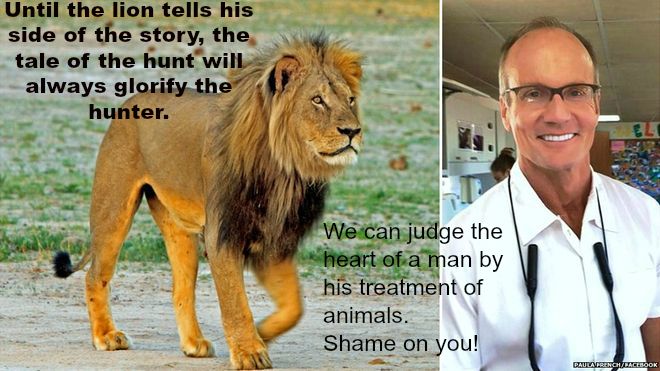


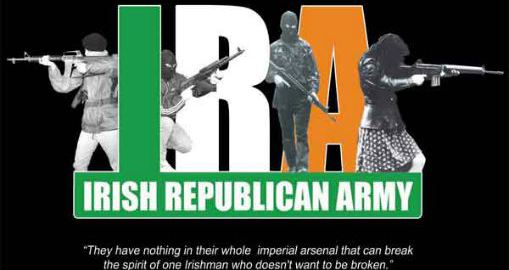








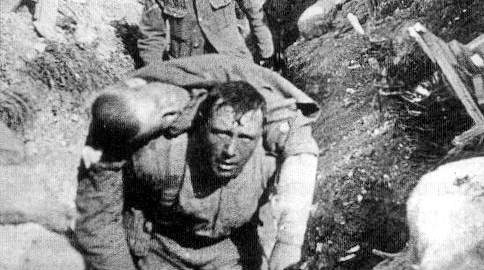
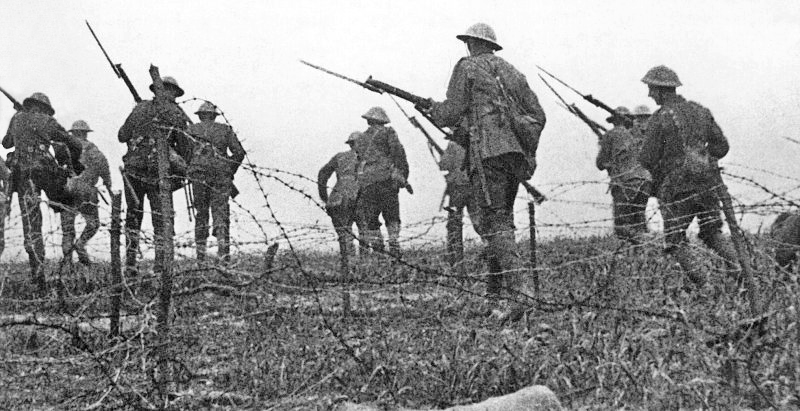


_after_the_1916_Easter_Rising.JPG)


.jpg)


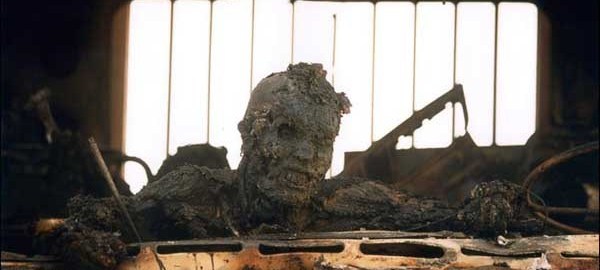


_-_Damage_from_an_Iraqi_Scud_missile.jpg)


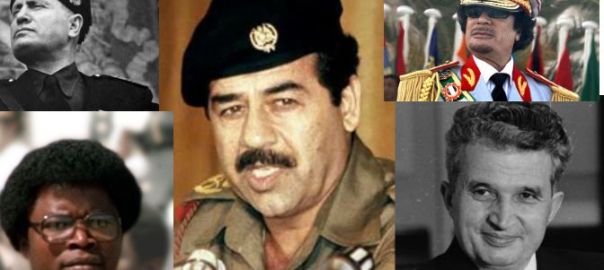


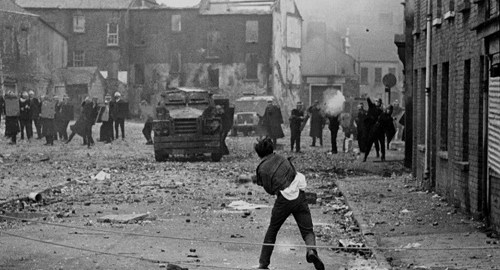


.JPG)


![[icon]](https://en.wikipedia.org/wiki/File:Wiki_letter_w_cropped.svg)


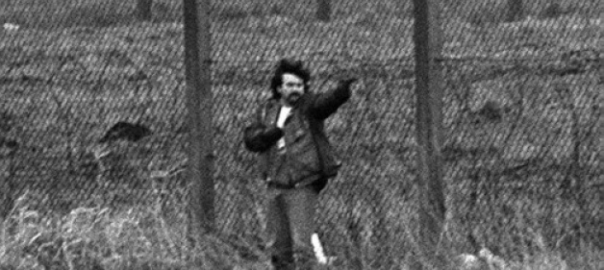




 belfastchildis.com