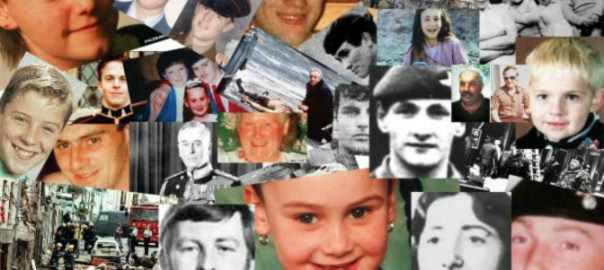
Key Events & Deaths on this day in Northern Ireland Troubles
27th October
Wednesday 27 October 1971
David Tilbury (29) and Angus Stevens (18), both members of the British Army (BA), were killed by the Irish Republican Army (IRA) during an attack on their observation post in Rosemount, Derry.
Ronald Dodds (34), a Royal Ulster Constabulary (RUC) officer, was shot dead by the IRA near Toome, County Antrim. David Powell (22), a member of the British Army, was killed by a landmine planted by the IRA at Kinawley, County Fermanagh.

A man was found shot dead in Dublin in an apparent internal Saor Eire dispute.
Gerard Newe, was appointed as Minister of State in the Prime Minister’s Department at Stormont. He was the first Catholic to serve in any Northern Ireland government since 1920 and was appointed by Brian Faulkner, then Northern Ireland Prime Minister. Newe was appointed to try to improve community relations.
Monday 27 October 1980

Hunger Strike Began Seven Republican prisoners began a hunger-strike to protest at the ending of special category status. One of their key demands was that they should be allowed to wear their own clothes rather than prison uniforms. The Republican prisoners viewed themselves as ‘prisoners of war’ and were refusing to be treated, as they saw it, as ordinary criminals.
[The tactic of the hunger strike has a special place in Republican history and it was to have a profound affect on Nationalists in Northern Ireland. This particular strike was to be called off on 18 December 1980. However, it also marked an escalation of the campaign which was to see a larger more serious hunger strike take place in 1981.]
Wednesday 27 October 1982
Three Royal Ulster Constabulary (RUC) officers where killed when the Irish Republican Army (IRA) detonated a land mine as the RUC patrol passed near Oxford Island, near Lurgan, County Armagh
Thursday 27 October 1988

Three people from the Republic of Ireland were found guilty of conspiracy to murder Tom King, then Secretary of State for Northern Ireland.
Friday 27 October 1989
It was revealed that the religious balance of the Northern Ireland Office was 78 per cent Protestant.
Saturday 27 October 1990
The Ulster Unionist Party (UUP) conference was held in Newcastle, County Down. James Molyneaux, then leader of the Ulster Unionist Party (UUP), attacked Articles 2 and 3 of the Irish Constitution.
Wednesday 27 October 1993
Dick Spring, then Tánaiste (deputy Irish Prime Minister and Minister for Foreign Affairs), speaking in the Dáil outlined proposals for sustainable peace that involved six “democratic principles”. Peace rallies were held at a number of venues in the Republic of Ireland including Dublin and Galway.
Thursday 27 October 1994

The European Parliament proposed that the European Union should provide £40 million to the International Fund for Ireland (IFI).
Friday 27 October 1995

Ian Paisley, then leader of the Democratic Unionist Party (DUP), together with Peter Robinson, then deputy leader of the DUP, held a meeting at the White House, Washington, with Al Gore, then United States Vice-President, and Anthony Lake, then United States National Security Adviser.
Sunday 27 October 1996
An article in The Observer (a London based newspaper) on the financing of the Irish Republican Army (IRA), claimed that the IRA was obtaining funds by smuggling tobacco products and producing pirate versions of video tapes
Monday 27 October 1997

The Parades Commissions published three booklets which were intended to act as a guide to the issue in Northern Ireland: Procedural Rules, Guidelines, and Code of Conduct.
Alistair Graham, then Chairman of the Parades Commission, announced that details of decisions taken by the Commission on contentious parades would be made public five days in advance.
[The various Loyal Orders all criticised the powers of the Commission and said that they would have nothing to do with it.] Roy Magee, who had helped broker the Loyalist ceasefire in 1994, offered to mediate in the feud between the Ulster Volunteer Force (UVF) and the Ulster Freedom Fighters (UFF).

The News Letter, a Northern Ireland paper with a mainly unionist readership, published the results of a telephone poll on the multi-party talks at Stormont. Of the 13,000 readers who took part 47 per cent said that Ian Paisley, then leader of the Democratic Unionist Party (DUP), had adopted the right strategy whereas only 24 per cent supported David Trimble, then leader of the Ulster Unionist Party (UUP). [The UUP criticised the unscientific nature of the poll.]
Wednesday 27 October 1999
Ed Moloney, Northern editor of the Sunday Tribune (a Dublin based newspaper), won his legal battle against a judge’s decision ordering him to hand over his interview notes with loyalist paramilitary William Stobie. Stobie had been charged with murdering Pat Finucane, a Belfast solicitor killed on 12 February 1989. Costs, estimated at £160,000, were awarded to the newspaper. Bomb disposal officers defused a bomb left at the home of Liam Shannon, then a prominent Republican, in Belfast. Loyalist paramilitaries had planted the device.
Saturday 27 October 2001
.JPG)
The 110-member Ulster Unionist Party (UUP) policy-making executive met to hear a recommendation from David Trimble, then leader of the UUP, that their ministers should retake their posts in the Northern Ireland Executive. The executive endorsed Trimble’s plan and called on the UUP MLAs to support his re-election as First Minister.
[However, two UUP MLAs, Peter Weir and Pauline Armitage, have said that at the moment they could not vote for Trimble. The vote is likely to take place on Friday 2 November 2001.] There were further disturbances during the evening in the Glenbryn area, off the Ardoyne Road, north Belfast.
————————————————————
———————————————————————————
Remembering all innocent victims of the Troubles
Today is the anniversary of the death of the following people killed as a results of the conflict in Northern Ireland
“To live in hearts we leave behind is not to die
– Thomas Campbell
To the innocent on the list – Your memory will live forever
– To the Paramilitaries –
There are many things worth living for, a few things worth dying for, but nothing worth killing for.
9 People lost their lives on the 27th October between 1971 – 1982
————————————————————–
27 October 1971
David Tilbury, (29) nfNI
Status: British Army (BA),
Killed by: Irish Republican Army (IRA)
Killed in bomb attack on British Army (BA) observation post at the rear of Rosemount Royal Ulster Constabulary (RUC) / British Army (BA) base, Derry.
————————————————————–
27 October 1971

Angus Stevens, (18) nfNI
Status: British Army (BA),
Killed by: Irish Republican Army (IRA)
Killed in bomb attack on British Army (BA) observation post at the rear of Rosemount Royal Ulster Constabulary (RUC) / British Army (BA) base, Derry.
————————————————————–
27 October 1971
Peter Graham, (26) nfNIRI
Status: Saor Eire (SE),
Killed by: Saor Eire (SE)
From Dublin. Found shot at his flat, St. Stephen’s Green, Dublin. Internal Saor Eire dispute.
————————————————————–
27 October 1971

Ronald Dodd, (34)
Protestant
Status: Royal Ulster Constabulary (RUC),
Killed by: Irish Republican Army (IRA)
Shot by sniper when RUC mobile patrol arrived at scene of fire in a house, Gallagh, near Toome, County Antrim.
————————————————————–
27 October 1971
David Powell, (22) nfNI
Status: British Army (BA),
Killed by: Irish Republican Army (IRA)
Killed in land mine attack on British Army (BA) Armoured Personnel Carrier, Kinawley, County Fermanagh.
————————————————————–
27 October 1974

Anthony Duffy, (18)
Catholic
Status: Civilian (Civ),
Killed by: Ulster Volunteer Force (UVF)
Found shot in farmyard, off Mullantine Road, near Portadown, County Armagh.
————————————————————–
27 October 1982

Sean Quinn, (37)
Catholic
Status: Royal Ulster Constabulary (RUC),
Killed by: Irish Republican Army (IRA)
Killed in land mine attack on armoured Royal Ulster Constabulary (RUC) patrol car, Oxford Island, near Lurgan, County Armagh.
————————————————————–
27 October 1982

Alan McCloy, (34)
Protestant
Status: Royal Ulster Constabulary (RUC),
Killed by: Irish Republican Army (IRA)
Killed in land mine attack on armoured Royal Ulster Constabulary (RUC) patrol car, Oxford Island, near Lurgan, County Armagh.
————————————————————–
27 October 1982

Paul Hamilton, (26)
Protestant
Status: Royal Ulster Constabulary (RUC),
Killed by: Irish Republican Army (IRA)
Killed in land mine attack on armoured Royal Ulster Constabulary (RUC) patrol car, Oxford Island, near Lurgan, County Armagh.
————————————————————–
–
- Belfast & Meath trip starts tomorrowEvening all , Im heading home to Belfast tomorrow for the Easter period and hopefully a trip down south to visit my bro and his family in County Meath , depending on a few factors which are out of my control 😜 Belfast will always be my home and although I look forward to visiting … Continue reading Belfast & Meath trip starts tomorrow
- 6 People lost their lives on the 6th January between 1980 – 2001 . read their stories here :6 People lost their lives on the 6th January between 1980 – 2001 6th January – Deaths & Events in Northern Ireland Troubles
- Merry Christmas to all my friends out there XHi folks, Just a shortish blog post to wish you all a wonderful evening and a fantastic Xmas day. Some of you guys have followed me and my story for years now and during recent tragic soul destroying lows to a few joy filled epic highs you have been there to support , comfort and … Continue reading Merry Christmas to all my friends out there X
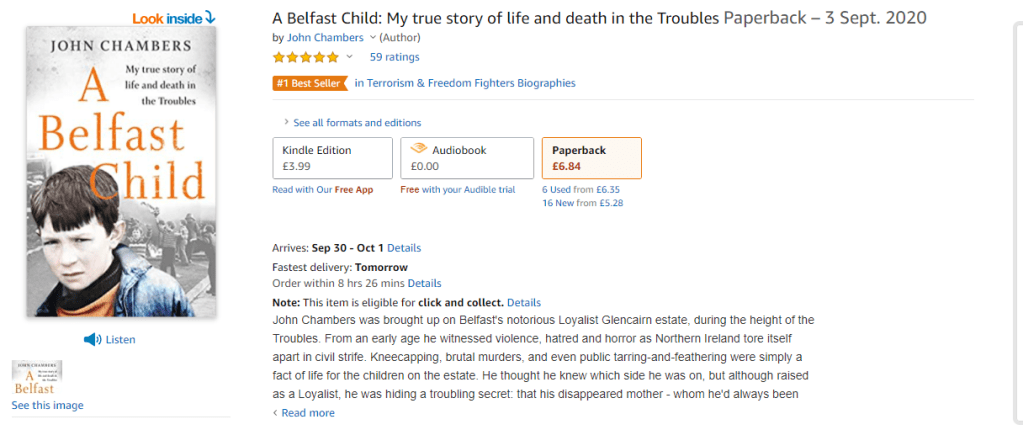
- A singed copy of my book for Xmas ?Last chance to order before Xmas delivery cut-off period nxt Wednesday . A personally signed copy of my No.1 Best Selling book : A Belfast Child , which may be worth a few quid if my story is made into a movie – watch this space ! UK Orders Free postage for UK orders only … Continue reading A singed copy of my book for Xmas ?
- I need some help folks 😜And Im happy to bribe you with a free giveaway 🎁 Read on for more detail… Ive doing a soft launch of my online shop : https://deadongifts.co.uk/ which I set up with my sister Mags and I need to drive some traffic to the store and start creating an online presence. The shop will be … Continue reading I need some help folks 😜

 belfastchildis.com